
The most popular advice about Pilates and strength training is also the least precise: “Pilates can completely replace weights.” That claim confuses several different adaptations. A session can leave your muscles shaking, improve your control, and make everyday movement feel easier without producing the same changes as progressively lifting heavier external loads.
So, is Pilates good for strength training? Yes, with an important qualification. Pilates can develop meaningful core, functional, isometric, and muscular-endurance strength. It can be a sensible primary method for some beginners, older adults, and people returning from pain or inactivity. But if your target is maximal force or substantial muscle hypertrophy, traditional resistance training gives you a clearer and more scalable route.
Table of Contents
- Redefining Strength Beyond the Weight Room
- The Clinical Evidence on Pilates and Muscle Growth
- Pilates vs Traditional Resistance Training
- Who Benefits Most from Pilates for Strength
- Integrating Pilates into Your Strength Program
- Summary
- Frequently Asked Questions
Redefining Strength Beyond the Weight Room
Strength isn't one physical quality. A powerlifter expressing a heavy single repetition, a runner stabilizing the pelvis during a stride, and an older adult rising from a chair all rely on strength, but they aren't demonstrating the same capacity.
The strength qualities Pilates trains
Maximal strength is the ability to produce very high force against a demanding external load. Barbells, dumbbells, machines, and other progressively heavier tools have a clear advantage here. The resistance is easy to quantify, and the exercise can be repeated with a deliberate increase in load. The National Strength and Conditioning Association provides a useful overview of how strength training is typically defined and progressed.
Isometric strength involves producing force without visible joint movement. Holding a Pilates position while keeping the pelvis, ribs, and spine aligned can challenge muscles intensely. That work may improve your ability to brace and maintain position, even if it doesn't automatically translate into a much heavier squat or deadlift.
Muscular endurance is the ability to sustain force over time. Pilates frequently demands continuous engagement, controlled repetitions, and precise transitions. Those qualities matter for posture, movement efficiency, and activities where fatigue causes technique to deteriorate.
Stability and coordination complete the picture. Pilates asks the trunk, hips, shoulders, and smaller stabilizing muscles to coordinate while you control resistance and range of motion. A movement can feel harder because your body is learning to organize force, not because the prime mover is approaching its maximum load capacity.
Practical rule: A deep burn tells you that a muscle is working. It doesn't tell you how much maximal force that muscle can produce or whether it has gained substantial mass.
Why the “replacement” claim fails
Traditional resistance training and Pilates can both create muscular tension, but they usually emphasize different constraints. Weight training makes external load the central variable. Pilates makes position, body mechanics, control, range, and sustained tension central variables, with mat exercises relying largely on body weight and reformer work adding spring resistance.
That distinction changes how you judge progress. In Pilates, better control, a longer hold, a more demanding variation, or cleaner movement can represent real improvement. In a strength program, adding resistance while maintaining technique is often the clearest sign that force capacity has increased.
The practical mistake is treating those measures as interchangeable. Improved trunk control can help you lift, run, or move with greater confidence, but it isn't proof that Pilates has matched a progressive resistance program for maximal strength or muscle size. A good coach therefore asks a more useful question than “Is Pilates strength training?” The question is, which kind of strength are you trying to build?
The Clinical Evidence on Pilates and Muscle Growth
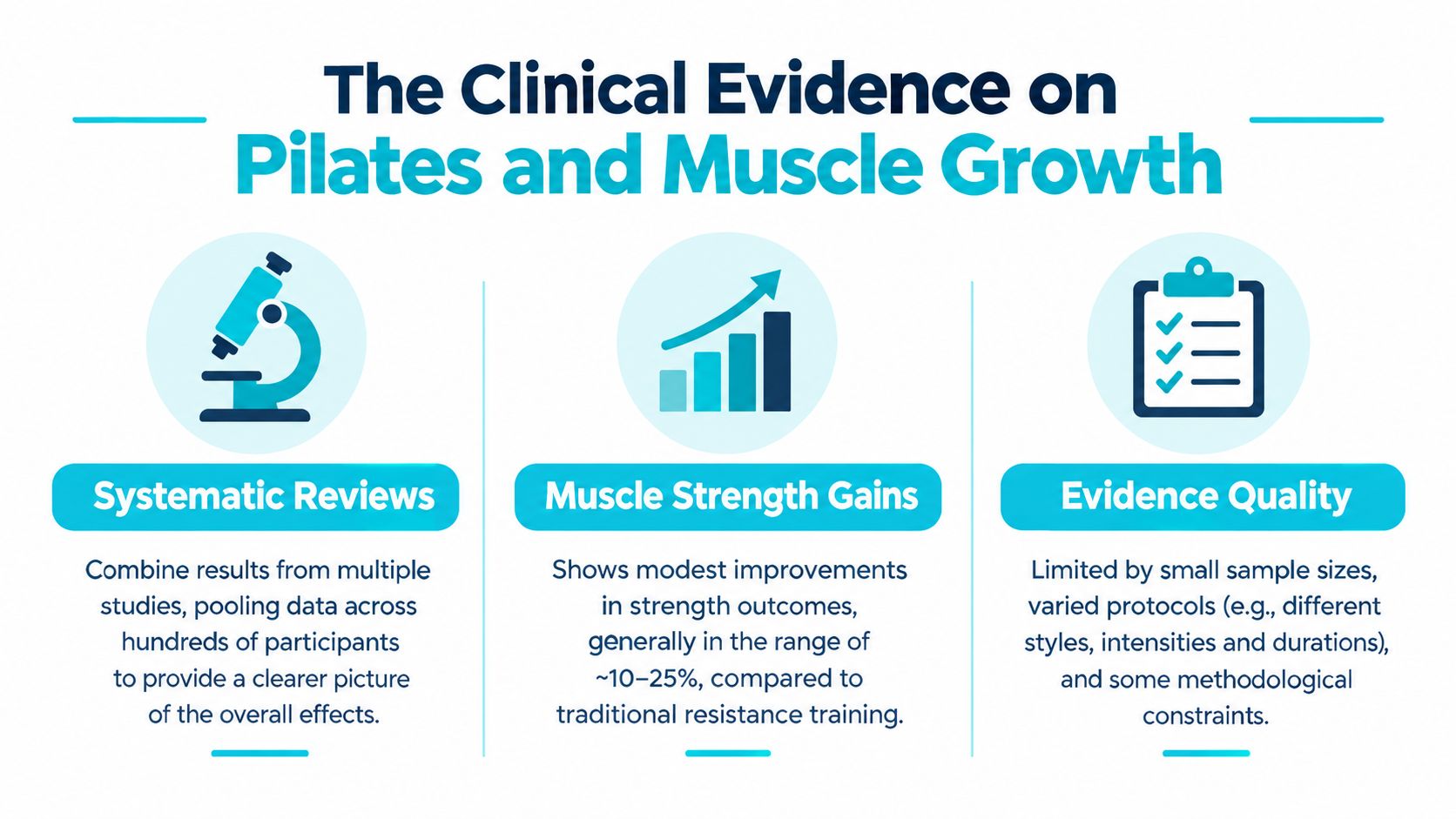
Pilates can build measurable strength, but the clinical evidence does not show that it consistently outperforms other exercise methods. A 2022 systematic review included 958 participants in its dynamic-strength analysis and 410 in its isometric-strength analysis. The review found very low to low-certainty evidence of no meaningful difference between Pilates and other exercise modalities for dynamic, isometric, and resistance strength (systematic review of Pilates and strength outcomes). For readers who want a broader evidence-based framework for exercise dose and progression, the American College of Sports Medicine position stand on progression models in resistance training offers useful context.
The pooled effects were small and statistically nonsignificant. Dynamic force was SMD = -0.29, with a 95% CI of -0.69 to 0.10. Isometric strength was SMD = 0.20, with a 95% CI of -0.06 to 0.47, while resistance strength was SMD = -0.19, with a 95% CI of -0.46 to 0.07. The same review therefore supports a measured conclusion: Pilates can improve strength, but it has no reliable overall advantage over other exercise methods.
What the studies say about practical gains
Pilates has a long training history rather than being a recent social-media invention. Joseph and Clara Pilates were teaching the method in New York in the 1920s, and the Body Conditioning Gym opened in 1926. That history does not prove superiority, but it shows that Pilates has been used as a structured movement and strengthening system for nearly a century.
Intervention studies show measurable gains in defined settings. One 12-week intervention reported a 31.5% improvement in core strength and a 13.5% improvement in lower-limb strength (intervention findings on Pilates strength gains). Another randomized study involving adults over 70 found greater lower-limb strength than the control group after 8 weeks, with p = 0.013 and d = 0.56.
These results matter, but they do not answer whether Pilates produces substantial muscle growth. A person may produce more force in a core test, coordinate movement more efficiently, or hold a position longer without adding much contractile tissue.
Strength adaptation isn't the same as hypertrophy
Early progress often comes from neural adaptation, improved motor coordination, and greater confidence with the movement. The nervous system becomes better at recruiting and coordinating the muscle already available. Pilates is well suited to trunk endurance, control, and force transfer through the body.
Hypertrophy requires a different outcome: an increase in muscle size from a sufficiently challenging, repeatable stimulus, supported by recovery and nutrition. Current evidence indicates that Pilates can improve strength and function, while lean-mass findings remain inconsistent. Mat Pilates generally produces minimal muscle-mass change. Reformer Pilates allows more load progression, yet high-quality hypertrophy trials remain limited (review of Pilates, strength, and muscle mass). For a broader primer on the mechanisms behind muscle growth, the Cleveland Clinic guide to muscle hypertrophy gives a helpful high-level summary.
The practical conclusion is specific. Pilates is credible for usable strength, coordination, and control. It is not yet an established substitute for progressive resistance training when the primary goal is increasing muscle size.
Pilates vs Traditional Resistance Training
The right comparison isn't “Which workout is better?” It's which training tool gives you the most direct stimulus for your objective. Pilates and weightlifting can coexist, but they measure progression differently and place different demands on the body.
A practical comparison
| Training Marker | Pilates, Mat and Reformer | Traditional Resistance Training |
|---|---|---|
| Primary stimulus | Bodyweight leverage, springs, controlled positions, and sustained tension | External loads from free weights, machines, bands, or other resistance tools |
| Progression | Harder variations, altered leverage, more demanding control, increased spring challenge, or additional work | More load, repetitions, sets, range, or demanding exercise variations |
| Strength emphasis | Core control, isometric strength, muscular endurance, coordination, and functional stability | Maximal force, high-load strength, and more direct loading of individual or compound movements |
| Hypertrophy pathway | Possible, particularly when resistance can progress, but evidence for muscle-mass gains is inconsistent | More direct and measurable for muscle growth because external resistance is easier to scale |
| Joint experience | Usually controlled and low impact, with intensity shaped by leverage and resistance | Varies by exercise, load, technique, range of motion, and individual tolerance |
| Equipment | Mat-based work needs little equipment; reformer work adds springs and a moving carriage | Requires access to weights, machines, bands, or other loadable equipment |
| Best fit | Movement control, entry-level conditioning, rehabilitation support, and complementary training | Maximal strength, systematic overload, and hypertrophy-focused goals |
Where traditional lifting has the edge
If you want to know whether you can produce more force against a heavy load, weight training offers a cleaner test. You can add resistance in small increments, repeat the same movement, and track whether performance improves. That makes progressive overload more transparent.
Traditional resistance training is also the more practical default for someone whose priority is maximum muscle hypertrophy. Pilates may challenge muscles, but mat work often reaches a ceiling because bodyweight and mechanical advantage limit how much resistance you can apply. Reformer springs expand the options, yet they don't turn every class into an equivalent substitute for a carefully designed lifting program.
Athletes should make the same distinction. Pilates can support trunk control, movement quality, and stability, while athletes who need higher force production still require sport-specific and heavy resistance work. A useful primer on how resistance training scales from foundational work to advanced athletic programming is this guide to strength training for athletes.
Where Pilates earns its place
Pilates is often easier to tolerate when a person needs controlled movement and lower-impact loading. It also combines strength work with deliberate range of motion and coordination instead of isolating every exercise around a single muscle group.
That makes Pilates valuable when the limiting factor isn't raw force. Someone may have enough strength to perform a movement but lack the trunk control, joint awareness, or endurance to repeat it with good mechanics. Pilates can address that gap without requiring every session to become a heavy lifting session.
The sensible conclusion isn't that one method wins. Use weight training when load capacity and muscle size are the main targets. Use Pilates when control, endurance, and coordinated stability deserve direct attention. Many people need both.
Who Benefits Most from Pilates for Strength
Pilates works best as a primary strength method when the person's goals match its strongest adaptations. It becomes less suitable when the goal demands high external loads or a clearly measurable hypertrophy stimulus.
People starting from a low base
A deconditioned adult doesn't need to begin with complex barbell work to make progress. Pilates teaches bracing, alignment, controlled range of motion, and body awareness while giving the coach multiple ways to adjust effort and challenge.
That makes it a useful entry point for someone who feels intimidated by a gym, struggles to control basic positions, or needs to rebuild confidence after inactivity. The initial win may be better movement quality and endurance rather than a dramatic change in muscle size. Those improvements can create a foundation for later resistance training.
Older adults
The evidence is particularly relevant for older populations. A 2015 review concluded that Pilates improved isokinetic torque in the knee extensors and flexors. It also described Pilates as an effective form of progressive resistance training for older adults when frequency and duration were similar to weight-training studies (2015 review of Pilates in older adults).
That doesn't mean Pilates is automatically superior to weights for every older adult. It means a well-progressed Pilates program can provide a meaningful strengthening option, especially when controlled movement, balance, and tolerance influence adherence. The method should still be adjusted to the person's medical history, symptoms, and ability.
People managing chronic low back pain
For chronic low back pain, the important comparison is often Pilates versus doing nothing, not Pilates versus a perfectly executed strength program. A review found Pilates wasn't inferior to equivalently dosed exercise and could outperform no exercise for core strength (review of Pilates for chronic low back pain).
That supports Pilates as a reasonable rehabilitation or re-entry tool, but pain isn't a diagnosis that can be managed by a generic class alone. A qualified clinician or coach should modify exercises when symptoms change, particularly if pain radiates, strength suddenly drops, or movement becomes less controlled. For general back-pain warning signs and when to seek medical assessment, the NHS low back pain guidance is a practical public-health resource.
Who should keep lifting central
Powerlifters, physique athletes, and people explicitly pursuing maximum hypertrophy shouldn't make Pilates their only strength method. Pilates may support their warm-up, trunk control, mobility, or recovery, but the primary stimulus still needs to match the goal.
The honest fit: Pilates can be the main driver for functional strength and control. It should usually complement, rather than replace, heavy resistance training when maximal force or muscle size is the priority.
Integrating Pilates into Your Strength Program
The simplest way to combine the methods is to assign each session a job. Don't add Pilates randomly on top of an already demanding schedule and then blame either method when recovery suffers.
Choose the role before choosing the session
A Pilates session can serve as a technical practice, an active-recovery session, or a secondary strength stimulus. Those roles aren't identical.
For technical practice, keep the focus on breathing, alignment, pelvic control, and precise movement. For active recovery, use a manageable sequence that leaves you feeling better rather than locally exhausted. For secondary strengthening, choose a reformer or more challenging mat progression that complements your lifting without competing with your main sessions.
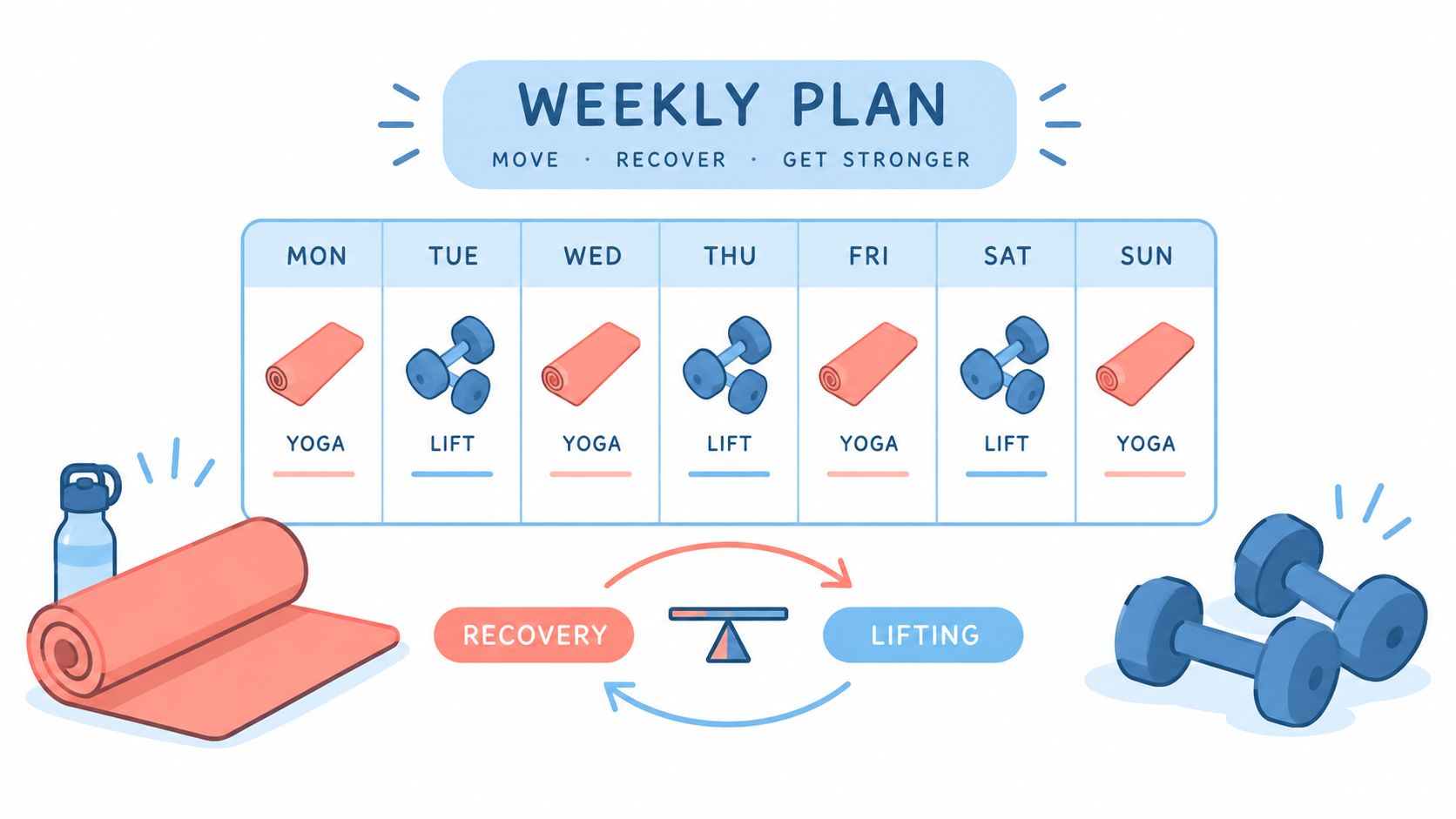
A workable weekly pattern might look like this:
- Primary lifting days: Perform your planned resistance work while you're fresh enough to protect technique.
- Pilates days: Use Pilates to train trunk control, coordinated stability, and muscular endurance.
- Recovery days: Choose a lower-demand session focused on movement quality rather than chasing fatigue.
- Combined days: If time is limited, place a short, controlled Pilates sequence before lifting as preparation, not as a second maximal workout.
The correct arrangement depends on how your body responds. If your lifting technique deteriorates, reduce the Pilates challenge before reducing the main strength work that matches your goal.
Track two kinds of progress
Don't use one score for both modalities. Track Pilates with measures such as:
- Control: Can you complete the movement without losing alignment?
- Progression: Can you perform a more demanding position or variation?
- Endurance: Can you maintain quality through the planned sequence?
- Resistance: Can you handle a greater reformer challenge while keeping form clean?
Track lifting with load, repetitions, sets, range of motion, and technical consistency. This separation prevents a common error, interpreting a better Pilates hold as proof that your one-repetition strength has increased.
A fitness app can make the mixed program easier to manage when it records both structured resistance sessions and technique work in one place. Thrive X Fitness combines AI workout planning with an AI Form Coach that reviews an approximately 60-second form clip, which can help you monitor controlled lifting technique alongside a Pilates-focused routine. Its exercise database includes muscle-group targeting and form guidance, while its partner Thrive X API supports workout and meal-plan generation for other apps.
Use technology as a feedback system, not as a substitute for judgment. A form review can flag visible technique issues, but it can't diagnose pain or decide whether your total training load is appropriate.
Progress without chasing exhaustion
Pilates doesn't need to leave you shaking to be productive. Progress through a harder variation, more precise control, greater range, or a gradual resistance change. Stop increasing difficulty when you can no longer maintain the position that gives the exercise its purpose.
For the lifting side, use a similarly conservative standard. Add load only when your repetitions remain controlled and your recovery stays acceptable. The combination works when Pilates improves how you organize movement and resistance training develops the force capacity you ultimately want to express.
Summary
Pilates is good for strength training when the goal includes core control, isometric strength, muscular endurance, and coordinated functional movement. Research supports measurable strength improvements, but systematic evidence doesn't show that Pilates consistently outperforms other exercise methods. Mat Pilates has limited evidence for muscle-mass growth, while reformer work allows more progression without strong hypertrophy trials. Use Pilates as a primary method for suitable beginners, older adults, and some rehabilitation settings. Keep progressive resistance training central for maximal strength and hypertrophy.
Frequently Asked Questions
Can Pilates build muscle mass?
Pilates can stimulate muscles and improve strength, control, and endurance. However, evidence on lean-mass gains is inconsistent. Mat Pilates generally shows minimal effects on muscle mass, while reformer Pilates offers more opportunities to progress resistance but still lacks high-quality hypertrophy trials. If gaining substantial muscle size is your main goal, traditional progressive resistance training provides a more direct and measurable approach.
Is Pilates as effective as weights for older adults?
Pilates can be an effective strengthening option for older adults. A review found improvements in isokinetic torque in the knee extensors and flexors and described Pilates as progressive resistance training when its frequency and duration were comparable to weight-training studies. Whether it is the best choice depends on the person's goals, tolerance, medical context, and ability to progress safely.
Can Pilates help with chronic low back pain?
Pilates can be useful for people with chronic low back pain, particularly when it provides a controlled way to rebuild core strength and movement confidence. Evidence indicates that Pilates wasn't inferior to equivalently dosed exercise and could outperform no exercise for core strength. It shouldn't replace individual assessment when symptoms are severe, changing, radiating, or associated with sudden loss of strength.
How should I track Pilates and weight training together?
Track them with different measures. For Pilates, record movement control, alignment, exercise variation, endurance, and reformer resistance when relevant. For weight training, track load, repetitions, sets, range of motion, and technique. A workout app can store both formats, while a form-review feature can help assess visible lifting mechanics. Don't treat a longer Pilates hold as proof of a higher one-repetition maximum.
Thrive X Fitness offers AI-generated workout planning, structured exercise guidance, nutrition tools, challenges, and an approximately 60-second AI Form Coach for reviewing technique clips. Visit ThriveXDNA to explore a practical way to organize Pilates and resistance training around your goals.