
You've got the dumbbells. Maybe they're adjustable, maybe they max out sooner than you hoped, and maybe the only thing between you and a real routine is a saved tab full of random workouts that all look intense and none of them tell you what to do next week. That's the hole a dumbbell only workout plan PDF needs to fill, not with more exercise ideas, but with a system that keeps working after the novelty fades.
Most home routines fail because they treat progress like an afterthought. A good PDF should give you a weekly calendar, exact set and rep targets, rest rules, and a clear trigger for when to raise the load so the same pair of dumbbells still matters in week 4, week 5, and week 6.
Table of Contents
- Why a Dumbbell Only Workout Plan PDF Beats Another YouTube Routine
- What Dumbbells Alone Can Actually Do for You
- The 4-Day Upper and Lower Split for Your Week
- Progression Rules That Keep the Plan Working Past Week 3
- Your Daily Workouts With Sets, Reps, and Form Cues
- Regressions and Progressions for Limited Equipment
- Nutrition, Recovery, and Delivering the Plan With Thrive X Fitness
- Summary
- Frequently Asked Questions
- Is a dumbbell-only workout enough to build muscle?
- How many days per week should I train with dumbbells?
- What should I do when my dumbbells stop feeling heavy enough?
- How much rest should I take between sets?
- Can I follow this plan if I don't have a bench?
- What's the fastest way to make a PDF plan useful?
Why a Dumbbell Only Workout Plan PDF Beats Another YouTube Routine
A video can show effort. It can't hand you a progression rule. That's the gap most home training resources leave open, and it's why people keep restarting from week one instead of building momentum.
A printable PDF solves that problem because it makes the workout visible before you start. You can see the weekly structure, the order of sessions, the rest intervals, and the exact place to log the weight you used. That matters more than flashy editing because the thing that drives results is not another exercise demo, it's knowing what gets repeated, what gets increased, and what gets held steady.
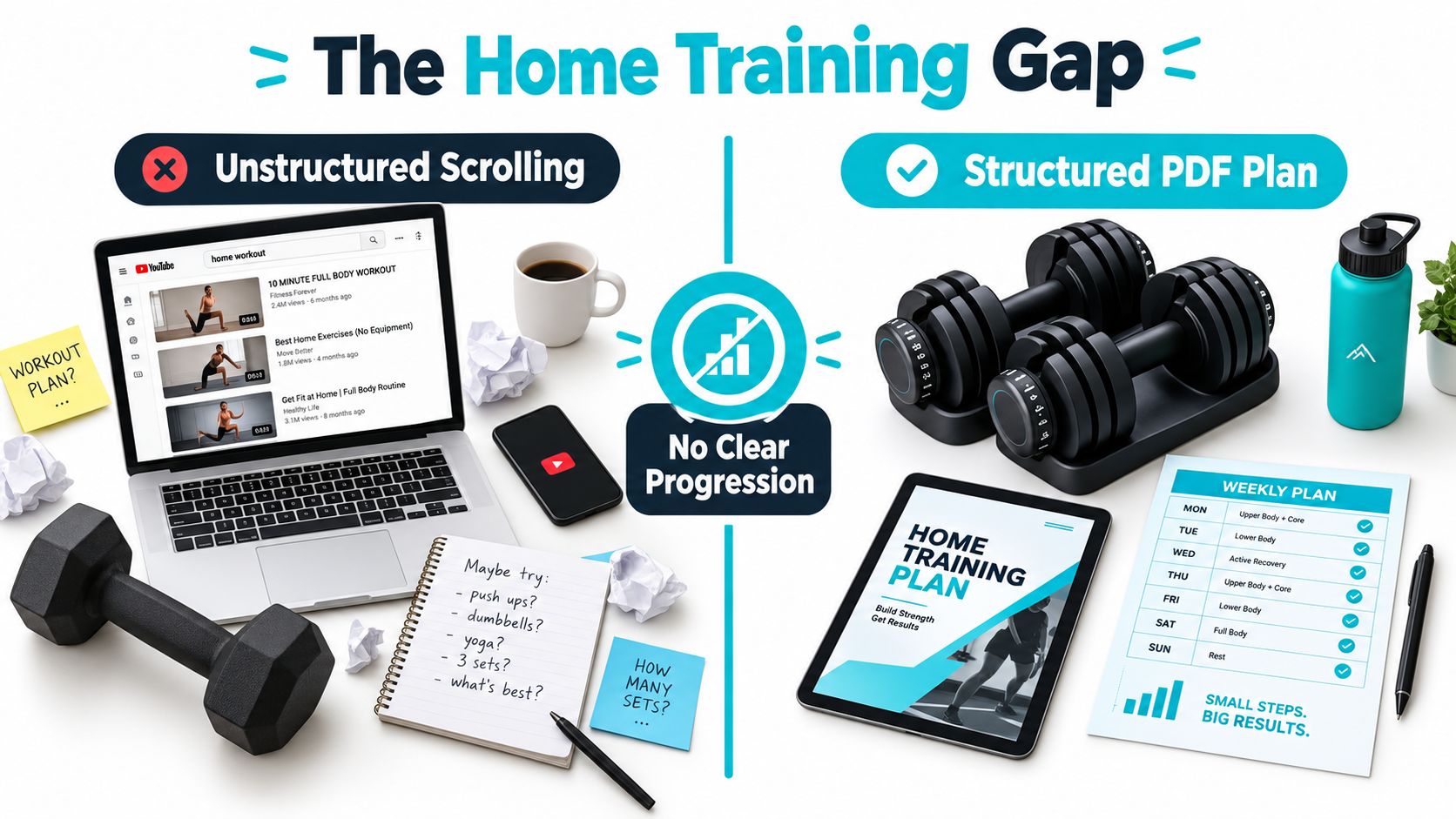
Practical rule: if a plan doesn't tell you when to add reps, when to add load, and when to keep the same weight, it's entertainment, not programming.
What the PDF format does better
A good dumbbell-only PDF gives you three things a video usually doesn't. First, it gives you a weekly calendar, so the plan lives in your actual life instead of in a playlist. Second, it gives you load progression, which is the difference between repeating a circuit and training with intent. Third, it gives you a place to track what happened, which is how you stop guessing whether you improved.
That's the reason a PDF is more than a download. It becomes the reference point for the next session. If your goal is to keep training with the same dumbbells past week three, the plan has to tell you how to progress when the weights feel familiar, not just how to sweat.
The rest of this guide is built around that idea, with a double-progression system, a four-day split, and daily sessions you can run at home.
What Dumbbells Alone Can Actually Do for You
Dumbbells are not a compromise tool. They're a legitimate training tool with enough intensity to create real change when the plan is written well. A 2010 rehabilitation-exercise comparison found that dumbbell training produced normalized EMG activity of 59% to 87% in prime muscles at 3-repetition maximum effort, and loading rose as resistance increased, with dumbbells and elastic tubing showing broadly similar responses (WHO-emro PDF). That's a strong signal that dumbbells can create serious neuromuscular demand, not just make a workout feel busy.
A separate clinical study of light resistance training found that a dumbbell-based program produced measurable body-composition and fitness changes over time, with waist circumference down 4.26 cm at 3 months and 5.60 cm at 6 months, alongside gains in cardiorespiratory fitness, muscular strength, muscular endurance, and flexibility (The Workout Mag summary of the clinical study). That matters because it shows dumbbells can do more than build arms. They can drive broader adaptation when the effort and progression are there.
The ceiling is real, but so is the utility
Dumbbells won't fully replace every gym setup. Heavy bilateral lower-body work still has an advantage when absolute loading is the main target, and the chest can be harder to overload without a bench angle that suits your body. Even so, dumbbells train each side independently, which raises stabilizer demand and exposes side-to-side weaknesses that fixed machines can hide.
| Dumbbell-Only vs. Full Gym | Dumbbell-Only Stimulus | Full Gym Stimulus | Key Limitation |
|---|---|---|---|
| Chest | Strong with pressing variations and careful setup | Strong with more angle options | Harder to keep loading climbing without a bench angle |
| Back | Strong through rows, pullovers, and unilateral work | Strong with more pulling stations | Fewer vertical pull options |
| Legs | Strong for squats, hinges, lunges, and split patterns | Stronger for maximal bilateral loading | Lower ceiling on absolute load |
| Core and carry work | Excellent | Excellent | Minimal limitation |
The practical takeaway is simple. A dumbbell-only plan can absolutely train the upper body close to gym-standard effort and the lower body to a level that produces measurable change for most trainees. The plan just has to respect the limits instead of pretending they don't exist.
The 4-Day Upper and Lower Split for Your Week
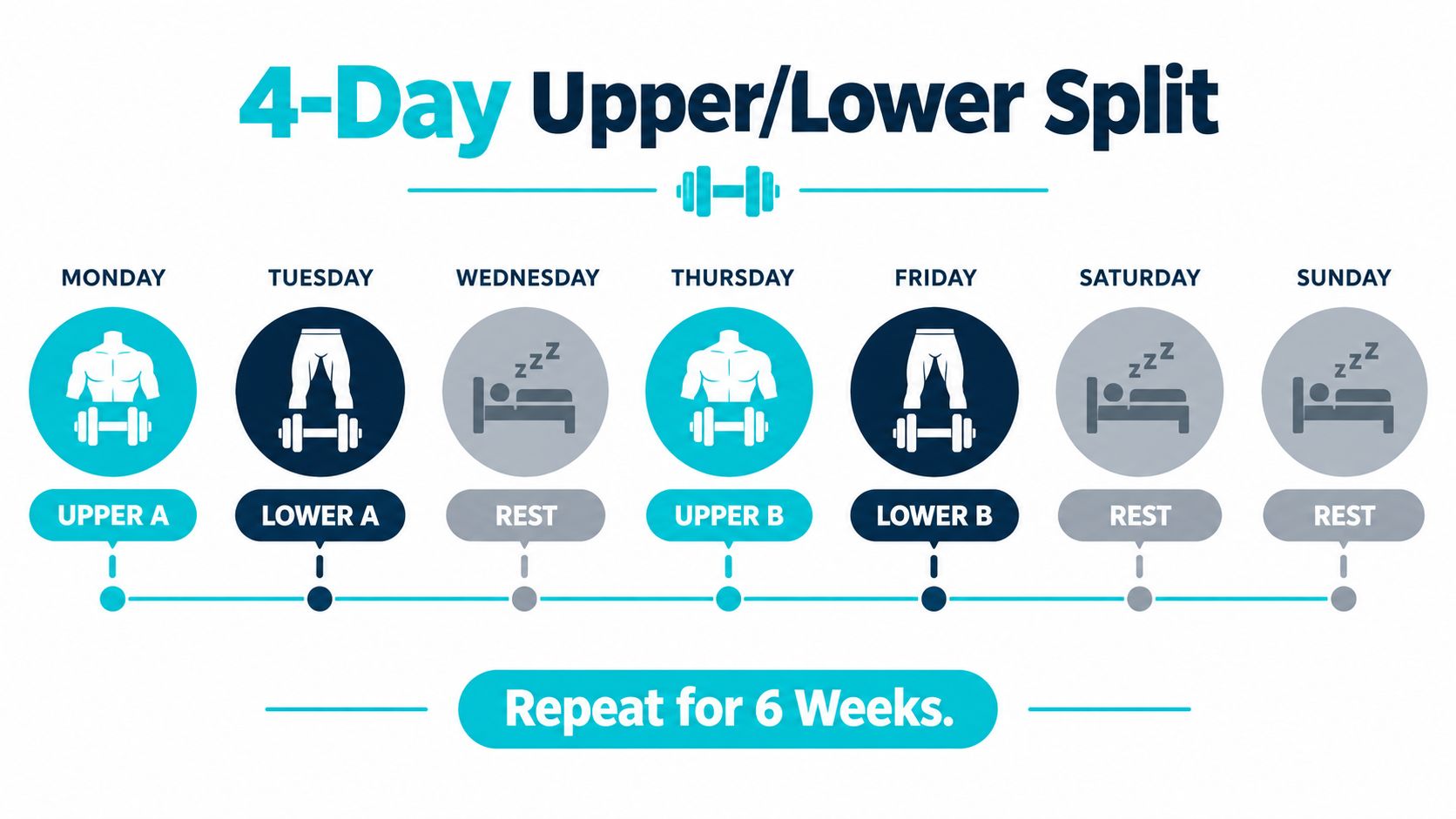
A beginner-friendly dumbbell-only routine works best when the week is predictable. The cleanest setup is a 4-day upper/lower split, because it gives each muscle a second exposure inside the week without crowding recovery.
The weekly calendar
- Monday, Upper A
- Tuesday, Lower A
- Wednesday, Rest or active recovery
- Thursday, Upper B
- Friday, Lower B
- Saturday and Sunday, Rest or active recovery
This layout is more useful than a vague three-day rotation because it gives you a repeatable rhythm. Each muscle group gets worked, then gets time to recover before you ask it to perform again. That spacing fits real home schedules, especially when sessions need to stay inside a practical evening window instead of turning into a two-hour project.
Why this split holds up
Upper A leans on horizontal pressing and rows, so the chest, shoulders, upper back, and triceps all get a balanced first stimulus. Lower A leans on the squat pattern and hinge, which covers quads, glutes, hamstrings, and trunk control. Upper B shifts toward vertical pressing and pulls, while Lower B uses single-leg work and accessories to close the gap between bilateral strength and real-life movement.
Recovery isn't passive. The days off only work if you let them support sleep, steps, and the boring habits that make the next session better.
Three rest days also make the plan easier to live with. That matters because adherence is the hidden limiter in home training, and the simpler the weekly decision tree, the less likely a busy adult is to drift away from the routine.
Progression Rules That Keep the Plan Working Past Week 3
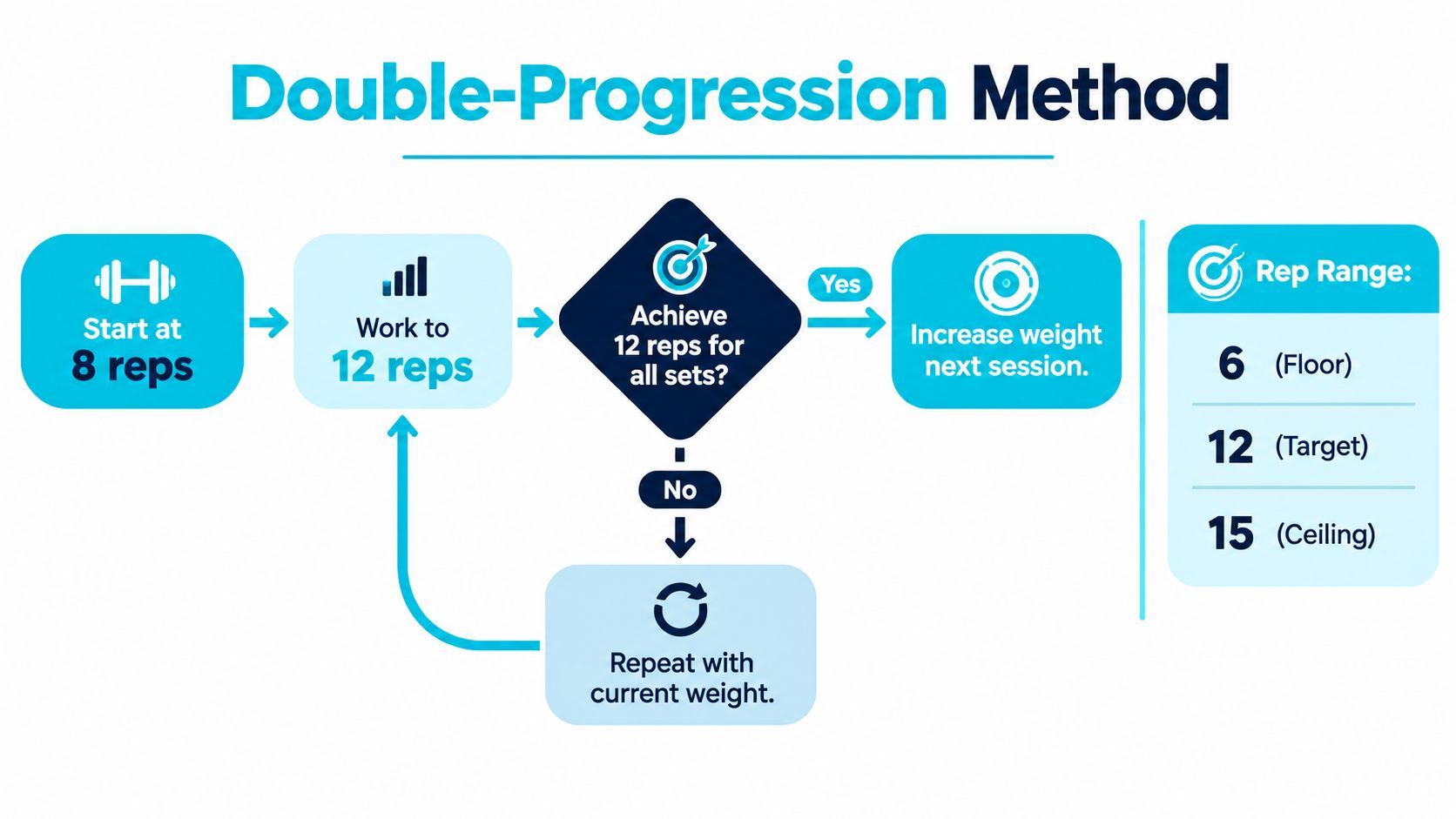
The plan stops being useful the moment the dumbbells stop challenging you. That's why the core rule is double progression. You keep the weight steady while you add reps inside a set range, then you raise the load once you own the top end with clean form.
How the rule works
Use a working range of 8 to 12 reps, with 6 as the floor and 15 as the ceiling for the broader program logic. Start where the exercise feels honest, not where it feels heroic. When you can hit the top of the rep range across all prescribed sets with about 1 to 2 reps in reserve, increase the dumbbell by the smallest practical jump and start the next session near the bottom of the range.
If reps drop below the floor, keep the load and repeat it. If a lift stalls for more than one session, don't scramble to change exercises. Fix the execution, keep the structure, and let the rep count rebuild.
Load jumps and rest rules
- Bilateral upper-body presses, add about 5 pounds total when the top of the range is secured.
- Single-arm isolation work, add about 2.5 pounds when possible.
- Lower-body squats and hinges, add about 5 to 10 pounds when form stays clean.
- Compound lifts, rest about 90 seconds.
- Accessory work, rest about 45 seconds.
A useful review of progression guidance also recommends 90 to 150 seconds between sets and micro-load jumps of roughly 2.5 to 5 lb per hand, with larger jumps usually working better on lower-body lifts (Home Fitness Brief). That lines up well with how home trainees progress, especially when the equipment jumps are limited.
How to break plateaus without changing exercises
Every fourth week, use one small intensity adjustment. You can add a 2-rep back-off set, slow the lowering phase to 3 seconds, or cut rest by 15 seconds. Those tweaks change the demand without turning the program into a random stress test.
The point isn't to keep inventing new movements. It's to make the same movements continue to work.
Your Daily Workouts With Sets, Reps, and Form Cues
The six-week version works best when every session has a job. The first three weeks stay inside the main rep range. Weeks four through six use a small back-off or tempo change so the body keeps getting a fresh signal without forcing a complete rewrite.
Upper A and Lower A
Upper A starts with pressing and horizontal pulling because those patterns are easy to track and easy to load at home. Use the incline press to target the chest with a slight elbow tuck, then move to the standing overhead press, single-arm lateral raise, and triceps extension. Keep the incline press smooth, drive the elbows at about 45 degrees, and stop trying to turn every set into a grind.
Lower A pairs the goblet squat, Romanian deadlift, walking lunge, and calf raise. On the Romanian deadlift, keep the chin packed and the dumbbells close to the legs. On the lunge, stay tall and let the front foot do the work instead of pitching forward.
Upper B and Lower B
Upper B shifts to the chest-supported row, single-arm row, pullover, and biceps curl. These lifts are where the dumbbells earn their keep, because unilateral loading makes cheating harder and honest reps easier to spot. Pull the elbow toward the hip on rows, and keep the rib cage down on pullovers so the movement doesn't become a low-back arch contest.
Lower B uses the reverse lunge, hip thrust, single-leg calf raise, farmer carry, and dead bug. The carry should feel deliberate, not rushed. The dead bug should look controlled enough that the lower back stays pinned.
| Day | Exercise | Sets x Reps | Rest | Form Cue |
|---|---|---|---|---|
| Upper A | Incline dumbbell press | 3 x 8-12 | 90 sec | Elbows about 45 degrees, control the lower |
| Upper A | Standing overhead press | 3 x 8-12 | 90 sec | Ribs down, press straight overhead |
| Upper A | Single-arm lateral raise | 2 x 12-15 | 45 sec | Lead with the elbow, not the hand |
| Upper A | Triceps extension | 2 x 10-15 | 45 sec | Keep upper arms still |
| Lower A | Goblet squat | 3 x 8-12 | 90 sec | Elbows inside knees, brace hard |
| Lower A | Romanian deadlift | 3 x 8-12 | 90 sec | Chin packed, dumbbells slide close |
| Lower A | Walking lunge | 2 x 10-12 each side | 60 sec | Tall torso, soft but stable front knee |
| Lower A | Calf raise | 2 x 12-15 | 45 sec | Pause at the top |
| Upper B | Chest-supported row | 3 x 8-12 | 90 sec | Pull elbows back, don't shrug |
| Upper B | Single-arm row | 3 x 8-12 each side | 60 sec | Square hips, finish the pull |
| Upper B | Pullover | 2 x 10-15 | 45 sec | Keep ribs down and shoulders set |
| Upper B | Biceps curl | 2 x 10-15 | 45 sec | Elbows near the ribs |
| Lower B | Reverse lunge | 3 x 8-12 each side | 60-90 sec | Step back quietly, keep balance |
| Lower B | Hip thrust | 3 x 10-15 | 60 sec | Lock the top with glutes, not low back |
| Lower B | Single-leg calf raise | 2 x 12-15 | 45 sec | Full stretch, full finish |
| Lower B | Farmer carry | 3 carries | 60 sec | Tall posture, no leaning |
| Lower B | Dead bug | 2 x 5-8 each side | 30-45 sec | Lower back stays flat |
Warm-up and cooldown
Use 5 minutes of dynamic warm-up before lifting, with joint circles, bodyweight squats, hip hinges, and shoulder openers. Finish with 5 minutes of cooldown that slows breathing and eases the next-day stiffness.
The first three weeks stay faithful to the rep range. Weeks four through six add a back-off set or a slower eccentric on the main lifts, which keeps the plan fresh without making it complicated.
Regressions and Progressions for Limited Equipment
Not every home setup gives you the exact dumbbells you want, and that's fine. The answer isn't to wait for better equipment. It's to make the plan match the equipment you already have.
When the weight is too light
If the dumbbells stop feeling challenging, shift the exercise before you abandon the plan. A single-arm or single-leg version usually raises difficulty immediately because the body can't hide behind symmetry. You can also use deficit positions or 1.5 reps to increase time under tension without adding weight.
If the load still feels easy, shorten the rep range to 12 to 15, slow the lowering phase to 4 seconds, or add a 1-second pause at the bottom. Those changes don't require new gear, just more control.
When the bench is missing
A sturdy chair can substitute for an incline setup when pressing, as long as it's stable and won't slide. A backpack can stand in for goblet squats when the dumbbell options run out. A towel on the floor can work as a slider substitute for controlled lower-body movements if the surface allows it.
What to fix when form starts slipping
- Elbow flare on overhead press, lower the load and bring the ribs down.
- Knee collapse on lunges, shorten the step and slow the descent.
- Rounded back on hinges, reduce range and keep the dumbbells closer to the legs.
- Swinging curls or raises, cut the weight and pause between reps.
If two sessions in a row miss the rep floor, drop the load by 10 percent and rebuild over one week. That keeps frustration from turning into a total reset.
| Exercise | Regression | Progression |
|---|---|---|
| Goblet squat | Backpack squat or reduced range | Tempo squat or 1.5 reps |
| Incline press | Chair-supported press | Single-arm press or slower eccentric |
| Row | Two-arm supported row | Single-arm row with a pause |
| Lunge | Shorter step-back lunge | Deficit reverse lunge |
| Calf raise | Two-leg raise | Single-leg pause raise |
Nutrition, Recovery, and Delivering the Plan With Thrive X Fitness
Training sets the signal. Food and sleep decide how well you respond to it. For a dumbbell-only plan, the simplest nutrition anchor is protein first, then fill the rest of the day around the workout.
Recovery basics that actually matter
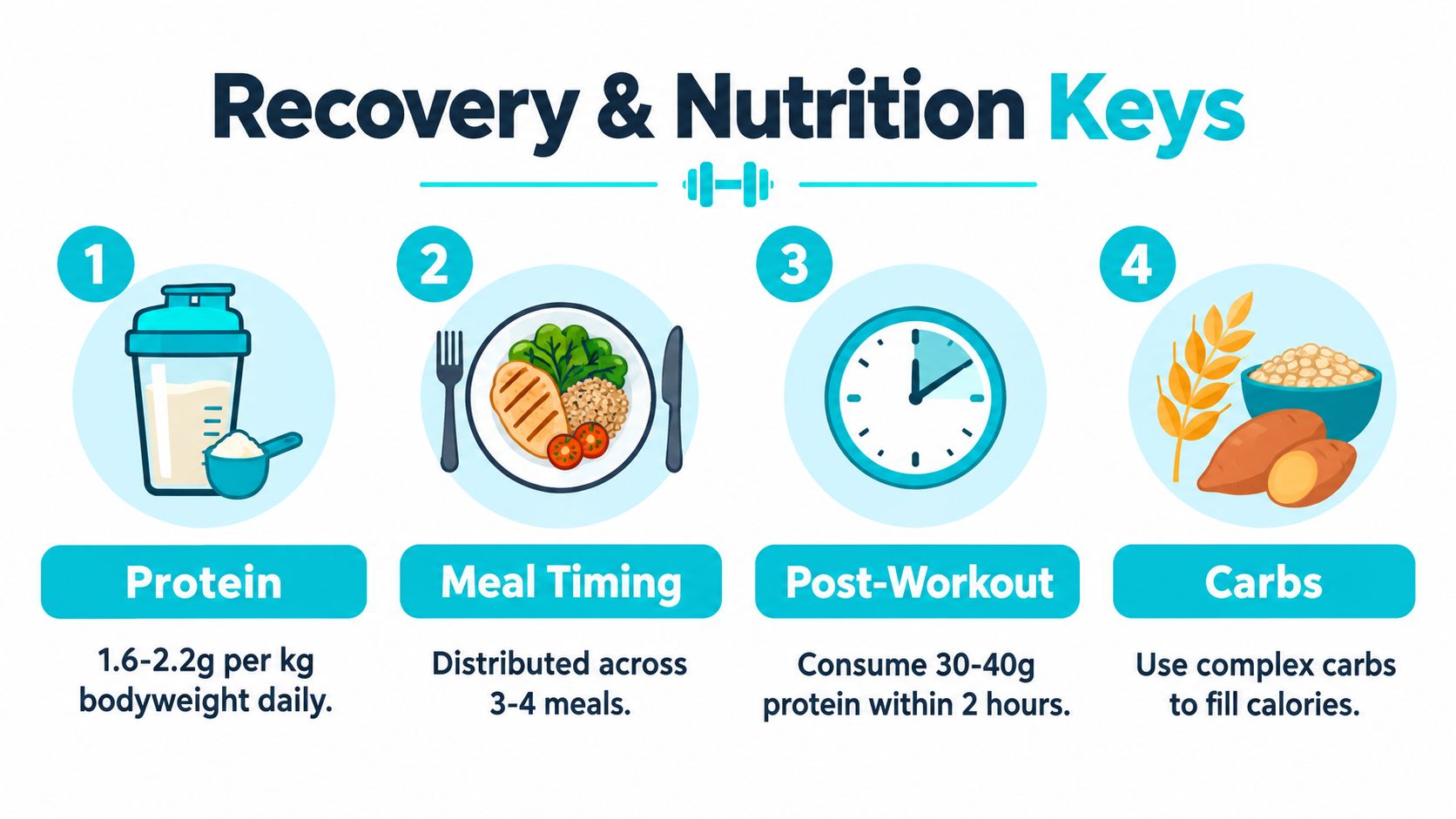
Aim for 1.6 to 2.2 grams of protein per kilogram of body weight daily, spread across 3 to 4 feedings. A useful post-workout anchor is 30 to 40 grams of protein within two hours after training. Keep the rest of your calories centered on complex carbs around training sessions, and use about 0.8 grams of fat per kilogram from whole-food sources.
If body-fat loss is part of the goal, keep the deficit mild. A 200 to 400 calorie deficit is easier to sustain without flattening strength output. Sleep seven to nine hours, keep hydration high enough that urine stays pale yellow, and take a short walk on rest days so your body doesn't go stale between sessions.
How coaches can package and track it
For coaches, the same program can be packaged inside Thrive X Fitness as a branded PDF, assigned with start and end dates, and logged with weights and RPE per set. That makes it easier to review adherence weekly without chasing screenshots or scattered messages. The same structure can also be listed on the ThriveXDNA marketplace, turning one well-built document into something clients can follow from their phone while you monitor progress remotely.
The advantage is operational, not flashy. Clients get a clean plan, and coaches get a repeatable delivery system that keeps the program organized.
Summary
A dumbbell-only plan works when it's built around progression, not novelty. The best home format uses a four-day upper/lower split, clear rest rules, and a double-progression system that tells you when to add reps and when to add load. Dumbbells can create meaningful neuromuscular demand and measurable body-composition change when the work is structured well. Nutrition, sleep, and recovery still matter, and a coach can deliver the same plan cleanly through Thrive X Fitness or list it through ThriveXDNA.
Frequently Asked Questions
Is a dumbbell-only workout enough to build muscle?
Yes, if the plan includes enough intensity, repetition, and progression. Dumbbell training can create strong neuromuscular demand, and a clinical dumbbell-based program showed measurable body-composition and fitness changes over time. The key isn't the tool alone. It's whether you keep adding reps, then load, while preserving clean form.
How many days per week should I train with dumbbells?
A four-day upper/lower split is a practical fit for most home trainees. It gives each muscle group a second exposure in the week, leaves room for recovery, and works well with realistic home-session time limits. That structure is easier to follow than a random routine because it turns the week into a repeatable calendar.
What should I do when my dumbbells stop feeling heavy enough?
Use double progression first. Stay in the rep range until you hit the top across all sets with good form, then raise the weight. If the dumbbells still feel easy, use slower eccentrics, pauses, 1.5 reps, or single-arm and single-leg variations. Those changes increase difficulty without requiring new equipment.
How much rest should I take between sets?
A simple rule is about 90 seconds for compound lifts and about 45 seconds for accessory work. That lines up well with common home-programming guidance and keeps the workout moving without turning the session into a race. If a set is especially demanding, a little more rest is reasonable, especially on squats, presses, and hinges.
Can I follow this plan if I don't have a bench?
Yes. A sturdy chair can substitute in some pressing setups, and the plan already includes several movements that don't depend on a bench at all. Rows, lunges, carries, squats, hinges, and core work all translate well to a home setup. The important part is that the pattern stays consistent enough for progression to be tracked.
What's the fastest way to make a PDF plan useful?
Make it trackable. Include the weekly schedule, set and rep targets, rest times, and a clear rule for load increases. A PDF becomes useful when it tells you what to do next session, not just what looked good this session.