
You're busy, you're carrying more than one role, and your workouts can't afford to be random anymore. If you're in your 40s or 50s and you've noticed that the old "I'll just do a few cardio sessions and some light weights" plan isn't giving you much back, that's not a motivation problem, it's a programming problem. Strength training for women over 40 works when it's built around the goals in front of you, stronger bones, better function, steadier balance, and a body that still feels capable in daily life.
Table of Contents
- Why Strength Training Matters More After 40
- How Your Body Changes and What Training Can Still Improve
- Your Core Training Framework for Safe Progress
- Weekly Routines From Beginner to Intermediate
- Mobility Recovery Nutrition and Staying Consistent
- Summary
- Frequently Asked Questions
Why Strength Training Matters More After 40
A lot of women I coach start here, not with a desire to “get shredded,” but with a wake-up call. Maybe stairs feel harder, joints complain more often, or they catch themselves hesitating before lifting groceries, carrying luggage, or getting off the floor. That's the job now, keep moving well, keep producing force, and keep trusting your body.
The data backs up that shift. In a 2025 study of 40 women aged 45 to 60, a high-intensity resistance-training program was feasible during the menopausal transition, and in a related 12-week trial, women in the resistance-training group improved hip function and lower-body strength by 19%, full-body flexibility by 21%, and dynamic balance, mobility, and stability by 10% (BMJ Open). The usual-activity group didn't show significant improvement. That matters because the change you're chasing isn't abstract, it's standing up easier, moving better, and feeling more stable in real life.
If you're worried about lifting “too late,” that fear usually comes from outdated gym culture, not from physiology. A practical place to start is a resource like osteoporosis exercises for women, especially if bone health is already on your mind. If you want a simple way to put those ideas into practice, a structured AI workout planner can make it easier to train consistently instead of guessing each week.
Practical rule: after 40, train for what keeps you independent, not just what changes the mirror.
The point is simple. Short, focused training blocks can still move the needle on strength, mobility, and balance, and that gives you a much better return than waiting for the perfect routine to appear. The sooner training becomes consistent, the sooner it starts paying you back in daily life.
How Your Body Changes and What Training Can Still Improve
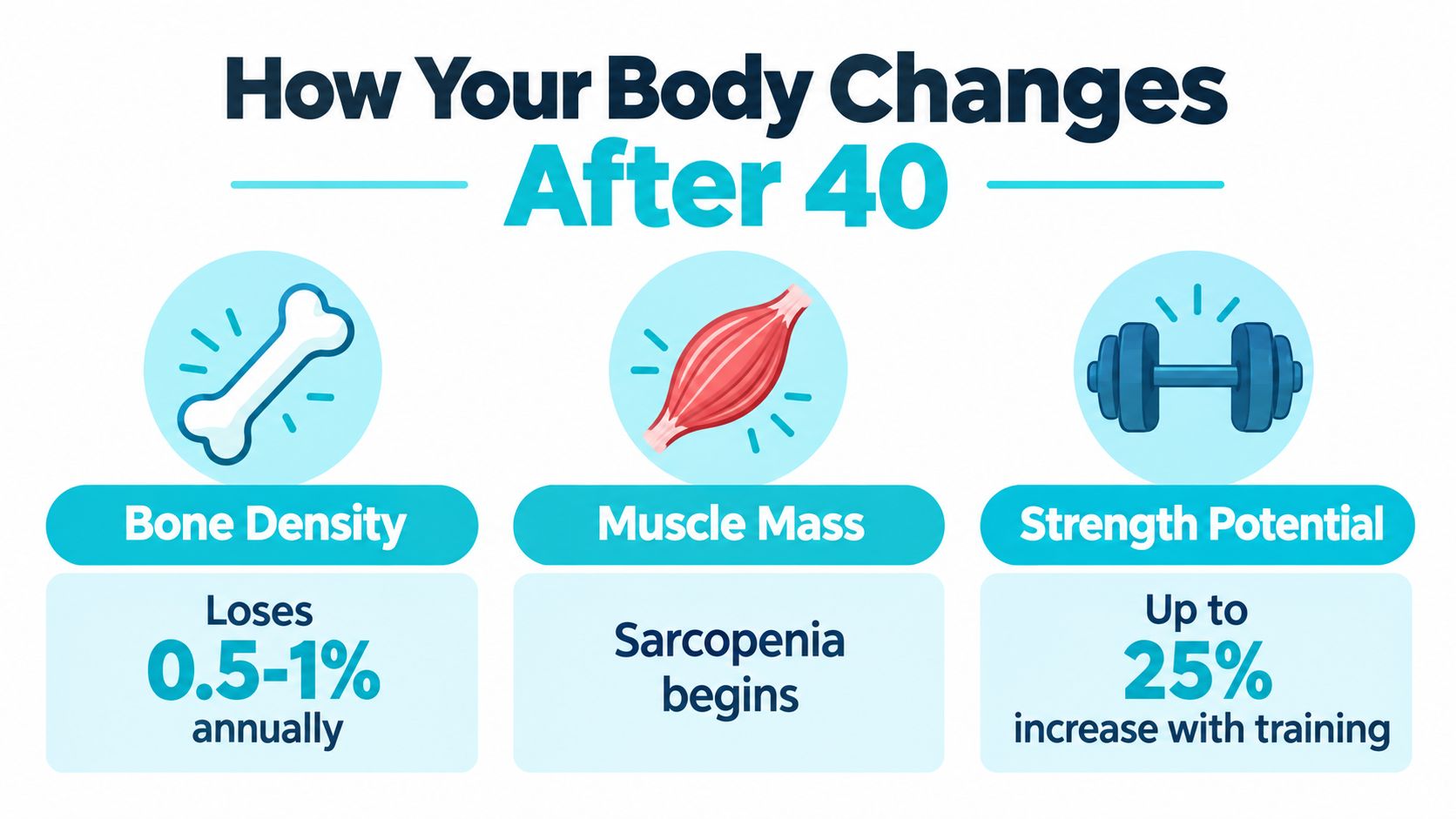
Menopause changes the training levers, not your ability to improve. Before you adjust volume or load, it helps to understand what happens to estrogen in menopause, because shifts in estrogen affect recovery, body composition, and how hard sessions feel from week to week. Many women also come to strength work later than they should have. Participation has historically been low, and women who do train often keep the habit once it starts.
The main myth is that menopause makes training stop working. It doesn't. Resistance training still improves strength and body composition in both premenopausal and postmenopausal women, and strength gains remain strong across both groups (PMC, PubMed).
Menopause shifts what responds fastest. Strength and function usually improve first. Hypertrophy and bone density often need better dose control, which means enough hard work to create a signal, but not so much that recovery falls apart. Random low-dose workouts usually maintain more than they change. For women in perimenopause and postmenopause, that trade-off matters. You want training that helps you lift groceries, climb stairs, protect bone, and look leaner without chasing fatigue for its own sake.
Menopause changes the starting point, not your ability to adapt.
Bone health deserves attention here because it sits beside body composition and daily function, not apart from them. A recent review also points to the need to train for bone health, mobility, and sarcopenia prevention without wasting energy on the wrong variables (PMC). That usually means choosing exercises you can repeat well, adding load when form stays clean, and keeping recovery honest. It can also help to pair your training with a practical nutrition planning system so recovery is supported outside the gym too.
If you train with poor mechanics, the body adapts to poor mechanics. If you train with repeatable form and enough effort, it keeps adapting. That is where tools like Thrive X Fitness AI form checks and meal guidance can help women stay consistent between sessions, especially when energy, sleep, and appetite are less predictable. For broader context on staying active as you age, the CDC physical activity guidelines for older adults are also a useful reference.
Your Core Training Framework for Safe Progress
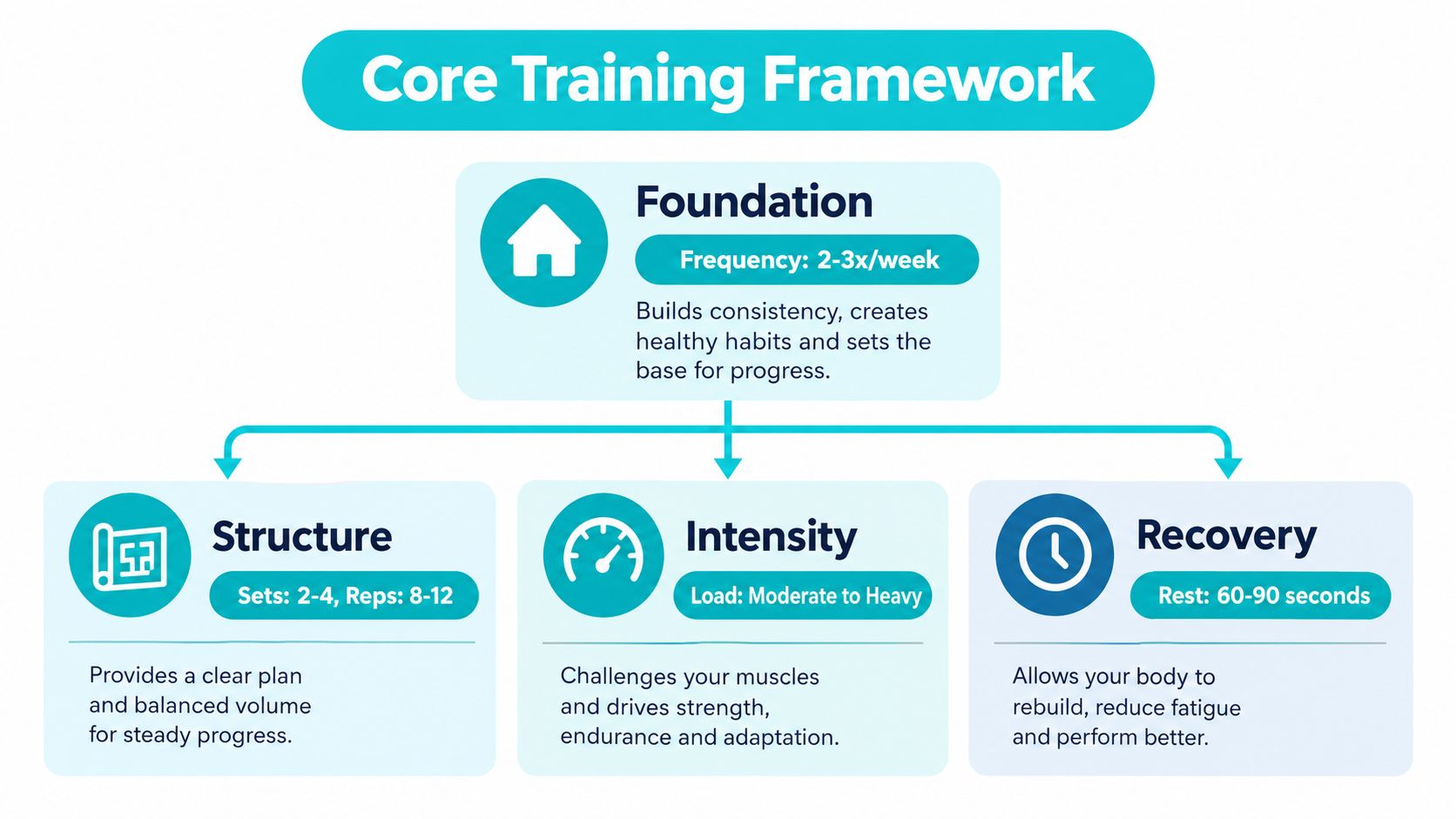
The cleanest framework is the one that keeps you moving long enough to adapt. For older adults, the ACSM progression model recommends 1 to 3 sets per exercise, 60% to 80% of 1RM for 8 to 12 repetitions, 1 to 3 minutes of rest, and training 2 to 3 days per week, using both multi-joint and single-joint exercises for strength and hypertrophy gains (HerDailyFit). That gives you a useful starting point without turning the gym into a guessing game.
The levers that actually matter
For women over 40, the first decision is frequency. Two to three weekly sessions are enough to build a meaningful base if you're consistent. From there, choose the main pattern, squat, hinge, push, pull, carry, and add a few accessories only if they support recovery instead of draining it.
For postmenopausal hypertrophy, volume becomes a bigger lever. One study in middle-aged women reported that free-weight training was safe and effective for improving 1-RM strength, but hypertrophy effects appeared only in premenopausal women, while postmenopausal women likely needed more than 6 to 8 sets per muscle per week for hypertrophy and body-composition change (PubMed). That doesn't mean endless sets. It means too little work usually maintains, but doesn't reshape.
| Goal | Recommended Approach | Weekly Structure |
|---|---|---|
| General strength | Moderate loads, clean form, consistent effort | 2 to 3 sessions weekly with 1 to 3 sets per exercise |
| Bone health | Moderate-to-heavier loading, steady progression | 2 to 3 sessions weekly, with load prioritized over random variety |
| Postmenopausal muscle gain | Higher weekly set volume, moderate-to-high loads | 2 to 3 sessions weekly, aiming to accumulate enough weekly work |
| Function and balance | Multi-joint lifts plus controlled single-leg and stability work | 2 to 3 sessions weekly, with careful recovery between sessions |
A 2023 review of resistance training in postmenopausal women concluded that 65% to 80% of 1RM, performed 3 days per week, may be optimal for improving bone mineral density at the lumbar spine, femoral neck, total hip, and trochanter (The House of Rose). Another systematic review found that 3-day-per-week training with 60-minute sessions is a solid starting point for quality of life, function, and disease-prevention-related outcomes (Anytime Fitness). A newer ACSM summary also points to around 80% of 1RM for 2 to 3 sets as a concrete progression target for strength development (Researcher.life).
If a workout always feels easy, it's maintenance, not adaptation.
Use this rule of thumb, start conservatively, train consistently, and raise volume or intensity every 4 to 6 weeks based on tolerance. That's the sweet spot for progress without turning recovery into a second job. If you prefer having progression mapped for you, a guided workout app can help you build around those same principles.
Weekly Routines From Beginner to Intermediate
The best routine is the one you can repeat on a normal week, not the one that looks perfect on paper. A two-day plan can build a strong base, and a three-day plan can layer in more volume once your joints, schedule, and recovery all cooperate.
Beginner full-body plan
If you're new, returning, or coming off a long gap, use two full-body sessions. Keep the lifts simple and repeatable, and stop a rep or two before form breaks. A good session might include a squat pattern, hinge pattern, push, pull, and carry, with 2 sets per move to start.
A practical structure looks like this.
- Day 1 focus: squat, row, incline press, hip hinge, farmer carry.
- Day 2 focus: split squat, lat pull or band pull-down, overhead press, glute bridge, dead bug or side plank.
- Progression rule: add reps first if form is steady, then add load when the top end of your rep range feels controlled.
If you train at home, dumbbells and a bench are enough to start. If you're in a gym, use machines when they help you stay consistent or reduce joint irritation. The best setup is the one that gets the work done without guessing.
Intermediate upper and lower split
Once two full-body days feel too easy to recover from, move to three sessions and split the work. An upper-lower-then-full-body pattern, or upper-lower-upper one week and lower-upper-lower the next, both work well. The goal is not to chase exhaustion, it's to spread useful work across the week.
Form first, then load. If the last rep turns into a body-English contest, the weight's too heavy for that set.
This is also where a tool like Thrive X Fitness can keep the process tight. Its AI workout builder can generate sets, reps, and progression, and the ~60-second form-clip review is useful when you're checking for knee cave, elbow flare, or depth drift before those patterns become habits. You don't need a perfect eye for movement to benefit from feedback. You just need a repeatable way to check it. If that kind of support sounds helpful, you can explore the platform at ThriveXDNA.
The point of progression is not drama. It's steady load management. If you can complete every rep with ease, the stimulus is probably too small. If your form collapses, the stimulus is too large. The useful middle is where most women over 40 make progress.
Mobility Recovery Nutrition and Staying Consistent
The workouts matter, but the part most women underestimate is the support system around them. Strength, balance, and bone work all improve faster when your body is not always running on fumes. Mobility, recovery, and nutrition aren't separate topics, they're what allow the training to stay productive.
Mobility and balance work should live beside lifting, not replace it. A few minutes of controlled ankle, hip, thoracic, and shoulder work before training keeps positions cleaner, and balance drills on easier days help reinforce the stability you need for squats, lunges, and carries. If you feel stiff, shorten the range slightly and build back in over time instead of forcing depth you can't control.
Recovery is where many women over 40 overreach. More sets aren't always better, especially when sleep is off or stress is high. Postmenopausal training often responds better to the right amount of work than to extra random volume, so the trade-off is clear, push enough to adapt, then get out and recover. If recovery is a weak point, the National Institute on Aging exercise guidance can be a useful companion resource.
Nutrition and consistency tools that help
Protein and meal planning are where most routines either stick or collapse. The goal is to make the next good choice easy, not to rely on willpower after a long day. Thrive X Fitness includes photo and barcode logging plus AI meal plans, which helps when you want a quick check on what you ate instead of estimating and hoping for the best. Its challenges and gamification can also keep the “I missed one day, so the whole week is gone” pattern from taking over.
If you need a more structured option, ThriveXDNA also offers a consumer app and partner API that cover workouts and nutrition planning. For some women, that kind of integrated setup is enough to keep training from falling apart after the first burst of motivation. For others, a simple notebook and a repeating schedule are enough. Use the lightest system that still keeps you honest. You can learn more about the full platform on the ThriveXDNA home page.
A few practical habits matter more than fancy rules.
- Warm up with purpose: get joints moving and tissues warm before loading them.
- Match effort to recovery: on low-sleep days, keep the session crisp rather than trying to win the gym.
- Modify instead of quitting: shorten range, reduce load, or swap the lift, then keep the habit alive.
- Watch the weekly trend: consistency beats occasional heroic workouts.
That's the difference between a plan and a lifestyle. The plan gets you through one motivated Monday. The lifestyle carries you through busy weeks, joint flare-ups, travel, and plain old life.
Summary
Strength training for women over 40 works best when it targets strength, function, bone health, and body composition together. The evidence shows women in perimenopause and postmenopause still respond well to training, and the main levers are frequency, load, and volume, not age alone. A 2 to 3 day weekly plan, built around clean movement, recovery, and consistent nutrition support, gives you a realistic path to progress. Use the routines, keep progression steady, and treat consistency as the win.
Frequently Asked Questions
Is strength training safe during perimenopause
Yes, and the research supports it. A 2025 study of women aged 45 to 60 found high-intensity resistance training was feasible during the menopausal transition, and functional gains showed up across pre-, peri-, and postmenopausal participants. The main rule is to keep form tight, start conservatively, and progress based on tolerance instead of ego. That approach protects recovery while still giving you a meaningful training signal.
How much volume do I need to build muscle after 40
Muscle gain becomes more volume-sensitive after menopause. One study suggested postmenopausal women likely need more than 6 to 8 sets per muscle per week for hypertrophy and body-composition change. That doesn't mean endless workouts. It means a low-dose plan may preserve strength, but if visible muscle change is the goal, you'll usually need more weekly work than a maintenance routine provides.
Do heavier weights help bone health
They can. A 2023 review in postmenopausal women found 65% to 80% of 1RM, done 3 days per week, may be optimal for improving bone mineral density at key sites like the lumbar spine and hip. Heavier isn't a license to rush, though. Use loads you can control, keep technique clean, and let the progression come from consistency rather than jumping too fast.
What should I do if I only have two days a week
Use a full-body plan. Two sessions can still build strength if you hit the major movement patterns, squat, hinge, push, pull, and carry, and keep progressing slowly. The key is not making each session an all-out event. A shorter, repeatable plan you can finish is better than a longer plan you keep skipping.
What if my joints feel beat up
Modify the lift instead of dropping the habit. Shorten the range a little, reduce the load, or switch to a more joint-friendly version such as a machine or dumbbell variation. The goal is to keep training the pattern while managing stress. If the issue is recovery, lower the weekly work first before you abandon the exercise altogether.
ThriveXDNA gives you a practical way to pair AI workouts, form-clip review, and nutrition tracking so your training doesn't fall apart when life gets busy. If you want a system that supports strength training for women over 40 with fewer guesswork moments and more repeatable sessions, visit ThriveXDNA and see how the app fits your routine.