

Approximately 337 to 340 calories are in 1/2 cup of uncooked long-grain white rice, which weighs about 92.5 grams dry. That calorie count belongs to the uncooked portion, not the cooked volume it later produces.
This distinction drives most rice-tracking errors. Water increases rice's weight and volume during cooking, but it doesn't add calories. If you log a dry portion as cooked, or weigh cooked rice while selecting a dry entry in a fitness app, your calorie and carbohydrate totals can be badly misaligned. For athletes, coaches, and meal-prep users, the reliable starting point is simple: identify the rice state first, then measure it consistently.
Table of Contents
- The Definitive Calorie Count for Uncooked Rice Portions
- Rice Variety Comparison, White, Brown, and Specialty Grains
- Dry to Cooked Conversion and Yield Calculations
- Macronutrient Profile and Macronutrient Breakdown
- Practical Applications for Fitness Tracking and Meal Prep
- Common Measurement Mistakes and How to Avoid Them
- Nutritional Advantages Beyond Calorie Counts
- Integrating Rice Data into Nutrition Apps and Tracking Systems
- Summary
- Additional Resources
- Frequently Asked Questions
The Definitive Calorie Count for Uncooked Rice Portions
The clearest baseline is about 337 to 338 calories for 1/2 cup uncooked long-grain white rice, based on a dry weight of roughly 92.5 grams and USDA-derived data listing about 675 calories per cup of dry white rice (USDA-derived calorie data). Rounded nutrition references commonly place the same portion near 337 to 340 calories, so that range is practical for meal planning and food logging.
The important detail is that the calories are tied to the dry rice itself. Cooking changes the amount of water held by the grain, which changes the final weight and volume. It doesn't remove the original energy from the rice. A half cup measured before cooking can produce substantially more food on the plate, but the entire cooked batch still contains the calories from the original dry amount.
| Measurement | Weight | Calories |
|---|---|---|
| 1/2 cup uncooked long-grain white rice | About 92.5 g | About 337 to 338 kcal |
| 1 cup uncooked long-grain white rice | About 185 g | About 675 kcal |
| 1/2 cup cooked white rice | About 79 g | About 103 kcal |
| 1 cup cooked white rice | Not specified in the cited database | About 205 kcal |
The cooked figures come from the same type of USDA-derived reference, which lists about 205 calories per cup cooked white rice (USDA-derived rice calorie reference). These aren't contradictory numbers. They describe different states and different quantities.
Practical rule: In a calorie-tracking system, “dry,” “uncooked,” “raw,” and “cooked” should never be treated as interchangeable labels.
For a coach building a meal plan, the dry benchmark gives you a dependable anchor. Weighing the rice before adding water makes the calorie entry predictable. Measuring after cooking can still work, but only if the cooked batch has been prepared consistently and divided using the correct cooked-food entry.
Rice Variety Comparison, White, Brown, and Specialty Grains
Black rice shows why the grain name alone cannot determine a reliable calorie entry. Databases may list different products, and some switch between dry and cooked measurements. For accurate macro tracking, confirm the grain, product definition, and measurement state before logging a portion.
The comparison below is useful for planning, but each range remains a guide rather than a universal value. White rice generally provides the most predictable entry, while brown and wild rice reflect different grain structures and nutrient profiles. Use the rice variety calorie comparison as a cross-check, not as permission to mix dry and cooked records.
| Rice Type | Calorie Range | Best For |
|---|---|---|
| Long-grain white rice | About 320 to 340 kcal per 1/2 cup dry | Straightforward carbohydrate planning and easy meal pairing |
| Brown rice | About 300 to 320 kcal per 1/2 cup dry | A higher-fiber whole-grain option |
| Wild rice | About 290 to 300 kcal per 1/2 cup dry | Specialty-grain variety and meal texture |
| Black rice | Variable by product and measurement state | People prioritizing specialty grains and nutrient variety |
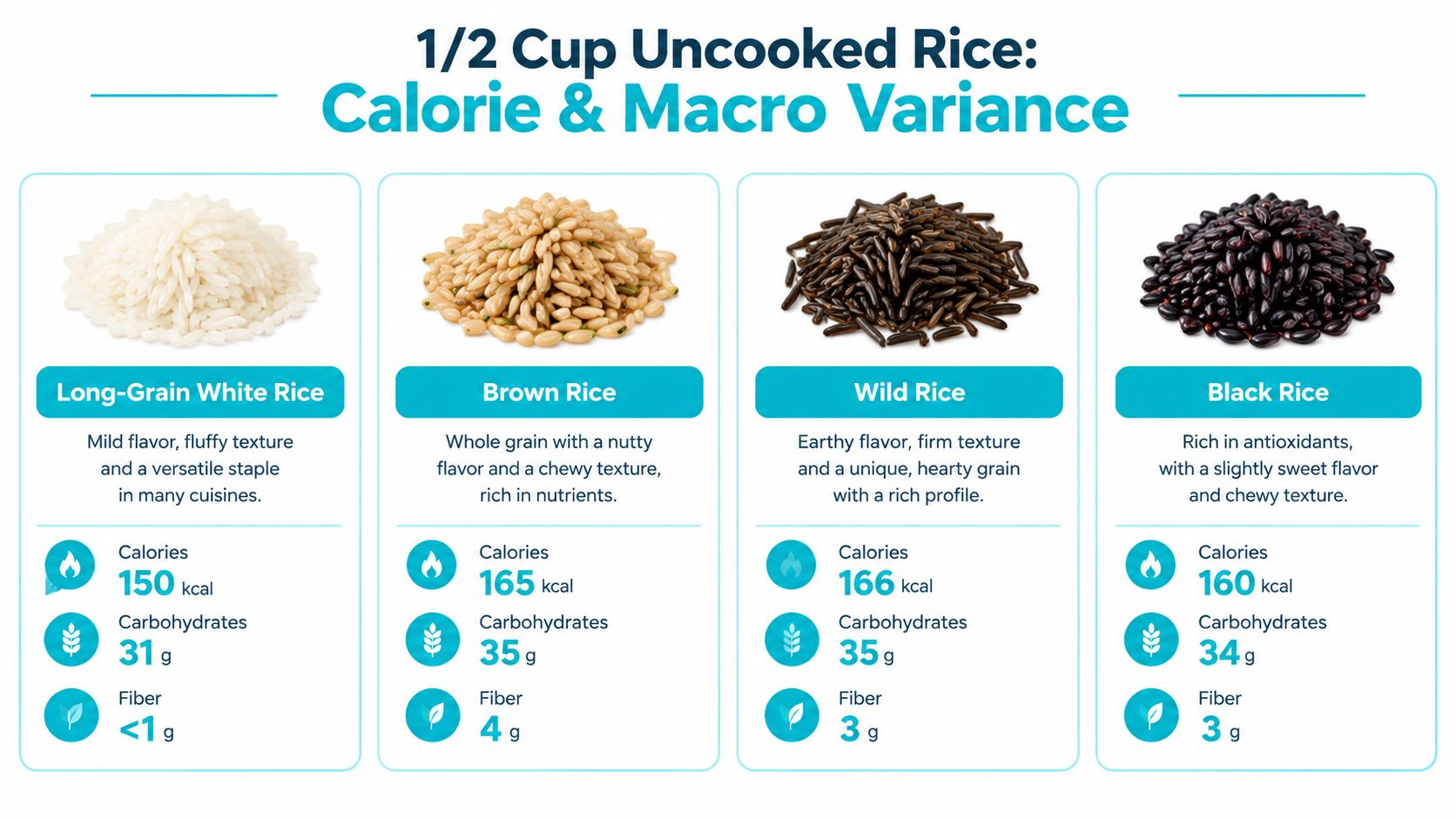
The infographic uses a separate dataset comparing calories, carbohydrates, and fiber across four rice types. Do not combine those figures with another database entry unless the product and measurement state match. For consistent meal planning, select one dry-rice record, record its gram weight, and use the same method for every batch.
Variety usually matters less than portion size and preparation ingredients. Oil, sauces, bouillon, and mixed foods can raise the meal total substantially. The grain choice mainly changes the fiber profile, texture, and eating experience, while consistent dry measurement keeps calorie and carbohydrate planning accurate.
Dry to Cooked Conversion and Yield Calculations
The dry-to-cooked gap comes from absorbed water, not added calories. A half cup of dry rice can yield around 1 to 1.5 cups cooked, depending on the grain and cooking method (uncooked rice serving and yield guide). For accurate app logging, convert by weight whenever possible.
Using the dry benchmark of 185 g per cup, a half cup starts at about 92.5 g dry. If cooking produces a 1.5× to 2× weight expansion, the yield can be estimated as follows:
| Dry amount | Estimated cooked yield |
|---|---|
| 92.5 g, 1/2 cup | About 139 to 185 g |
| 185 g, 1 cup | About 278 to 370 g |
Use this five-step workflow:
- Measure the dry rice. Record the gram weight before adding water.
- Log the dry entry. Choose a database item labeled uncooked, raw, or dry.
- Cook the measured batch. Water changes the final yield, not the starting rice calories.
- Weigh the finished batch. Divide the dry-entry calories by the cooked batch weight, then multiply by each portion's cooked weight.
- Keep measurement states consistent. Never match a cooked portion with a dry database entry.
The USDA-derived reference lists about 205 calories in 1 cup cooked white rice (USDA-derived calorie data). That figure applies to cooked volume. A dry cup cannot be substituted directly because retained water changes the final weight and volume.
Water changes the scale reading and the volume. It doesn't create additional rice calories.
For meal prep, cook the full measured batch, record its actual cooked weight, and portion it into containers. If the rice, water ratio, or cooking method changes, measure the new yield instead of reusing an old conversion.
Macronutrient Profile and Macronutrient Breakdown
A food-database listing reports 368 calories for 1/2 cup dry white rice, with 79.52 grams of carbohydrate, 7.58 grams of protein, and 0.8 grams of fat (white rice food-database entry). The same listing assigns the calorie split as 89% carbohydrates, 9% protein, and 2% fat.
That entry is somewhat higher than the USDA-derived estimate of about 337 to 338 calories. This is a normal database-management issue, not proof that one measurement state is correct and the other is wrong. Product definitions, serving weights, rounding, and database conventions can produce different listings.
| Nutrient | Amount | Calorie % |
|---|---|---|
| Carbohydrate | 79.52 g | 89% |
| Protein | 7.58 g | 9% |
| Fat | 0.8 g | 2% |
For performance nutrition, the practical message is that dry white rice is primarily a carbohydrate serving. That makes it useful in meals where carbohydrate availability matters, while the relatively small protein and fat amounts mean athletes generally need other foods to complete the meal's protein and fat targets.
Don't force every rice variety into the same macro template. Brown, wild, and black rice differ in fiber and product composition, and their calorie ranges aren't identical. The right app entry is the one that matches the package, grain type, and measurement state.
When two credible database entries disagree, consistency matters. Pick the entry that best matches the product label, record the dry weight, and use that same reference across the meal plan instead of switching between listings from day to day.
Practical Applications for Fitness Tracking and Meal Prep
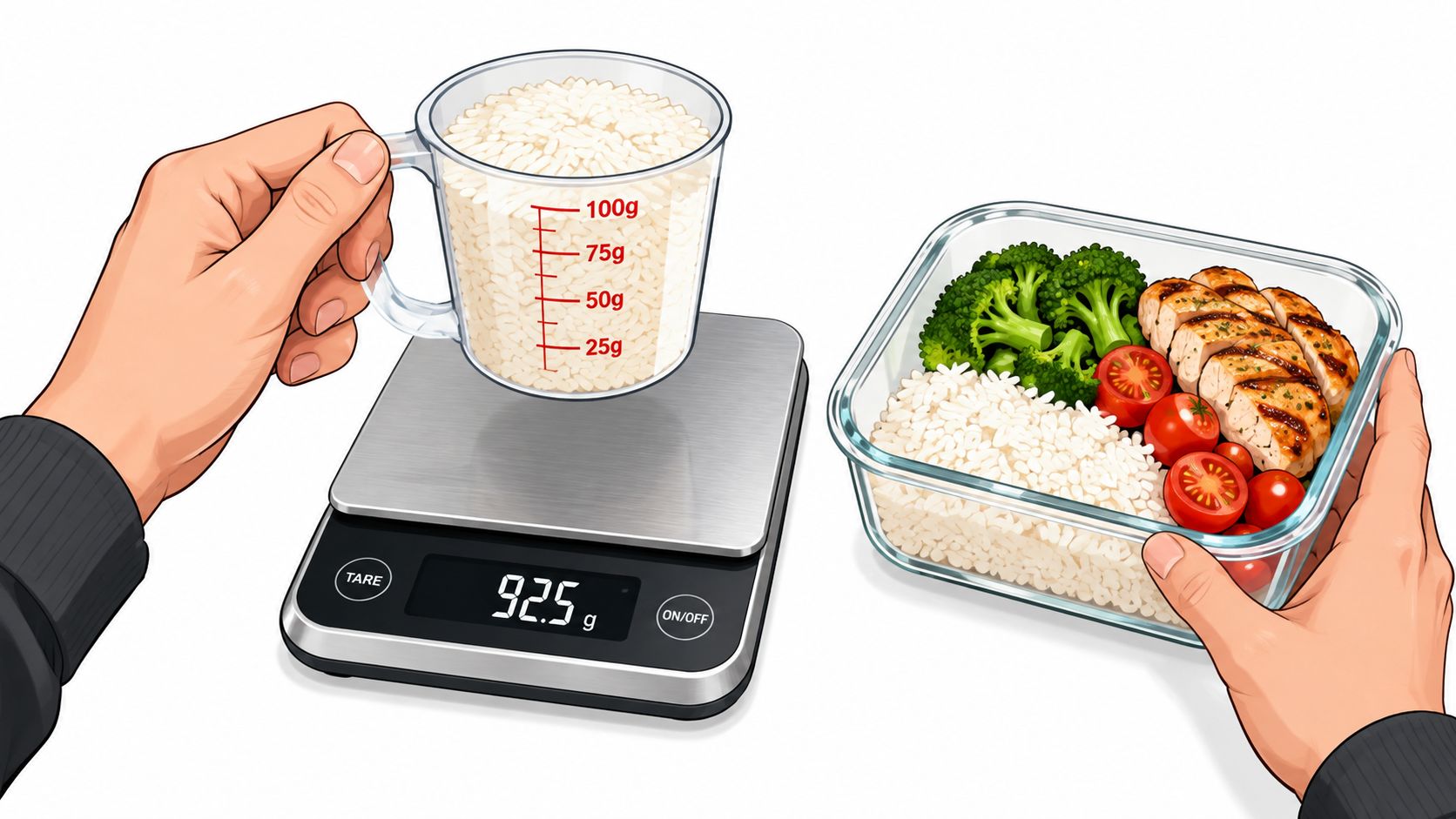
The 92.5-gram dry benchmark helps coaches and athletes standardize pantry portions, recipe scaling, and nutrition-label checks (rice portion measurement guide). A full dry cup is about 185 grams, making half a cup a useful reference when no scale is available. Gram weight is more reliable because density and packing differ among rice varieties.
Treat dry and cooked measurements as separate tracking inputs. A portion guide may use roughly 90 to 100 grams of dry rice, yet long-grain white rice, brown rice, and specialty grains can produce different cup weights. For accurate app entries, weigh the uncooked rice and select a database listing that specifies dry, uncooked, or raw rice.
Use this meal-prep workflow:
- Before cooking: Weigh the entire dry rice batch and log its calories and macros.
- After cooking: Weigh the finished batch, or divide it into equal containers.
- For each meal: Assign the batch totals by the number of equal portions, or log each container from its share of the cooked yield.
- For recipe scaling: Multiply the dry weight by the selected database entry, then keep the cooking method consistent.
This approach works for coaches assigning meals through Thrive X Fitness. Clients may use photo or barcode nutrition tracking, but a dry pantry ingredient still needs manual confirmation. A photo can show rice on a plate, not whether the correct entry should be dry or cooked.
Record the dry input and cooked yield together. That pair lets you build a repeatable conversion for future batches without treating a cooked cup as a fixed dry portion.
A kitchen scale turns rice from an estimated side dish into a repeatable input for the whole meal plan.
Common Measurement Mistakes and How to Avoid Them
The biggest mistake is logging 1/2 cup cooked rice as 1/2 cup uncooked rice. A half cup cooked white rice is commonly listed at about 103 calories, while a half cup uncooked portion is generally modeled at about 320 to 340 calories (dry versus cooked rice calorie comparison). The difference comes from the measurement state and water absorption, not from calories disappearing during cooking.
A second mistake is selecting an entry that says “white rice” without checking whether it means raw or cooked. Food databases often default to cooked volume unless the listing specifically says raw, uncooked, or dry (white rice measurement guidance).
Use these checks before saving a meal:
- Read the state: Confirm that the entry says dry, uncooked, raw, or cooked.
- Match the unit: If you weigh grams, choose an entry that supports grams rather than converting a cooked cup into a dry serving.
- Check the package: Product labels can provide a more relevant reference than a generic database entry.
- Standardize your cup: If you must use volume, review measuring cup accuracy tips and use the same cup and filling method each time.
- Name the recipe clearly: Save “dry white rice batch” and “cooked white rice serving” as separate items.
The scale is the better tool when accuracy matters, but a consistent measuring cup is still more useful than changing methods repeatedly. The method only fails when the entry and the physical state don't match.
Nutritional Advantages Beyond Calorie Counts
Calories aren't the only reason to compare rice varieties. The available comparison data places brown rice at roughly 300 to 320 calories per half cup dry and wild rice at roughly 290 to 300 calories, while white rice commonly sits around 320 to 340 calories (rice variety calorie comparison). Those ranges overlap enough that portion size can matter more than choosing one grain based solely on its calorie label.
Fiber is a meaningful differentiator in the comparison graphic. Brown, wild, and black rice are presented as higher-fiber choices than long-grain white rice, which is shown with less than one gram of fiber in that dataset. That can make whole-grain or specialty rice a better fit for someone managing hunger, meal texture, or dietary variety.
The decision should match the training context:
- White rice: A familiar, lower-fiber carbohydrate option that can fit meals where digestibility and simplicity matter.
- Brown rice: A whole-grain choice with more fiber in the comparison data, useful when a meal needs greater staying power.
- Wild or black rice: Specialty options that add variety and a different texture, with the database entry requiring closer inspection.
Preparation still matters. A calorie-controlled portion of any rice variety can fit a plan, while a larger serving or calorie-dense additions can shift the meal more than the modest differences between grains. Choose the grain for the complete nutrition strategy, not a single number detached from the meal.
Integrating Rice Data into Nutrition Apps and Tracking Systems
Nutrition apps should treat rice as a structured food record, not just a cup measurement. A useful entry stores the ingredient, measurement state, unit, and recipe relationship. This lets athletes and coaches audit a meal without guessing whether the logged portion refers to the original ingredient or the finished dish.
In the Thrive X Fitness app, open the food log, search for the rice variety, and review the serving description before saving it. Select the gram field when available, then check whether the entry is labeled dry or cooked. If the database entry does not identify that state, create a custom food with a clear name such as “long-grain white rice, dry” or “rice, cooked,” rather than relying on an ambiguous cup option.
For batch cooking, save the recipe with the measured ingredient and the completed batch as separate fields. Record the cooked yield once, then portion the finished batch by weight. This gives the app a repeatable recipe record and lets each serving inherit the batch calculation without changing the ingredient definition.
The same workflow helps when unified health data apps compared are being assessed. Check the food-log screen for editable serving units, a visible dry-or-cooked descriptor, custom recipe creation, and the ability to correct an imported entry. Barcode and photo tools improve speed, but they cannot resolve an unclear measurement state on their own.
Coaches can standardize the process by naming custom foods consistently and requiring clients to record the gram amount shown in the recipe or meal log. That creates cleaner comparisons across training days, rest days, and repeated meal-prep batches. It also makes errors easier to identify when recorded portions do not match the planned meal.
Summary
One-half cup uncooked long-grain white rice contains approximately 337 to 340 calories and weighs about 92.5 grams. That dry measurement should remain separate from cooked volume in meal plans and tracking apps, because water absorption changes the cooked weight and yield. Brown rice generally provides 300 to 320 calories, while wild rice provides 290 to 300 calories per half cup dry. A half cup cooked white rice is about 103 calories. Dry white rice also supplies 79.52 grams carbohydrate, 7.58 grams protein, and 0.8 grams fat, with calories primarily from carbohydrates.
Additional Resources
If you want to compare rice entries across major food databases, it can help to review both the USDA FoodData Central database and consumer trackers such as FatSecret. For general guidance on portioning grains in a balanced eating pattern, the Harvard T.H. Chan School of Public Health Healthy Eating Plate is also a useful reference.
Frequently Asked Questions
How should mixed-grain rice be logged?
Create a recipe with each dry grain entered separately, then divide the finished batch by its cooked weight or number of servings. This method preserves the different ingredient proportions instead of assigning the entire dish to a single rice entry. Keep the dry quantities and final yield recorded together so the recipe can be repeated accurately.
Why do two brands of the same rice show different nutrition values?
Cultivar, milling, fortification, moisture, and database conventions can change the label or listing. Serving definitions may also differ, particularly when one entry describes dry rice and another describes cooked rice. Use the package label for the product in your kitchen, and compare entries only after confirming the measurement state.
How should sticky rice and long-grain rice be logged?
Texture does not change the rice's basic macronutrients by itself, but it can change how tightly grains pack into a measuring cup and how much water the cooked batch retains. Weigh the dry portion when possible. For cooked tracking, weigh the complete batch, record its cooked yield, and portion by grams rather than assuming the same volume represents the same amount across textures.
What should I do if a recipe-scraping tool imports the wrong rice entry?
Check whether the imported ingredient is labeled dry, uncooked, cooked, instant, or prepared. Replace it with the matching database item before saving the recipe. If the tool cannot distinguish those states, enter the rice manually by dry weight and add the water separately only when the recipe's totals require it.
Can I use a cup measure for repeat meal prep?
A cup can work if you use the same utensil and preparation each time, but a scale gives more consistent portions. Record the convention in the recipe, especially whether servings are divided before or after cooking. ThriveXDNA can keep that dry-versus-cooked convention attached to meal plans, photo and barcode nutrition tracking, and coach-guided fitness workflows.