


You've finished eight weeks of bench press work, and the log looks respectable. You've added reps, repeated the same load, and still aren't sure what to change next. Should you add another set, another rep, or another kilo? The answer depends on what you mean by training volume, because lifters and apps use that phrase for several different measurements.
Training volume is the amount of work you perform for a movement or muscle group. In resistance training, people may count sets, repetitions, sets multiplied by repetitions, or sets multiplied by repetitions multiplied by load. For hypertrophy programming, many coaches now use a more practical filter, counting hard sets performed close to failure rather than treating every repetition as equally valuable. A peer-reviewed review of resistance-training volume explains why volume has never had just one fixed definition.
Table of Contents
- What Training Volume Really Means
- The Four Ways Volume Gets Calculated
- Session Volume vs Weekly Volume vs Program Volume
- Hard Sets and Proximity to Failure
- Recommended Volume Ranges by Experience and Goal
- Progressive Overload Through Volume Levers
- Tracking Volume Without Losing Your Mind
- The Common Mistakes and the Bigger Picture
- Quick Summary
- FAQ
- What is the simplest way to define training volume?
- Is training volume the same as intensity?
- Should I track volume per workout or per week?
- What counts as a hard set?
- How many sets per week should I do for muscle growth?
- Does more volume always build more muscle?
- Is volume load better than hard sets?
- Can beginners ignore volume load?
- Further Reading on Training Volume
What Training Volume Really Means
A useful training volume definition starts with one simple question: How much work did you do? If you performed four sets of eight bench presses, you completed 32 repetitions. If every repetition used the same load, you can also express the work as sets multiplied by reps multiplied by load. Four sets of eight with 50 kg equals 1,600 kg of volume load, while four sets of eight with 100 kg equals 3,200 kg, even though both sessions contain the same number of repetitions. If you want a reference for how coaches classify sets, reps, and load, the National Strength and Conditioning Association offers a helpful overview of the distinction.
That's why volume is different from the other basic training variables:
- Volume asks how much work you completed.
- Intensity asks how demanding the load or effort was.
- Frequency asks how often you trained.
These variables overlap in practice, but they answer different questions. A lifter might train chest twice in a week, use a challenging load, and still perform too few productive sets to create the desired stimulus. Another lifter might complete many sets but use an effort level that makes several of them less useful for muscle growth. A systematic review and dose-response meta-analysis on weekly resistance-training volume and muscle hypertrophy helps explain why simply counting sessions is not enough, and a 2022 systematic review on resistance training volume and muscle hypertrophy gives more context on how low, moderate, and high weekly set ranges compare in practice.
Volume has more than one time frame
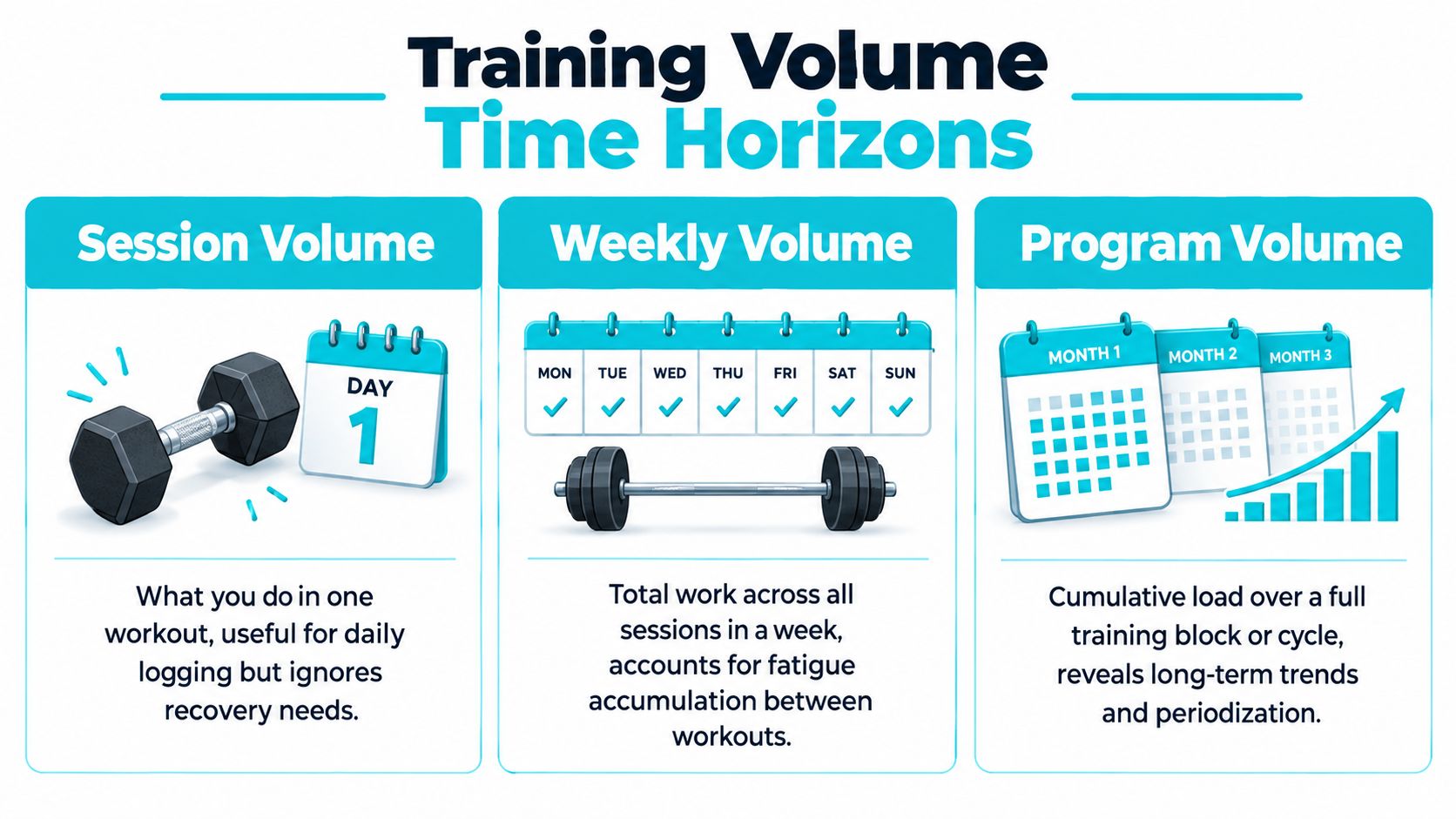
You can measure volume for a single session, across a week, or over an entire training cycle. Session volume tells you what happened in today's workout. Weekly volume shows the combined dose for a muscle group or lift, which is often more useful for hypertrophy decisions. Program volume captures the larger pattern, including periods of building work and planned reductions.
The unit matters just as much as the time frame. A log showing 100 repetitions doesn't tell the whole story unless you also know the load, the sets, and how close those sets came to failure. Contemporary exercise-science teaching materials describe volume as the total activity completed within a chosen period, while modern coaching practice often turns that broad idea into weekly hard sets per muscle group.
Practical rule: Before comparing two programs, identify whether they're counting sets, reps, volume load, or hard sets. Otherwise, you may be comparing different training doses while using the same word.
The Four Ways Volume Gets Calculated
The simplest method counts sets multiplied by repetitions. Four sets of eight equals 32 reps. This approach is easy to record and useful when the load stays stable, but it treats a light set and a heavy set as equal if both contain the same repetitions.
The second method includes load. Four sets of eight at 80 kg becomes 2,560 kg of volume load, calculated as 4 × 8 × 80. This is often called tonnage or workload. It gives you a clearer picture of the external weight moved, although it still doesn't show whether the set challenged the target muscle effectively.
The third approach focuses on effective repetitions. Instead of counting every rep, it tries to identify the repetitions that occur close enough to muscular fatigue to provide a meaningful growth stimulus. This model is harder to measure precisely, particularly without consistent effort tracking, so it's less convenient for a basic workout log. A peer-reviewed paper on resistance training to muscular failure and its relevance for muscle hypertrophy adds useful context to this idea.
The fourth approach counts hard sets, usually sets performed within about 1-3 repetitions of failure. A set stopped with four or more repetitions still available is often treated as low-value for hypertrophy volume in modern programming models. A resistance-training review describes the main operational forms as total sets, sets multiplied by repetitions, and volume load, while also discussing hard sets near failure as a practical hypertrophy measure. If you want a closer look at how researchers discuss volume prescription methods, this methodological review on set volume, effort, and resistance training dose is a useful addition.
One bench press example
Suppose your bench session contains four sets of eight at 80 kg.
| Metric | Formula | Worked Example | Best Used For |
|---|---|---|---|
| Sets | Number of working sets | 4 sets | Comparing basic workload |
| Reps | Sets × reps | 4 × 8 = 32 reps | Simple session logging |
| Volume load | Sets × reps × load | 4 × 8 × 80 kg = 2,560 kg | Tracking external workload |
| Hard sets | Sets close to failure | Depends on effort and RIR | Hypertrophy programming |
If the first three sets were easy and the final set was difficult, the raw total remains 32 reps and 2,560 kg. The hard-set total may tell a different story. That's why current hypertrophy discussions increasingly favour weekly hard sets per muscle group, rather than raw repetitions alone. Recent review work on training-volume definitions highlights the competing definitions and the growing practical preference for weekly sets.
Session Volume vs Weekly Volume vs Program Volume
A chest workout with eight working sets has a clear session volume. You can record the exercises, sets, reps, loads, and effort, then compare that workout with the next one. The limitation is that session volume says nothing about what happened to the same muscle earlier in the week or how well you recovered before today's training.
Weekly volume adds those sessions together. If you train chest twice per week and complete eight working sets in each session, your weekly chest volume is 16 sets. That number gives you a better view of the total stimulus and fatigue you're asking the muscle to handle across the week. It's also the time frame most commonly used when coaches discuss hypertrophy volume. A meta-analysis on resistance-training frequency and muscular adaptations supports the idea that weekly set totals matter alongside how those sets are distributed, and a systematic review and meta-analysis on load and hypertrophy or strength when volume is equated helps show why weekly planning should consider both total work and the kind of stimulus created.
Program volume looks at the longer training block. A program may gradually accumulate work, then reduce it during a deload before building again. This view helps an experienced lifter see whether training has been rising, stable, or deliberately reduced over the full cycle, but it can overwhelm a new lifter who hasn't yet built a reliable log.
What should a beginner track?
Start with weekly hard sets per muscle group. Record session details so you can check your work, but make the weekly total your main decision-making number. Don't worry about calculating every program-level total until you've collected a few months of consistent training data.
A simple weekly review can sit alongside other routine administration. If you already use a client login portal for visits, keep your training log equally straightforward, with one reliable place for dates, sessions, and notes. The tool matters less than consistently recording the same information.
Hard Sets and Proximity to Failure
A set count can look precise while hiding a major difference in effort. Three sets of ten performed with five repetitions still available aren't equivalent to three sets of ten where the final repetition is slow and difficult. Both logs show three sets, but the second workout contains more sets that likely challenged the intended muscle.
A hard set is a working set performed close enough to failure to create a meaningful stimulus for the target muscle. Modern guidance commonly uses about 1-3 repetitions in reserve, or an effort around RPE 7 or higher, as a practical threshold. Warm-up sets, technique practice, and very easy work generally shouldn't be included in your hypertrophy tally. Methodological work on resistance-training volume also discusses why relative effort measures, including velocity loss, may control training dose better than raw set counts alone. A 2023 meta-analysis on resistance training performed to set failure or non-failure adds another useful point, showing that absolute failure is not consistently superior for muscle growth when volume is matched.
RIR changes the meaning of the set
Suppose you perform three exercises, each for three sets of ten. If you stop every set at RPE 6, you may have left substantial capacity unused. If you perform the same structure at RPE 9, the target muscle has experienced a much more demanding session.
| RIR / RPE Zone | Effort Level | Counts as Hard Set? | Programming Use |
|---|---|---|---|
| 4 or more RIR, around RPE 6 or lower | Comfortable, several reps remain | Usually no for hypertrophy volume | Warm-ups, skill work, early ramping |
| About 3 RIR, around RPE 7 | Challenging but controlled | Often yes | Productive working sets |
| About 1-2 RIR, around RPE 8-9 | Very demanding | Yes | Main hypertrophy work |
| 0 RIR, around RPE 10 | Absolute failure | Can count, but fatigue is high | Occasional use, exercise-dependent |
RPE gives you a shared language for effort. It also explains why two lifters can record identical tonnage and see different outcomes. One may perform the work with the target muscle under real strain, while the other may finish each set far from a meaningful challenge or lose the intended technique. A peer-reviewed review on proximity to failure and muscle hypertrophy adds more detail on why effort changes the value of a set.
Recommended Volume Ranges by Experience and Goal
Use weekly set targets as starting points, not fixed rules. A review of hypertrophy recommendations places a minimum effective zone around 4-12 weekly sets per muscle group, while higher-volume discussions describe effective upper ranges around 20-30 weekly sets performed at or near failure. The review of set-volume recommendations also cites ACSM guidance of 2-4 sets per muscle group performed 2-3 times per week.
The word working limits what belongs in these ranges. Count sets that challenge the target muscle, rather than every empty-bar movement or warm-up. A dose-response meta-analysis associated each additional set with an effect-size increase of 0.023, which the authors translated to roughly a 0.37% increase in muscle-size gain per extra set. The cited dose-response summary reports that relationship, but it does not justify adding sets indefinitely. Recovery still sets the practical limit. For a more direct research reference, the systematic review and meta-analysis on weekly set volume and muscle hypertrophy remains one of the main anchors for this dose-response discussion.
| Experience Level | Strength Sets/Week | Hypertrophy Sets/Week | Notes |
|---|---|---|---|
| Beginner | About 4-8 | About 4-12 | Build consistency and technique first |
| Intermediate | About 8-16 | About 10-20 | Adjust based on progress and recovery |
| Advanced | About 12-20 | About 20-30 | Higher volume requires careful fatigue management |
A beginner full-body routine might accumulate about 12 total sets per muscle group per week, spread across several sessions. An intermediate upper/lower split could use 16-20 weekly sets for a priority muscle. An advanced push/pull/legs or body-part split may reach 22-30 sets for selected muscles, though more work is not automatically better. A position stand on progression models in resistance training for healthy adults is a useful peer-reviewed anchor for how volume recommendations shift with training age.
Recovery decides the ceiling. Sleep, nutrition, stress, exercise selection, and training age affect how much work you can turn into progress. Willpower does not expand recovery capacity.
Strength-focused training usually sits toward the lower end of a lifter's available set range. Hypertrophy-focused training often uses more hard sets. During a deload, reduce training volume by roughly 40-50% instead of maintaining the full workload. Use performance and recovery to decide whether that reduction is appropriate.
Progressive Overload Through Volume Levers
Progressive overload doesn't mean you must add weight every time you train. Load is only one lever. You can increase the amount of productive work by adding a set, adding a repetition at the same load, or eventually adding load once the current target feels controlled.
Consider a bench press cycle:
- Week 1: 185 lb for 3 × 8 at RPE 8.
- Week 2: 185 lb for 3 × 9 at a similar effort.
- Week 3: 185 lb for 3 × 10.
- Week 4: 190 lb for 3 × 8, then repeat the process.
The first lever, adding a set, is useful when a muscle needs more direct work and recovery is good. It can be a strong hypertrophy tool, but adding sets also creates more fatigue. Use it selectively, perhaps on a lagging muscle rather than across every exercise in the program.
The second lever, adding a rep within your planned range, is usually the cleanest progression. You keep the exercise and load stable while asking for slightly more work. This makes it easier to judge whether the change helped.
The third lever, adding load, matters greatly for strength, but it's often overrated as the only route to progress. A small load increase can reduce repetitions or alter technique, so don't force it before you've earned the top of your rep target.
Change one lever at a time. Adding a set, more reps, and more weight in the same week makes the outcome harder to interpret and can push fatigue up too quickly.
Tracking Volume Without Losing Your Mind
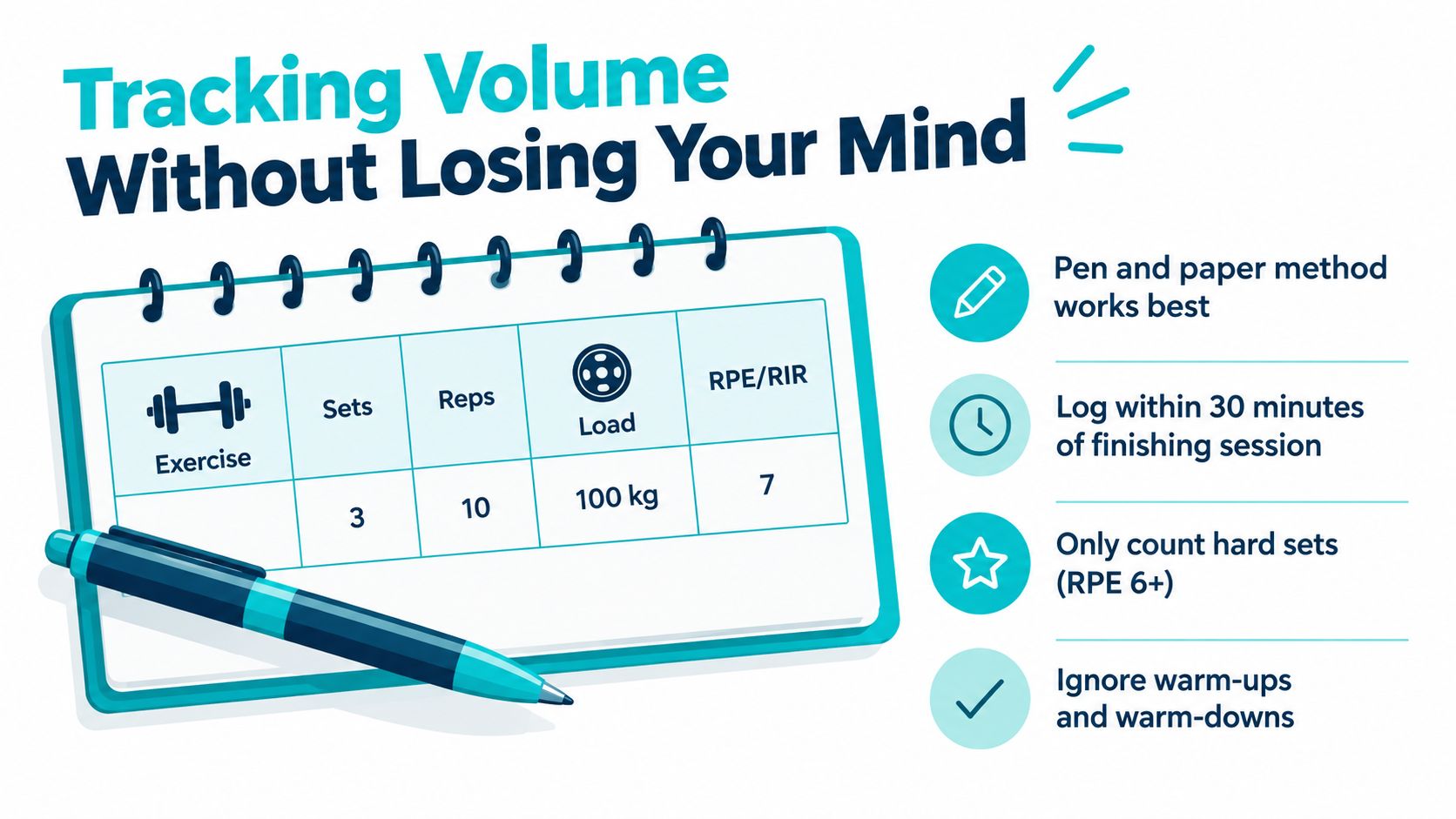
You don't need a complicated spreadsheet to understand your training volume. A notebook or phone note can work if it records the same fields every session:
- Exercise: Bench press, row, squat, or another movement.
- Sets and reps: The completed working sets, not planned sets you skipped.
- Load: The weight used for each set.
- RPE or RIR: How close the set came to failure.
At the end of the week, total your hard sets for each muscle group. You can also track volume load if comparing the same exercise under similar conditions, but don't let tonnage replace effort information. A workout logger can automate weekly set totals, chart tonnage, and export records for a coach, while manual logging keeps the process transparent. For a simple evidence-based training log template, ExRx also provides useful workout planning and tracking resources.
Use a five-minute weekly review
At the end of the week, check each body part, mark missed sessions, and write one sentence describing the next adjustment. You might decide to keep volume unchanged because performance improved, add one hard set because recovery was strong, or reduce work because performance and readiness declined.
Trackers only help when your inputs stay consistent. Use the same definitions throughout a program, log effort in the same way, and avoid switching apps halfway through unless you're willing to reconcile the data. The point isn't to collect every possible metric. It's to make a better decision next week.
The Common Mistakes and the Bigger Picture
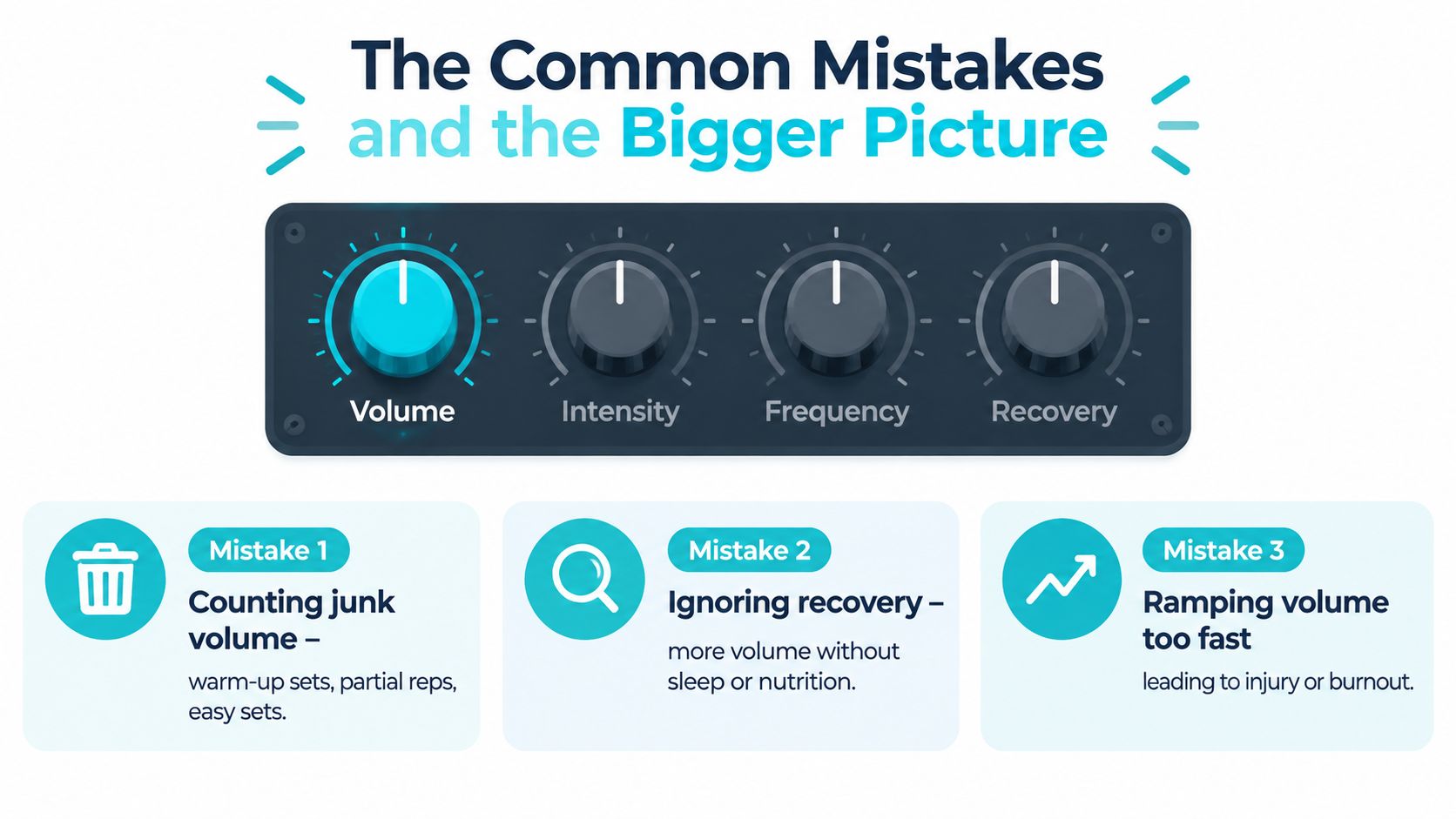
Volume is one knob on the training console, not the entire control panel. Intensity, frequency, exercise choice, sleep, nutrition, and stress can all change how much benefit you get from the same number of sets.
The first mistake is counting junk volume. Warm-up sets, form practice, and easy sets performed far from failure can inflate the log without adding equivalent productive work. The second is chasing a number from a study while ignoring personal recovery. A set target isn't useful if your performance, technique, or readiness keeps deteriorating.
A third mistake is adding sets when intensity or frequency is the problem. More work won't fix a load that's too light for the goal, a schedule that leaves no recovery between sessions, or an exercise that doesn't train the intended muscle well. The fourth is changing everything at once, which leaves you unable to identify what caused progress or fatigue.
Before adding work, check whether you're recovering from the work already assigned. For a practical explanation of why your muscles need better recovery, review how recovery capacity affects the way you respond to training.
Pick one variable to hold constant for the next four weeks, then progress the others one at a time. That approach turns the training volume definition from a confusing formula into a useful decision tool.
Quick Summary
If you only remember a few points, make them these:
- Training volume has multiple valid definitions. People may mean total sets, total reps, volume load, or hard sets.
- Weekly hard sets are usually the most practical metric for hypertrophy. They capture productive work better than raw rep totals alone.
- Effort changes what a set means. Sets taken within roughly 1-3 RIR usually matter more for muscle growth than easy sets performed far from failure.
- More volume is not always better. The useful range depends on your goal, training age, recovery, and exercise selection.
- Track consistently before you change anything. A simple weekly review often tells you more than a complicated spreadsheet.
FAQ
What is the simplest way to define training volume?
The simplest definition is the total amount of work you perform. In practice, most lifters track this as sets, reps, or sets × reps for a given exercise or muscle group.
Is training volume the same as intensity?
No. Volume describes how much work you did. Intensity describes how heavy or demanding that work was. You can raise volume without raising intensity, and you can raise intensity without increasing total work.
Should I track volume per workout or per week?
Track both if you can, but use weekly volume as your main planning number. Session data helps you see what happened today. Weekly totals help you decide whether a muscle group is getting enough work overall.
What counts as a hard set?
A hard set is usually a working set performed close to failure, often within about 1-3 reps in reserve. Easy warm-ups and technique sets generally do not count toward hypertrophy volume.
How many sets per week should I do for muscle growth?
A practical starting point is often about 4-12 weekly hard sets for beginners and 10-20 weekly hard sets for many intermediates. Some advanced lifters tolerate more, but only if recovery stays strong.
Does more volume always build more muscle?
Not indefinitely. Extra sets can help up to a point, but returns usually slow down as fatigue rises. If performance, soreness, motivation, or recovery worsen, your effective ceiling may already be reached.
Is volume load better than hard sets?
They answer different questions. Volume load is useful for tracking external work on the same lift. Hard sets are often more useful for hypertrophy planning because they account for effort.
Can beginners ignore volume load?
Usually yes. Most beginners do better by tracking exercises, working sets, reps, and effort consistently before worrying about tonnage calculations.
Further Reading on Training Volume
If you want to go deeper, these resources add useful context on programming, effort, and weekly set targets:
- American College of Sports Medicine position stands and resistance training guidance
- NSCA guidance on training volume and intensity
- ExRx exercise science calculators and training tools
- PubMed Central archive for resistance training volume research
ThriveXDNA's Thrive X Fitness app can help you apply this system with AI workouts, form review from short clips, nutrition tracking, meal plans, challenges, and progress-focused coaching tools. Visit ThriveXDNA to explore a practical way to plan training, record your work, and keep progressing without drowning in data.
Related guides
- What Is Training Volume and How to Use It
- Recovery-First Fitness: How The “Readiness” Metric Helps
- more on Longevity Training vs Peak Performance: Why Chasing PRs Is
- Personal Trainer Programming That Delivers Results
- more on 10 Trainerize Alternatives for Fitness Coaches
- Grip Strength Training for Climbing That Actually Works
- more on 20-Minute Full-Body Workout You Can Do Anywhere
- more on Best Runna Alternatives 2026 for AI Run Coaching
- more on Runna vs TrainAsONE 2026: AI Running Coach Test
- details: 10 MyFitnessPal Alternatives for Smarter Tracking
- Best AI Fitness Apps for Runners
- 5 Best AI Workout Plan Generators in 2026 (and Where They Quietly
- Thrive X Fitness app for tracking training