
You've got a client arriving before sunrise, another sending a deadlift video from yesterday, and a new consultation waiting on your calendar. The workout itself is only one part of the job. The rest is deciding what to ask, what to observe, what to change, what to document, and how to keep the client moving between sessions without turning your practice into an endless stream of messages.
That's exercise professional's guide to personal training. It's an operating system for independent coaching, from intake and assessment to programming, nutrition conversations, remote form review, retention, and the boundaries that protect both trainer and client.
Table of Contents
- A Day in the Life of a Modern Exercise Professional
- Program Design and Periodization That Actually Works
- Cueing and Form Assessment In Person and Remote
- Training Nutrition and Meal Plan Integration
- Client Onboarding and Retention Workflows
- Remote Coaching Best Practices With Thrive X
- Business and Ethical Considerations for Independent Trainers
- Summary
A Day in the Life of a Modern Exercise Professional
At 5:45 a.m., the inbox tells you more than the calendar does. Your first client's knee flared over the weekend. A remote client uploaded a deadlift clip overnight. Someone new has booked an onboarding call for the afternoon, while another client has logged a meal photo suggesting that yesterday's training-day plan failed during a late shift at work.
The first decisions are triage, not replies. Scan for issues that affect today's sessions, acknowledge the knee problem without diagnosing it, and ask what the client feels, which movement provokes it, and whether swelling, numbness, or a sudden loss of function is present. Those red flags call for medical referral rather than a clever exercise variation. A trainer's scope commonly covers risk screening, fitness assessment, programme design, and safe exercise instruction, not diagnosis or treatment. The personal trainer scope of practice helps when a programming question starts to look medical.
The first hour starts before the first exercise
The new client's intake begins with the pre-session questionnaire. Review PAR-Q+ responses, training history, current activity, previous injuries, occupation, sleep, stress, and the outcome they want. “Get fit” needs a usable meaning, such as lifting without back irritation, rebuilding confidence after time away, or preparing for a recreational event.
Then watch the client move. An overhead squat offers a broad view of ankle, knee, hip, trunk, and shoulder coordination. Single-leg balance can reveal control differences that bilateral movements hide. A hinge pattern shows whether the client can load the hips without borrowing movement from the lumbar spine. If you want a reference point for common movement screens and exercise technique, practical libraries such as ACE Exercise Library can help standardize what you coach and observe.
Each observation should change a decision. An old ankle sprain may justify a longer ankle-mobility warm-up, a squat with the heels raised, or a temporary reduction in depth. A high-stress job may call for less volume and more repeatable technique practice. A returning lifter with a clean movement history does not need weeks of beginner drills.
A first 60-minute appointment can cover this work if you avoid testing everything. Use the questionnaire before the appointment, keep the opening conversation for clarification, run a small set of movement observations, collect only body-composition or girth measures the client understands and consents to, and finish with a short training exposure. The client should leave having trained, not merely having been inspected.
Professional boundary: Pain during screening, numbness, suspected injury, or a meaningful change in function warrants referral. Treat those findings as a referral decision, not a programming puzzle.
The working day is a chain of small decisions
By mid-morning, the knee client is completing a pain-free warm-up, controlled split-stance work, and a version of the planned lower-body pattern that fits the information available. Between sessions, review the deadlift clip. The bar drifts away from the legs and the lowering phase is rushed. Send one priority cue instead of a lecture, then log it for the next session.
The afternoon onboarding call tests fit as much as motivation. Explain how communication works, what the client needs to track, how progress will be reviewed, and where your role ends. In the evening, review meal photos without policing every bite. Look for repeatable patterns, such as missed pre-session fuel, low fluid intake, or a schedule that makes the proposed meal plan unrealistic.
Retention grows from these ordinary contacts. Clear expectations, visible progress, and timely communication have more practical value than motivational speeches. If you are refining your systems, this guide to boost fitness client retention can complement your check-in process when adapted to the people you coach.
The independent trainer's week also includes work between appointments: updating remote feedback, adjusting AI-generated workout drafts before a client sees them, and deciding whether a nutrition photo needs a question or a simple acknowledgment. Marketplace selling can create another route to reach clients, but it adds follow-up, delivery, and quality-control tasks to the same calendar. Treat each channel as part of the operating system, not as a separate business.
At 9:30 p.m., reply to the form clip, update tomorrow's programme notes, and close the loop with the knee client. Assessment fed exercise selection, training fed review, and communication protected continuity. The day held together because each piece informed the next.
Program Design and Periodization That Actually Works
Periodization is useful when it answers a practical question: what should this client repeat, progress, or change next? It becomes theatre when a simple client receives a complicated calendar that neither of you can explain.
For a true beginner or someone returning after a long break, linear progression usually wins. Keep the exercise menu stable, improve technique, and add load or repetitions when execution stays consistent. An intermediate client training on two or more days can benefit from undulated emphasis, such as a heavier strength day and a moderate-load hypertrophy day. Block periodization belongs mainly with advanced lifters or athletes who have a defined performance peak.
General strength guidance supports at least two resistance-training sessions per week, heavier loads around 80% of one-repetition maximum or more, and two to three sets per exercise, with multi-joint movements covering the major muscle groups. The guideline update on resistance training also discusses broader programming ranges, including eight to ten exercises, one to four sets of eight to twenty repetitions, and two to three minutes of rest between sets. Use those ranges as a menu, not a command.
Choose the stimulus before the spreadsheet
For strength, use heavier loading, low-to-moderate repetitions, and enough rest to preserve skill. For hypertrophy, a full range of motion, long-muscle-length loading, and controlled repetitions matter more than making every set look dramatic. Evidence synthesis supports a controlled tempo of roughly two to eight seconds per repetition for hypertrophy-focused work, with the target muscle challenged in a lengthened position. The hypertrophy evidence synthesis supports avoiding bouncing, excessive momentum, and range reductions that allow the client to use more weight without preserving the intended stimulus.
Volume remains the main lever for many general goals, but it has to fit recovery. A 45-minute session for three clients can use the same movement menu while changing the dose:
| Client Profile | Primary Goal | Sets x Reps | Load Intensity | Weekly Volume (sets per muscle) | Notes |
|---|---|---|---|---|---|
| New trainee | Skill and general strength | 2 x 8-12 | Moderate, technique-led | Start conservatively | Prioritize repeatable patterns |
| Returning lifter | Strength rebuilding | 3 x 5-8 | Moderately heavy | Build gradually | Reintroduce familiar lifts |
| Intermediate trainee | Hypertrophy | 3-4 x 8-15 | Moderate to heavy | Individualized to recovery | Use full ROM and controlled tempo |
The first client might use a goblet squat, incline push-up, and cable row. The returning lifter might use a squat, bench press, and row. The intermediate client can use the same broad patterns with more work, longer-length positions, and a second accessory pairing.
Change the dose before changing the whole plan
Use RPE to autoregulate. If the prescribed work feels much harder than expected and technique deteriorates, reduce load or repetitions. If it feels easy with clean execution, progress within the agreed range. A deload is appropriate when fatigue, performance, sleep, or movement quality consistently deteriorate, not just because a calendar says the client has reached a particular week.
Before replacing a programme, ask whether the client understands the exercise, reaches the intended range, rests enough, and logs accurately. Many “bad programmes” are coaching problems. Change the plan when the stimulus no longer matches the goal, recovery has become incompatible with the workload, or a limitation has emerged. Coach the same plan better when the client hasn't yet had a fair opportunity to learn it. For a simple primer on progression variables, the NSCA training basics overview offers a useful high-level reference.
Cueing and Form Assessment In Person and Remote
A good cue changes behaviour immediately. Start with an external cue, such as “push the floor away” or “keep the bar close to your legs.” Internal cues, such as directing attention to a specific muscle, can help when the client already has enough control to feel the distinction. Demonstrate only when words and an external target haven't solved the problem.
During a working set, your eyes should move through a consistent checklist:
- Bar path: Is the load travelling where the exercise requires, or is the client creating a workaround?
- Tempo: Does the lowering phase stay controlled, especially near the point where form changes?
- Breathing: Can the client brace and breathe without panic or unnecessary straining?
- Joint stacking: Do the joints stay organized for the task, or does one segment repeatedly collapse?
- Range of motion: Is the client reaching the intended range without pain or compensation?
You don't need to fix everything at once. If the bar drifts because the client loses position near the floor, cue the bar path first. If the path improves but the client still rushes, address tempo on the next set. A programme note should record the cue that worked, not merely “bad form.”
A remote clip needs a strict brief
Ask for a 45 to 75 second clip, with the full body visible, a fixed camera, and a clear view of the working set. Two angles are useful when one angle hides the relevant joint or bar path. If the client sends a cropped video from below, don't pretend you can assess what you can't see. Ask for a reshoot or limit your comment to what the footage supports.
Reply with one or two priorities. A remote review should be short enough for the client to use and specific enough for the next set. Log the cue, then revisit it rather than sending a new correction every time. For video coaching and exercise demonstration ideas, the NCSF exercise resource hub can help you compare teaching approaches across common lifts.
| Channel | Best For | Feedback Loop | Limitations |
|---|---|---|---|
| In person | Novel, loaded, or technically demanding movements | Immediate cue, retry, and observation | Requires shared time and location |
| Remote | Maintenance, travel weeks, and familiar exercises | Clip, written cue, reshoot or next-session review | Camera angle, lighting, and missing context reduce certainty |
In-person coaching wins when you need to intervene quickly or teach a new movement. Remote review wins when the client is travelling or maintaining a familiar pattern between appointments. Use both, but keep the standard of observation consistent.
Training Nutrition and Meal Plan Integration
A trainer can coach training nutrition without presenting as a dietitian. Keep the conversation tied to fuelling sessions, recovery, hydration, and habits the client can repeat. The current trainer competency framework places nutrition and weight management within exercise programming, alongside assessment, programme delivery, behaviour change, and ongoing review. That doesn't turn a trainer into a clinician.
Track only what you'll use. Protein in grams per kilogram of bodyweight can help structure a conversation about adequate intake. A hydration baseline gives the client a practical starting habit. A simple pre-session and post-session fuel rule works better than an elaborate menu the client abandons during a busy week.
Meal planning should support training emphasis. Put more carbohydrate around demanding training blocks when that matches the client's preferences and needs. Keep recovery or technique days simpler if the client doesn't need the same fuelling strategy. The objective isn't to make food more complicated. It's to stop nutrition habits from undermining the programme.
Use photos to coach patterns
Photo and barcode logging work best as compliance tools, not calorie surveillance. A client can add a meal photo or scan a packaged food during a check-in, and you can review patterns over time. You might see that breakfast disappears on early training days, that post-session meals are inconsistent, or that the proposed plan doesn't fit the client's work schedule.
That information creates a coaching conversation. Ask what made the habit difficult, then adjust the environment or the plan. Don't infer medical conditions from a food log. For public-facing nutrition guidance that can support basic habit coaching, the Academy of Nutrition and Dietetics offers accessible educational resources.
Refer to a registered dietitian when the client needs clinical nutrition care, has a complex medical condition, shows signs of disordered eating, or asks for treatment beyond your training scope. Make the handoff collaborative. Explain what you can continue coaching, obtain consent before sharing relevant information, and keep the relationship focused on the client's broader goal.
Client Onboarding and Retention Workflows
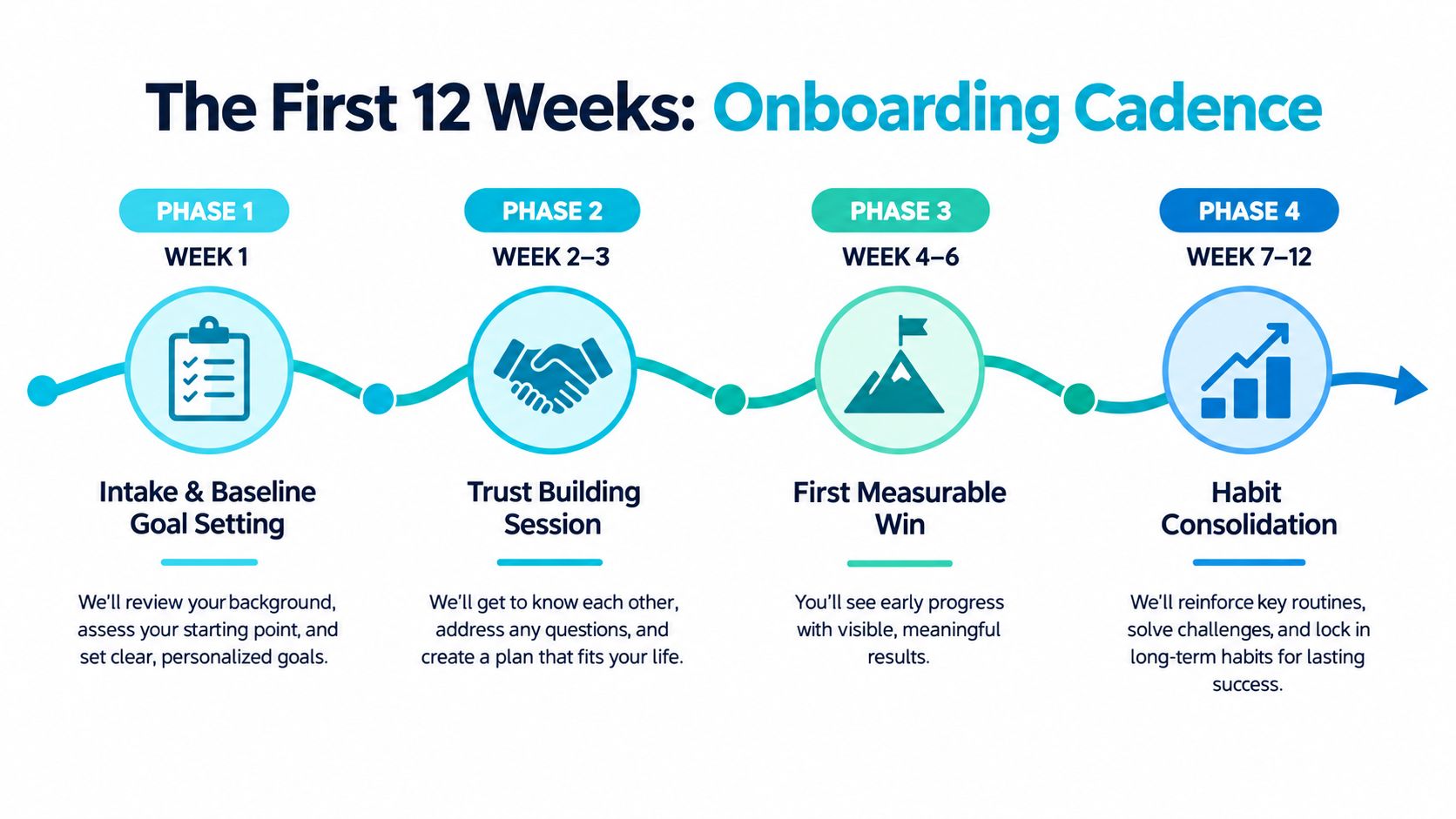
A new client shouldn't receive a giant programme and disappear into it. The first twelve weeks need a cadence that makes progress visible, catches friction early, and gives both of you a reason to review the plan.
Week one includes intake, baseline assessment, goal setting, and a short onboarding session that produces an immediate win. That win might be a clean hinge, a completed circuit, or confidence using a previously avoided movement. Weeks two through four focus on habits, attendance, logging, and a movement standard. A 15-minute check-in at the end of week two gives the client space to mention barriers before they become cancellations.
Review progress before motivation fades
Weeks five through eight should connect progression to objective markers. Track the load moved, sessions completed, body-composition trend when appropriate, or a skill milestone such as a first bodyweight pull-up. Don't use every marker with every client. Choose measures that match the stated goal and that the client has agreed to discuss.
Weeks nine through twelve form a progress review that feeds the next mesocycle. Re-anchor the goal, identify what the client can now do, and decide whether the next phase needs more volume, a different emphasis, or better execution of the current plan.
A retention radar sits over the whole process. Missed sessions, skipped check-ins, and stalled lifts trigger proactive outreach within 48 hours. The outreach should be specific: ask what changed, offer a smaller next action, and avoid framing a disrupted week as a character flaw. A published retention cadence also uses weekly goal-setting, a mid-month pulse, early outreach, and a monthly review that transitions into the next month. You can adapt that structure from the coaching retention cadence.
A client rarely needs more pressure. They need a clear next step that still feels possible.
Document the contact, the barrier, and the agreed adjustment. Retention improves when the client experiences a trainer who notices changes and responds with a plan. If you want additional behavior-change ideas for adherence, the CDC physical activity resources can be a useful source for practical education and habit support.
Remote Coaching Best Practices With Thrive X
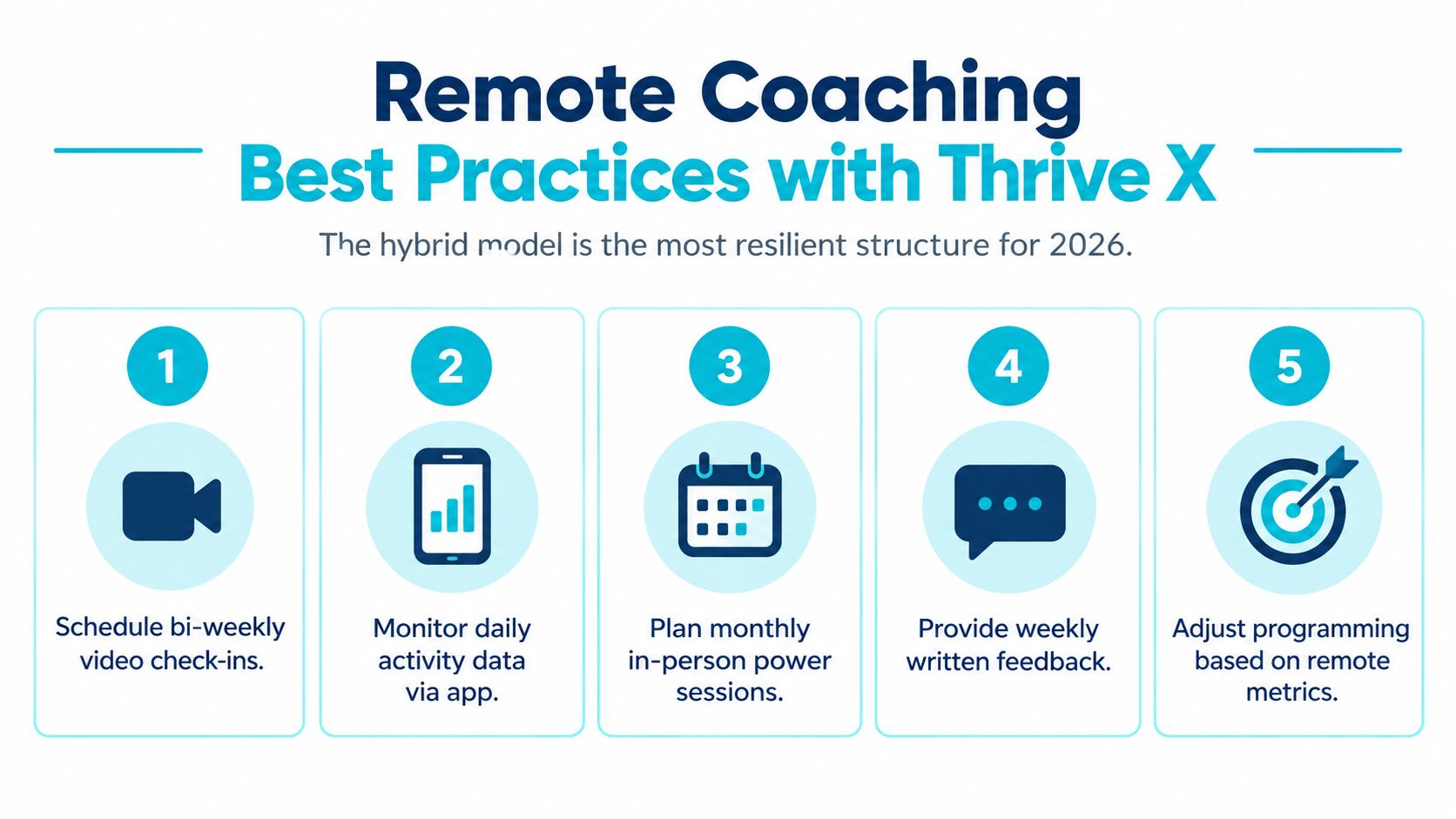
A hybrid model gives an independent trainer more ways to coach without turning every problem into another live appointment. In-person sessions are valuable for novel movements, loaded technique, and relationship-building. Remote delivery handles accountability, travel weeks, programme access, and the small decisions that otherwise disappear between sessions.
The workflow starts with the AI workout builder drafting a session template. You still decide whether the exercise fits the client's history, equipment, movement quality, and current phase. Automation can save programming time, but it can't replace professional judgment about pain, readiness, or the reason a client is struggling.
Assign each tool a job
Photo nutrition logging handles between-session accountability. A marketplace listing can put a structured programme in front of prospective clients who aren't already in your network. Form-clip review fits into a defined turnaround window, rather than becoming an always-on chat obligation.
Thrive X Fitness, from ThriveXDNA, combines AI workouts, form-clip review, photo and barcode nutrition logging, meal plans, challenges, and a marketplace where coaches can sell programmes. Those features are useful only when they map to a decision in your week. If the app creates more notifications than you can answer, your system needs fewer promises, not more automation.
Use a simple adoption checklist:
- Define response windows: Tell clients when written feedback and clip reviews happen.
- Keep human approval: Review AI-generated sessions before assigning them.
- Choose meaningful metrics: Use activity and training data to adjust decisions, not to create noise.
- Protect live coaching: Reserve in-person time for work that benefits from eyes-on instruction.
- Test the workload: Start with a small remote cohort before rebuilding your entire practice.
The hybrid model works when the client knows what happens live, what happens asynchronously, and what information you need from them. It fails when an app becomes a substitute for a coaching relationship or when the trainer promises continuous access they can't sustain.
Business and Ethical Considerations for Independent Trainers
Your business model should make the service understandable before the client pays. A hybrid package might combine scheduled in-person sessions, programme access, written feedback, and form-clip review. Price the parts according to the time and responsibility they require, rather than treating remote support as free background work that gradually consumes your evenings.
Write the boundaries into the agreement. State the cancellation process, communication channel, expected response time, media requirements, and what happens when a client misses a check-in. Informed consent matters for remote form review because the client is sending videos that show their body, home, and sometimes other people.
Scope and data need operational rules
Keep medical and clinical nutrition questions within the referral process. Document when you advised a client to seek a physician, physical therapist, or registered dietitian, and continue coaching only within the part of the plan that remains appropriate.
Store client videos and food photos in the agreed platform, limit access, and explain how long you retain them. Ask for explicit consent before using a client clip for education or promotion. A private review and a public testimonial are different permissions.
Marketplace selling adds another responsibility. Describe the programme accurately, state who it suits, and avoid promising a result you can't guarantee. A loyalty platform for gyms may help a facility think about repeat engagement, but an independent trainer still needs a retention process based on coaching value, not rewards alone.
This month, review four documents: your intake form, service agreement, referral language, and media-consent process. Then check that your actual messages match those documents. Ethical practice isn't a statement on a website. It's the workflow you follow when a client is in pain, misses a session, or asks for advice outside your qualifications.
Summary
A trainer's capacity is shaped less by the programme than by the handoffs around it. The intake should produce decisions, each session should produce usable feedback, and follow-up should keep the client progressing without turning your phone into an always-on help desk. That operating system is the practical advantage of an independent coach.
One immediate test: choose one client this week and run the intake form through your movement screen before the next session. Note which finding changes your warm-up, exercise selection, or coaching cue. Then set a response window for remote reviews and a fixed check-in point, so support remains reliable without consuming the week.
If you want to sharpen your coaching framework further, it can help to review position stands from the American College of Sports Medicine, behavior-change resources from the National Academy of Sports Medicine, and practical exercise libraries such as ExRx. These can complement your own systems for assessment, programming, and exercise instruction.
Use AI-drafted workouts, form-clip review, nutrition logging, meal plans, and marketplace delivery where they reduce admin, while keeping approval, scope, consent, and data handling under your control. ThriveXDNA provides tools for that workflow.