
Last reviewed: June 2026
A single therapy session without insurance runs $100 to $200 in most US cities, and most health plans that cover mental health cap coverage at somewhere between 12 and 20 sessions per year. Once those are used, you are on your own until the plan resets. That gap is exactly where app-based tools like Youper and Wysa sit, and you can find both alongside a broader set of options in the AI health and wellness tools directory for AI health and wellness tools. At under $15 per month, they are the most direct head-to-head in consumer AI mental health support.
But treating them as interchangeable products with slightly different price tags misses the point. Youper and Wysa are built on opposite design philosophies about when and how you actually want help. One rewards a daily habit. The other works when you reach for it. Which one fits your real life, not your ideal life, is what this comparison works through.
Key takeaways
- Youper’s value builds over weeks through daily mood check-ins; it is most useful if you want to track emotional patterns over time rather than get immediate relief from a single session.
- Wysa’s free tier covers a broad library of CBT-based exercises, grounding tools, and thought records without requiring any daily commitment or streak.
- Youper premium runs roughly $8 to $10 per month; Wysa’s self-guided tools are free, but its paid coaching tier starts around $30 per month and is a different product category entirely.
- Neither app is designed for crisis intervention, acute psychiatric episodes, or replacing a licensed clinician for diagnosed conditions.
- If you want to build an emotional tracking practice, Youper fits better. If you want a toolkit you can pull specific exercises from when you already know what you need, Wysa’s free tier delivers more immediately.
Two Apps Built on Opposite Assumptions About You
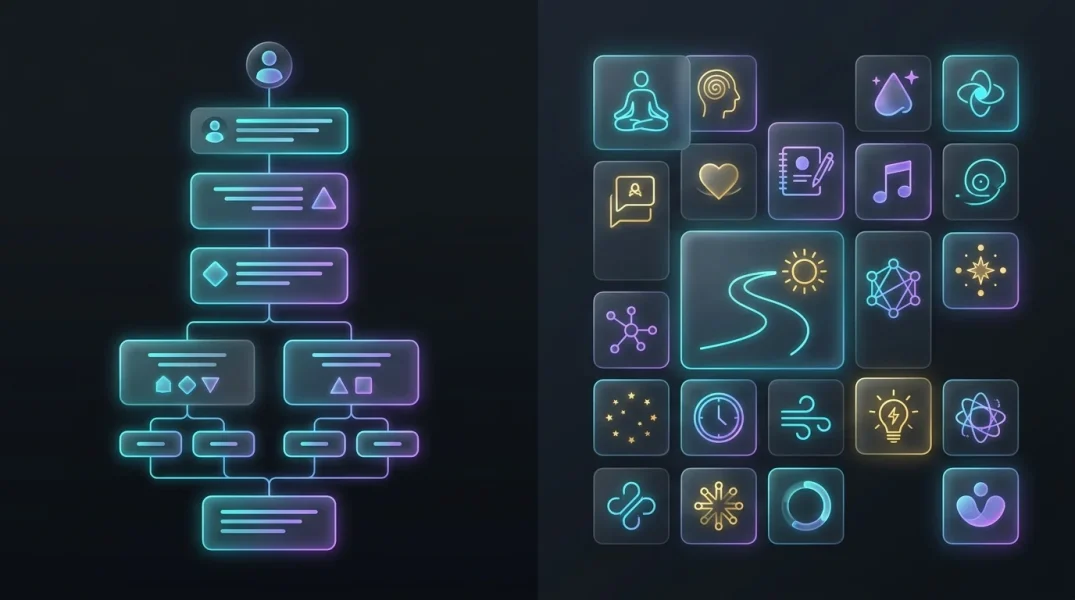
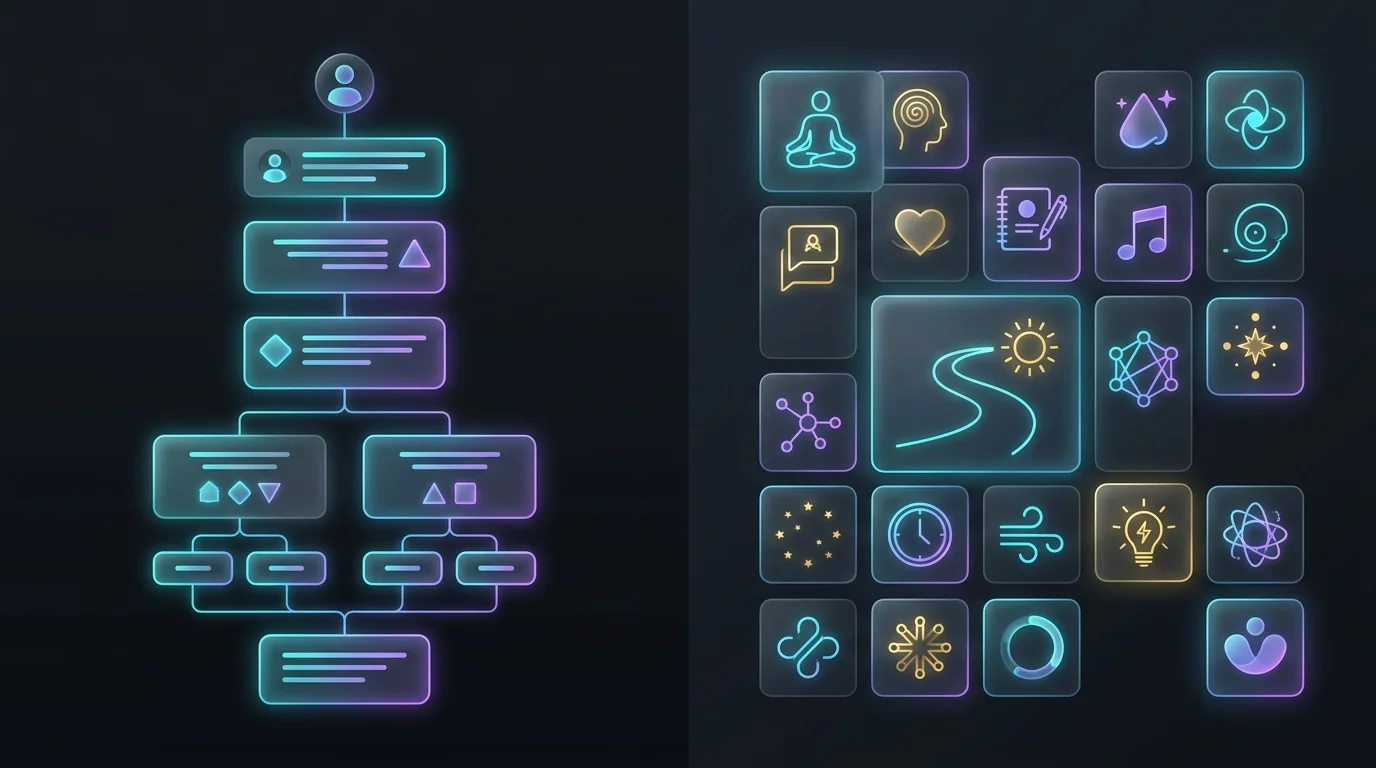
Youper is a mood-tracking app with an AI conversation layer on top. Every session starts the same way: you open the app, the AI asks how you are feeling, you pick from a set of emotion labels, and a short guided conversation follows. The AI draws on cognitive behavioral therapy and acceptance and commitment therapy principles to lead you through a brief reframing exercise or a defusion technique tied to what you reported. The session runs 5 to 10 minutes, logs your response, and closes. Then you do it again tomorrow.
Wysa is organized around a library of standalone tools grouped by goal. You can run a grounding exercise, complete a CBT thought record, or work through a sleep wind-down sequence without narrating your week to a chatbot first. Nothing requires a streak. Nothing locks content behind a daily check-in. You pick the tool that matches your current situation and run it. The AI conversation is available, but it is not the product’s center of gravity.
This is not a cosmetic difference. It determines whether you will still be using the app in month two. If you are the kind of person who maintains daily rituals, Youper gives you something Wysa does not: compounding data about yourself over time. If your schedule is irregular or you only want support in specific high-stress moments, Wysa’s on-demand structure fits better. Most reviews that declare one app superior are really describing which model matched the reviewer’s actual usage pattern.

How Youper Builds a Picture of Your Emotional Life
The daily check-in is not a rating scale from 1 to 10. After you select your emotional state, Youper’s AI asks follow-up questions to narrow down what is driving it. You tag contributing factors: poor sleep, work pressure, a difficult interaction. The AI then leads you through a CBT or ACT exercise matched to the emotion and context you described. If you said you are anxious about a presentation, it does not just validate that. It might walk you through identifying the cognitive distortion underneath the anxiety, or guide you to write out a more balanced version of a catastrophic thought. See the National Institutes of Health for official guidance.
After 3 to 4 weeks of consistent check-ins, the app starts surfacing patterns. Your mood scores may be lower on Sunday evenings. Your anxiety ratings may be consistently higher on days you logged 5 hours of sleep versus 7. Your baseline score may have shifted since you started tracking. That kind of feedback is not available from a one-off chatbot session or a static worksheet. It requires data over time, and Youper is designed to make that data collection feel like a small daily act rather than a research project.
Youper has also developed a clinician-facing dashboard that lets therapists view a patient’s check-in data between sessions. This positions Youper as something that can sit alongside professional support rather than only as a standalone consumer tool. If you are already in therapy and want to bring longitudinal mood data to appointments, that integration layer has practical value in a way that few consumer mental health apps offer.
What Wysa’s Tool Library Actually Covers
Wysa’s core product is a library of structured exercises organized by problem type. You can access a body scan, complete a CBT thought record where you write down an automatic thought and systematically challenge the assumptions underneath it, or work through a 5-4-3-2-1 grounding sequence. Breathing exercises include diaphragmatic breathing with a visual pacer. Sleep tools run through progressive muscle relaxation and cognitive techniques for winding down. Most exercises run 5 to 15 minutes and stand completely alone.
The AI conversation, delivered through a penguin character named Wysa, is also available for open-ended support. The AI can suggest which tools might be relevant based on what you describe, but you do not have to go through that intake step. If you already know you want a grounding exercise, you can open it directly without answering any questions first. That directness matters more than it sounds when your nervous system is already activated and you do not have patience for a setup sequence before getting to the thing you actually need.
Wysa has been deployed in enterprise workplace wellness programs and in partnerships with NHS-affiliated organizations in the UK. That institutional background shapes the tool library: the exercises map closely to standard CBT clinical practice rather than gamified consumer approximations. If you have done any CBT in a therapy context, Wysa’s tools will feel familiar in structure, not like a watered-down version of the real thing.
Free Tier Comparison: What You Get Without Paying
Wysa’s free tier is one of the most complete in this category. The core self-guided tool library is accessible without a subscription and without a trial countdown. You can run CBT exercises, grounding sequences, breathing tools, and sleep aids at no cost. The AI chatbot is also on the free tier. The only thing behind the paywall is human coaching: if you want a real Wysa coach to respond to your messages, that requires the paid plan.
Youper’s free tier includes the daily check-in loop and the mood log. AI conversation time is capped per month on the free plan, and the exact limit has shifted across versions, but it is enough to run the check-in habit and evaluate whether the format works for you. What the paywall covers on Youper is unlimited AI conversation time, deeper analytics reports, and access to targeted multi-week programs for specific challenges like social anxiety, health anxiety, or perfectionism.
If your primary goal right now is accessing structured CBT exercises at no cost, Wysa wins that comparison without much debate. If your goal is testing whether a daily mood-tracking habit is sustainable for you before committing any money, Youper’s free tier covers that adequately. The free version of each app is genuinely useful for what it is built around, which is a less common feature of mental health apps at this price tier.

The Premium Tier Decision
Youper premium runs roughly $8 to $10 per month on a monthly plan and closer to $5 to $6 per month if you pay annually. At that price you get unlimited AI conversation time, full access to mood analytics over your entire history, and the targeted programs. Those programs are structured multi-week curricula using CBT and ACT techniques with a progression from session to session, which is where Youper starts to look less like a mood tracker and more like a self-guided digital therapy supplement. If you are using the app daily and hitting the free conversation cap, the upgrade is worth running the numbers on.
Wysa’s upgrade path is structured differently because the self-guided tools are already free. What you pay for on Wysa’s premium plan is primarily access to a credentialed human coach you can message through the app. Pricing for Wysa coaching has varied across markets, but the general range puts it around $30 per month or higher depending on the plan. This is not really a premium version of Wysa the mood tool. It is a separate product: text-based support from a licensed counselor, with Wysa the app serving as the interface.
The practical implication is that Wysa and Youper do not really compete on premium. If you want a paid AI coaching experience under $15 per month, Youper’s premium tier is the relevant option. If you want a human in the loop, Wysa coaching is the relevant option but costs significantly more. Many people use Wysa free indefinitely and never touch the paid tier, which is by design.
Where Both Apps Fall Short
Neither Youper nor Wysa is appropriate for acute mental health situations. If you are in crisis, experiencing suicidal ideation, or dealing with a condition that requires medical management, neither app is the right first call. Both include referrals to crisis lines and resources, but the AI is not equipped to navigate a mental health emergency. This is a category limitation that all consumer AI mental health tools share, not a specific failure of either product.
Youper’s value is entirely dependent on consistency. The pattern recognition that makes it genuinely useful requires 3 to 4 weeks of regular check-ins. If your schedule is irregular, if work travel or life variability makes daily habits hard to maintain, the app’s core differentiator erodes. A sparse mood log cannot surface meaningful patterns. The free tier is specifically useful for testing whether you are the kind of person who will maintain that habit before paying for the deeper analytics.
Wysa’s tool library is thorough but can feel procedural without context if you are completely new to CBT concepts. If you open a thought record and are not sure how to complete it, the app gives written instructions but no feedback on whether you are applying the technique correctly. Someone who has never been exposed to CBT frameworks, through therapy, a workbook, or structured reading, may find the tools feel technical without enough guidance on the reasoning behind each step. The library works best for people who already understand what they are trying to do and want a structured place to do it.

A Framework for Choosing Between Them
Download Youper if you want to understand your emotional patterns over time, you are willing to spend 5 to 10 minutes per day on a check-in, and you have a recurring issue you want to track against variables like sleep or stress. Youper also works well as a between-session supplement if you are already in therapy and want to show up to appointments with longitudinal data rather than trying to reconstruct the past month from memory. The daily conversational format suits people who prefer a guided AI interaction over a menu of self-service tools.
Download Wysa if you want immediate access to structured exercises without committing to a daily practice. Wysa fits people who know what they need in specific moments, such as a grounding exercise before a difficult meeting or a breathing sequence to wind down at night, but who do not want an app that measures their consistency or requires a streak to deliver value. Wysa is also the lower-risk starting point if you are budget-constrained, since the free tier is genuinely functional without a timer counting down.
There is a third scenario worth addressing: you are not sure what you need yet. In that case, start with Wysa’s free tier. It costs nothing, gives you real tools immediately, and does not require any setup habit to use. After 2 to 3 weeks, if you find yourself wanting continuity and pattern feedback rather than individual tool sessions, add Youper as a daily check-in layer. The two apps address different enough needs that running both is not redundant. You can use Wysa for on-demand relief and Youper to track what is driving your baseline over time.
How these tools compare
| Feature | Youper | Wysa |
|---|---|---|
| Primary design | Daily mood check-in with AI conversation | On-demand CBT tool library |
| Free tier scope | Daily check-in and mood log; capped AI conversation time | Full self-guided tool library plus AI chat |
| Paid price (approximate) | $8 to $10/month; roughly $5 to $6/month billed annually | Tools stay free; coaching tier approximately $30+/month |
| Core technique | CBT and ACT through conversational AI | CBT exercises, grounding, breathing, thought records |
| Mood pattern tracking | Yes, with trend analytics over time | Minimal |
| Human coaching option | No (clinician dashboard for providers only) | Yes, via paid coaching tier |
| Crisis support | Links to crisis resources only | Links to crisis resources only |
| Platform | iOS and Android | iOS and Android |
Related guides
- What Is TrumpRx.gov? Good or Bad? Your Complete Guide to Lower Prescription Drug Prices in 2026
- Your Guide to the Best Cyber Liability Coverage Options That Won’t Break the Bank
- Best Identity Theft Protection Plans in 2025: Secure Your Personal Data Now
- Best AI Apps for Anxiety in 2026 (Tested)
- Do AI Mental Health Apps Actually Work in 2026?
- Best AI Meditation Apps for Beginners in
- Best Free AI Fitness Apps in 2026 (No Paywall)
- Best AI Nutrition Apps for Weight Loss in
- Best AI Health Apps for Women in
- Best Headspace Alternatives 2026 (Tested Picks)
- Wysa vs Woebot 2026: AI CBT Chatbots Compared
- Do AI Insurance Comparison Apps Really Save Money?
Summary
Given the reader is choosing between two apps by budget and habit, the takeaway is simple: match the app to how you actually plan to use it. Pick Youper if you want to build a daily check-in habit that reveals patterns in your mood over time, at roughly 8 to 10 dollars a month for full access. Pick Wysa if you want free, on-demand CBT exercises, grounding tools, and thought records without any streak or commitment. Either way, these apps are self-guided support, not crisis care or a substitute for a licensed clinician treating a diagnosed condition.
Frequently asked questions
Is Wysa’s free tier actually free, or does it expire after a trial period?
Wysa’s self-guided tool library is free without a trial countdown. You can access CBT exercises, grounding tools, breathing sequences, and AI conversation without hitting a paywall. The paid tier adds human coaching access. Unlike apps that give you 7 days of full access and then lock the content, Wysa’s free tier is ongoing for the tools themselves.
Can Youper or Wysa replace therapy for anxiety or depression?
No. Both are designed for subclinical emotional support and skill-building, not for treating diagnosed anxiety disorders or clinical depression. They work well as supplementary tools, either between therapy sessions or for people who want structured self-help resources outside of a clinical setting. If symptoms are consistently affecting your work, sleep, or relationships, a licensed clinician is the right starting point, not an app.
Which app works better for generalized anxiety?
Both address anxiety through different entry points. Youper is more useful for someone who wants to identify anxiety triggers across time, spot patterns in what sets it off, and work through reframing in a guided daily conversation. Wysa is more useful for someone who wants specific in-the-moment tools like cognitive defusion exercises, thought records, or grounding techniques available when anxiety is already elevated. Wysa also has a dedicated anxiety tool set in its free library. Neither is a clinical intervention for diagnosed generalized anxiety disorder.
Do these apps work for teenagers?
Wysa has been deployed in educational settings and school mental health programs, particularly in the UK, and is generally considered appropriate for teenagers. Youper’s terms of service typically require users to be 13 or older, but it is primarily designed around adult usage patterns. If you are a parent evaluating options for a teenager, Wysa’s track record in youth-facing institutional contexts gives it a more established footing for that age group.
Can you use Youper and Wysa at the same time?
Yes, and because they solve different problems, using both is not redundant. You could use Youper as a daily check-in habit that builds long-term mood pattern data, while keeping Wysa available for moments when you need a specific exercise quickly. The apps do not share data and operate independently, so you manage them separately. Some people find this combination covers both ongoing tracking and on-demand relief without either app trying to do both.
How does the AI in these apps actually work?
Neither Youper nor Wysa has published detailed technical specifications about their underlying models. Both use conversational AI trained within mental health frameworks, primarily CBT and related approaches, to guide users through structured interactions. The AI operates within constrained pathways shaped by clinical consultants rather than as an open-ended general chatbot. That is why both apps feel consistent and structured rather than unpredictable, and also why neither can handle complex or crisis-level situations the way a human clinician can.