


You've finished a workout, but you're not sure whether it was enough. Maybe you added another set because progress felt slow, or maybe you lifted heavier while doing less work. Without a clear way to measure training volume, both choices can feel like guesswork.
Training volume is the amount of work you perform, usually tracked across a session or week. Once you measure it, you can make deliberate adjustments instead of adding sets randomly. Think of volume as a training budget. You want enough work to create progress, but not so much that recovery costs more than the stimulus is worth.
Table of Contents
- Why Training Volume Matters for Every Lifter
- The Core Formula for Calculating Training Volume
- How Volume Goals Differ by Training Outcome
- A Sample Week of Volume Calculations
- Diminishing Returns and the Upper Limit of Volume
- Using Progressive Overload Through Volume
- Tracking and Applying Volume in Thrive X Fitness
- Summary
- FAQ
- Key Takeaways and Volume Budgeting Checklist
Why Training Volume Matters for Every Lifter
Consider a lifter three months into a bench press program. Progress feels slow, so they add sets to every session. At first, the extra work seems productive. Soon, their pressing stalls, their shoulders feel tired, and each workout becomes harder to recover from.
The problem isn't necessarily effort. It may be unmanaged training volume. In exercise science, training volume commonly means the total work performed in a session or over a week. A standard calculation is sets × repetitions × load, although coaches also track total repetitions, hard sets, volume load, and time under tension. The American College of Sports Medicine resistance-training guidance shows that volume changes with training status and goal, rather than existing as one universal number.
A weekly view is usually more useful than judging a single workout. If you train chest across several days, the relevant question isn't only how much you bench today. It's how many challenging sets your chest receives before the week ends, and whether those sets fit your goal and recovery capacity.
Practical rule: Count your work before you decide you need more work.
Tracking volume turns vague effort into something you can adjust. It's similar to budgeting calories. You don't need perfect precision to make useful decisions, but you do need a consistent method for seeing whether you're consistently underdoing, overdoing, or missing work. That practical coaching approach is supported by the peer-reviewed Frontiers review of training volume, which highlights why different volume measures can answer different programming questions.
The framework is simple:
- Define the outcome: Strength, muscle growth, or muscular endurance requires a different emphasis.
- Choose a metric: Use volume load for a specific lift, or hard sets for weekly muscle-group planning.
- Set a weekly budget: Distribute your target across the sessions that train each muscle.
- Review the result: Compare performance, recovery, and completed work before changing the plan.
If you want extra context on exercise selection and weekly planning, resources from ExRx, the National Strength and Conditioning Association, and the peer-reviewed Sports Medicine review on resistance training variables can complement the research linked throughout this guide.
The Thrive X Fitness app can support this process by giving lifters and coaches a central place to record sets, repetitions, and loads. The useful habit isn't logging for its own sake. It's using the log to make the next programming decision more informed.
The Core Formula for Calculating Training Volume
The classic formula is:
Training volume = sets × repetitions × load
Suppose you perform bench press for four sets of eight repetitions at 80 kilograms. The calculation is:
4 × 8 × 80 kg = 2,560 kg
That result means you moved 2,560 kilograms of external load across the exercise. It doesn't mean your muscles experienced identical work on every repetition, because fatigue, range of motion, technique, and effort can change from set to set. It gives you a repeatable external-work figure, which is useful when comparing the same lift over time.
The classical volume-load method remains the most commonly used metric in resistance-training research, while a systematic review found that total sets taken to failure or near failure can adequately quantify hypertrophy volume when repetitions fall between 6 and 20 or more, as described in the Journal of Strength and Conditioning Research review. Additional work in the European Journal of Sport Science has also discussed how different volume metrics can change how training dose is interpreted in practice.
Choose the metric that answers your question
| Metric | Formula | Best For |
|---|---|---|
| Volume load | Sets × reps × load | Comparing progressive overload on the same lift |
| Hard sets | Count challenging sets close to failure | Balancing weekly stimulus across muscle groups |
| Total repetitions | Add all completed reps | Bodyweight work or exercises with inconsistent loading |
| Time under tension | Track how long muscles work | Endurance-focused or machine-based training |
Hard sets are sets performed close enough to failure that they provide a meaningful training stimulus. They're often more practical than tonnage when comparing a barbell row with a cable row, because the numbers on different machines aren't directly interchangeable.
Effective reps refers to the repetitions closest to failure that are thought to contribute most strongly to adaptation. Treat this as a coaching concept rather than a second spreadsheet that you must calculate perfectly. If you already track hard sets and effort, adding an exact effective-rep count may create complexity without improving your decisions.
Time under tension can be useful when load is difficult to standardize, particularly for machine work, controlled-tempo exercises, or muscular endurance sessions. Pick one primary metric for each training block. Volume load is strong for tracking one lift, while hard sets usually work better for distributing weekly work across muscle groups. For a deeper look at how proximity to failure interacts with useful volume, see the peer-reviewed Sports Medicine review on resistance training to muscular failure.
How Volume Goals Differ by Training Outcome
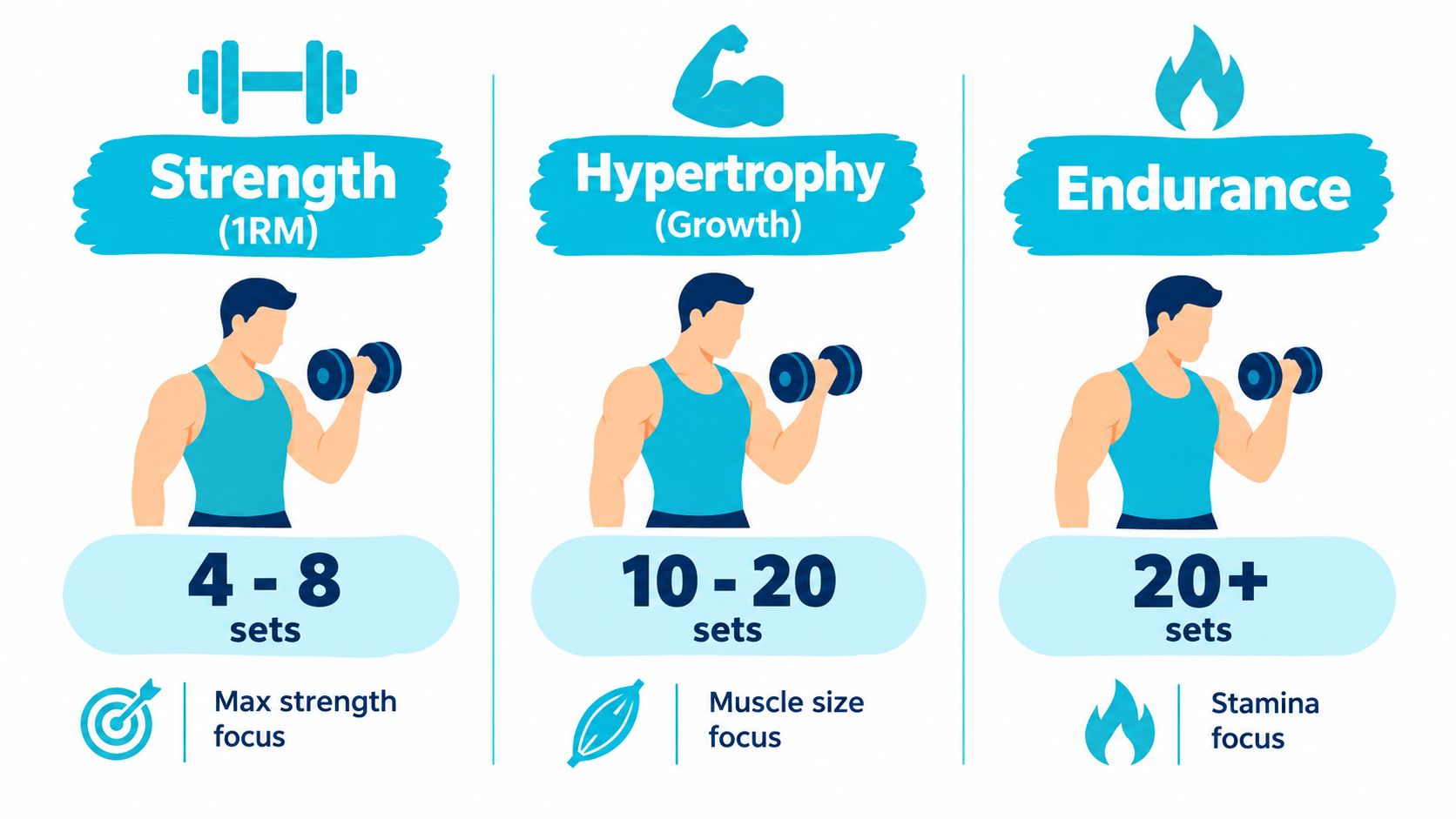
A lifter preparing for a one-repetition maximum may practice a few heavy sets, while someone training for muscle growth may distribute more challenging sets across the week. Endurance work uses lighter resistance and longer efforts. The same exercise can therefore represent different amounts of useful training, depending on the goal and the person performing it.
For strength-focused intermediates, start with roughly 4 to 8 hard sets per muscle group per week. For hypertrophy, begin around 10 to 20 hard sets per muscle group per week. These are budgeting ranges, not promises. Training age, exercise choice, effort, and recovery determine whether your starting point should be lower or higher.
The ACSM resistance-training guidance lists practical prescriptions such as 1 to 3 sets of 8 to 12 repetitions for novice-to-intermediate lifters and 2 to 6 sets of 1 to 8 repetitions for advanced lifters. The difference shows why a useful volume target must match both the lifter and the outcome.
Strength plans usually keep weekly set volume more controlled and spend more of the training budget on heavy loading and high-quality practice. Hypertrophy plans often assign more hard sets, spread across sessions so performance stays consistent. Endurance plans use lighter resistance, longer efforts, and more time under tension, so kilograms moved alone may give an incomplete picture. Research in Sports Medicine and the peer-reviewed Journal of Sports Sciences supports the idea that total weekly work should be matched to the adaptation you want.
Use this weekly budgeting process:
- Choose the goal.
- Set a starting hard-set range.
- Divide those sets among the sessions training the muscle.
- Log the plan and review performance and recovery before adjusting it.
For hypertrophy, the 2026 ACSM guidance describes about 10 sets per muscle group per week as a starting aim. In Thrive X Fitness, record each exercise, its sets, repetitions, load, and target muscle, then review both hard-set totals and volume load. That gives you two views of the same weekly budget before you adjust the next week.
A Sample Week of Volume Calculations
Use two columns in your log: volume load and hard sets. Volume load tells you how much external weight you moved, while hard sets show how much challenging work each muscle received.
| Muscle Group | Sets | Reps | Load (kg) | Total Volume (kg) |
|---|---|---|---|---|
| Chest | 14 | Mixed | Mixed | Exercise-specific total |
| Quads | 18 | Mixed | Mixed | Exercise-specific total |
| Back | 16 | Mixed | Mixed | Exercise-specific total |
| Hamstrings | 10 | Mixed | Mixed | Exercise-specific total |
On Monday, you perform heavy bench press for 5 × 5 at 100 kilograms:
5 × 5 × 100 kg = 2,500 kg
The stated session example of 12,500 kilograms would require that calculation to be repeated across five identical bench-press exposures. This distinction matters. A log should separate the volume of one exercise from the running weekly total, rather than assigning a repeated figure to a single session.
Tuesday includes 4 × 8 squats. Record the actual load used, multiply it by the sets and repetitions, and add four hard sets to the quad total if the sets were challenging. Wednesday's pull session can include weighted pull-ups and rows. Log the external load for each movement separately, then count the hard sets that meaningfully train the back.
Thursday's accessory hypertrophy block adds direct work for chest, quads, back, and hamstrings. Friday's deadlift session contributes heavily to the posterior chain, with the exact allocation depending on the exercise and how you classify overlapping compound work. If you want a research-based framework for organizing weekly frequency alongside volume, see the peer-reviewed meta-analysis on resistance training frequency and muscle hypertrophy.
A practical logging sequence
- Record each exercise: Name the movement before entering sets, reps, and load.
- Calculate tonnage: Multiply the three values for each movement.
- Convert units consistently: Divide kilograms by 1,000 when you want to view the result in tonnes.
- Count hard sets: Add challenging sets to the muscle groups they train.
- Audit overlap: Decide in advance how you'll classify compound lifts so your weekly totals stay consistent.
This is why raw tonnage and hard-set counts should sit beside each other. Two workouts can move similar weight while creating different levels of muscular challenge. The PLOS ONE review of training-volume definitions explains that sets, repetitions, load, tonnage, and total program work each capture different signals.
Diminishing Returns and the Upper Limit of Volume
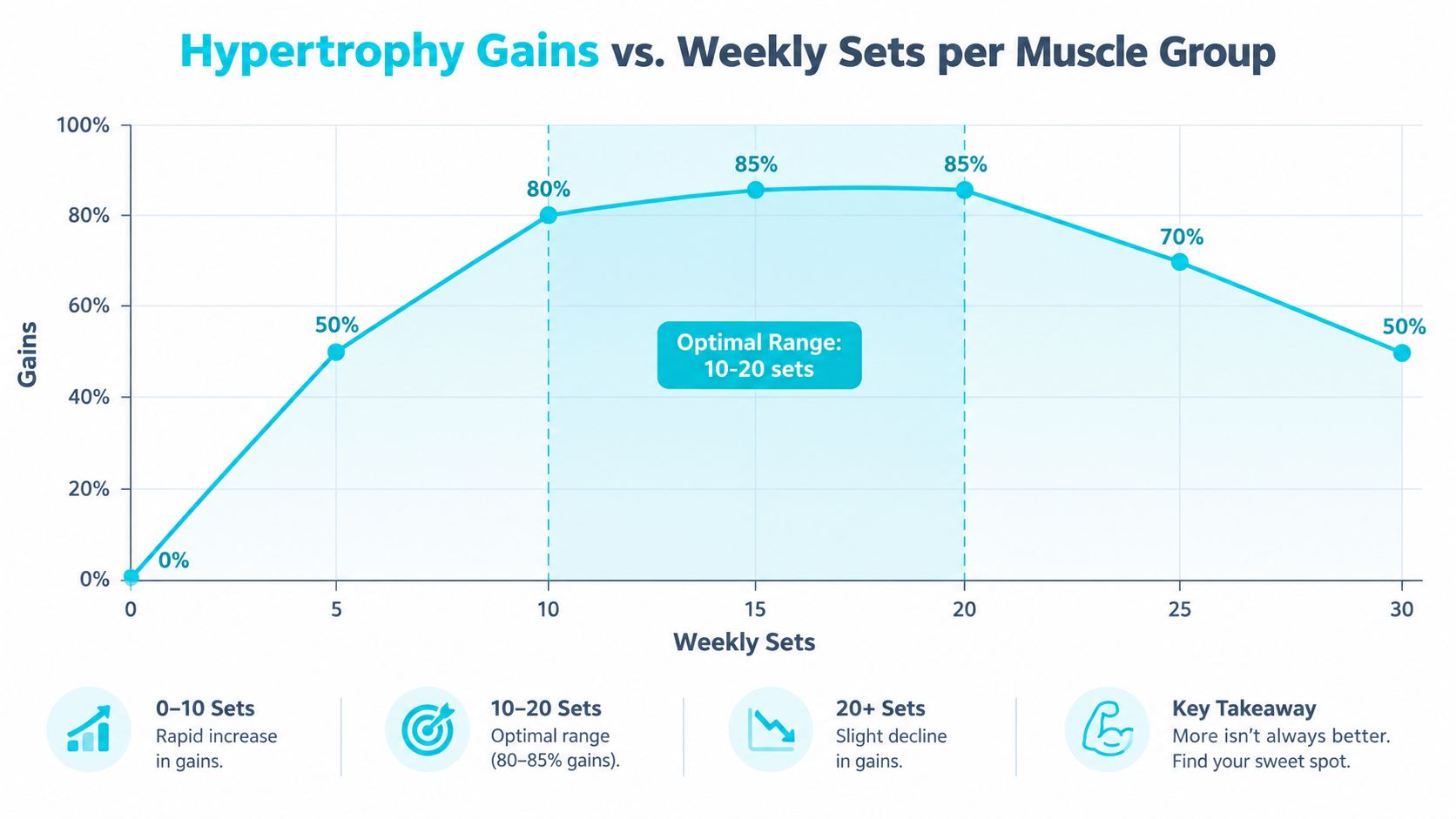
More sets aren't automatically better sets. A systematic review found a favorable trend for higher volume around 20 sets per muscle group per week, but it didn't find clear superiority of moderate versus high volume for quadriceps or biceps hypertrophy across the seven studies it examined. A separate dose-response analysis reported that greater weekly volume was generally associated with greater muscle-growth gains, which means the relationship is useful but not unlimited. These findings are summarized in the systematic review on resistance-training volume.
The 2026 ACSM position-stand summary reports diminishing returns beyond about 18 to 20 weekly sets for hypertrophy. A newer meta-regression also identified diminishing returns as per-session set volume rises, with a point of useful overlap around 11 fractional sets for hypertrophy and 2 direct sets for strength, according to the SportRxiv preprint. The practical lesson is to distribute work rather than cram every set into one workout. Related findings in the peer-reviewed Scandinavian Journal of Medicine & Science in Sports also point to a dose-response relationship that eventually flattens as set volume climbs.
Treat volume as a budget
Watch for a combination of stalled strength, a resting heart rate that stays raised, and joint discomfort that lingers between sessions. None of these signs proves that volume is the cause, but together they justify reviewing your workload, exercise selection, sleep, nutrition, and stress.
Don't use a rigid percentage reduction as a universal prescription when the verified evidence doesn't establish one. Instead, remove the least productive sets, keep the highest-quality work, and rebuild gradually after performance and recovery improve. The 2026 analysis of trained male athletes reported no additional gains beyond 60 weekly sets, reinforcing that an extremely high total isn't automatically productive.
Using Progressive Overload Through Volume
Progressive overload doesn't require you to add weight every session. A volume-first approach lets you increase the amount of quality work while keeping the load stable, which makes weekly comparisons easier.
Use this order:
- Add a set while technique and effort remain consistent.
- Add repetitions within your planned effort range.
- Add load once you can complete the target work without exceeding your effort cap.
- Repeat the cycle in the next training block.
Consider a bench press performed twice weekly. At 4 × 6 at 80 kilograms, the weekly volume load is:
4 × 6 × 80 × 2 sessions = 3,840 kilograms
If you performed only one session, the figure would be 1,920 kilograms, so your log must state whether it covers an exercise session or the full week. The same load can then progress through 5 × 6, 5 × 7, and finally 5 × 8, provided the repetitions remain technically sound and appropriately challenging. Increase the load in the following block rather than changing sets, repetitions, and weight simultaneously.
Progression principle: Change one main training variable at a time so you can identify what produced the result.
RPE caps help prevent junk volume. If the added sets cause form to deteriorate or push effort beyond your planned limit, they no longer represent the same type of work. Log the set, note the effort, and decide whether the next week should repeat the dose rather than increase it.
Keeping load constant while extending volume also works well in any tracking system. You can see whether performance improves because you completed more quality work, not because several variables changed together. For more context on progression models, the peer-reviewed Sports review on progression in resistance training remains a useful reference.
Tracking and Applying Volume in Thrive X Fitness
A useful volume dashboard should answer practical questions quickly: Which muscle groups received enough work? Which sessions were missed? Is a planned increase being completed? In Thrive X Fitness, members can use logged sets, repetitions, and loads to review weekly volume by muscle group, inspect trends, and compare completed work with their targets.
A post-session heatmap can show where work accumulated across the week. Members can set weekly set targets for each body part and review prompts when a group falls below its selected range. Coaches can use the same information to distinguish a programming problem from an adherence problem. If the plan calls for more chest work but the client repeatedly skips the second pressing day, adding more sets to the first day may not solve the issue.

The coach workflow
For partners, the Thrive X API and SDK can support workout-plan generation and related tracking workflows. A coach's integration can retrieve session records through a GET /sessions endpoint containing set, repetition, and load values, then use a derived volume endpoint to convert those records into tonnage and hard-set counts per muscle.
A practical workflow might look like this:
- Filter clients: Select members currently following a hypertrophy block.
- Review adherence: Compare prescribed sets with completed sets.
- Export weekly data: Create CSV files containing muscle-group totals.
- Adjust the next block: Add, remove, or redistribute work based on completion and recovery.
The dashboard becomes more useful when it supports communication, not just measurement. Coaches building long-term relationships with members can also review customer loyalty tips from Quikly for ideas on keeping clients engaged outside individual workouts.
Summary
Training volume helps turn workouts from guesswork into something measurable. For single lifts, the classic formula is sets × reps × load. For muscle growth planning, hard sets per muscle group per week is often more useful. This matches the broader resistance-training literature, which shows that both load-based and set-based volume measures can be useful depending on the question being asked, as discussed in the peer-reviewed PLOS ONE review of training-volume definitions.
In practice, most lifters do best when they:
- pick one primary volume metric for the block
- set a realistic weekly target based on their goal
- distribute that work across the week
- increase volume gradually before making large jumps in load
- review performance and recovery before adding more work
If progress stalls, the answer is not always more volume. Sometimes the better move is improving exercise quality, recovery, consistency, or weekly distribution. That idea is consistent with peer-reviewed evidence showing that more volume can support hypertrophy up to a point, but the response is not unlimited and should be balanced against fatigue and recovery, as summarized in the systematic review on resistance-training volume and the peer-reviewed Scandinavian Journal of Medicine & Science in Sports.
FAQ
What is training volume in simple terms?
Training volume is the amount of work you do in training. It can mean total weight moved on a lift, or the number of challenging sets you perform for a muscle group over a week. A peer-reviewed PLOS ONE review of training-volume definitions explains why multiple definitions are used in both research and coaching.
How do you calculate training volume?
The standard formula is sets × reps × load. For example, 3 sets of 10 reps at 50 kg equals 1,500 kg of volume load. This volume-load method remains widely used in resistance-training research, including the peer-reviewed Journal of Strength and Conditioning Research review.
Are hard sets better than volume load?
Neither is always better. Volume load is best for tracking progress on the same lift over time. Hard sets are usually better for planning weekly hypertrophy work across muscle groups. That distinction is also discussed in the peer-reviewed European Journal of Sport Science.
How many sets per week should I do for hypertrophy?
A practical starting range is about 10 to 20 hard sets per muscle group per week, then adjust based on progress, fatigue, and recovery. Peer-reviewed reviews suggest hypertrophy tends to improve as weekly set volume rises, up to a point, with diminishing returns at higher amounts, as summarized in the systematic review on resistance-training volume.
How many sets per week should I do for strength?
A practical starting range for many intermediate lifters is about 4 to 8 hard sets per muscle group per week, with more emphasis on heavy loading and movement quality. This fits the broader peer-reviewed guidance that strength outcomes depend heavily on load, specificity, and manageable weekly volume, as discussed in the Sports Medicine review on resistance training variables.
Can too much training volume hurt progress?
Yes. Very high volume can reduce performance quality, increase fatigue, and make recovery harder. More work helps only when you can recover from it and continue progressing. That pattern is consistent with the peer-reviewed Scandinavian Journal of Medicine & Science in Sports, which describes a dose-response relationship that eventually flattens.
Should I add load or volume first?
For many hypertrophy phases, it often makes sense to add a set or rep first, then add load once you can complete the work cleanly within your effort target. A gradual progression model is also consistent with the peer-reviewed Sports review on progression in resistance training.
Key Takeaways and Volume Budgeting Checklist
Training volume has two useful meanings. The classic calculation is sets × repetitions × load, while practical hypertrophy planning often relies on hard sets per muscle group per week. Use the first to compare external work on a lift, and the second to budget challenging stimulus across a program.
The Frontiers review of training volume describes volume by weekly sets per muscle group and highlights why tonnage alone can mislead. Two plans can move similar loads while using different repetitions, exercises, effort levels, and distributions.
Your next-block checklist
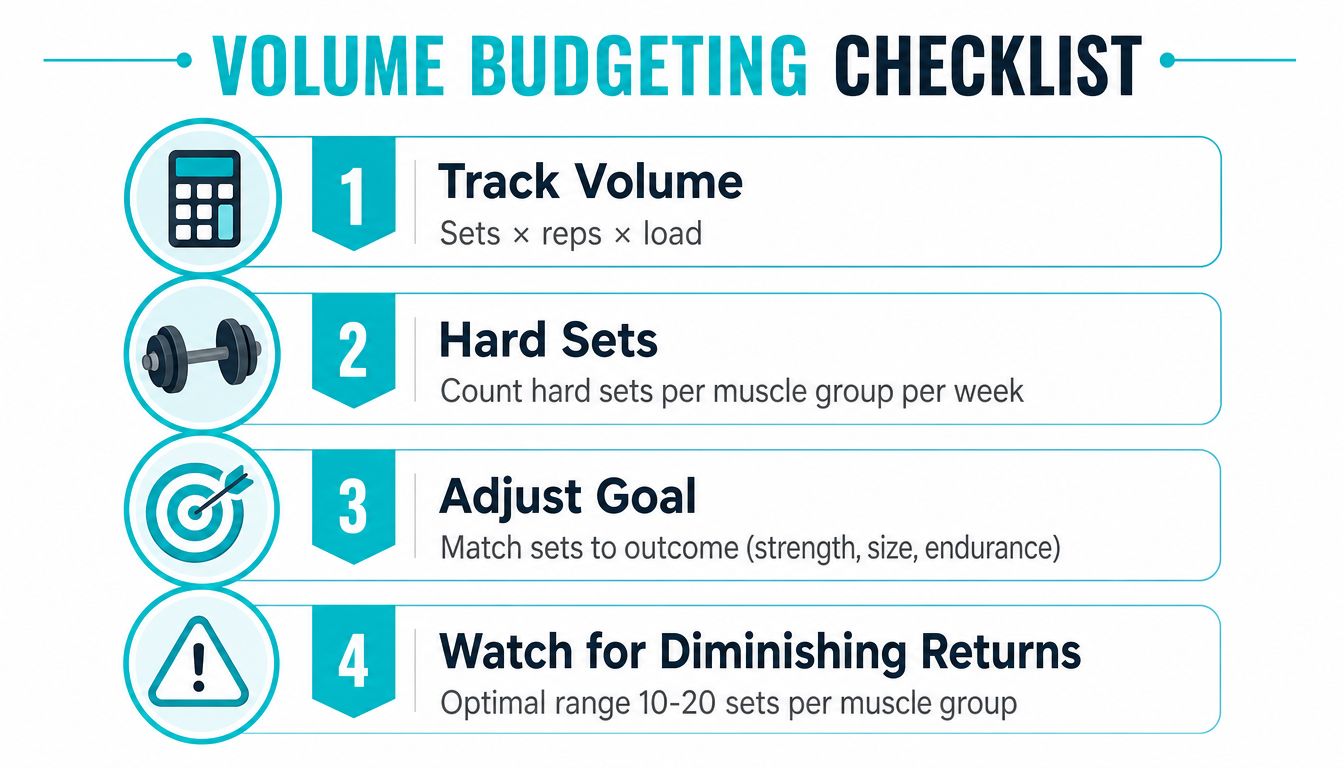
- Define the outcome: Decide whether strength, hypertrophy, or endurance leads the block.
- Select a weekly range: Choose a hard-set target for each muscle group.
- Log every working set: Record the exercise, repetitions, load, and effort.
- Calculate weekly totals: Review both hard sets and volume load.
- Add sets before load for hypertrophy: Increase quality work while keeping other variables stable.
- Watch recovery markers: Note performance, persistent joint discomfort, fatigue, and readiness.
- Keep increases modest: Avoid making large jumps before you know how you respond.
- Schedule deloads when needed: Reduce demanding work when performance and recovery remain poor.
- Review dashboard trends: Use Thrive X Fitness records to spot low or unusually high weeks.
- Adjust the next block: Keep what worked, redistribute what didn't, and avoid changing everything at once.
Start your next training cycle by choosing the goal and writing down each muscle group's weekly set budget before your first session. Use ThriveXDNA to connect structured workouts, logged performance, and volume reviews in one fitness workflow, then adjust your plan from the data instead of from frustration.
Related guides
- more on How Fitness Supports a Better Life Insurance Quote Online
- Training Volume Definition Explained Clearly
- more on Longevity Training vs Peak Performance: Why Chasing PRs Is
- DNA Workout Blueprint: How To Choose Muscle Growth Workouts Based
- Top 5 Best AI Workout Plan Generators in 2026 That Actually Keep You
- Thrive X Fitness vs Traditional Personal Training: 7 Big Differences
- Recovery-First Fitness: How the “Readiness” Metric Stops
- more on Best Runna Alternatives 2026 for AI Run Coaching
- Recovery-First Fitness: How The “Readiness” Metric Helps
- Best Wearable Tech for AI Fitness Tracking in 2026: 9 Devices That
- Best AI Fitness Apps for Beginners
- Is Your Personal Trainer Worth the Cost? Thrive X Fitness
- Thrive X Fitness app for tracking training