

Last reviewed: June 2026
In 2026, we finally have proof that training is not one-size-fits-all: in a recent study, resistance training increased muscle thickness by 8.8% in 12 weeks, while HIIT increased it by 5.3%, and those differences were strongly tied to DNA. If your genetics can predict almost half of how well you grow from a specific workout style, then guessing your program is no longer good enough.
Key Takeaways
| Question | Answer |
|---|---|
| How much of muscle growth is influenced by DNA? | Twin studies suggest around 50% of your muscle size and strength potential is heritable, so genetics set your baseline, and your workouts decide how much of that potential you actually use. |
| Can DNA really tell me whether to focus on heavy lifting or HIIT? | Yes. Recent research has identified different genetic markers for resistance-training versus HIIT-induced hypertrophy, which supports using DNA as one of your guides when choosing a muscle growth plan. |
| What is the practical first step to use DNA for muscle growth? | Start logging your training data and recovery, then use a tool that can adapt your plan to your physiology, like the AI coaching inside the Thrive X Fitness App. |
| Is DNA-based training only for elite athletes? | No. In 2026, consumer-grade apps and platforms are bringing analytics and AI programming to anyone who trains, not just pros and lab subjects. |
| Will a DNA-guided plan replace coaching and effort? | Never. DNA can guide your strategy, but consistency, smart progression, and recovery still decide your actual results. |
| What if I do not have a DNA test yet? | You can still train “DNA-aware” by watching how your body responds and using adaptive tools like Thrive X Fitness, which evolve your plan based on performance and recovery data. |
1. Why Genetics Matter For Muscle Growth In 2026
For a vetted, regularly updated list of tools that can help, explore our AI health and wellness tools directory.
Have you ever wondered why your friend explodes on a simple 3-day split while you grind for every rep? The answer is not willpower, it is genetics plus training fit. Research now shows lean body mass and strength are around 50 to 60 percent heritable, which means your DNA heavily influences how fast and how much you grow.
In 2026, we also know that different workout styles trigger different genetic advantage profiles. Studies have identified separate sets of genetic variants that respond better to resistance training versus high-intensity interval training, which is exactly why copying your favorite influencer’s program often fails.
Our stance is simple. You cannot change your genes, but you can choose the training style that works with them instead of against them. That is the core of DNA-aware muscle programming.
We treat genetic information as a force multiplier for smart planning, not as an excuse or a limit.
2. DNA 101: The Genetic Markers Behind Strength And Hypertrophy
To choose muscle growth workouts based on DNA, you need a basic map of what those genes actually do. Several well-studied markers affect how your muscle fibers behave, how easily you put on size, and how you handle fatigue.
Variants in genes like ACTN3 and MSTN influence things such as fast-twitch fiber performance and natural strength orientation. Some ACTN3 genotypes correlate with larger muscle cross-sectional area, while specific MSTN variants appear more often in strength-focused athletes.
At the same time, large genomic reviews now list hundreds of variants tied to activity traits, endurance, power, and strength. Your “muscle profile” is a network, not a single on-or-off switch.
Our role is to help you translate that network into practical training decisions: sets, reps, rest, and weekly structure you can actually follow.
3. Resistance Training Vs HIIT: What Your DNA Is Telling You
The big decision for muscle-focused trainees in 2026 is often how much time to give resistance training versus conditioning like HIIT. The latest data finally gives that choice a genetic context instead of guesswork.
One genome-wide study found distinct lead genetic variants for resistance-training hypertrophy and for HIIT-induced hypertrophy. Those variants help explain why some people blow up on lifting while others respond surprisingly well to intense intervals.
If your DNA profile leans toward resistance-training responsiveness, more of your weekly “growth budget” should go into structured lifting. If it leans toward HIIT-induced hypertrophy, you might benefit from hybrid plans that keep intervals as a real driver, instead of just a fat-loss add-on.
We see DNA as a way to prioritize, not as a way to exclude. You will still use both strength work and conditioning, but with clear emphasis based on how you actually respond.
Did You Know?
Polygenic predictor scores can explain about 47.2% of how much muscle you gain from resistance training and 38.3% from HIIT, which means DNA models can account for nearly half of your individual hypertrophy response.
Source: Yang et al., Physiol Genomics

4. Step-By-Step: Building A DNA-Guided Muscle Growth Plan
You do not need a full lab team to start acting on your genetics. You just need a simple process that connects your biology to your plan.
Here is a clear framework we use when we help people shift from random plans to DNA-aware programming.
Step 1: Gather Your Genetic And Training Data
If you already have raw DNA data from a reputable test, that is your starting point. If not, you can still train “DNA-aware” by tracking how your body responds to volume, frequency, and intensity over several weeks.
Pair that with consistent logging of your lifts, sets, reps, body measurements, and recovery markers such as soreness and sleep. This is where an AI-powered coach that centralizes data becomes valuable, because manual tracking often falls apart after a few weeks.
Step 2: Choose Your Primary Growth Modality
Based on your genetic leaning and your observed response, decide whether your main driver will be classic resistance training, a hybrid strength-plus-HIIT setup, or a more endurance-slanted structure with strategic hypertrophy work.
Commit to this primary modality for at least 8 to 12 weeks so you can actually see a clear response pattern before making changes.
Step 3: Match Set And Rep Schemes To Your Profile
Strength-leaning genotypes tend to thrive on lower reps, heavier loads, and longer rest with enough volume to drive hypertrophy. If you respond better to metabolic stress and HIIT, you may grow more with moderate loads, shorter rest, and higher total work.
Start with evidence-based templates, then adjust based on how your body reacts across 3 to 4 week blocks, not day-to-day emotion.
5. Using Thrive X Fitness To Turn DNA Insights Into Daily Workouts
Data is useless if it never changes what you do at the gym. That is exactly why we focus on tools and systems that translate your physiology into daily decisions you can execute in under 60 minutes.
The Thrive X Fitness App is built around that idea, combining AI coaching with physiology-aware tracking so you do not have to stare at spreadsheets every night.
AI-Powered Workouts That Adapt To You
Thrive X Fitness uses AI to build and adjust your plans based on performance data and recovery, rather than static templates. As you log sets and sessions, the system learns how your body responds to volume, intensity, and rest.
That is the bridge between DNA-informed principles and real-world training, especially for people who are busy and need the plan to just be there when they open the app.
Pricing And Access In 2026
As of 2026, the Thrive X Fitness App is listed as “Coming Soon,” with consumer pricing still in development. The goal is straightforward: deliver high-quality analytics and AI plans without elite-level price tags.
On the integration side, the broader Thrive X Fitness platform works as an API-driven solution that other products and gyms can plug into, so your training stays personalized across different environments.
The future of muscle growth coaching is a hybrid: your human drive paired with a system that handles pattern detection and adjustment for you. That is how you avoid years of spinning your wheels on a split that is a poor genetic fit.
Train smarter. Then your effort finally pays you back.
6. Matching Volume, Frequency, And Intensity To Your DNA
Once you know your general bias, you still have three big knobs to turn: volume, frequency, and intensity. Each of these interacts with your genetics in different ways.
Some lifters grow best with higher weekly volume and more frequent hits per muscle group, while others break down fast under similar loads because of how their tissues and nervous system handle cumulative stress.
Volume: How Much Work You Can Actually Recover From
If your DNA and history suggest robust recovery and high work capacity, you can usually handle more weekly sets per muscle and still grow. If injury history, soreness patterns, and fatigue say the opposite, you may need to run lower volume with more strategic overload phases.
Think in weekly “growth budgets,” then adjust based on soreness and performance trends rather than ego numbers.
Frequency And Intensity: Splits That Respect Your Biology
Strength-oriented profiles often thrive on higher intensity, meaning heavier loads and lower rep ranges, with enough rest between sessions targeting the same muscle groups. Some people gain more by spreading moderate-intensity work across 3 to 4 weekly touches per muscle, especially with more endurance-leaning traits.
The right answer is not dogma. It is what your body proves in the logbook across a training block.
In 2026, using AI to track these knobs is not a luxury. It is how you avoid years of spinning your wheels on a split that does not fit your biology.
Success thrives on accountability and feedback, not motivation videos.
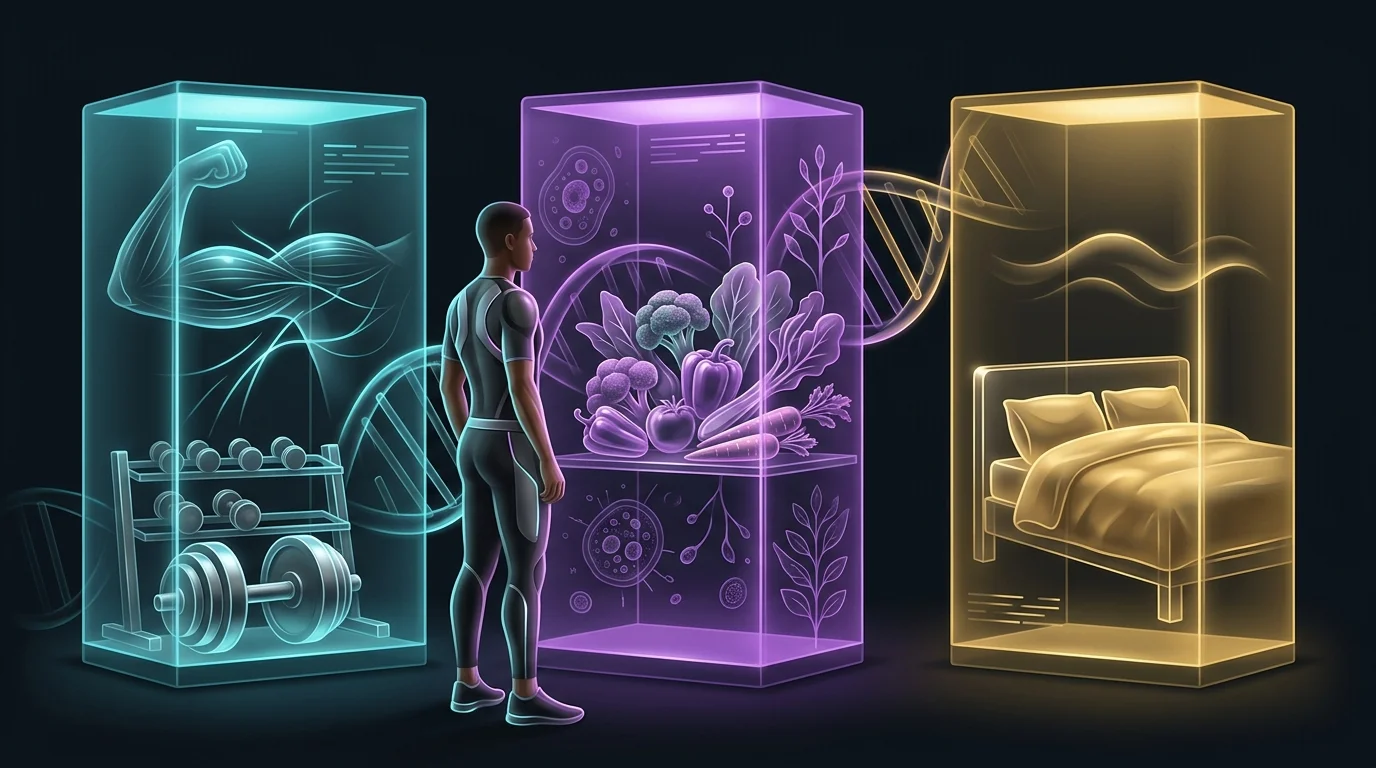
7. Nutrition And Recovery: Completing The DNA Training Triangle
Your workout is only one side of the equation. DNA also affects how you handle nutrients, inflammation, and sleep, all of which are critical for muscle growth.
Even without a full nutrigenomics panel, you can use feedback and structured tracking to see how your body responds to different calorie levels, macro splits, and sleep routines.
Precision Nutrition For Your Muscle Profile
Some people tolerate higher carb loads very well during hypertrophy phases, while others feel and perform better with more balanced or higher fat intakes. Your hunger signals, energy levels, and pump in training will tell you more than trends on social media.
The Precision Nutrition features planned for platforms like Thrive X Fitness App aim to simplify this by pairing barcode scanning and macro tracking with your training response patterns.
Recovery Matrix: Listening To Your Muscles, Not Just Your Watch
Genetic differences influence how quickly you repair muscle damage and how sensitive you are to overreaching. A well-built “recovery matrix” looks at soreness, readiness, and performance, then adjusts your workload accordingly.
Our goal is to help you hit the sweet spot where stress and recovery are balanced for your specific body, not a textbook average.
Did You Know?
As of recent genomic research, at least 149 genetic variants are linked to physical activity traits and over 250 variants are associated with athlete status, including endurance, power, and strength profiles.
Source: Ahmetov et al., Adv Genet
8. Data Privacy: Protecting Your DNA And Training Information
With great data comes great responsibility. When you start connecting DNA, health, and training metrics, how that data is handled matters deeply.
We design our systems with privacy first, because your genetic information is not just another data point. It is part of your identity.
How We Think About Your Data
Our privacy policies for tools like Thrive X Fitness are built around clear consent, limited sharing, and transparent use of health-related data. That includes everything from account information to training logs.
Before you connect any DNA or health platform, read how they store, process, and protect your information. If it is vague, walk away.
Practical Steps You Can Take Today
- Use strong, unique passwords for your health and training apps.
- Enable multi-factor authentication when available.
- Review privacy policies such as the Thrive X Fitness Privacy and general ThriveXDNA Privacy Policy so you know your rights.
Treating your data carelessly is as risky as training with bad form. Both can hurt more than you expect.
Smart muscle growth is not only about sets and reps, it is also about smart digital hygiene.
9. Common Mistakes When Choosing DNA-Based Muscle Workouts
DNA-guided training is powerful, but it is easy to get wrong if you chase buzzwords instead of results. We see the same mistakes come up over and over.
Here is how to sidestep them and go straight to what works.
Mistake 1: Treating DNA As Destiny
Some people see a report and decide they “cannot grow” because their profile is not perfect. That thinking kills progress faster than any gene ever could.
Genetics set probabilities, not guarantees. You can still build serious muscle with average genetics if your plan and consistency are not average.
Mistake 2: Ignoring Real-World Feedback
The best model in the world still has to pass the reality test in the gym. If your DNA predicts you respond to one style, but your performance, recovery, and measurements say otherwise, you adjust.
We always combine genetic insights with live data from training logs, body composition checks, and readiness tracking.
Mistake 3: Chasing Complex Protocols You Cannot Sustain
Going all in on an intricate protocol you cannot actually stick to is the fastest way to waste your genetic data. The best DNA-based plan is useless if your schedule and motivation fall apart after two weeks.
We always prioritize sustainability over perfection, because muscles grow on what you repeat, not what you try once.
10. A Sample DNA-Aware Muscle Growth Week
To make this concrete, here is how a week might look for someone with a strength-leaning genetic profile and solid recovery capacity. This is not a prescription, it is an example of how to apply the principles.
We balance heavy lifting, moderate conditioning, and recovery, then let an adaptive system tweak details like load progressions and deload timing.
| Day | Focus | Key DNA-Aware Notes |
|---|---|---|
| Monday | Heavy Upper (4-6 reps) | Leverages strength-oriented genotype with low reps and long rest. |
| Tuesday | Low-Impact Conditioning | Supports cardiovascular health without overtaxing recovery. |
| Wednesday | Heavy Lower (3-5 reps) | Targets high-force output and neural adaptations tied to your profile. |
| Thursday | Active Recovery / Mobility | Keeps tissues moving while protecting against overtraining. |
| Friday | Hypertrophy Full Body (8-12 reps) | Adds volume for size on top of strength-focused work. |
| Weekend | Optional HIIT or Rest, based on recovery matrix | Uses readiness data to decide between extra stimulus or deeper recovery. |
A HIIT-responsive athlete’s week would tilt more toward intervals and circuit-style lifting, with slightly lower maximal loads and more frequent training exposures per muscle group.
In both cases, nutrition and sleep are tuned around your appetite, energy swings, and recovery data, not generic “2,000 calories and 8 hours” advice.
Stop Guessing. Build Around Your Biology.
“Train hard and hope” is no longer a smart strategy for muscle growth. We have clear evidence that genetics influence how you respond to resistance training versus HIIT, how easily you gain mass, and how your body handles volume and recovery.
Choosing muscle growth workouts based on DNA is not about perfection or predicting every rep. It is about stacking the odds in your favor, matching your programming to your biology, and letting AI-driven tools like the upcoming Thrive X Fitness App handle the complexity.
If you are tired of spinning your wheels, this is your call to stop surviving on generic plans and start thriving on a blueprint built around you. Use your data, respect your genetics, and execute with consistency.
Make the time or make an excuse. The choice is yours.
Related guides
- more on Top 5 Best AI Workout Plan Generators in 2026 That Actually
- more on Thrive X Fitness vs Traditional Personal Training: 7 Big
- more on 5 Best AI Workout Plan Generators in 2026 (and Where They
- more on Muscle Soreness Recovery: What Actually Speeds Healing After
- more on Dr. Muscle vs Fitbod 2026: AI Auto-Progression
- more on Best Free AI Fitness Apps in 2026 (No Paywall)
- more on Best AI Fitness Apps for Beginners in
- Longevity Training vs Peak Performance: Why Chasing PRs Is Sabotaging
- High Protein Meal Prep for Muscle Gain: The Under-Eating Mistake Almos
- Is Your Personal Trainer Worth the Cost? Thrive X Fitness vs Tradition
- Source: additional detail from Physical Activity Guidelines for Americans
- Source: a good plan includes rest
- Source: Habits form through repetition over time
Frequently Asked Questions
Do I need a DNA test before I can use any of this?
No. If you already have raw DNA data from a reputable test, that is a useful starting point, but you can still train “DNA-aware” without one. The idea is to track how your body responds to volume, frequency, and intensity over several weeks, then let that observed response guide your plan. An adaptive tool that learns from your performance and recovery data can fill the gap until you ever decide to test.
How much of my muscle growth is actually controlled by my genes?
Twin studies suggest around half of your muscle size and strength potential is heritable, and lean body mass and strength are roughly 50 to 60 percent heritable. So your DNA sets the baseline, but your training, consistency, and recovery decide how much of that potential you actually reach. Genetics set probabilities, not guarantees, which is why people with average genetics can still build serious muscle with an above-average plan.
Can my DNA really tell me to prioritize heavy lifting over HIIT, or the reverse?
To a meaningful degree, yes. One genome-wide study found distinct lead genetic variants for resistance-training hypertrophy and for HIIT-induced hypertrophy. If your profile leans toward resistance-training responsiveness, more of your weekly growth budget should go into structured lifting. If it leans toward HIIT, intervals can be a real driver of size rather than just a fat-loss add-on. You still use both, just with a clear emphasis.
Which genes are worth knowing about for strength and size?
ACTN3 and MSTN are two of the well-studied ones. Certain ACTN3 genotypes correlate with larger muscle cross-sectional area, and specific MSTN variants show up more often in strength-focused athletes. That said, your muscle profile is a network, not a single on-or-off switch. Large genomic reviews now list hundreds of variants tied to activity, endurance, power, and strength, so no single gene decides your outcome.
How long should I stick with one approach before deciding it works for me?
Commit to your primary modality for at least 8 to 12 weeks so you can actually see a clear response pattern before changing course. Within that window, adjust set and rep schemes across 3 to 4 week blocks based on soreness, performance, and measurements rather than day-to-day emotion. The logbook, not your mood, is what proves whether a style fits your biology.
Is the Thrive X Fitness App available to buy right now?
As of 2026, the Thrive X Fitness App is listed as “Coming Soon,” with consumer pricing still in development. The goal is to deliver quality analytics and AI plans without elite-level price tags. The broader Thrive X Fitness platform also works as an API-driven solution that other products and gyms can plug into, so your training can stay personalized across different environments while the consumer app rolls out.