

The term muscle recovery often brings to mind less soreness. That's the popular advice, and it's incomplete. You can wake up feeling fine while your force output is still suppressed, or feel stiff while your muscles have already regained much of their function.
So, what is muscle recovery? It's the process of restoring fuel, repairing stressed tissue, rebuilding neuromuscular function, and preparing for the next workload. Soreness may appear during that process, but it isn't the finish line. A better approach asks a practical question: Can you perform the next session with control, useful force, and sound technique? For broader exercise recovery guidance, readers can also review resources from the American College of Sports Medicine and the National Strength and Conditioning Association.
Table of Contents
- Why Soreness Lies About Your Recovery
- The Three Phases of Muscle Recovery Explained
- How Long Muscle Recovery Takes
- Evidence-Based Recovery Strategies That Work
- Recovery Tools and Modalities Under the Microscope
- Your Recovery Decision Tree for Any Training Day
- Tracking and Optimizing Recovery with Thrive X Fitness
- Summary
- FAQ
Why Soreness Lies About Your Recovery
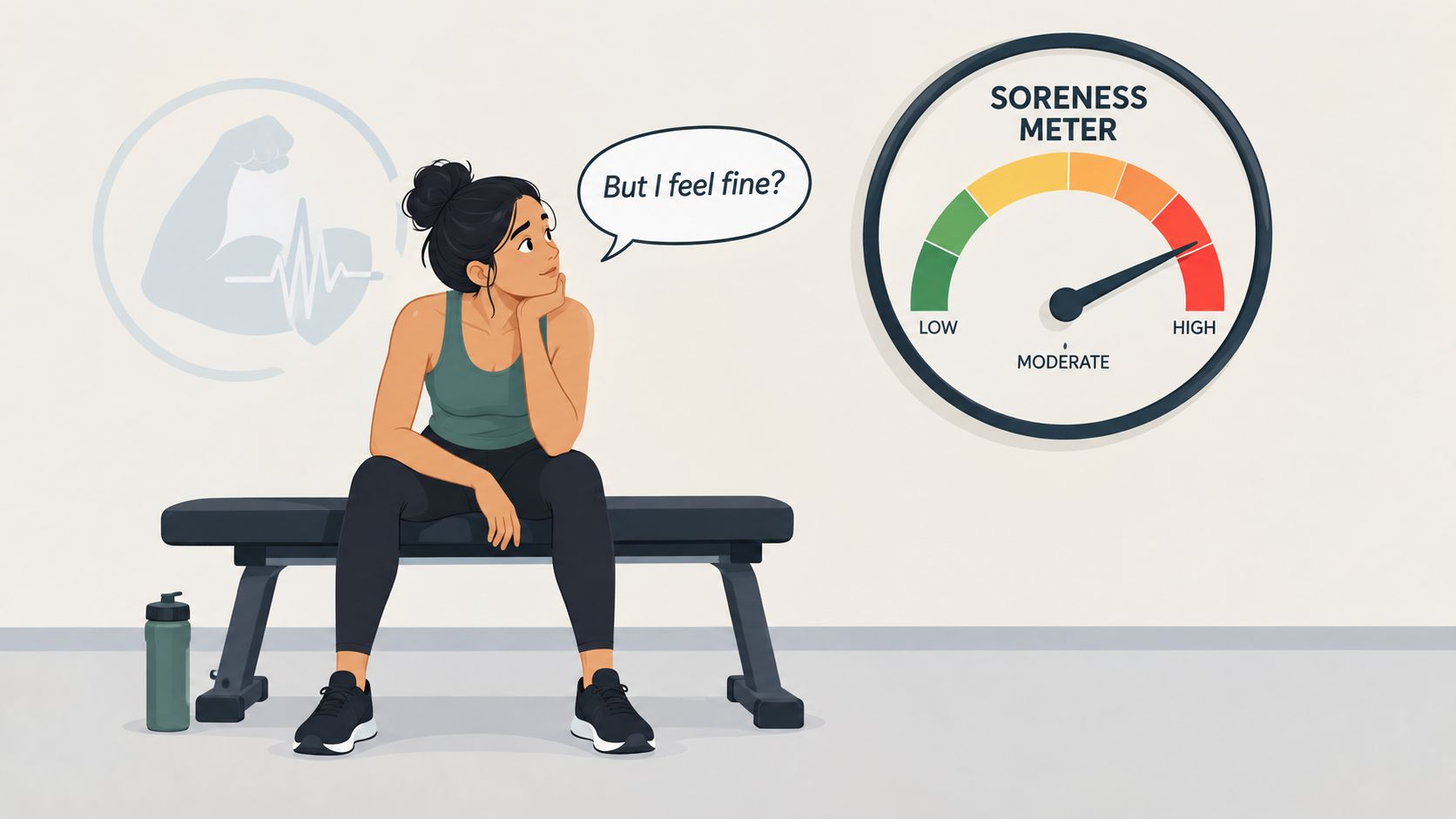
Delayed-onset muscle soreness, or DOMS, is an easy signal to notice. That's why lifters use it as a scoreboard. If your legs hurt, you assume they're not recovered. If they don't hurt, you assume you're ready to train hard again. For a general overview of DOMS and exercise-related soreness, the Cleveland Clinic offers a useful primer.
The problem is that soreness measures discomfort, not the complete condition of the muscle. A 2022 systematic review found that protein supplementation helped preserve strength and lower creatine kinase after resistance exercise, but it didn't reduce muscle soreness (Frontiers in Physiology review). That finding separates two ideas people commonly blend together: feeling better and being physiologically ready.
What soreness can and cannot tell you
Soreness reflects sensations associated with training stress and local irritation. It can be useful context, especially after an unfamiliar movement, but it doesn't tell you whether you can express your usual strength, coordinate a complex lift, or tolerate another demanding session. Readers who want a plain-language breakdown of post-exercise soreness versus injury symptoms can also reference the Hospital for Special Surgery.
A lifter might be sore after a new split-squat variation yet move well, produce normal force, and complete a planned session. Another lifter might feel little soreness after repeated heavy training but show slower bar speed, reduced control, or an unusually poor warm-up response.
Better question: Don't ask only, “How sore am I?” Ask, “What can I do today that I could normally do?”
Use performance as the stronger signal
Your warm-up gives you information that soreness can't. Pay attention to whether familiar loads feel unusually heavy, whether your range of motion changes, whether one side takes over, and whether technique breaks down earlier than expected. Mood, motivation, and sleep quality add useful context, but they shouldn't replace direct observation of movement and force. Athletes who want a broader framework for monitoring training readiness can explore education from the National Strength and Conditioning Association.
This doesn't mean soreness is irrelevant. It means soreness belongs in a recovery dashboard, not in the driver's seat. Recovery is complete enough for a particular session when your body can meet that session's demands, even if some discomfort remains.
The Three Phases of Muscle Recovery Explained
Feeling ready and being physiologically ready are different states. Muscle recovery works more like a construction project than a light switch: the body responds to immediate stress, rebuilds affected tissue, and adapts for future demands. These phases overlap, so use the timeline as a guide rather than a fixed appointment. For a general anatomy refresher, MedlinePlus provides a useful overview of how muscles function.
Phase one, the immediate response
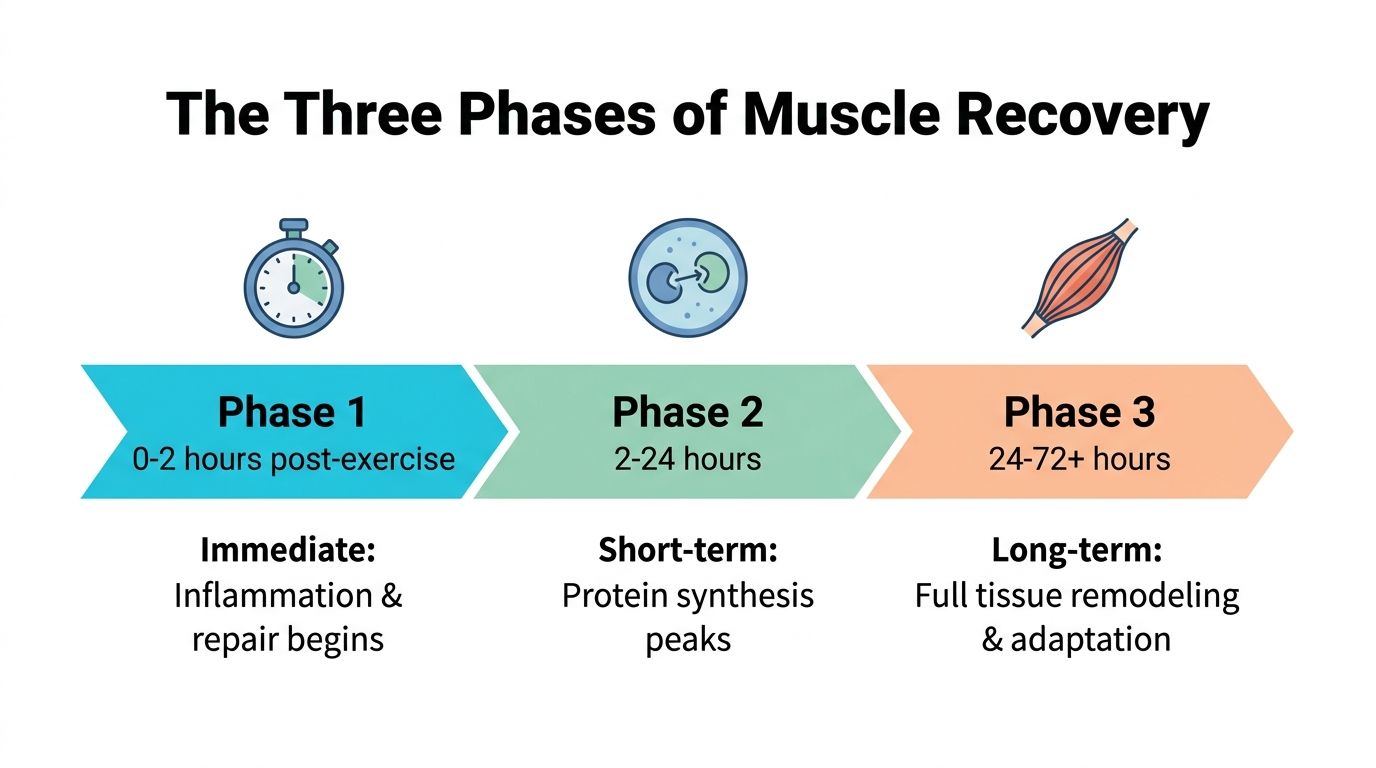
The immediate phase runs from 0 to 2 hours after exercise (ACSM recovery guidance). Your body starts responding to the workload by replacing used fuel, supplying material for repair, and restoring fluid balance. For hydration basics after exercise, the Academy of Nutrition and Dietetics has a practical guide.
For endurance athletes with another session less than 8 hours away, early recovery deserves more attention. Coingesting carbohydrate and protein soon after exercise can accelerate glycogen resynthesis and stimulate muscle protein synthesis, according to the same ACSM guidance. A commonly cited early target is about 0.25 g/kg of high-quality protein plus at least 0.75 g/kg of carbohydrate.
That timing matters less when your next demanding session is farther away. Your total intake and the demands of training still shape the decision.
Phase two, the rebuilding window
The short-term phase covers 2 to 24 hours, when muscle protein synthesis can peak, as described in the same ACSM guidance. Amino acids and energy support tissue rebuilding and help the muscle respond to the training signal.
One post-workout meal does not carry the entire repair process. Protein-rich meals distributed through the day provide repeated access to repair materials. The best pattern depends on body size, training demands, and total intake, while consistency matters more than chasing a narrow “anabolic window.” For daily meal planning ideas, active adults can also browse sports nutrition resources from the Academy of Nutrition and Dietetics.
Phase three, adaptation and remodeling
The longer phase generally spans 24 to 72 hours or longer, and remodeling continues during this period, according to the same ACSM guidance. The muscle is adapting to the stress you applied, not just waiting for discomfort to disappear.
Neuromuscular recovery adds another layer. After brief, high-intensity exercise, central fatigue may recover within about 2 minutes, and parts of peripheral fatigue within about 3 to 5 minutes. Full muscle function can still remain impaired for hours because calcium release and sensitivity inside the muscle may stay depressed (Journal of Applied Physiology review). For readers interested in exercise physiology fundamentals, Physiology.org offers broader access to related research and reviews.
Breathing normally again is only one checkpoint. Before repeating a demanding session, compare familiar loads, movement control, and force production with your usual performance. Soreness can add context, but performance markers show whether the muscle can meet today's demands.
How Long Muscle Recovery Takes
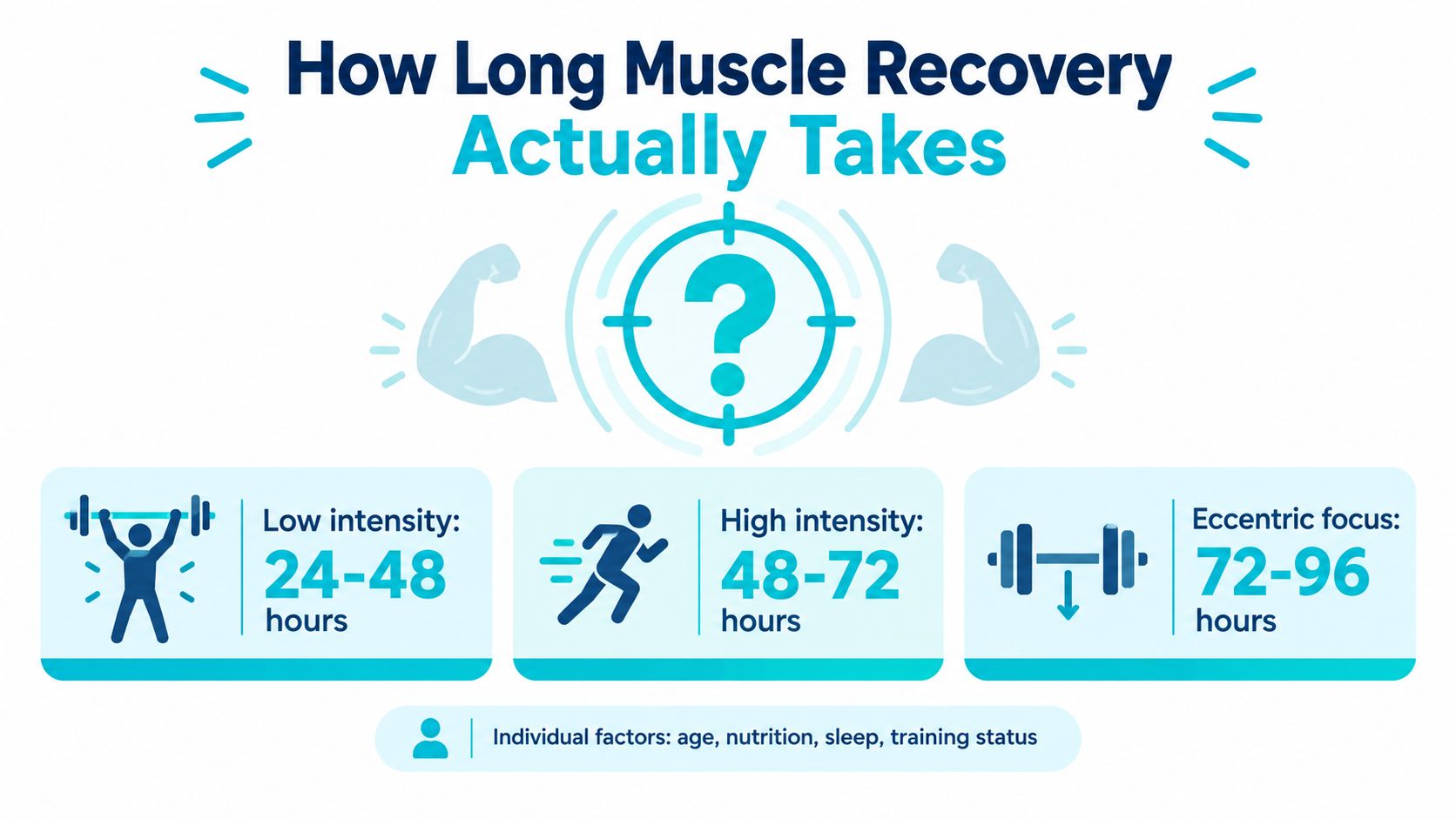
A single recovery countdown is convenient, but misleading. The workout sets the clock. A moderate session and a high-damage eccentric session can place very different demands on the same muscle group.
A review in the Journal of Applied Physiology found that when muscle strength fell by 20% or less immediately after exercise, it was usually restored within 2 days. After especially eccentric contractions, a drop of about 50% could leave strength below pre-exercise levels after 7 days (Journal of Applied Physiology review). The practical lesson is simple: feeling ready after one workout does not predict readiness after the next. If you want a plain-language explanation of eccentric exercise, Verywell Fit has a beginner-friendly summary.
The workout changes the clock
Eccentric contractions occur when a muscle lengthens while producing force. They can create more disruption than familiar, controlled work. Training status also matters. A new movement, a sudden return after time away, or a workload beyond your current tolerance can extend recovery.
The same review describes older strength-and-conditioning findings in which maximal voluntary contraction was not fully recovered at 132 hours after exercise in some cases. One subject still had not recovered after 89 days. That range is not a reason to avoid hard training. It shows why recovery cannot be treated as a universal countdown.
For programming, many coaches use at least 48 hours between high-intensity sessions for the same muscle group as a starting rule. Adjust it using warm-up performance, technique, and the demands of the next session. If discomfort may reflect an injury rather than ordinary post-training soreness, information about muscle strain recovery time can help clarify when medical attention may be appropriate. For broader injury prevention reading, the Mayo Clinic also covers common exercise safety basics.
Replace the soreness gauge
Use a repeatable movement or load as your checkpoint. If your warm-up feels normal and technique remains consistent, mild soreness may not block training. If output, coordination, or control is clearly reduced, low soreness is not permission to force the planned intensity.
Recovery is a performance question, not a pain-rating contest. Compare today's movement quality and force with your familiar baseline, then choose the session your body can execute well. Athletes who want to build a training log around these observations can also reference general tracking advice from the American Council on Exercise.
Evidence-Based Recovery Strategies That Work
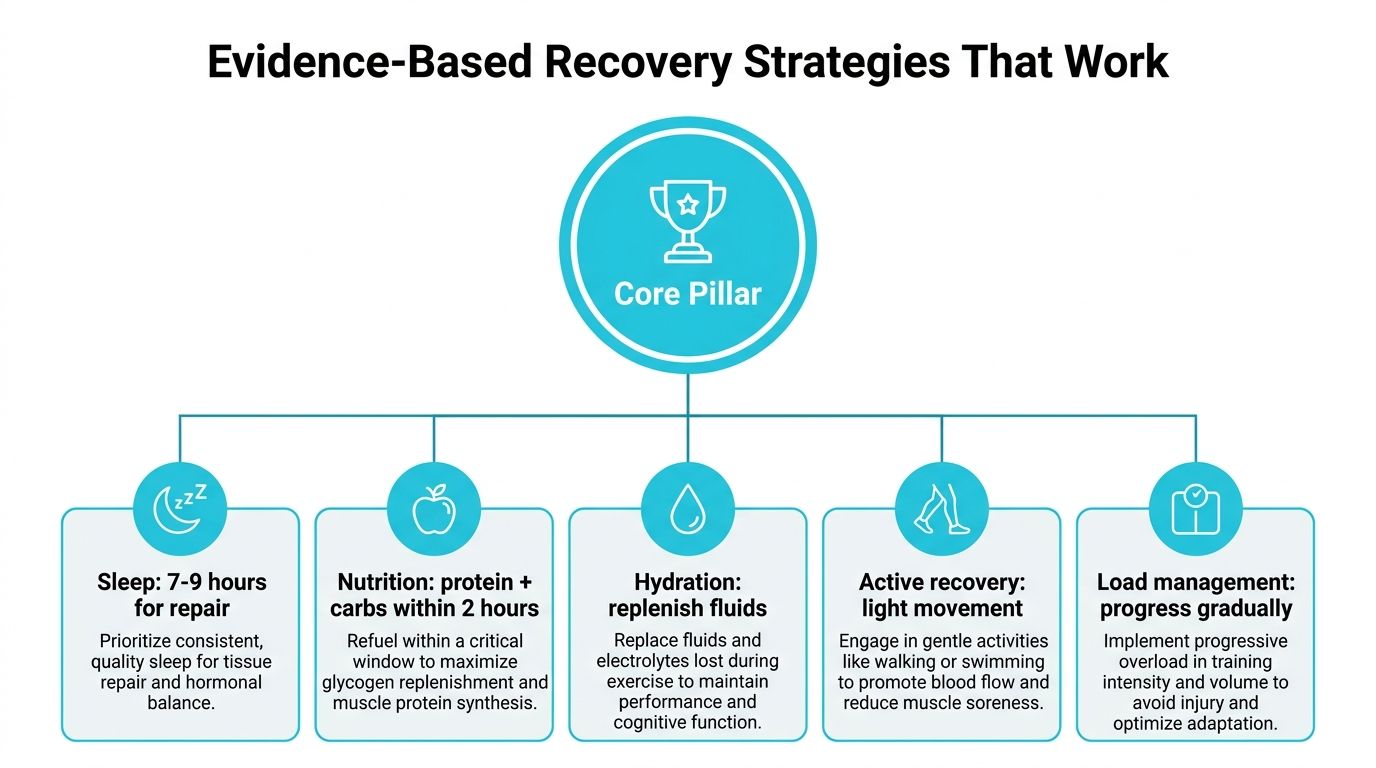
Recovery is built by meeting the next training demand, not by collecting hacks. Sleep, sufficient food, hydration, manageable loading, and low-demand movement do most of the work. Supplements and devices belong lower on that list. The Centers for Disease Control and Prevention also emphasizes these lifestyle fundamentals as part of overall physical activity support.
Sleep comes first
Sleep supports the return of normal function, steadier technique, and uninterrupted repair time. If your performance is slipping alongside poor sleep, extending rest is a more rational first adjustment than buying another recovery tool.
Protect a consistent bedtime, reduce late stimulation, and make the room suitable for sleep. You do not need a complicated sleep stack to identify the obvious problem. Repeatedly short or disrupted sleep makes hard training harder to absorb. For practical sleep hygiene tips, the Sleep Foundation offers a straightforward checklist.
Feed the next demand
Sports-nutrition guidance commonly recommends 20 to 40 g of high-quality protein soon after training, followed by protein-rich meals every 3 to 4 hours (sports nutrition review). The same review reports about 1.2 to 1.8 g/kg for endurance athletes and 1.7 to 2.2 g/kg for power-based athletes.
For many exercising people, a practical daily range is 1.4 to 2.0 g/kg of body weight, with 20 to 25 g per meal and no more than 3 to 4 hours between meals suggested as a distribution strategy (ISSN position stand). Another review places adequate daily intake around 1.2 to 1.6 g/kg or 1.4 to 2.0 g/kg, particularly when protein is consumed close to exercise (nutrition and muscle recovery review). For broader protein guidance in everyday diets, Harvard Nutrition Source provides a concise overview.
If the next session is within 24 hours, carbohydrate deserves equal attention. The Frontiers review cited earlier notes that 1 to 1.2 g/kg/h of carbohydrate with 20 to 40 g of protein can improve glycogen resynthesis. The practical question is simple: will your muscles need to produce hard work again soon? If yes, replace both building material and training fuel.
Hydrate, move, and manage load
Hydration supports nutrient transport and normal exercise function. Drink consistently around training and replace fluids according to your environment and sweat response, rather than treating hydration as a contest to consume as much as possible.
Active recovery uses low-demand movement, such as an easy walk or gentle mobility work. It can reduce perceived stiffness and rehearse movement without adding another hard stress. Keep the effort easy enough that you finish feeling better, not depleted. If you want examples of light recovery activity, the Hospital for Special Surgery explains how active recovery can fit into a training week.
Load management decides whether recovery strategies can keep up. If performance markers fall across sessions, reduce the demand before adding products. For a food-first look at magnesium sources and supplementation considerations, consult the Aspen Falls Wellness magnesium guide. Use it as nutrition education, not as a substitute for inadequate sleep, insufficient food, or excessive training load.
Recovery Tools and Modalities Under the Microscope
Recovery tools can change how you feel without speeding tissue repair, restoring force, or improving performance. That distinction matters: comfort may help you move normally and follow your plan, but it cannot confirm physiological recovery.
A 2025 review found that post-exercise stretching used alone did not significantly improve soreness, strength, performance, flexibility, or pain threshold (PubMed review). Stretching can still belong in a movement routine, especially when it reduces perceived stiffness. Treat it as one small input, not the entire recovery plan. For a consumer-friendly explanation of when stretching can still help, Johns Hopkins Medicine provides useful context.
Recovery modality evidence verdict
| Modality | Evidence Strength | Best Use Case | Verdict |
|---|---|---|---|
| Post-exercise stretching | Limited for broad recovery outcomes | Movement routine and perceived stiffness | Useful for comfort or habit, not a stand-alone recovery strategy |
| Cold-water immersion | Conditional | Situations where short-term soreness management matters | Potentially useful, with effects influenced by dose and context |
| Compression | Mixed and context-dependent | Comfort during travel or post-session downtime | Consider it an optional aid, not a foundation |
| Massage guns | Narrow and variable | Temporary sensation of looseness | May change how you feel, but doesn't replace sleep, food, or load control |
| Foam rolling | More useful for short-term mobility than repair | Preparing to move or reducing perceived tightness | A movement tool, not proof that tissue has recovered |
Cold-water immersion needs a conditional verdict. The same review describes dose-dependent effects and suggests targeted value for DOMS rather than universal recovery gains. Use it when short-term soreness management supports the next demand, rather than automatically after every workout.
Compression may improve comfort during travel or quiet downtime, while massage guns and foam rollers may create a temporary sense of looseness. Their effects are useful for movement preparation, but they do not establish that muscle capacity has returned. If you want a general overview of foam rolling technique and limits, SELF offers a basic primer.
Comfort is an outcome, not a diagnosis. Feeling looser can help you train well, but it doesn't prove that the muscle has regained full capacity.
Use performance markers to check the difference. If your usual squat load feels unusually heavy, your pulling strength is down, or your technique becomes unstable, a tool that changes sensation has not solved the underlying readiness problem. Adjust the session and address sleep, food, or training load before adding another modality.
Your Recovery Decision Tree for Any Training Day
Start with the next workout, not the soreness number. Recovery is a decision about readiness for a specific demand.
First question, when do you train again?
If the next session is less than 8 hours away, prioritize rapid restoration. For endurance work, immediate carbohydrate and protein can accelerate glycogen resynthesis and stimulate muscle protein synthesis (ACSM recovery guidance). Use the early recovery targets already described, then eat another balanced meal rather than assuming one shake completes the job.
If the next session is tomorrow, total carbohydrate, protein, fluids, and sleep all matter. If the next hard session is several days away, there's less reason to chase an emergency protocol. Focus on regular meals, normal hydration, and restoring your usual training rhythm. If you need a simple visual for athlete plate building, the U.S. Olympic & Paralympic Committee provides practical sports nutrition education.
Second question, what does that session demand?
A technical session needs coordination. A heavy strength session needs force. An endurance session needs fuel availability. Match your recovery choice to the limiting resource.
- Force is down: Reduce load or volume, extend recovery, and avoid turning a compromised session into a test.
- Technique is unstable: Choose controlled practice, mobility, or an easier variation.
- Fuel feels low: Emphasize carbohydrate alongside protein, especially if another demanding session is close.
- General fatigue is high: Prioritize sleep and reduce training stress before adding modalities.
Third question, what does your warm-up show?
A sore but capable athlete may complete a modified session. A pain-free athlete who can't control familiar movement should be more cautious. Returning from a layoff also requires restraint because the muscles may not tolerate the workload that your memory says you can handle.
For competition weeks, preserve performance rather than chasing soreness or novelty. For back-to-back training days, distribute stress across muscle groups and intensities. For ordinary training, let performance trends guide adjustments instead of making every decision from one morning's sensation. Coaches and athletes interested in return-to-play thinking can also browse educational resources from the National Athletic Trainers' Association.
Tracking and Optimizing Recovery with Thrive X Fitness
A recovery-aware app should connect training demand with the signals you can observe. Thrive X Fitness combines AI workouts, a form coach that reviews an approximately 60-second clip, photo and barcode nutrition tracking, meal plans, challenges, gamification, and a coach marketplace (Thrive X Fitness app).
That combination can support a practical workflow. Log the session, note how the warm-up felt, and use nutrition tracking to check whether protein and carbohydrate are appearing consistently in your day. Submit a form clip when a familiar movement starts showing compensation, such as shifting away from one side or losing control near the hardest part of a rep. For readers who want a broader training reference, the American College of Sports Medicine offers general exercise guidance, and the National Strength and Conditioning Association publishes coaching and performance resources.
Coaches can also build programs with planned recovery periods rather than treating rest as an afterthought. The marketplace gives members access to coach-created plans, while challenges and gamification can reinforce consistency without requiring every session to become a maximal effort. For nutrition planning support outside the app, the Academy of Nutrition and Dietetics provides evidence-based sports nutrition articles for active adults.
The useful principle is simple: let the app organize information, but keep the judgment tied to performance. A soreness score can start the conversation. Your movement quality, force, energy, sleep, and next-session requirements should finish it.
Summary
Muscle recovery is not the same as soreness fading. It includes refueling, tissue repair, neuromuscular restoration, and adaptation for future training. Research on exercise-induced muscle damage shows that changes in strength and function often tell you more than discomfort alone (MDPI review on exercise-induced muscle damage).
In practice, recovery should be judged by what your body can do today. Sleep, adequate protein, carbohydrate when needed, hydration, and smart load management remain the most reliable inputs. Broader reviews on nutritional support and recovery physiology support that foundation over a tool-first approach (Nutrients review).
Recovery tools may help you feel better, but they do not automatically restore force output or technical quality. Monitoring readiness through warm-up performance, movement control, and repeated training trends is a more defensible strategy, which aligns with peer-reviewed work on monitoring fatigue and readiness in sport (Sports review).
FAQ
Is muscle soreness a reliable sign that I am not recovered?
Not by itself. Soreness can reflect training stress, but it does not always match force output, movement quality, or readiness for the next session. Reviews on delayed-onset muscle soreness and muscle damage consistently show that soreness and functional recovery do not always move together (Open Access Journal of Sports Medicine review).
How long does muscle recovery usually take?
It depends on the session. Moderate training may allow recovery within about 24 to 48 hours, while high-damage eccentric work can impair strength for several days. Research on eccentric exercise and recovery variability helps explain why there is no single countdown that fits every workout (Frontiers in Physiology article).
What helps muscle recovery the most?
The fundamentals matter most: sleep, total calorie intake, sufficient protein, carbohydrate when the next hard session is close, hydration, and reasonable programming. Position stands and reviews in sports nutrition continue to support these basics as the main drivers of recovery outcomes (Journal of the International Society of Sports Nutrition position stand).
Are recovery tools like foam rollers and massage guns enough?
No. They may improve comfort or short-term mobility, but they should not replace sleep, food, or load control. Use them as optional support, then verify readiness with performance markers.
ThriveXDNA offers recovery-aware training through ThriveXDNA, including structured workouts, nutrition tracking, form review, and coach-built programs. Visit the platform to turn tonight's recovery check into a clearer plan for your next session.
Related guides
- details: Best Financial Strategies During Long-Term Illness Recovery
- Best AI Recovery Apps for Athletes
- Muscle Soreness Recovery: What Actually Speeds Healing After a Hard
- Recovery-First Fitness: How The “Readiness” Metric Helps
- details: Whoop vs Oura 2026: Which Recovery Tracker Wins
- Thrive X Fitness vs Traditional Personal Training: 7 Big Differences
- DNA Workout Blueprint: How To Choose Muscle Growth Workouts Based
- Recovery-First Fitness: How the “Readiness” Metric Stops
- Best Wearable Tech for AI Fitness Tracking in 2026: 9 Devices That
- details: Dr. Muscle vs Fitbod 2026: AI Auto-Progression
- High Protein Meal Prep for Muscle Gain: The Under-Eating Mistake
- Top 5 Best AI Workout Plan Generators in 2026 That Actually Keep You
- Thrive X Fitness app for tracking training