
You want to train together, but one of you works late, the other prefers early mornings, and neither of you has the same strength, experience, or goal. One partner wants to lift heavier, the other wants to improve endurance. A shared workout can quickly become a comparison, a negotiation, or another appointment that gets cancelled.
The strongest fitness challenges for couples don't require identical workouts or identical results. They create a shared practice while allowing each person to train at an appropriate level. That distinction matters. A 2026 Brigham Young University study on shared exercise and marriage covered nearly 1,700 young married couples in the United States and connected exercising together with better communication, stronger conflict resolution, and lower marital conflict. Shared movement can support the relationship, but only when the format reduces pressure rather than adding it.
The seven challenges below focus on synchronization, nutrition accountability, form coaching, unequal strength, recovery, meal economics, and skill exchange. Before starting, choose a time horizon, decide whether you're cooperating or competing, record individual baselines, agree on safety boundaries, and track only metrics that support consistency. If you want general training guidance before choosing a format, the American College of Sports Medicine exercise guidelines and the CDC physical activity basics are useful references. Thrive X Fitness can help with AI-generated workouts, form-clip review, nutrition logging, meal planning, challenges, and gamification.
Table of Contents
- 1. Synchronized Workout Partner Protocol
- 2. Reciprocal Nutrition Photo Logging Challenge
- 3. Form Mastery Peer Review Tournament
- 4. Inverse Strength Progression Challenge
- 5. Recovery and Mobility Accountability Pact
- 6. Meal Prep Economics Challenge
- 7. Asymmetric Fitness Skill Swap Challenge
- 7-Point Comparison: Couples Fitness Challenges
- Turn the Challenge Into a Sustainable Couple Routine
- Summary
- Frequently Asked Questions
- Do couples need to complete the same workout?
- Should fitness challenges for couples be competitive?
- How can partners avoid judging each other's food?
- What should couples do when one partner is much stronger?
- Is recovery a valid fitness challenge?
- What if partners have different fitness backgrounds?
- How often should a couple review the challenge?
1. Synchronized Workout Partner Protocol
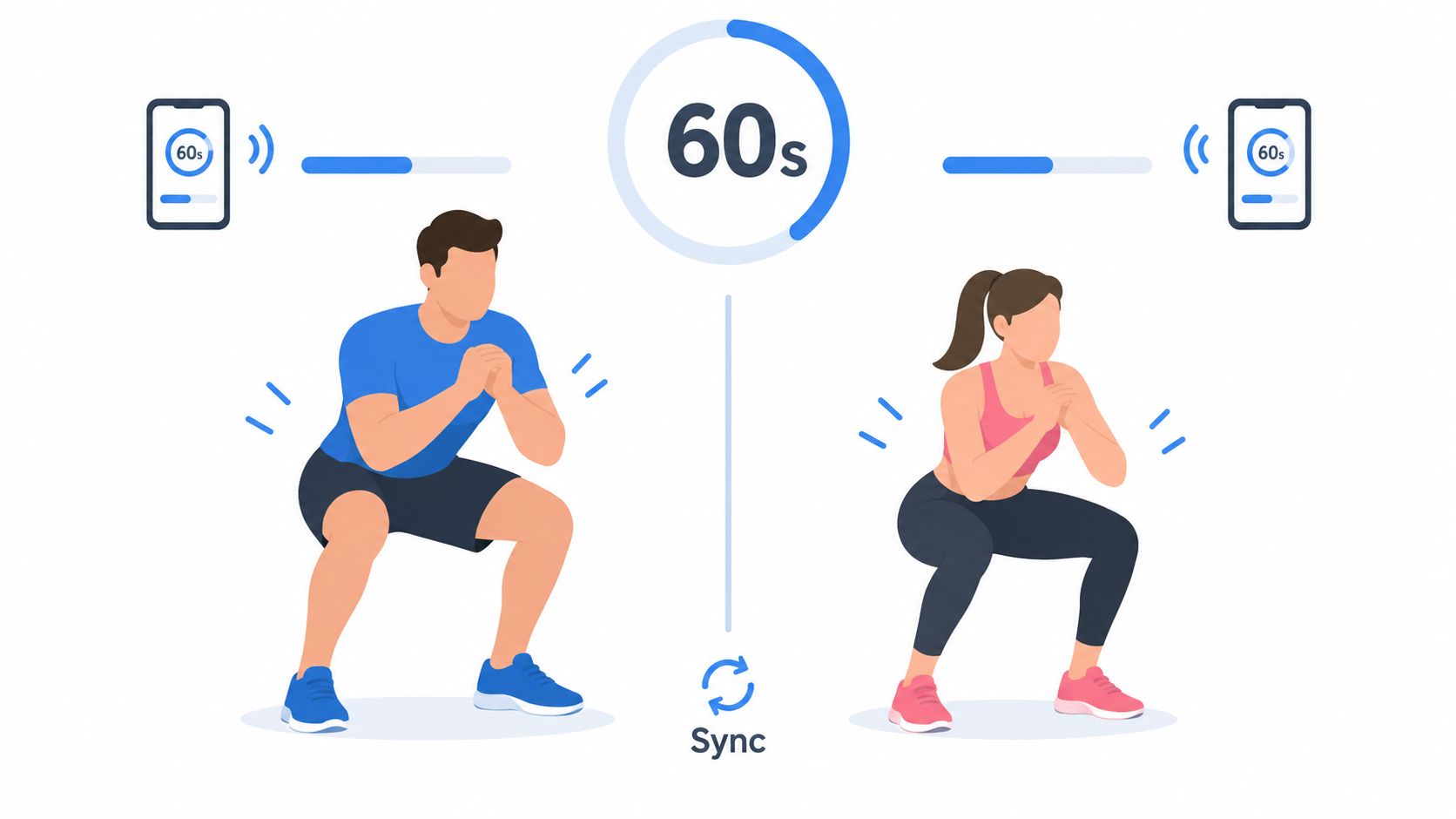
Synchronized training works best for couples who want the feeling of exercising together without forcing the same difficulty. Both partners start the same AI-generated workout at the same time, either in the same room or remotely. The exercise sequence and timing stay aligned, while each person receives movements and progressions matched to their ability.
Start with 20-minute sessions. Keep the appointment short enough that a busy day doesn't automatically cancel it. Once the routine feels stable, extend sessions toward 45 minutes if both partners want more training volume. Schedule the workout at the same time each week, and treat the appointment as a shared ritual rather than an optional extra.
Thrive X Fitness can support the shared structure through AI workouts, synchronized challenges, and private form-clip reviews. Each partner can submit a form clip of roughly 60 seconds for review after training. The clips are useful for spotting common issues, such as rushed repetitions or poor bracing, without making one partner responsible for judging the other.
Practical rule: Form feedback should be instructional, not critical. Say, “I noticed your knee moved inward on that repetition,” rather than, “You're doing it wrong.”
Make timing shared, not difficulty
Use cooperative scoring when the priority is adherence. Award a point whenever both partners complete the planned session, regardless of weight, repetitions, or workout variation. Use competitive scoring only for low-risk measures, such as who completes more sessions in a week. Don't compare loads when the programs are intentionally personalized.
Review form clips together once weekly instead of immediately after every session. A delayed review creates space for useful observation and prevents a tired post-workout conversation from turning into criticism. Couples can also use the Thrive X Fitness marketplace to gift each other custom coach-designed programs, which adds personal investment without requiring identical training.
A runner who usually trains alone might add side-by-side strength sessions to an existing schedule. A remote couple can press start together on a call, complete separate scaled exercises, and compare one form clip afterward. The shared clock creates accountability, while the individual progression protects safety. For movement variety, couples can also explore how dance improves focus and flexibility.
2. Reciprocal Nutrition Photo Logging Challenge
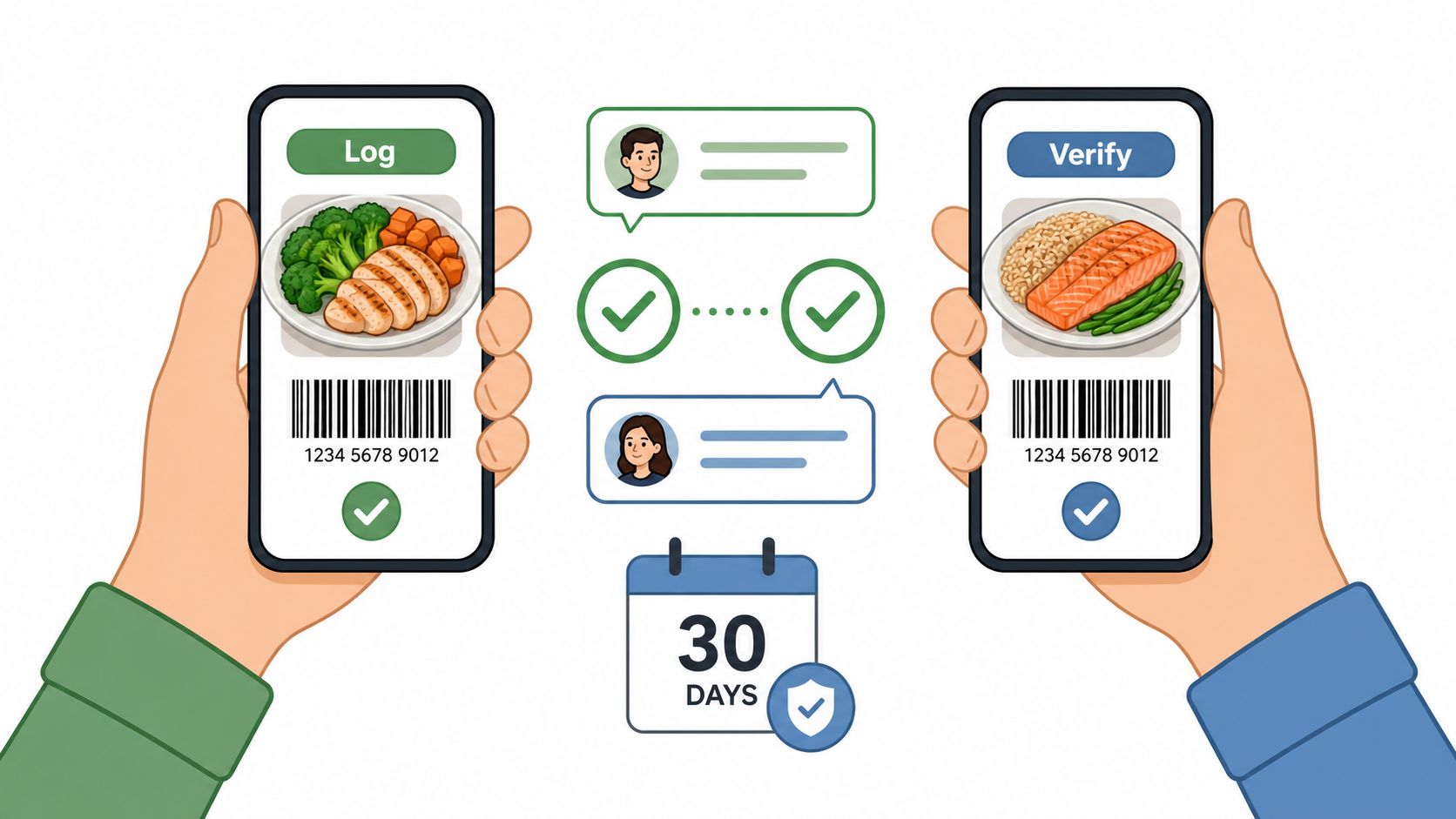
Nutrition accountability becomes more useful when both partners participate. Each person logs meals with a photo or barcode in Thrive X Fitness, then the other partner checks the entry and responds before the day's points are awarded. The purpose isn't to approve or reject food. It's to make eating patterns visible and create a shared conversation around energy, hunger, convenience, and preparation.
Choose a fixed period, such as 30 or 90 days, and decide what counts as completion before starting. A simple daily rule is one photo or barcode entry for every meal, followed by a short comment from the other partner. If a meal is missed, log it accurately and continue. A challenge that punishes one imperfect day usually creates secrecy instead of consistency.
Use curiosity as the accountability method
The verification language matters more than the points. Ask, “How did that meal make you feel?” or “Did it keep you satisfied?” Don't ask, “Why did you eat that?” Partners should discuss patterns, not police choices. A person who works late may need convenient meals, while the other partner may have more time to cook. The challenge should reveal that difference and help the couple plan around it.
A weekly full-day recipe bundle in Thrive X Fitness can reduce logging friction. Choose shared meals in advance, assign preparation tasks, and decide which meals can be repeated. A rotating meal-prep day works well when one partner cooks while the other portions food, scans items, or records recipes.
- Track more than calories: Celebrate protein, fiber, hydration, micronutrient variety, and regular meal timing when those measures support the couple's goals.
- Create one shared logging ritual: Both partners can complete their entries before bed, even if they ate separately.
- Set a no-shame boundary: Nobody loses points because a meal differed from the plan.
Use cooperative scoring for completed logs and planned meals. Competitive scoring can work for preparation tasks, but don't rank body weight or restrict food as a penalty. Couples often struggle with different preferences and competing priorities, so a flexible plan is more sustainable than a strict menu. If one partner needs a higher-energy intake, the couple can share the base recipe and adjust portions individually.
3. Form Mastery Peer Review Tournament
Technique improves faster when couples use a consistent review process instead of spontaneous corrections. Run this challenge for 8 weeks. Partners alternate roles each week, with one acting as the Form Coach and the other as the Athlete. The Athlete submits three weekly form clips of roughly 60 seconds, and the Coach reviews them using the same rubric every time.
Use four categories: range of motion, control, breathing, and positioning. Score each category with simple language such as developing, consistent, or ready to progress. The rubric gives both partners equal authority and prevents feedback from becoming a vague judgment about athletic ability.
Separate coaching from the relationship
Start every review with one observation that went well. Then identify one improvement, explain why it matters, and suggest a manageable adjustment. Don't deliver a long list of corrections. A partner who receives five criticisms at once may remember the tone instead of the technique.
Thrive X Fitness's form-clip tool provides a practical place to record and review the same exercise across the challenge. Choose one shared movement each day, or select one movement per training session if daily recording feels burdensome. Remote couples can schedule a weekly 10-minute debrief call and discuss recurring trends rather than arguing over individual clips.
“Show me what you saw, then show me the adjustment” keeps the conversation specific and collaborative.
At the midpoint and finish, hold a Form Replay session. Compare the earliest and latest clips, discuss which cues helped, and celebrate improvements in control or consistency. A couple with a lifter and a yoga practitioner might choose a squat, hinge, or overhead press. A beginner couple might start with bodyweight movements before reviewing loaded exercises.
Use cooperative scoring for completed reviews and successful technique adjustments. A light tournament format can award points for clear feedback, not for being “right.” Safety comes first. Pain, dizziness, or a movement that feels unstable is a reason to stop and seek qualified professional guidance, not a reason to push through for points.
4. Inverse Strength Progression Challenge
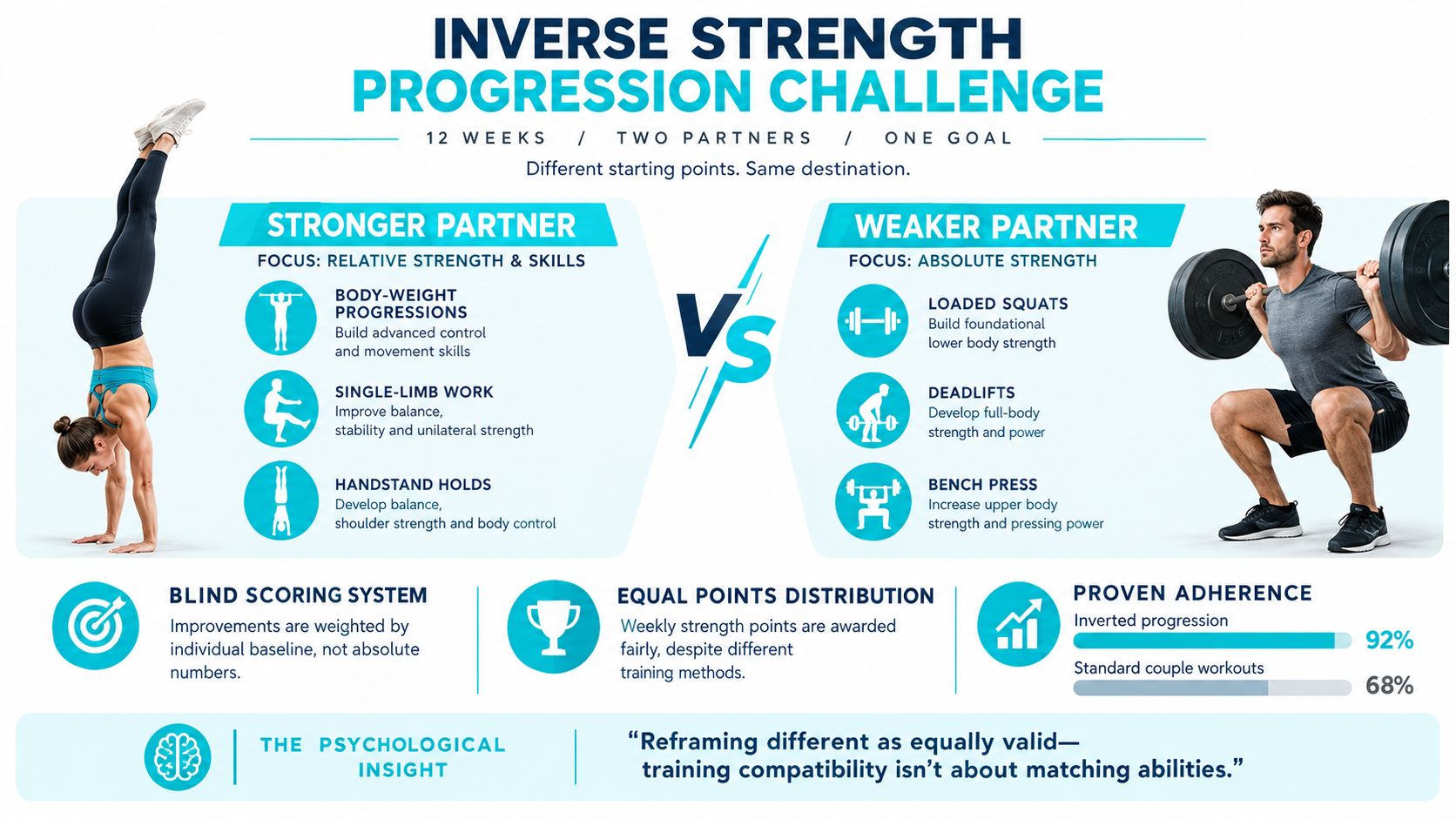
Unequal strength doesn't need to disappear for a couple to train well. In this 12-week challenge, each partner follows a different progression based on individual needs. The stronger partner might work on relative strength, single-limb control, bodyweight progressions, or handstand holds. The less experienced partner might focus on absolute strength through appropriately loaded compound lifts.
The couple shares the training appointment, but the success criteria remain personal. That structure prevents the stronger partner from turning every session into a heavier lifting contest and stops the less experienced partner from treating slower progress as failure.
Score improvement against the starting point
Record each partner's baseline before week one. The baseline can include a comfortable repetition range, an accessible load, a hold duration, a movement quality rating, or the number of planned sessions completed. Use percentage-free, baseline-based scoring: award points for improving the individual's own starting marker, completing the planned progression, or maintaining safe form.
Thrive X Fitness gamification can hold weekly points and keep the challenge playful. Create categories for absolute strength, relative strength, skill progression, form improvement, and consistency. A partner who adds load isn't automatically ahead of a partner who achieves a controlled single-leg variation or completes every planned session.
- Agree on definitions first: Decide whether progress means strength, skill, consistency, confidence, or technique.
- Train separately when needed: Different exercises can happen in the same room without becoming separate lives.
- Review monthly: Ask whether either partner feels isolated, embarrassed, or pressured.
The review matters because competition can create status imbalance. The best couples challenges are collaboration-first. A married-pairs fitness study found higher long-term attendance for married pairs than married singles, with monthly attendance of 54.2% ± 10.3 compared with 40.3% ± 14.3, and dropout of 6.3% compared with 43.0% over 12 months in the respective groups, as reported in the PubMed record for the fitness adherence study.
Finish with side-by-side videos of each partner's best movement, not a ranking. The point is to show two valid paths through the same challenge.
5. Recovery and Mobility Accountability Pact
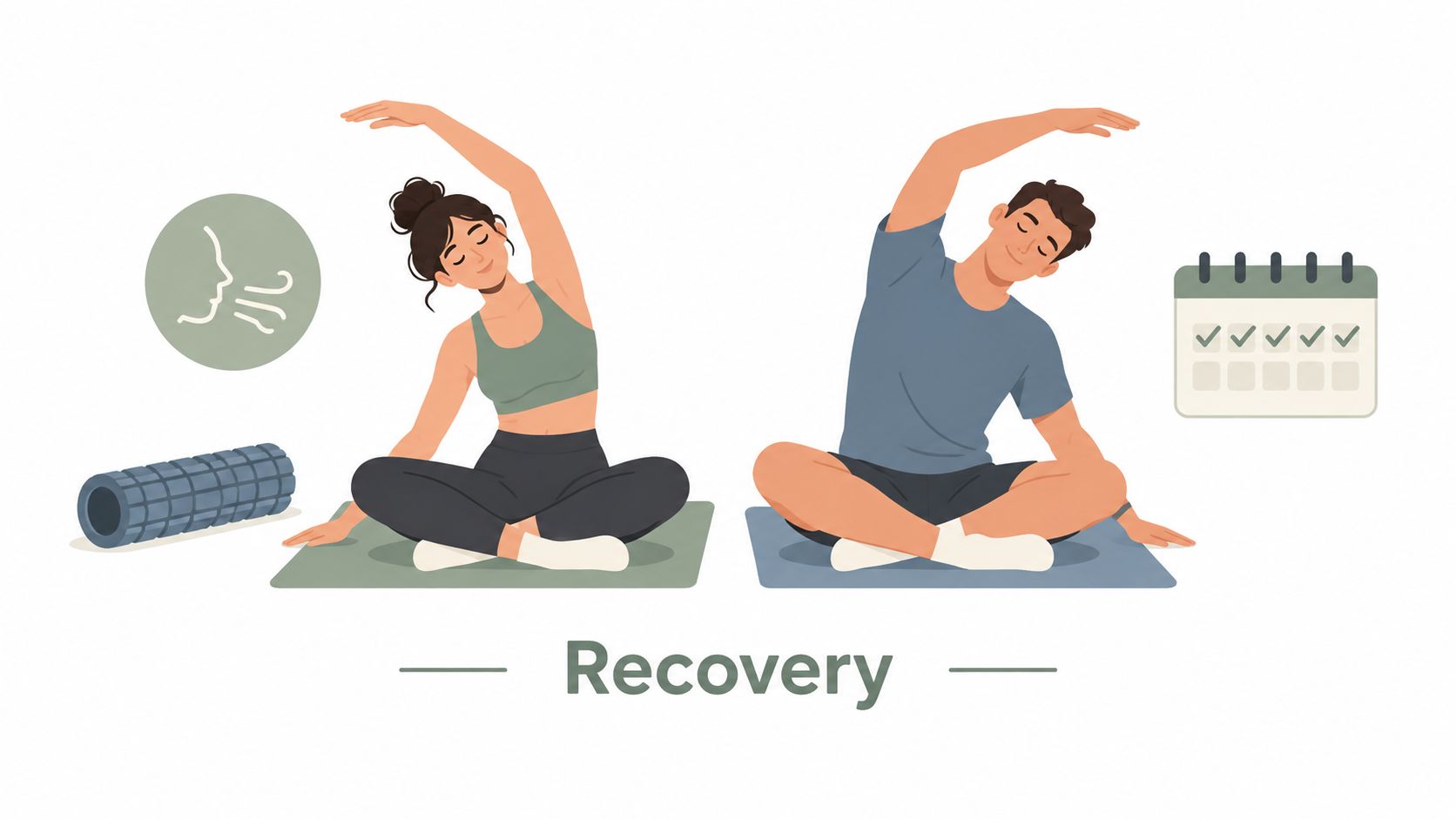
Recovery is easy to skip because it doesn't feel as urgent as a workout. Make it a shared appointment instead. Both partners complete 15 minutes of mobility or recovery work each day and log it with a photo in Thrive X Fitness. At the end of the week, each partner verifies the other's entries with a simple checklist.
The daily practice can include stretching, foam rolling, breathwork, yoga, or other recovery methods that fit the person's needs. Cold or heat exposure may be appropriate for some people, but it shouldn't be treated as a requirement or used to override pain. When symptoms persist or a person has a medical condition, professional advice should guide the plan.
Build the environment before relying on motivation
Create a recovery corner with mats, a roller, and any tools you already use. Keep the setup visible and easy to access. Schedule the session after an existing routine, such as the evening shower or the end of a shared workday. Couples who live apart can start a video call, complete separate mobility sequences, and upload their own photos.
Rotate the emphasis across the week to prevent boredom. One day can focus on hips, another on shoulders, another on breathing, and another on gentle full-body movement. The program should feel restorative. If the session increases pain or leaves either person excessively fatigued, modify it or stop.
Recovery isn't a consolation prize after training. It's part of the training plan.
Use cooperative scoring for completing the daily practice together. Competitive scoring is better reserved for streaks or creative recovery setups, not for pushing deeper into a stretch. Connect the work to a meaningful performance goal, such as feeling prepared for a hike or moving comfortably during strength training. Celebrate a completed month with a shared reward, such as a massage or a new recovery tool, rather than adding more exercise.
The pact also helps couples identify different recovery needs. One partner may need more rest between hard sessions, while the other benefits from gentle movement. Shared accountability doesn't mean shared intensity.
6. Meal Prep Economics Challenge
Household food decisions affect both fitness and daily stress. This challenge combines meal preparation with cost awareness. Each week, partners choose recipes, shop, cook, and track the cost per portion. They also record nutrition information through Thrive X Fitness photo or barcode logging.
Set a budget target that reflects your actual household rather than copying someone else's number. Record the first week's cost as a baseline, then compare later weeks against it. The target can be lower cost, more meals prepared at home, fewer last-minute purchases, or better alignment with each person's nutrition needs.
Make the spreadsheet useful
A shared spreadsheet can include the recipe, ingredients, cost per portion, calories, and macros. The purpose isn't to turn eating into accounting. It's to identify which meals are affordable, satisfying, and easy enough to repeat. A full-day recipe bundle in Thrive X Fitness can help couples choose recipes before shopping and reduce the number of decisions during the week.
Assign roles so one person doesn't carry all the work. One partner can select recipes, the other can price ingredients, and both can cook or portion meals. Rotate those jobs monthly. Treat meal preparation as a recurring couple date, with music or a shared reward, rather than as unpaid kitchen labor.
- Reward consistency: Give points for planning, shopping, preparation, and logging.
- Protect nutrition quality: Don't cut cost by removing foods that one partner needs.
- Review efficiency: Compare cost per portion and nutrition fit, not just the final grocery total.
- Fund the next step: Redirect genuine savings toward equipment, coaching, or another agreed fitness expense.
Cooperative scoring usually works better than a contest because both partners eat from the plan. A competitive option can award points for the most creative use of leftovers or the clearest recipe record. Keep the challenge practical. If a recipe takes too long or produces food nobody enjoys, remove it without treating that decision as failure.
This format suits couples whose main barrier is household planning. It also creates a direct connection between training goals, meals, time, and money, which makes the routine easier to continue beyond the challenge.
7. Asymmetric Fitness Skill Swap Challenge
Different training backgrounds can create misunderstanding. A lifter may view running as repetitive, while a runner may see lifting as unnecessarily technical. For 8 weeks, each partner learns the other's primary discipline at a beginner level. A runner can follow a conservative strength introduction, while a lifter can follow a gradual running plan.
The experienced partner acts as an informal guide, not a drill instructor. Explain why a technique matters, demonstrate it once, and let the beginner practice without constant interruption. The beginner's job is to ask questions and record observations. Neither person needs to become equally skilled.
Reward humility and learning
The first 2 weeks may feel awkward. Treat them as data gathering, not failure. Write down what feels unfamiliar, what cues help, and what the beginner wants to repeat. A shared journal can track completed sessions, confidence, technical questions, and “humility wins,” such as accepting a slower pace or using a lighter load.
Thrive X Fitness AI can generate conservative beginner progressions for both partners. Use the app to keep the starting point modest and avoid the common mistake of copying the experienced partner's volume. A runner learning lifts may need basic movement practice. A lifter beginning a running plan may need walk-run intervals or another low-impact entry point.
- Choose a low-risk entry: Start with simple movements and manageable sessions.
- Explain the reason: Technical knowledge transfers better when the beginner understands the purpose of a cue.
- Keep the journal shared: Curiosity is more useful than judging performance.
- Decide after week eight: Continue the new discipline once or twice weekly, or return to specialization with a better understanding of the other person's training.
Use cooperative points for completing the unfamiliar session and competitive points for harmless learning tasks, such as identifying a technique cue or designing a warm-up. Don't race during the beginner phase. The point is empathy, variety, and shared vocabulary.
Couples can also borrow the structure of formal partner competition without copying its intensity. In the IFBB Fitness Challenge rules, pairs complete the same exercises at six stations, alternate within timed rounds, and combine repetitions for a team result. That team-based scoring model is more useful here than a winner-takes-all format.
7-Point Comparison: Couples Fitness Challenges
| Item | 🔄 Implementation Complexity | ⚡ Resource Requirements | ⭐ Expected Outcomes | 📊 Ideal Use Cases | 💡 Key Advantages |
|---|---|---|---|---|---|
| Synchronized Workout Partner Protocol | Moderate–High, real-time device sync + per-user AI scaling | Two devices, stable internet, dual subscriptions or family plan | High ⭐⭐⭐⭐, improved adherence, collaborative form work | Couples wanting live shared sessions (remote or cohabiting); habit formation | Personalized intensity, shared form-clip review, time-locked rituals |
| Reciprocal Nutrition Photo Logging Challenge | Moderate, photo/barcode system + verification workflow | Time investment for logging/verification; camera or barcode scanner | High ⭐⭐⭐⭐, greater accountability, clearer eating patterns | Couples comfortable with transparency; nutrition-focused goals | Reveals unconscious patterns, encourages shared meal prep, data-based accountability |
| Form Mastery Peer Review Tournament | High, weekly role rotation, standardized rubric, written feedback | Significant time for reviews; form-clip tool and documentation storage | Very High ⭐⭐⭐⭐⭐, reduced injury risk, measurable technique gains | Couples who value coaching skills or heavy-lift safety | Builds coaching skill, creates documented progress, reciprocal respect |
| Inverse Strength Progression Challenge | High, blind scoring logic + individualized progressions | AI personalization, testing protocols, clear communication | High ⭐⭐⭐⭐, fair competition, higher adherence for mismatched pairs | Couples with large strength gaps seeking equitable competition | Blind-weighted scoring, skill development for stronger partner, fair recognition |
| Recovery & Mobility Accountability Pact | Low, simple daily logging and weekly verification | Minimal daily time (15 min), optional recovery tools/space | Moderate ⭐⭐⭐, better recovery, fewer interruptions, improved sleep | Older couples, injury-prone partners, those neglecting recovery | Makes recovery visible, builds consistent low-intensity bonding habits |
| Meal Prep Economics Challenge | Moderate, dual nutrition + cost tracking and reporting | Weekly 2–3 hr meal prep, kitchen space, storage; manual cost logging | High ⭐⭐⭐⭐, cost savings + improved nutrition adherence | Budget-conscious couples who cook together and want measurable savings | Aligns financial + fitness goals, measurable savings, shared cooking skills |
| Asymmetric Fitness Skill Swap Challenge | Moderate–High, dual beginner programs and coaching sessions | Significant weekly time (6–8 hr) and conservative progressions to avoid injury | Moderate–High ⭐⭐⭐⭐, new skills, empathy, some permanent habit adoption | Couples open to vulnerability and learning each other's discipline | Breaks ego, mutual learning, expands partners' fitness capacities |
Turn the Challenge Into a Sustainable Couple Routine
Choose the format that solves your actual friction point. Pick synchronized training when your biggest problem is finding the same workout time. Choose reciprocal nutrition logging when shared meals, convenience eating, or unclear habits create tension. Form review suits partners who want better technique and a calmer way to discuss movement. Inverse progression is the better fit when strength, experience, or body size differs substantially.
Use recovery accountability when one or both partners keep skipping mobility and rest. Meal Prep Economics works when household planning and food costs are the obstacles. Choose a skill swap when you want variety or need to understand why your partner trains differently. You don't need the most demanding challenge. You need the one that makes the next session easier to start.
A 2025 survey reported in UK health coverage of partner exercise found that 43% of 7,600 adults said they exercise or had exercised with a partner. Among those respondents, about half said the activity positively affected their relationship. The same survey identified schedule conflicts, differing fitness levels, different activity preferences, competing priorities, and cost as common barriers. Your launch plan should address those operational details before motivation becomes the only strategy.
Use a simple launch sequence
- Agree on one goal: Choose consistency, technique, nutrition, recovery, skill, or household planning.
- Choose the time horizon: Use a daily, weekly, or monthly rhythm that fits the challenge.
- Define the scoring: Decide whether points reward joint completion, individual improvement, or harmless competition.
- Record baselines: Each partner should measure a personal starting point, not borrow the other's target.
- Set a stop-or-modify rule: Pain, unusual symptoms, or excessive fatigue overrides the score.
- Schedule a weekly review: Discuss what worked, what created friction, and what needs changing.
The review is where a challenge becomes a routine. Ask whether the format helped you spend better time together, whether the tracking felt useful, and whether either partner felt judged. The 2025 scoping review of relationship-improvement apps identified communication, intimacy, and expressions of love as common app capabilities. A couples fitness challenge should borrow that relationship-centered thinking. Workout completion matters, but the way partners communicate around it matters too.
Research on mobile fitness app users also found that satisfaction was driven most strongly by positive emotional factors and perceived usefulness. In gamified fitness apps, hedonic, pragmatic, social, and burden-related factors all predicted satisfaction, as summarized in the fitness app research reference. In practical terms, make the challenge enjoyable, useful, social, and easy to maintain. Remove unnecessary steps before adding harder workouts.
The most important trade-off is between intensity and adherence. A demanding contest may create excitement for a week, but a flexible cooperative protocol has a better chance of surviving travel, late shifts, soreness, and different abilities. If training starts crowding out shared time, modify the schedule. Partner exercise can support communication and conflict resolution, but exercise can also become a relationship hindrance when it takes priority over the relationship itself, as discussed in the research on exercise and relationship dynamics.
ThriveXDNA can fit into this process through Thrive X Fitness, which combines AI workouts, form-clip review, nutrition logging, meal planning, challenges, gamification, and coach-created programs. Use the platform to reduce setup work, then keep the relationship rules human: no shaming, no forced competition, and no score that matters more than safety or trust. For broader progress tracking beyond body weight, review progress metrics beyond the scale.
Summary
The best fitness challenges for couples match the relationship dynamic and solve a practical obstacle. Synchronized workouts support shared scheduling, nutrition logging creates mutual accountability, and form review gives partners a structured way to discuss technique. Inverse progression protects individual goals when strength differs, while recovery, meal economics, and skill exchange address consistency, household planning, and variety. Successful challenges use personal baselines, clear safety rules, cooperative scoring when appropriate, and weekly reviews that protect both training progress and relationship quality.
Frequently Asked Questions
Do couples need to complete the same workout?
No. Couples can train at the same time while using different exercises, loads, or progressions. Synchronized training works because the timing and ritual are shared, not because the results are identical. This approach is especially useful when partners have different strength levels, experience, or goals. Each person should follow a safe progression that matches their ability.
Should fitness challenges for couples be competitive?
Competition is optional. Cooperative scoring often works better when the goal is consistency, nutrition, recovery, or household planning. Competition can remain light and low risk, such as counting completed sessions or learning tasks. Don't rank body weight, force uncomfortable exercise, or compare loads when partners are following different programs.
How can partners avoid judging each other's food?
Use curiosity rather than criticism. Ask how a meal felt, whether it was satisfying, and what might make the next meal easier. Reciprocal photo logging should create visibility and conversation, not permission for one partner to police the other. Celebrate nutrition quality and consistency, not only calorie totals.
What should couples do when one partner is much stronger?
Use inverse strength progression. The stronger partner can work on relative strength, single-limb control, bodyweight skills, or handstand holds, while the less experienced partner develops absolute strength through suitable loaded movements. Score improvement against each person's baseline. This recognizes different kinds of progress without turning the training session into a status contest.
Is recovery a valid fitness challenge?
Yes. A recovery pact can make mobility and restorative work visible and consistent. Partners can complete 15 minutes of stretching, foam rolling, breathwork, or another appropriate method each day, then log the practice. Recovery should never require pushing through pain or unusual fatigue. Modify or stop the session when the body signals that the plan isn't appropriate.
What if partners have different fitness backgrounds?
Try a skill swap. Each partner learns the other's main discipline at a conservative beginner level for 8 weeks. The experienced partner explains technique and purpose, while the beginner records questions and observations. The goal is learning and empathy, not immediate performance. Afterward, decide whether to keep the new activity or return to specialization.
How often should a couple review the challenge?
Schedule a weekly review, even when the challenge itself is daily. Discuss completion, friction, energy, safety, and whether the scoring still feels fair. Form-review challenges can include a 10-minute debrief, while nutrition or meal-prep challenges can use the review to adjust recipes and responsibilities. Change the system when it stops supporting consistency.
Thrive X Fitness offers AI-generated workouts, roughly 60-second form-clip review, photo and barcode nutrition logging, meal plans, gamified challenges, and coach-created programs for shared routines. Explore ThriveXDNA and choose one couple challenge you can start this week.