
Many assume the Pilates Reformer for core strength is about chasing a burn. That's the wrong target. The machine matters because its springs and sliding carriage change how your trunk stabilizers fire, and the bigger win is clean control under shifting resistance, not frantic effort or sloppy reps.
The reformer was built into Joseph Pilates's larger system of about 500 exercises and five apparatuses, with a studio using his method established in New York in 1926 after he emigrated to the United States. Historical accounts describe the reformer as one of his original resistance-based devices, designed to strengthen the core, improve posture, and assist rehabilitation for injured dancers and bedridden patients. Modern reviews still connect reformer work to trunk and abdominal activation, and one review reports about 10–20% of maximum voluntary contraction in the multifidi and external obliques during reformer-based exercises, which is a big reason the machine still anchors core training Medscape's overview of reformer Pilates and the evidence. For general background on the method's origins and principles, the Encyclopaedia Britannica overview of Pilates adds useful context.
Table of Contents
- Setting Up the Reformer for Deep Core Activation
- Key Exercises and Spring Tension Biomechanics
- Programming Your 8-Week Core Progression
- Common Mistakes and Safety Modifications
- Summary
- Frequently Asked Questions
Setting Up the Reformer for Deep Core Activation
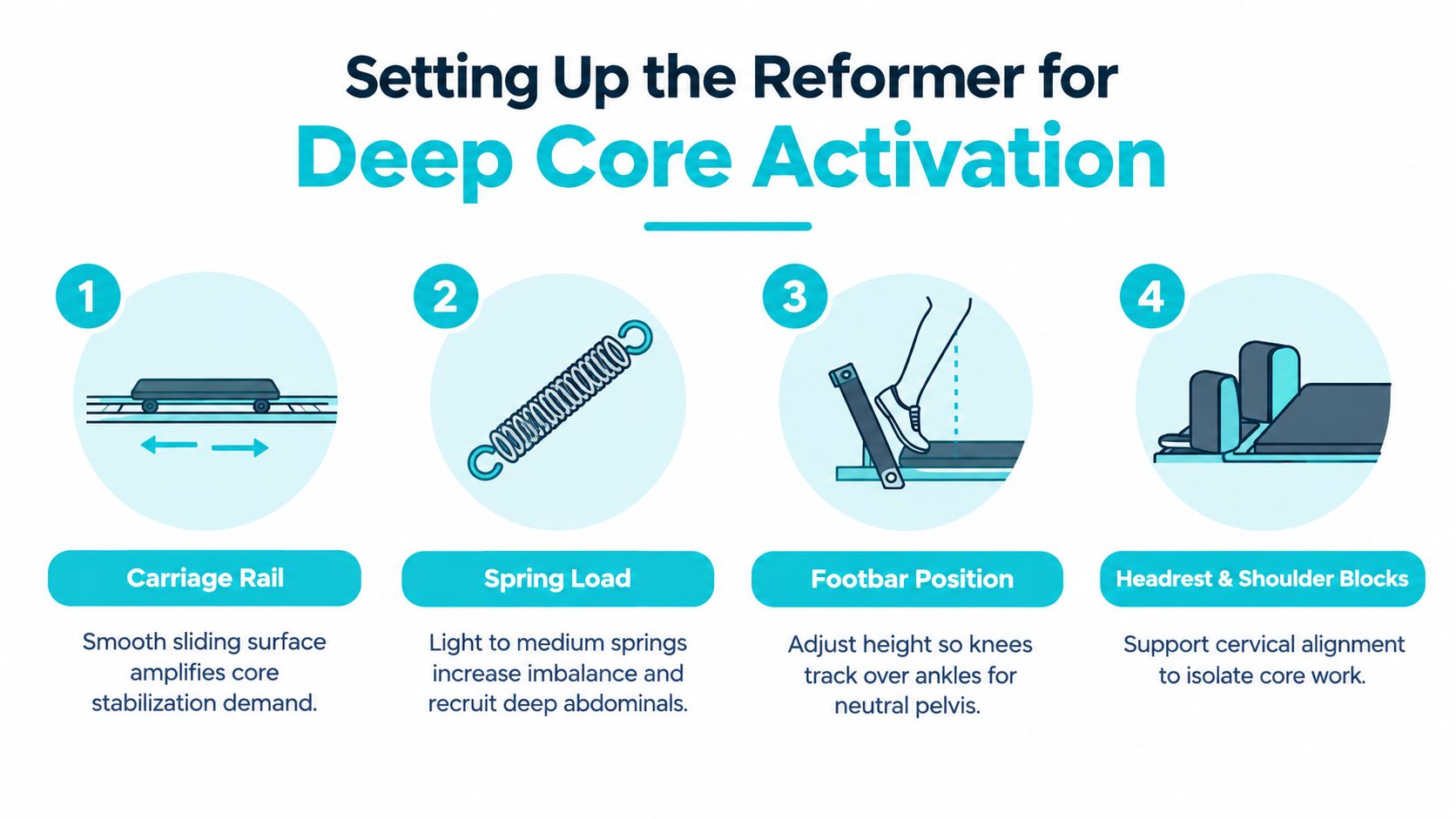
The carriage is the point. It moves, and that movement forces your trunk to solve a balance problem while your limbs do the work. That's why the reformer can do more for deep core recruitment than a stable surface when you set it up with intention. If you are new to equipment-based Pilates, the Cleveland Clinic overview of Pilates benefits and basics is a helpful primer before you load the carriage.
Start with the machine, not the exercise
Check the shoulder blocks first so your body has a clear boundary without pinching the neck or forcing you to overreach. Set the headrest so your cervical spine can stay calm, because a tense neck usually means the trunk has already started cheating. Then place your feet or hands so your joints stack well enough to let the pelvis stay quiet.
Practical rule: if your setup makes you brace through your jaw, rib flare, or hip flexors before the first rep, the machine is too aggressive for that day.
The footbar should let your knees track over your ankles when you load through the legs. That cue matters because a neutral pelvis is easier to keep when the lower body isn't twisted into compensation. On the reformer, small setup errors travel fast into the spine.
Build the baseline before you add challenge
A smooth carriage slide is the biomechanical advantage. Springs create resistance, but the moving platform creates the instability that makes your trunk, hips, and shoulders coordinate instead of freelancing. When the machine is set well, you feel the abs, multifidi, and pelvic control working together rather than the low back grabbing everything.
Before the first movement, take a slow breath and find neutral spine on the carriage. If you can't hold that position without gripping the neck or thrusting the ribs, the load is too much or the range is too big. I'd rather see a smaller, cleaner setup than an impressive-looking shape with a wobbly trunk.
A simple preflight checklist keeps the session honest:
- Carriage rail: confirm the carriage slides smoothly, because a clean glide makes stabilization feedback easier to feel.
- Spring load: begin with a setting that lets you control the return, not just the push.
- Footbar position: adjust it so the pelvis can stay level while the legs move.
- Headrest and blocks: use them to support alignment, not to hang on passively.
The best reformer sessions start with restraint. If you organize the body well at the start, the later core work feels obvious instead of random.
Key Exercises and Spring Tension Biomechanics
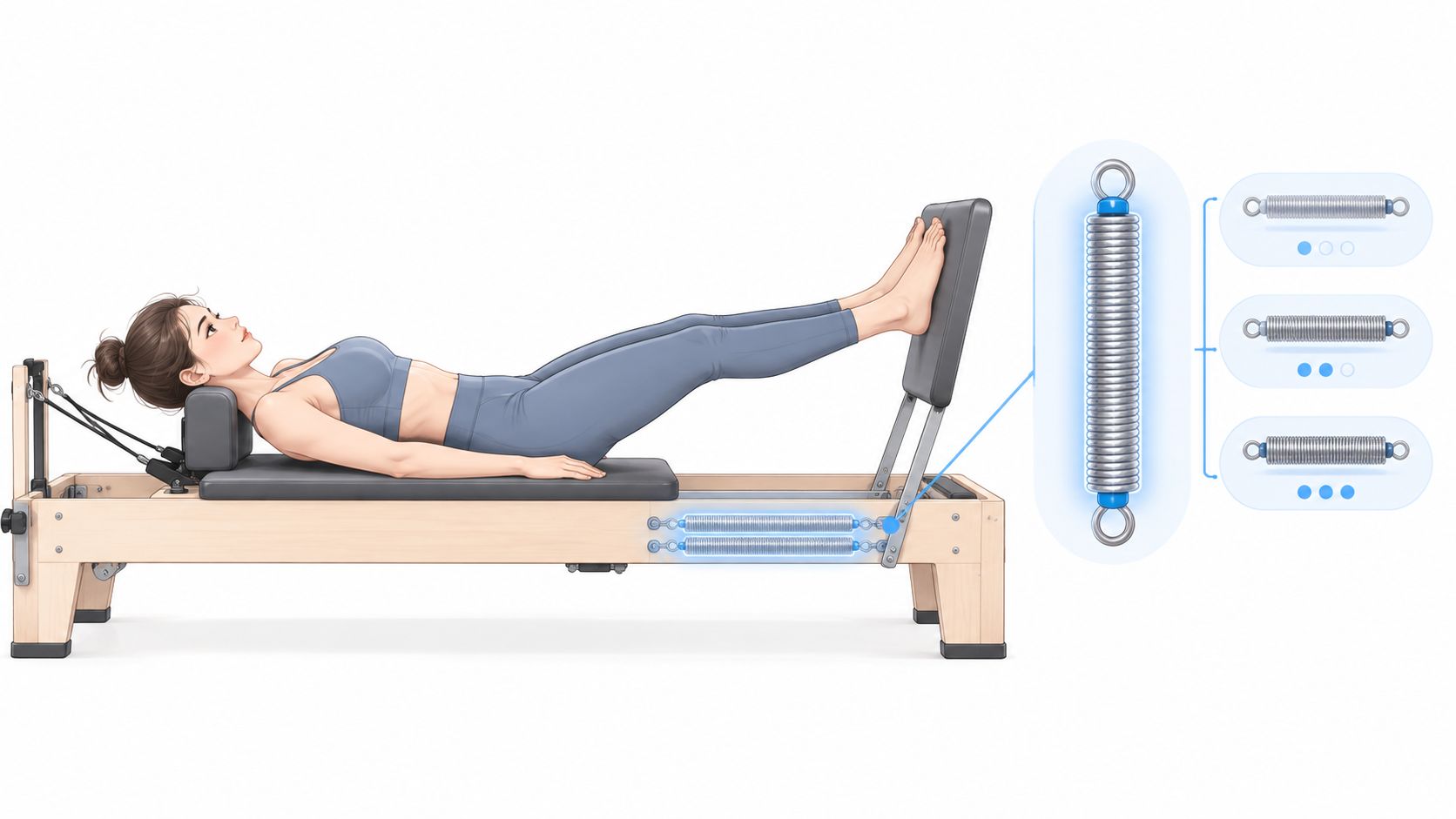
Spring tension isn't just a difficulty dial. It changes which tissues take the load, how fast compensations show up, and whether the trunk stays organized or leaks effort into the hips and neck. A recent motion-analysis study found that heavier spring tension increased activation of deep core muscles, including the gluteus medius, internal oblique, and multifidus, more than light tension, while the abdominal line muscle was more active under light tension 2023 motion-analysis study. For a broader anatomy refresher, Cleveland Clinic's core muscles guide explains how these stabilizers support spinal control.
Footwork, bridges, and control under load
Footwork looks simple, but it's a live test of pelvic control. Heavy enough springs can help some movers feel the deeper trunk and lower-back stabilizers work more effectively, while lighter load can expose whether the abdominal wall is managing the return or just coasting. I cue a slow exhale on the press and a quiet, measured return, because the return phase is where many lifters lose the spine.
Bridge work on the reformer rewards patience. The carriage's instability makes the pelvis want to tip, so the deep system has to organize before the hips extend fully. If the ribs pop or the hamstrings cramp, the core isn't driving the movement cleanly yet.
Heavy spring tension can improve deep core recruitment, but only when the pelvis stays steady enough to absorb the load.
Long box pulling and strap work
Strap-based pulling drills are where many people learn the difference between abdominal effort and shoulder effort. The trunk should resist rotation while the arms or legs move, and the reformer gives immediate feedback if the rib cage opens or the lumbar spine arches. That's why controlled tempo matters more than range.
A 2021 review of trunk muscle activation stated that Pilates-based stabilization work efficiently activates local abdominal and back muscles, especially the transversus abdominis and multifidus, which support the pelvis and trunk rather than just the surface abs 2021 review. That's the lens I use when teaching. If the exercise only makes the rectus abdominis look busy, it's not enough. If you want a clinical explanation of the transversus abdominis, Physiopedia's summary is a useful reference.
Why load choice changes the target
Heavier springs can make the trunk work harder to hold the pelvis and spine in place, but they can also hide poor control by giving the body more external help. Lighter springs demand precision in the return and often expose who's relying on momentum. Both have a place, but they don't train the same thing.
A practical sequence is simple: start with stable carriage control, then use light to medium spring settings to prove alignment, and only then use heavier loads if the spine stays long and the pelvis doesn't tilt. The goal isn't maximal tension. The goal is the right tissue doing the right job.
Programming Your 8-Week Core Progression
Clinical work matters here because it shows that core change doesn't come from random sessions. An 8-week intervention in women aged 20–30 found statistically significant improvements in core muscle endurance, balance, and flexibility versus controls (p<0.05) 8-week intervention study. A 12-week protocol with sessions twice per week also produced significant gains in core endurance, balance, flexibility, and body composition 12-week protocol. For readers who want broader physical activity guidance alongside Pilates, the World Health Organization adult activity recommendations are a useful benchmark.
The structure that actually holds up
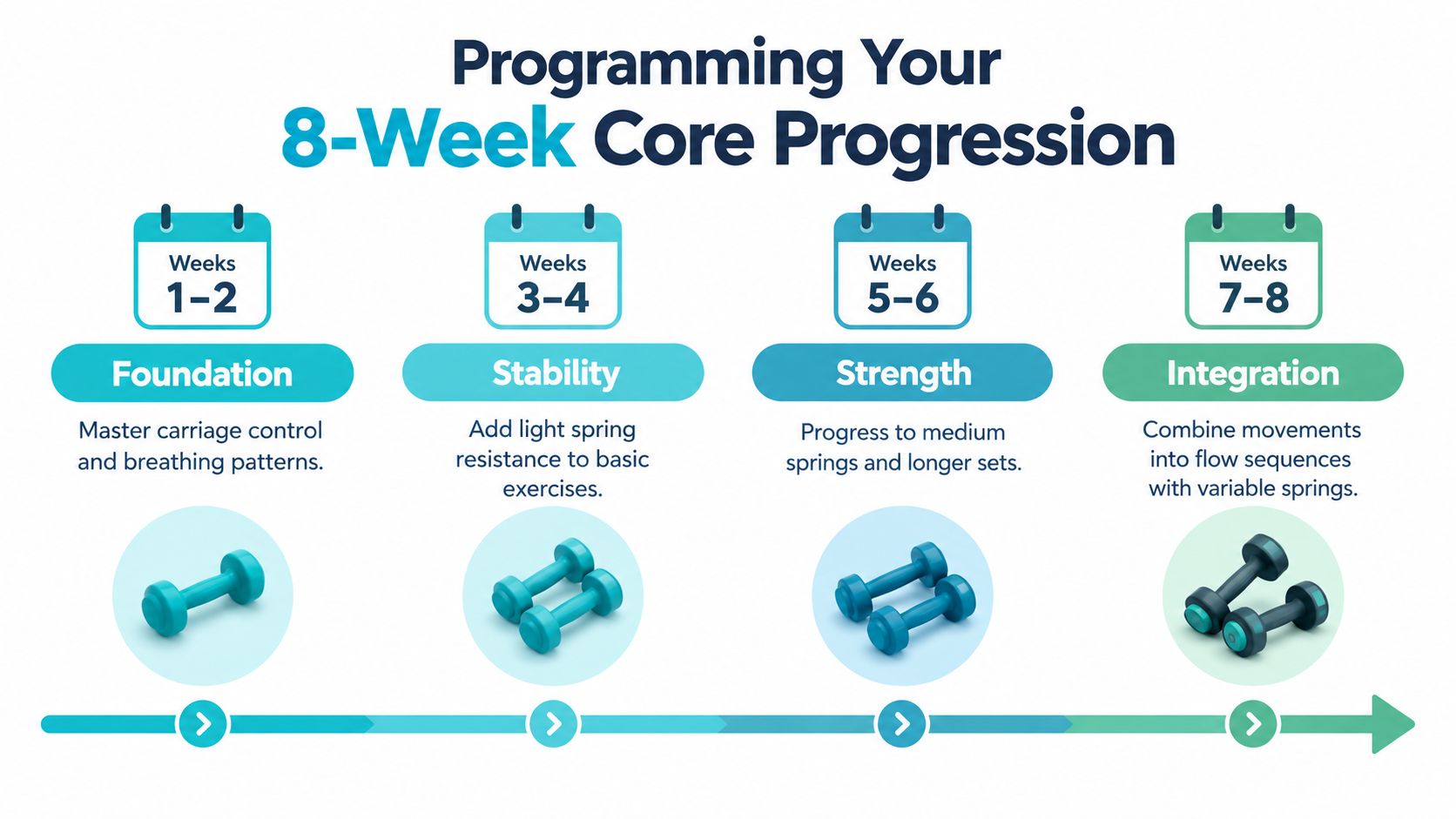
A clean 8-week framework is enough to teach the body what to do, as long as the work is repetitive and progressive. I like to keep the first two weeks about carriage control and breathing, then spend weeks three and four on stability with light resistance. Weeks five and six can build strength with medium springs and longer sets, and the final two weeks should blend movements into flow with variable springs.
That progression lines up with the broader evidence that structured multi-week dosing produces measurable core adaptations, while short, inconsistent exposure usually doesn't. The practical takeaway is simple. Twice weekly is a credible target, and the session itself should evolve instead of repeating the same easy pattern forever 12-week protocol.
How to self-correct as complexity rises
Form review earns its keep here. A 60-second clip of a bridge, footwork set, or strap series can reveal rib flare, pelvic drift, or head tension faster than memory can. Thrive X Fitness, a ThriveXDNA offering, provides AI workouts and ~60-second form-clip review, so it fits neatly into an at-home progression when you want a second set of eyes without waiting for a live class.
Use a simple feedback loop:
- Record one set from the side so spine and pelvis are visible.
- Check the return phase for carriage speed and rib control.
- Adjust only one variable next time, usually spring or range, not both.
- Repeat the same pattern until the trunk stays stable under load.
If you want a coach to look at a problem sequence rather than guess at it, a marketplace model can help you find one-off feedback without rebuilding your whole training setup.
The point of an 8-week core plan isn't exhaustion. It's repeatable load, cleaner mechanics, and enough time for the deep stabilizers to change their behavior under pressure.
Common Mistakes and Safety Modifications
The reformer can punish impatience. Poor technique, too much resistance, moving too quickly, or jumping into advanced exercises too soon can lead to muscle strain, joint irritation, or worse pain, and a medical overview flags extra caution for recent surgery, acute injury, osteoporosis, severe disc problems, uncontrolled high blood pressure, balance disorders, dizziness, or nerve symptoms medical overview. For a plain-language look at back pain red flags, the NHS overview of back pain and when to seek help is also useful.
What usually goes wrong
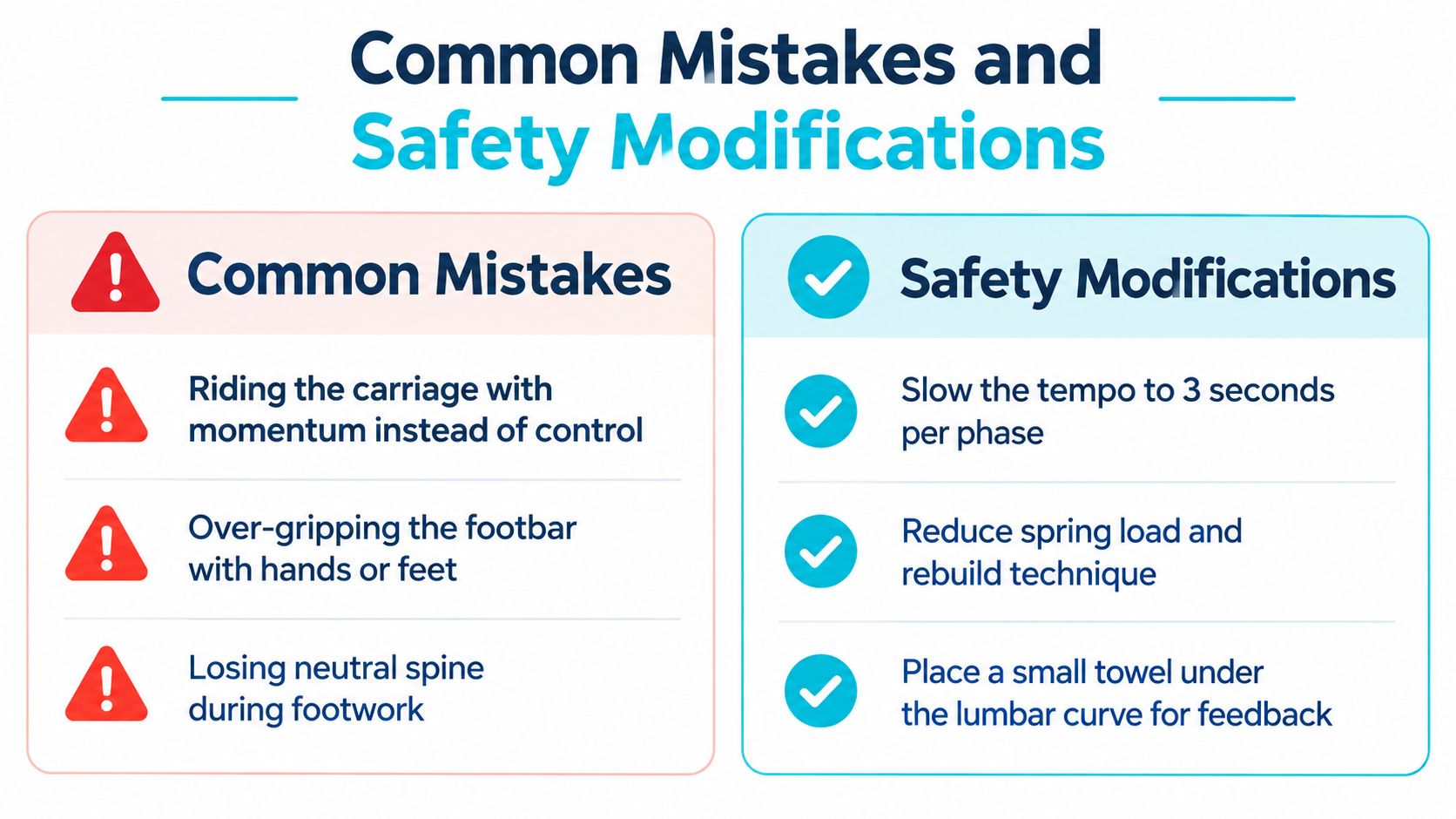
Momentum is the biggest liar on the reformer. If the carriage flies out and slams back, the springs are driving the workout instead of the trunk. The same thing happens when the feet or hands grip too hard, because the body uses the outer chain to survive a setup that should have been organized by the deep core.
A 2023 study also helps explain why resistance choice matters. Heavier spring tension activated deep abdominal and lower-back muscles more effectively in that analysis, but only when the movement stayed controlled 2023 motion-analysis study. Load without control is just noise.
Fast regressions that protect the spine
When the lower back starts talking, reduce the spring and shorten the lever. Slower tempo helps too, and I often use a three-second phase to stop the carriage from becoming a ride. If the pelvis keeps tipping, a small towel under the lumbar curve can give feedback without forcing a rigid hold.
If a client can't keep neutral spine, I'd rather see an easier spring and smaller range than a bigger exercise with a broken pattern.
The common compensation patterns are easy to spot once you know them:
- Hip flexors taking over: the pelvis tips forward and the ribs pop.
- Neck gripping: the chin juts, shoulders rise, and breathing gets shallow.
- Carriage rushing: the return phase loses control and the spring rebounds.
Who should hold back on harder work
People with the caution flags listed in the medical overview should avoid advanced reformer work until they've cleared it clinically medical overview. Recent surgery, acute injury, osteoporosis, severe disc problems, uncontrolled high blood pressure, balance disorders, dizziness, and nerve symptoms all deserve conservative decision-making.
The safest rule is boring, and that's a good thing. Build technique first, then add instability, then add spring complexity. If the body can't keep the spine organized, the reformer isn't being “challenging,” it's being vague.
Summary
The reformer builds core strength by forcing the trunk to organize around a moving carriage and adjustable springs. Setup, spring choice, and tempo all change which muscles work and how clearly they work. Structured multi-week practice gives the body enough time to adapt, while rushed loading and sloppy carriage control push the low back and neck to compensate. Clean form, thoughtful progression, and clip-based feedback keep the work on the deep stabilizers where it belongs.
Frequently Asked Questions
How do I choose the right spring tension for core work?
Use spring tension to match the goal. Heavier settings can increase deep core activation when control is solid, while lighter settings can expose whether the trunk is managing the carriage or just getting pulled around by it. The practical rule is to start with the setting that lets you keep neutral spine, then progress only when pelvic control and breathing stay steady.
How often should I do reformer Pilates for core strength?
The strongest patterns in the research come from structured multi-week work, especially programs done twice per week over 8 to 12 weeks 12-week protocol. Short, inconsistent sessions are less likely to create measurable change. The reformer responds best when the body sees repeated, controlled loading over time.
What if my lower back hurts during carriage work?
Stop chasing range and reduce the spring. Back off the speed, shorten the lever, and check whether the ribs are flaring or the pelvis is tipping. If you still can't keep control, use a simpler variation and rebuild from there. The machine should challenge the trunk, not force the lumbar spine to brace for everything.
How can digital form review help on the reformer?
A short clip can show carriage speed, rib flare, pelvic drift, and neck tension faster than you can feel them during the set. That matters because the reformer rewards small corrections. AI form review or a coach's eyes can help you adjust one variable at a time, which keeps progression clean and makes the deep stabilizers do the work instead of the outer muscles.
Is the reformer safe for everyone?
No, and that's why screening matters. Recent surgery, acute injury, osteoporosis, severe disc problems, uncontrolled high blood pressure, balance disorders, dizziness, and nerve symptoms call for caution or medical clearance first medical overview. For the right person, with the right setup and load, it's a precise tool. For the wrong setup, it's easy to overload the wrong tissues.
If you want a tighter system for reformer practice, ThriveXDNA gives you tools for AI workouts, form-clip review, and workout planning that can fit this kind of progression. Visit ThriveXDNA and use it to keep your core work structured, visible, and technically clean as the springs get less forgiving.