
If you've got 45 minutes, a timer, and just enough energy to do this properly, the hard part isn't finding motivation, it's stopping a workout from drifting into tired, moderate cardio. A 45 minute HIIT workout only works when the hard parts are hard, the recoveries are honest, and the whole session doesn't leave you wrecked by week three. The goal is simple, build a session that feels demanding without pretending every minute has to be redline effort.
Table of Contents
- Why Most 45 Minute HIIT Workouts Miss True Intensity
- Your Complete 45 Minute HIIT Session Blueprint
- Exercise Selection Form Cues and Intensity Control
- Scaling Progressions and Recovery That Keep You Consistent
- Summary
- Frequently Asked Questions
Why Most 45 Minute HIIT Workouts Miss True Intensity
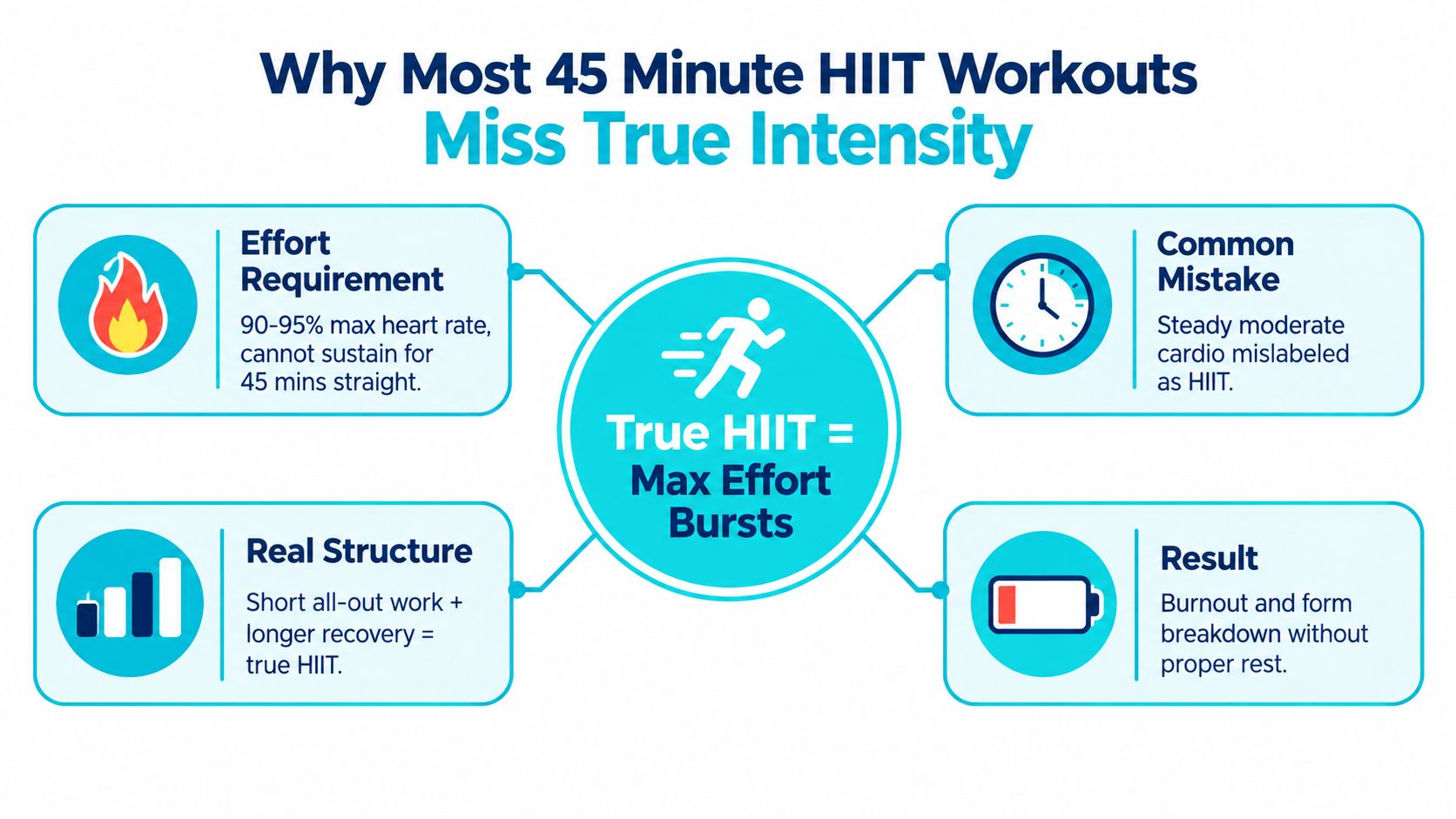
A lot of people call a long workout HIIT when it's really just paced cardio with short breaks. That's the first mistake. True HIIT depends on brief, very hard bursts, and the classic Tabata-style work that helped define the format used 20-second all-out efforts with 10-second recoveries in the landmark work associated with Dr. Izumi Tabata, a protocol later summarized as delivering benefits that compared favorably with about 60 minutes of moderate exercise Nine.
The intensity test
If someone can hold the same pace for the full session, the session probably isn't HIIT in the strict sense. Guidance tied to HIIT prescriptions puts the hard bouts at 80% to 100% of peak heart rate or peak oxygen uptake, or 15 to 18 on a 20-point perceived exertion scale fit.com.au. That's not a comfortable, chatty effort.
Practical rule: if the “hard” work feels sustainable for most of 45 minutes, it's probably too easy.
Why protocol adherence matters
The shape of the workout matters as much as the effort. Research summaries note that outcomes vary with training duration, interval type, and total training time, which is why the same label can describe very different sessions MDPI. A long session only earns the HIIT label if the hard intervals stay hard and the recovery intervals protect that quality.
That's also why a 45 minute HIIT workout should be treated as a mix of true work, active recovery, and cooldown, not as 45 minutes of nonstop suffering. The minimum effective dose idea shows up again and again in the literature, and the practical takeaway is blunt, more time is not automatically better if intensity slips. The best sessions feel demanding, controlled, and repeatable.
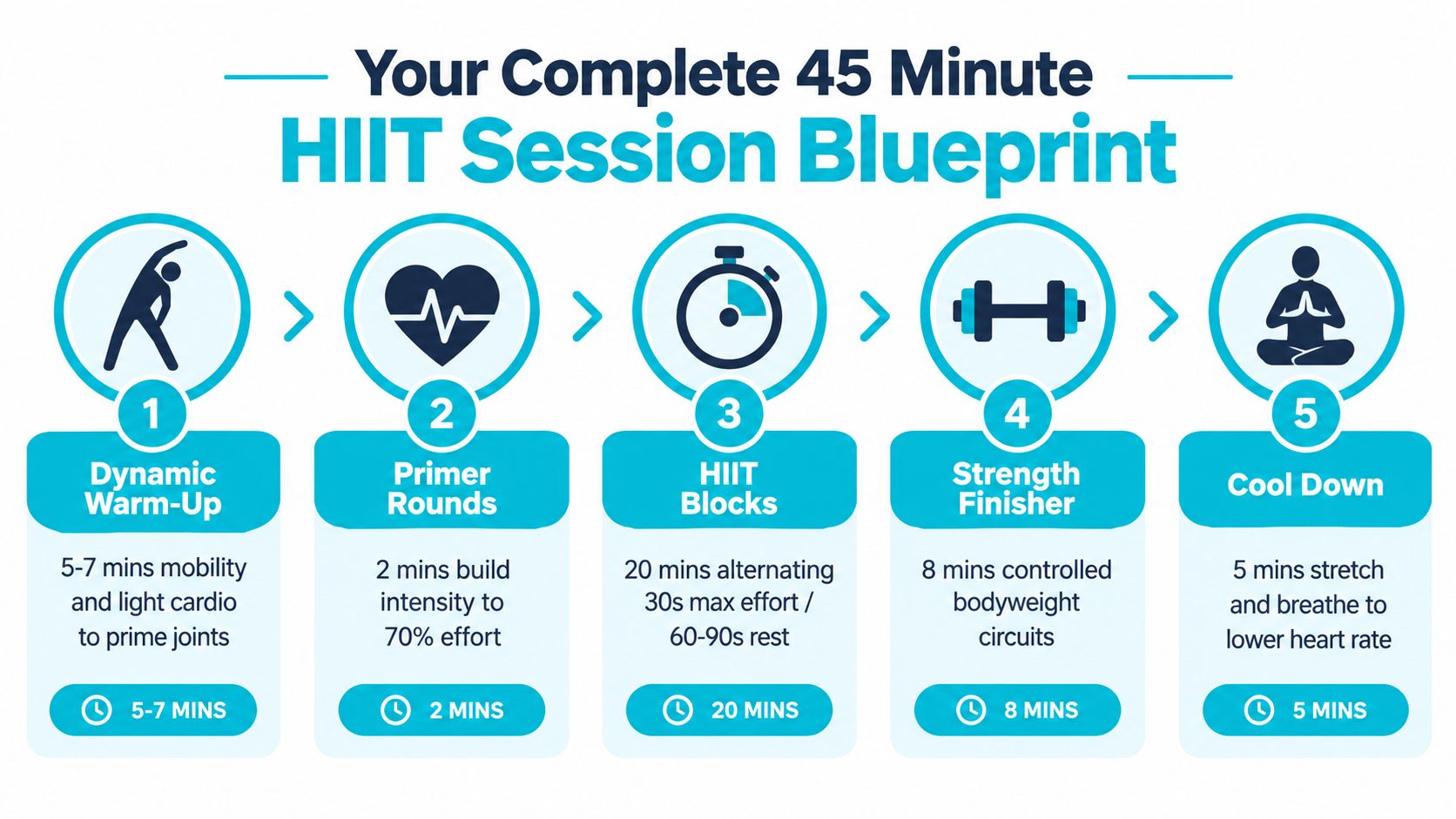
Your Complete 45 Minute HIIT Session Blueprint
A usable 45-minute session has to earn each minute. The warm-up should raise temperature and loosen joints, the work intervals should hit true intensity, the recovery blocks should be long enough to preserve quality, and the cooldown should bring the system back down instead of stopping cold. That's the difference between a smart session and a sloppy one.
A simple session flow
Harvard's 4×4-style example is a clean model: 10 minutes warm-up at about 60% of maximum heart rate, four 4-minute high-intensity bouts at 85% to 95% of maximum heart rate, 3-minute lower-intensity recoveries at about 60%, and a 5-minute cooldown, for a 43-minute session POPSUGAR. Health's reporting on a Nordic-style version points to the same structure, with a session often landing in the 35 to 40 minute range once warm-up and cooldown are counted Health.
| 45 Minute HIIT Blueprint At A Glance | Duration | Intensity Target | Purpose |
|---|---|---|---|
| Warm-up | 10 minutes | About 60% max heart rate | Raise body temperature and prepare joints |
| Main intervals | Four 4-minute rounds | About 85% to 95% max heart rate | Push aerobic and anaerobic output |
| Active recovery | 3 minutes between rounds | About 60% max heart rate | Bring breathing under control without fully resting |
| Cooldown | 5 minutes | Easy pace | Lower heart rate and reduce abrupt stop stress |
A plug-and-play version
A practical 45-minute HIIT session can also be built from shorter work pieces without losing the point. One published template uses 1 to 4 minutes warm-up, 5 to 10 minutes of 30-second sprints and 30-second rests, 11 to 16 minutes of 60-second runs and 60-second recoveries, 17 to 20 minutes of fast walking, then repeats the pattern from 21 to 45 minutes, finishing with a 2-minute cooldown Daily Healthy Body. Another example uses 20 seconds of all-out work and 10 seconds of rest, repeated eight times for 4 minutes, with a 5-minute warm-up before the interval block Dave Scott Inc..
Coach's note: don't stretch the “work” blocks just to make the clock feel full. Stretch the recovery instead if the quality of the hard reps starts falling apart.
Exercise Selection Form Cues and Intensity Control
The exercise choice should make it possible to move explosively without losing shape. Squat patterns, push patterns, hinges, rows, and core work all work well because they're easy to scale and easy to recognize when fatigue starts changing the rep. The mistake is picking fancy movements that look athletic but fall apart once the heart rate climbs.
What to choose and what to avoid
Bodyweight and minimal-equipment moves are enough if they're hard enough. Dumbbell goblet squats, step-ups, reverse lunges, push-ups, rows, shoulder presses, glute bridges, and plank variations all fit the job because they let you stay focused on output instead of setup. When a load is involved, keep it light enough that form doesn't collapse halfway through the interval.
Breathing cue: if you can't reset your breath during recovery, the rest block is too short or the work block is too long.
How to control effort
Use the heart-rate and perceived-exertion targets together. The hard pieces should live in the 80% to 100% effort zone from the ACSM-style guidance, or land around 15 to 18 out of 20 on perceived exertion fit.com.au. If the interval feels strong but controlled, you're probably close. If you're cruising, you're not there yet.
A simple self-check also helps keep the workout honest. Review a short clip after training, then compare how your squat depth, trunk position, and landing control looked on the first and last rounds. Thrive XDNA's Thrive X Fitness app is one option that combines AI workouts with ~60-second form-clip review, photo and barcode nutrition tracking, meal plans, challenges, and a marketplace for coaches and members ThriveXDNA. Use that kind of feedback loop to spot the moment when speed starts stealing form.
Cues that keep intervals hard and safe
- Set the ribs and brace early: a loose trunk makes every rep leak power.
- Own the first two reps: if they're messy, the rest of the interval will only get worse.
- Choose repeatable moves: a good HIIT exercise is one you can do again with the same quality.
- Stop chasing burn when mechanics slip: the session should feel hard, not chaotic.
The point is not to survive the interval. The point is to repeat quality under pressure, then recover enough to do it again.
Scaling Progressions and Recovery That Keep You Consistent
Not every body should run the same 45-minute prescription. Older adults, beginners, returning lifters, and people with joint history need different loading, different impact, and sometimes a different total dose. That's not a compromise, it's the way you keep the workout in the routine long enough for it to matter.
Compare the main options
A 4×4 style session fits people who already tolerate hard cardio and can stay composed under fatigue. A shorter interval pattern works better for beginners who need cleaner movement and more rest. A mixed approach with low-impact swaps is often the safest bridge for people coming back after time off.
Older-adult research summarized by Health reported that three weekly 45-minute sessions led to greater body-fat-percentage reduction and better muscle retention than low-intensity stretching and balance work, while matching moderate treadmill exercise for fat loss Health. That doesn't mean everyone should copy the same setup. It does show that structure and recovery matter as much as effort.
Who should scale what
- Beginners: shorten work to 20 seconds, extend rest to 90 seconds, and keep frequency modest. This protects form while you learn how hard true hard work feels.
- Intermediate trainees: add rounds or light dumbbells only when the movement stays crisp from start to finish.
- Returning lifters: keep the exercise list simple and resist the urge to turn HIIT into an ego test.
- Joint-sensitive exercisers: swap impact for low-impact versions and preserve the interval structure instead of forcing jumps.
The adherence and injury picture supports that caution. A cohort study in obese women with early-stage knee osteoarthritis found only 34% reached a high-adherence threshold, while a feasibility trial in people with Parkinson's reported 78.4% adherence with wide variability PHRIR. The same paper also reported 127 HIIT-related injuries among 74 participants, with an injury prevalence of 46.5% and an estimated incidence of 3.3 per 1,000 hours PHRIR. That's a strong reminder that consistency depends on whether the format fits the person.
Recovery rules that keep the plan alive
If the session is intense enough to count, recovery has to be real. A workable pattern is to leave time between sessions, keep sleep steady, and track whether soreness is resolving instead of accumulating. If form breaks early, your current dose is too aggressive.
Simple recovery test: if you're dreading every session and your reps are getting sloppier, the plan is too hard, not too easy.
The right version of a 45 minute HIIT workout leaves you able to come back and do it again without pain, burnout, or a week off. That's the benchmark that matters.
Summary
A real 45 minute HIIT workout is built around true hard intervals, not steady effort disguised as intensity. The best versions use a warm-up, repeated work blocks, active recovery, and a cooldown that protects output and form. Heart rate and perceived exertion help confirm you're in the right zone, while exercise choice and scaling decide whether you can repeat the plan without breakdown. Consistency comes from matching the session to the person, not forcing every workout to feel maximal.
Frequently Asked Questions
Should a 45 minute HIIT workout be hard the whole time?
No. The hard parts should be hard, but the session also needs warm-up, recovery, and cooldown. If every minute feels like a redline effort, you'll usually lose intensity before the workout ends. The better approach is to make the work intervals demanding enough to hit the proper effort zone, then use the recovery blocks to preserve quality for the next round.
How do I know if I'm doing true HIIT?
Look at effort and recovery together. HIIT hard bouts are typically prescribed at 80% to 100% of peak heart rate or peak oxygen uptake, or around 15 to 18 on a 20-point perceived exertion scale fit.com.au. If the pace feels sustainable for a long stretch, it's probably too easy. If you can repeat the work with strong form and real fatigue, you're closer.
Can beginners do a 45 minute HIIT workout?
Yes, but they should scale it. Shorter work intervals, longer rest, and simple movements are the safer way in. Beginners should focus on maintaining good mechanics instead of copying advanced volume. The point is to build tolerance and consistency, not to prove they can survive a workout that's too aggressive for their current level.
What if my joints don't like jumping?
Keep the interval structure and swap the impact. The same session can be done with squats, step-ups, hinges, pushes, rows, and core work without forcing jumps. The evidence on adherence and injury tolerance shows that joint status matters, so a lower-impact version is often the smarter long-term choice PHRIR.
How often should I repeat this workout?
The best frequency is the one you can recover from and repeat with quality. The literature and the older-adult trial both point to recovery as part of the program, not an afterthought Health. If you're dragging into every new session or your form is falling apart, the frequency is too high for your current capacity.
ThriveXDNA gives you a way to turn that structure into something you can follow, with AI workouts, form-clip review, nutrition tracking, meal plans, and tools that help coaches and members stay organized. If you want a cleaner way to build, track, and adjust a 45 minute HIIT workout without guessing, visit ThriveXDNA and see how the Thrive X Fitness app fits your training.