
Most lifters hear zinc supplements bodybuilding and jump straight to the same claim, that zinc is basically a legal steroid. That's the wrong starting point. Zinc only looks dramatic when someone starts from low zinc status, because the mineral is mainly a correction tool, not a universal muscle-builder.
That distinction matters. If your intake is already adequate, more zinc usually doesn't push testosterone higher or make training adapt faster. If your intake is low, the body can respond quite differently, and that's where the supplement gets its reputation.
Table of Contents
- The Zinc Myth Most Lifters Still Believe
- What Zinc Does Inside a Hard-Training Body
- Deficiency vs Replete Evidence and Why It Changes Everything
- Zinc Picolinate, Citrate, Sulfate and ZMA Compared
- Dosing, Timing and the Interactions You Cannot Ignore
- Testing Zinc Status the Way Coaches Use It
- A Practical Zinc Protocol for Bodybuilders
- Summary and Frequently Asked Questions
The Zinc Myth Most Lifters Still Believe
The gym-floor version of zinc is simple, and wrong in the way good marketing often is. People talk about it like a switch for more testosterone, better pumps, and faster muscle gain. The actual evidence points in a different direction, because zinc's effect depends on whether the body is deficient or already replete Prasad et al..
A spark plug is a useful comparison. If the engine is healthy, a fancier plug does not turn it into a race car. If the plug is worn and misfiring, fixing it restores normal ignition. Zinc works more like that second case, a repair nutrient for a bottleneck, not a standing boost for everyone.
Why the shortcut story falls apart
The strongest bodybuilding evidence does not support the idea that extra zinc beyond recommended intake reliably improves performance. In resistance-trained men, ZMA raised serum zinc only modestly and non-significantly, and it did not significantly change hormones, body composition, bench press, leg press, muscular endurance, or cycling anaerobic capacity Wilborn et al..
A later exercise review reached the same bottom line. It found no experimental evidence that zinc beyond recommended intake improves training adaptations in athletes.
That does not make zinc useless. It means the right question is not, “Should every lifter take more zinc?” The better question is, “Is zinc one of the things limiting this lifter right now?”
Practical rule: if your intake is already solid, zinc is unlikely to be the missing muscle-building piece.
The rest of this guide uses that deficiency-correction model. That lens keeps you out of supplement marketing traps and makes the decision process much clearer.
What Zinc Does Inside a Hard-Training Body
Testosterone, repair, defense, recovery
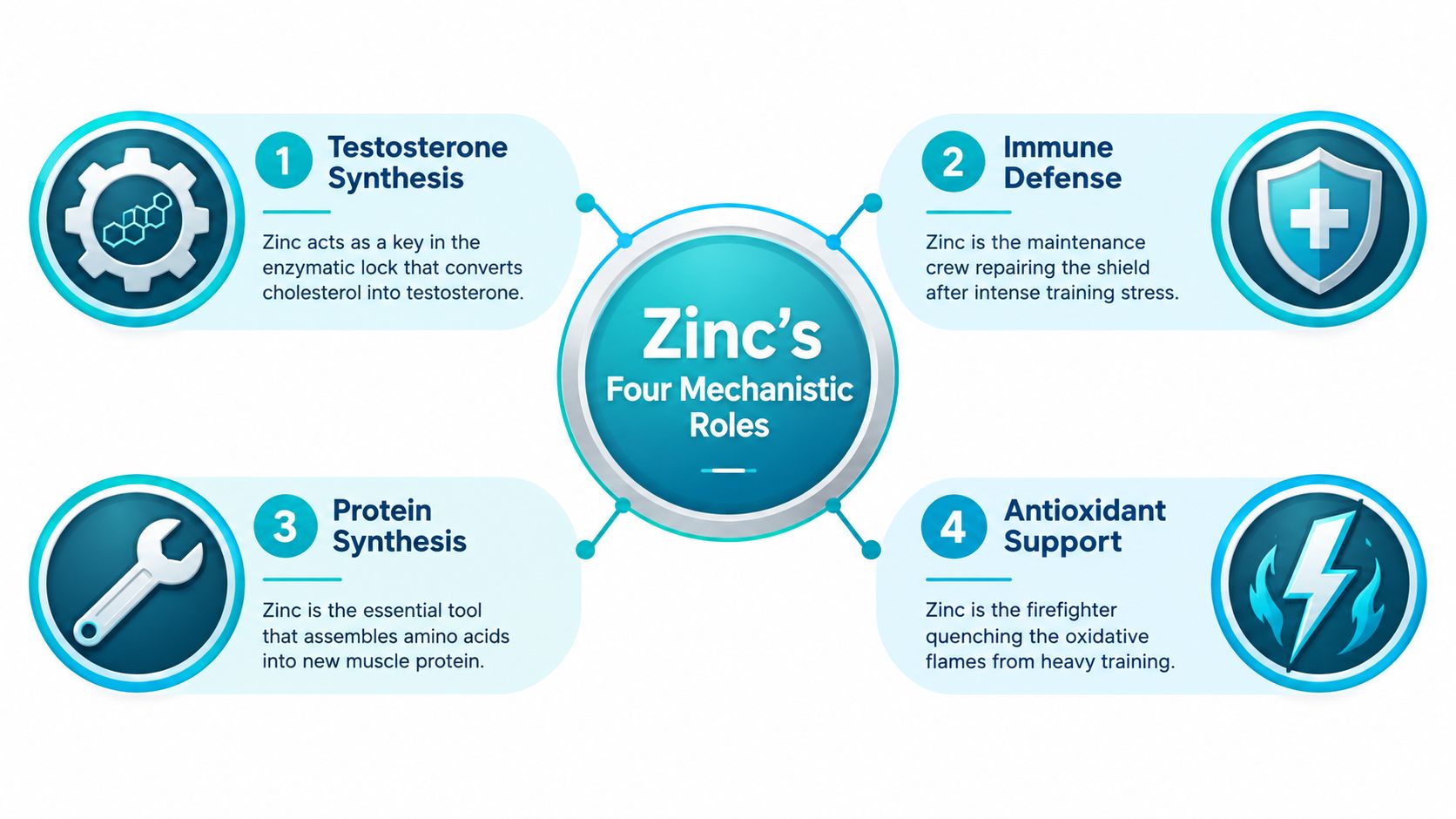
Zinc matters because hard training asks a lot from the body at once. It supports testosterone synthesis, helps regulate protein synthesis, assists immune defense, and contributes to recovery balance. Those pathways explain why low zinc can feel like “poor recovery” even when the issue is a mineral bottleneck, not a missing stimulant.
Zinc is a cofactor, not the finished product. In hormone production, it helps keep the steroid-making machinery running. When zinc status is low, that machinery slows down. When zinc is already adequate, adding more does not keep pushing output higher.
The same logic applies to muscle repair. Zinc takes part in gene expression and transcription-related processes that help the body decide which proteins get made and when. A useful comparison is a permit office stamping construction blueprints. Without the stamp, the build stalls. Once the stamp is there, more stamps do not speed the work.
How the body uses it during training stress
Hard sessions also tax the immune system and the oxidative-stress response. Zinc supports the cleanup work that follows, much like a maintenance crew clearing debris after demolition. That is one reason low intake can show up as sluggish recovery rather than only a lab result.
The practical question is not whether zinc has a role. It does. The question is whether a given lifter is low enough to benefit from correction. That is why increase testosterone with home testing is a useful resource, it treats testosterone as something to verify, not guess about. That same mindset fits zinc.
The takeaway is straightforward. Zinc supports the systems training stresses, but extra zinc is unlikely to matter much in someone who already has enough on board.
Deficiency vs Replete Evidence and Why It Changes Everything
Zinc only makes sense in bodybuilding when you separate low-status lifters from those who are already replete. If zinc is missing, correcting it can change hormones. If zinc intake is already adequate, more zinc usually has little to offer. That is the core issue, and it is why supplement marketing overstates the mineral's value.
What changes when zinc is low
In a landmark study, experimentally induced zinc restriction in healthy young men for 20 weeks caused serum testosterone to fall by about 73%, while plasma zinc dropped by about 50% Prasad et al.. In marginally zinc-deficient elderly men, six months of zinc supplementation raised testosterone from 8.3 ± 6.3 nmol/L to 16.0 ± 4.4 nmol/L with p = 0.02 Prasad et al.. A 2021 synthesis reached the same general conclusion, deficiency can impair testosterone synthesis, and supplementation can bring levels back toward the normal physiological range 2021 synthesis.
That is the correction model. A lifter with low intake, high sweat loss, or a restricted diet may improve recovery or endocrine markers after zinc intake is fixed because the body was missing a component and finally got it back.
What happens when zinc is already adequate
The replete-side evidence is far less dramatic. In experienced resistance-trained men, ZMA did not significantly change hormones, body composition, strength, endurance, or cycling output, even though serum zinc rose only modestly Wilborn et al.. A review of exercise biology drew the same practical conclusion, there is no experimental evidence that zinc above recommended intakes improves training adaptations in athletes.
| Zinc Trials in Lifters | Deficient vs Replete Outcomes |
|---|---|
| Study Population | Baseline Zinc Status |
| Dose & Duration | Testosterone Change |
| Strength/Muscle Outcome | |
| Healthy young men under restriction Prasad et al. | Zinc dropped under restriction |
| 20 weeks of restriction | Testosterone fell about 73% |
| Deficiency created a clear hormonal deficit | |
| Marginally zinc-deficient elderly men Prasad et al. | Low at baseline |
| Six months of supplementation | Testosterone rose from 8.3 ± 6.3 to 16.0 ± 4.4 nmol/L |
| Hormonal correction was measurable | |
| Resistance-trained men using ZMA Wilborn et al. | Mostly adequate |
| Supplementation period in the trial | No significant hormone or strength change |
| No significant bench, leg press, endurance, or body-composition benefit |
Practical rule: if you are already well fed and recovering normally, extra zinc is unlikely to move strength numbers.
This is why the first job is not picking a bottle. The first job is deciding whether zinc deficiency is plausible.
Zinc Picolinate, Citrate, Sulfate and ZMA Compared
Bodybuilders usually meet four names first, picolinate, citrate, sulfate, and ZMA. They are not equal in stomach feel, ease of use, or how cleanly they fit a practical stack. The useful way to compare them is elemental zinc, likely absorption, tolerability, and whether the extra ingredients serve a purpose.
What the forms really mean
Zinc picolinate and zinc citrate are the most practical everyday choices when the goal is correcting status. They are common, usually well tolerated, and straightforward to slot into a supplement routine. Zinc sulfate can still do the job, but it is often the least comfortable option if stomach tolerance matters.
ZMA is not a stronger zinc form. It is a product format that combines zinc with magnesium and vitamin B6. That may suit someone who also wants magnesium, but it does not turn zinc into a better muscle-building tool. If magnesium is already covered, ZMA often adds cost without changing the zinc outcome.
The comparison is simpler than the marketing suggests. For intake correction, the best default is picolinate or citrate in the 15 to 30 mg elemental zinc range per serving. If magnesium intake is already adequate, standalone ZMA usually adds little. If budget is the main constraint, sulfate is the fallback rather than the first choice.
| Zinc Form Comparison for Bodybuilders | |
|---|---|
| Form | Best For |
| Picolinate | Routine correction of low intake, simple stack design |
| Citrate | Routine correction with good tolerability |
| Sulfate | Budget-first use when price matters most |
| ZMA | People who also want magnesium and B6 in the same product |
A reader who wants more context on how to choose recovery supplements may also want to compare with how to choose recovery supplements, because the key question is rarely one mineral by itself. It is whether the whole stack matches the training problem.
Dosing, Timing and the Interactions You Cannot Ignore
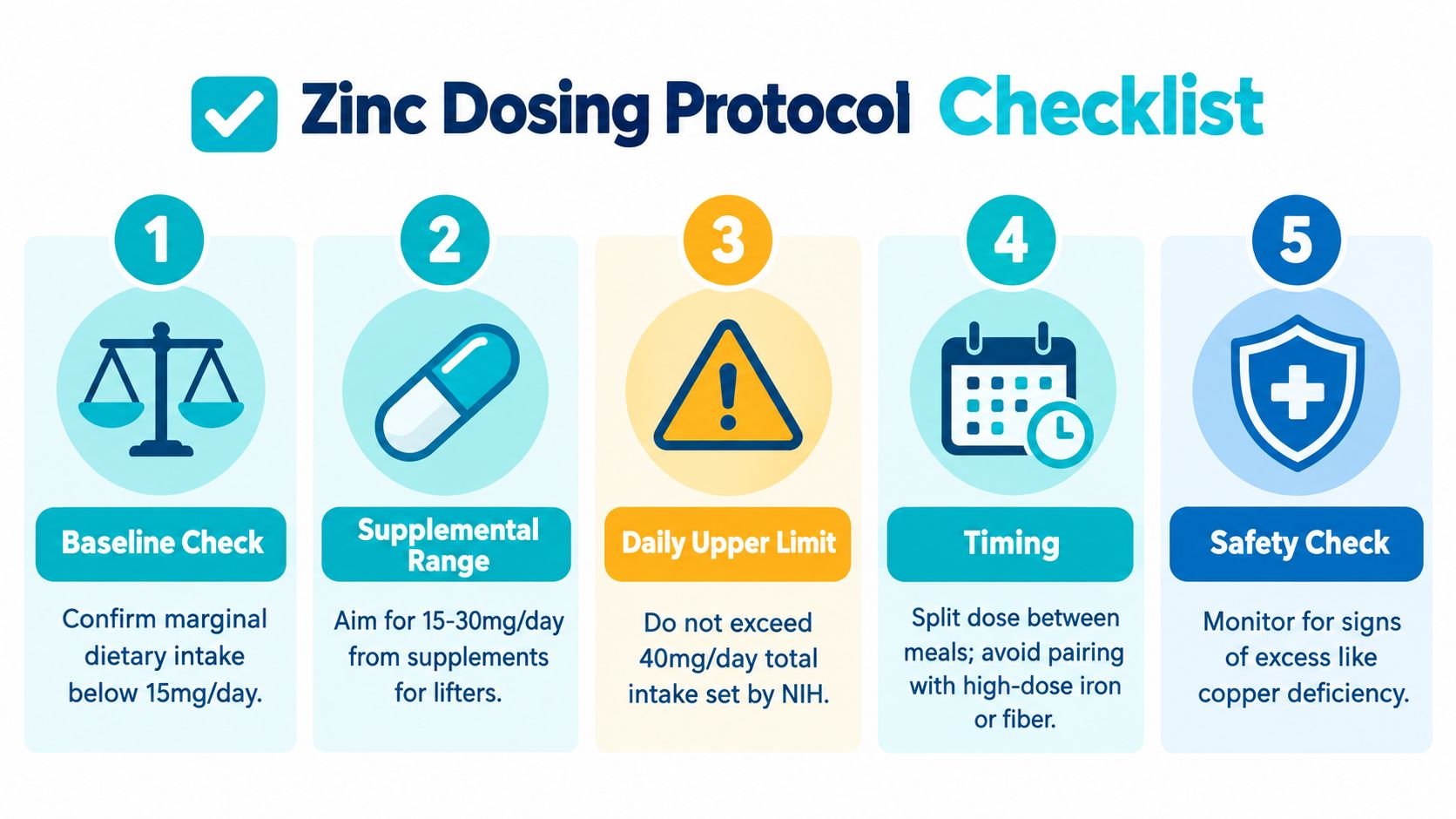
For adult men, the recommended dietary allowance is 11 mg/day, and the adult upper limit is 40 mg/day from all sources combined NIH zinc fact sheet. That ceiling matters because lifters often combine a multivitamin, pre-workout, and a ZMA-style product without noticing how quickly the total adds up NIH UL reference.
A workable daily protocol
A practical supplemental range for lifters with marginal intake is 15 to 30 mg/day. That usually stays below the upper limit while still giving a meaningful repletion dose for someone who needs it. If a dose pushes toward the higher end, splitting it can reduce nausea and make the routine easier to tolerate.
Zinc absorbs better away from meals heavy in phytates, which are common in whole grains and legumes. A fasted window or a post-workout window works well if you train without food. If you train with food, taking zinc with a lighter meal is often easier than pairing it with a high-phytate plate.
The three interactions that trip people up
- Copper balance matters. Chronic high zinc can reduce copper status, so if you supplement for longer than about eight weeks, adding 1 to 2 mg copper is a sensible guardrail in many stacks NIH UL reference.
- Iron competes with zinc. Non-heme iron and zinc can get in each other's way, so separate them by at least a couple of hours.
- Antibiotics are a real issue. Zinc interacts with quinolones and tetracyclines, so those need spacing too NIH zinc fact sheet.
Simple stack rule: keep total zinc under the adult upper limit, take it away from heavy phytate meals, and don't pair it with copper, iron, or certain antibiotics at the same time.
Testing Zinc Status the Way Coaches Use It
Coaches do not judge zinc status from one symptom. Low energy, slower recovery, poor appetite, frequent illness, or a restricted diet are prompts to test, not proof. The usual screening lab is serum zinc, even though it is still only a single marker.
How to read the number without panicking
Serum zinc is most useful as a screening tool. A result below 70 µg/dL suggests deficiency that deserves attention, 70 to 100 µg/dL is generally adequate, and a result above 100 µg/dL suggests current intake is sufficient. Serum zinc can also fall after meals and during illness, so timing matters zinc testing guidance.
A fasted morning sample is usually the cleanest draw. It also makes sense to wait until an acute infection has passed before testing zinc testing guidance. Even then, the result should be read alongside the training and diet picture, because a normal serum value does not fully rule out a functional issue.
Who should test before supplementing
Athletes with high sweat losses, restrictive diets, or chronic digestive issues should test rather than guess. That is especially true when the pattern looks more like under-recovery than under-training.
If you want a service-oriented route for performance labs, Telomyx health and performance testing shows how testing can be framed around coaching decisions instead of supplement hype.
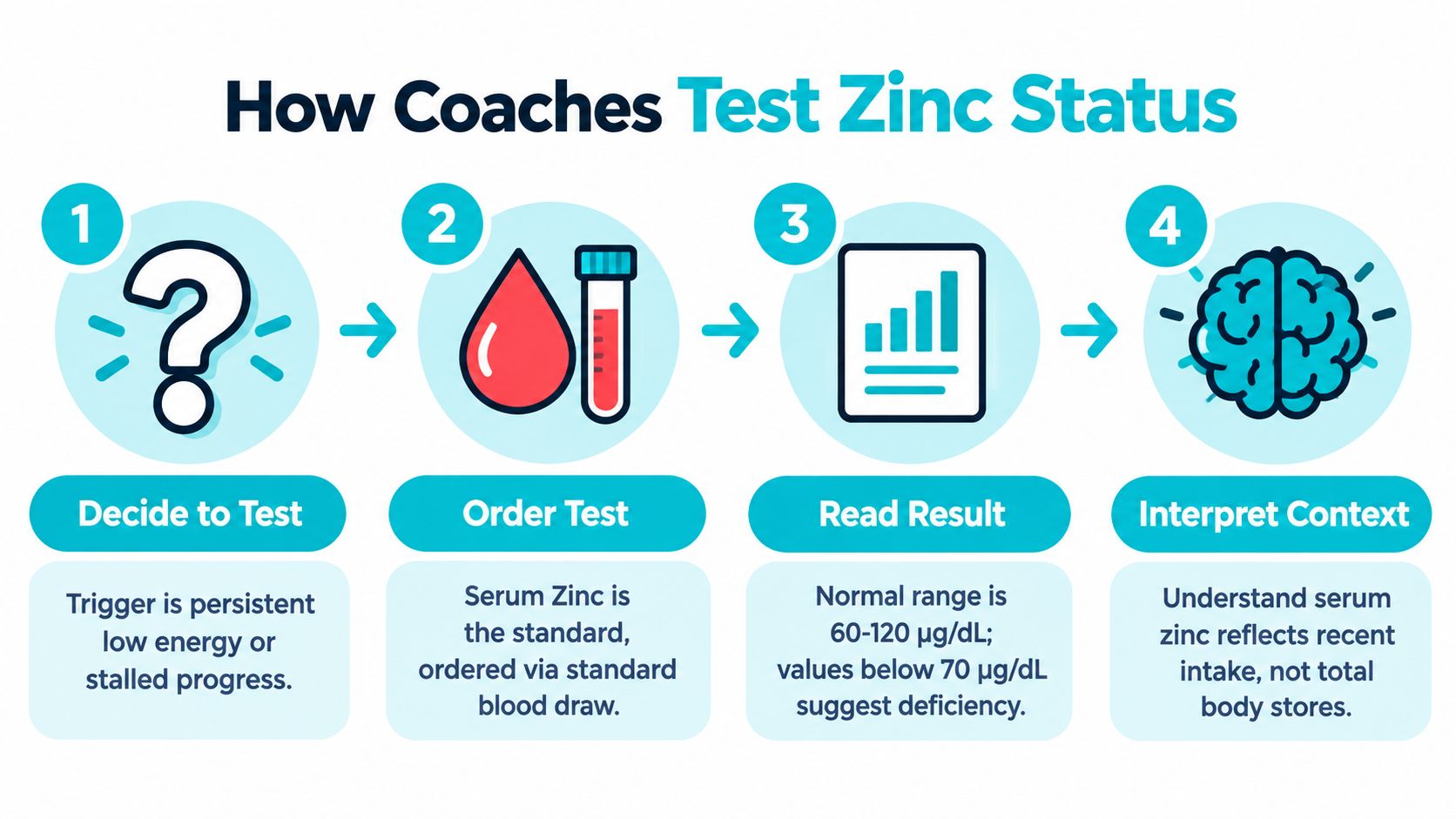
The main mistake is treating serum zinc like a final verdict. It works better as a starting point, then a follow-up check after the protocol has had time to change intake and status.
A Practical Zinc Protocol for Bodybuilders
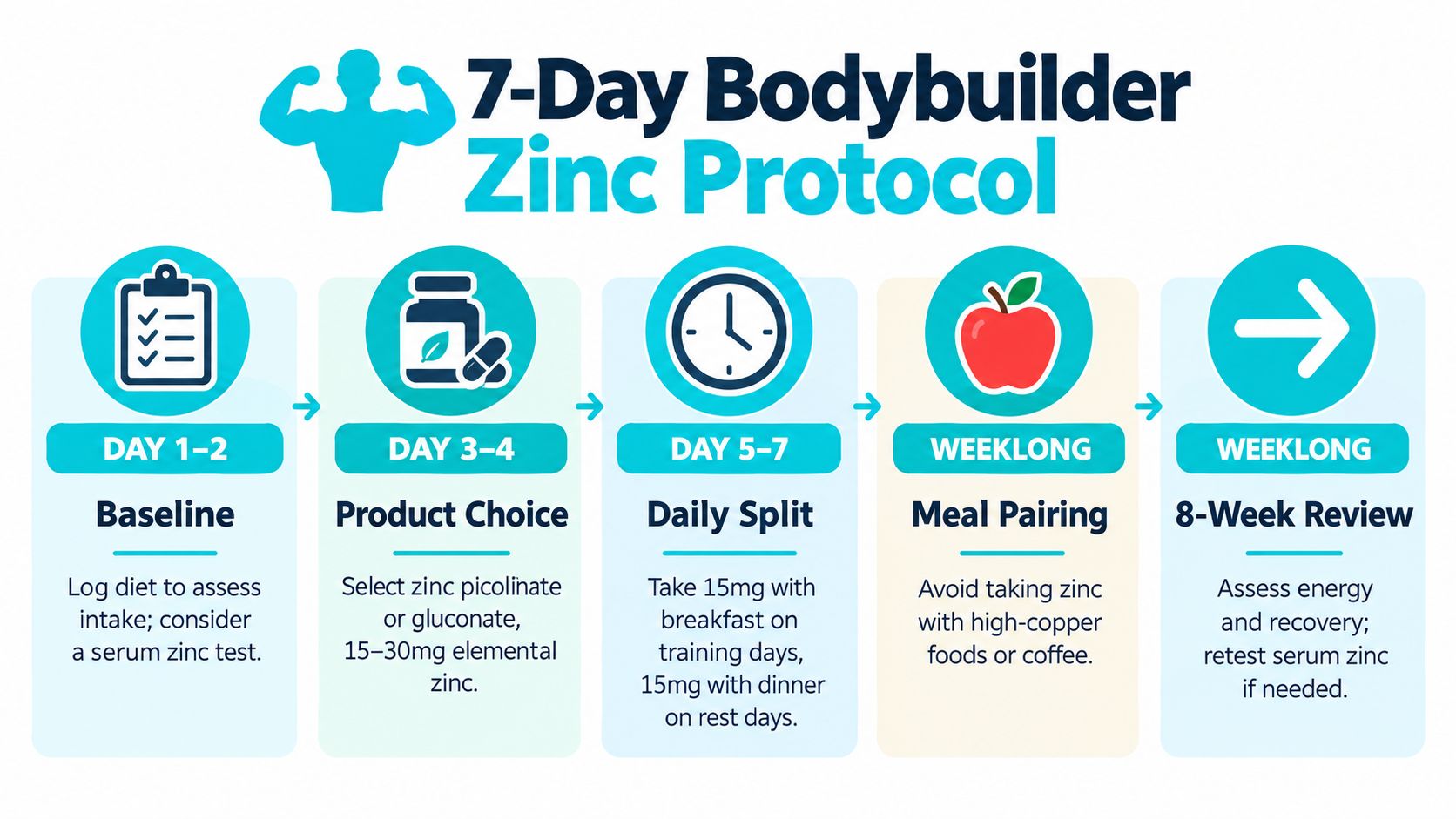
Start with food, then use a supplement only if the diet still leaves a gap. A quick food audit often shows the actual issue, which is inconsistent intake of zinc-rich foods rather than some hidden need for more pills. If the pattern still looks thin, a serum zinc test is the next step.
A simple seven-day setup
For many lifters, zinc picolinate or citrate in the 15 to 30 mg elemental zinc range is the least complicated choice. If magnesium is already covered, a separate ZMA product usually adds little. Dinner is a practical default because it fits normal routines and is easier to keep consistent.
Timing is flexible. A post-workout or evening dose is fine if the stomach tolerates it, and on rest days it is better taken with a meal that is not paired with iron or very phytate-heavy foods. Plant-forward diets can make absorption less efficient, so spacing zinc away from the highest-phytate meal is a simple fix.
When to stop, adjust, or retest
If the goal is to confirm a change in status, retest at 8 to 12 weeks. That window gives the protocol enough time to matter without overreacting to short-term shifts from food, illness, or hard training.
If supplementation continues beyond that, watch the whole mineral picture, not just zinc alone. Nausea, an odd metallic taste, or signs that iron markers are drifting in the wrong direction are reasons to reduce the dose and reassess.
Athletes who train twice a day, sweat heavily, or eat mostly plant-based diets deserve a closer look at zinc intake because demand can run higher. That does not make zinc magic. It just means the margin for error is smaller, and recovery planning needs the same discipline as the rest of the stack. The article on how to choose recovery supplements helps put zinc in context with the other choices lifters usually add around training.
Summary and Frequently Asked Questions
Zinc supplements bodybuilding works best as a deficiency-correction strategy, not as a universal anabolic shortcut. If zinc status is low, bringing it back into range can support normal hormone function and recovery. If status is already adequate, extra zinc usually adds little. For most adults, keeping total intake under the 40 mg/day upper limit and using 15 to 30 mg/day in the right form is the practical middle ground NIH fact sheet. Picolinate and citrate are the most useful everyday forms, and testing beats guessing when recovery, diet, or sweat loss suggest a problem.
Does ZMA still have a place
Yes, but only in narrow cases. ZMA can make sense if someone wants magnesium and vitamin B6 in the same product, but it has not shown better zinc-related performance results in well-fed resistance-trained men Wilborn et al.. If magnesium is already covered, ZMA usually is not adding much.
How long should I supplement before retesting
A retest at 8 to 12 weeks is a reasonable checkpoint. That gives the protocol time to show whether status changed, instead of reacting to short-term noise from meals, illness, or training stress.
Do vegans and endurance athletes need more zinc
They may need to pay closer attention, especially if intake is restricted or sweat losses are high. The issue is not identity alone, it is whether diet and training make deficiency more plausible. Testing is still the cleanest way to avoid overcorrecting.
Why is the upper limit so important
The adult 40 mg/day upper limit exists because higher chronic intakes can impair copper status and cause unpleasant side effects, including nausea and cramping NIH fact sheet. In bodybuilding, overshoot happens easily when multiple products overlap.
Does zinc help acne
Zinc gets talked about a lot in skin discussions, but for lifters the more important point is still intake status. If you are low, fixing it can help normalize a few body systems at once. If you are already adequate, do not expect it to behave like a skin or muscle shortcut.
How does zinc compare with tongkat ali or ashwagandha
They are different tools. Zinc is about correcting a mineral bottleneck, while those herbs are usually discussed as broader stress or hormonal supports. If the actual issue is low zinc, mineral correction comes before chasing adaptogens.
If you want a personalized training and nutrition workflow that ties lab data, recovery habits, and supplement choices together, visit ThriveXDNA. The platform is built around coaching workflows, and that makes it a practical place to organize a zinc decision instead of guessing from forum advice.