


You've entered your ZIP code, compared several Medicare supplement policies, and found something that doesn't make sense. Two insurers offer the same Medigap letter, yet the listed premiums look dramatically different. That's not a reason to panic or automatically choose the cheapest option. It's a sign that you need the right comparison method.
A Medicare supplement plan finder is useful, but it's only the beginning. The reliable approach is simple: choose the standardized plan letter first, compare that same letter across insurers, then confirm the actual offer directly with the carrier. That sequence prevents the most expensive shopping mistake, choosing a familiar company before deciding whether its benefit structure fits your healthcare needs.
Table of Contents
- Why a Medicare Supplement Plan Finder Saves Time and Money
- Eligibility and Enrollment Windows You Must Know First
- How to Use a Medicare Supplement Plan Finder Without Mistakes
- Comparing Benefits and Prices the Right Way
- Smart Tips to Get the Best Value and Avoid Overpaying
- Your Next Move to Lock In the Right Medigap Plan
Why a Medicare Supplement Plan Finder Saves Time and Money
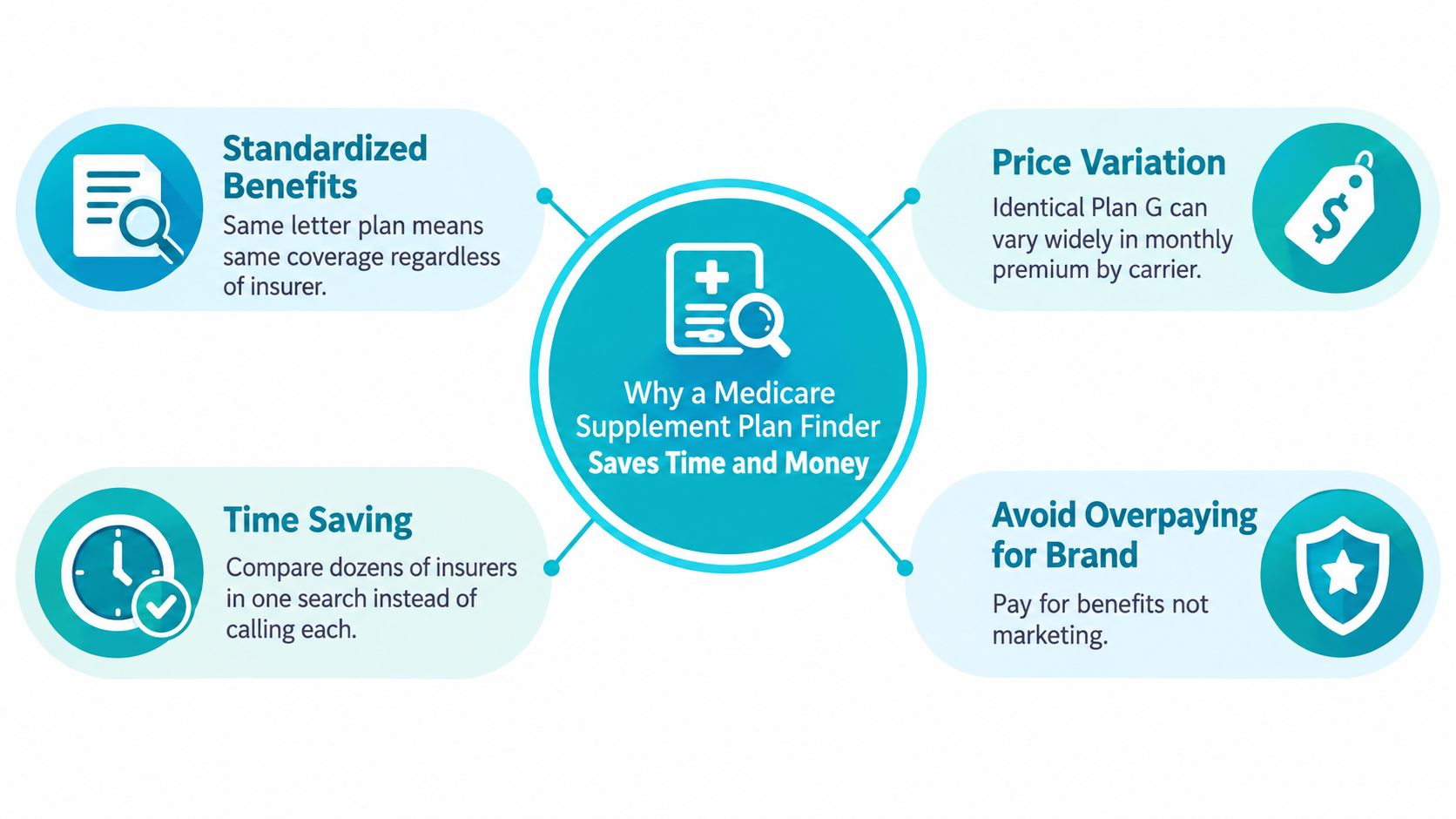
A finder earns its place before you contact an insurer. It filters the market by location, plan letter, and available pricing information, so you can focus your calls on realistic options instead of collecting random quotes.
The plan letter defines the standardized benefit package. The insurer sets the premium and may apply household discounts, use a particular rating method, or offer additional features. A familiar brand does not make its version of the same letter more extensive. Compare the benefits attached to the letter, then examine the carrier's price and enrollment terms.
The finder is a screening tool
Medicare.gov explains that Medigap policies are standardized in most states. Plans use letters, and price often becomes the main difference between companies offering the same lettered plan. That structure makes a finder useful for screening a crowded market before you spend time contacting insurers.
The Centers for Medicare & Medicaid Services launched a modernized Medicare Plan Finder in 2019, calling it the first major upgrade in a decade. CMS also described the tool as the most-used feature on Medicare.gov. The same report said about 25% of Medicare beneficiaries accessed it on mobile devices in 2018, up 40% from 2017 (CMS-related Medicare supplement statistics).
Treat every directory result as an estimate. The listed amount may differ from the carrier's final premium after the insurer reviews your application, confirms your enrollment timing, checks eligibility, and applies available discounts.
The practical rule: Use the finder to narrow your options. Use the carrier quote before you make an enrollment decision.
What the screening process reveals
A useful finder helps you identify which insurers sell the plan letters available in your area and shows how their listed premiums compare. It can expose large price differences that deserve investigation, but it cannot explain every reason behind them.
Review the results for the same letter, check whether the pricing information reflects your circumstances, and record each carrier's contact details. Then ask the insurer to confirm the premium and any rating method, discounts, underwriting requirements, or extra features shown in the listing.
The carrier's response is the quality check. Directory data can become outdated or fail to reflect your eligibility and application details. Confirming the quote protects you from choosing a policy based on an attractive number that the insurer will not honor.
A finder saves time when it reduces unnecessary calls and directs your attention to comparable policies. It saves money when you verify the premium before applying.
Eligibility and Enrollment Windows You Must Know First
Before entering information into any finder, confirm that Medigap is the right type of coverage for you. Medicare supplement policies work with Original Medicare, which includes Medicare Part A and Part B. They aren't designed to supplement a Medicare Advantage plan.
You'll generally want to review your other coverage first. Employer or retiree benefits, Medicaid, Medicare Savings Programs, and other assistance may already address some Medicare out-of-pocket costs. If you're uncertain, ask the benefits administrator or a licensed Medicare professional to explain how the coverage coordinates before you apply for a supplement policy.
Check your Part A and Part B status
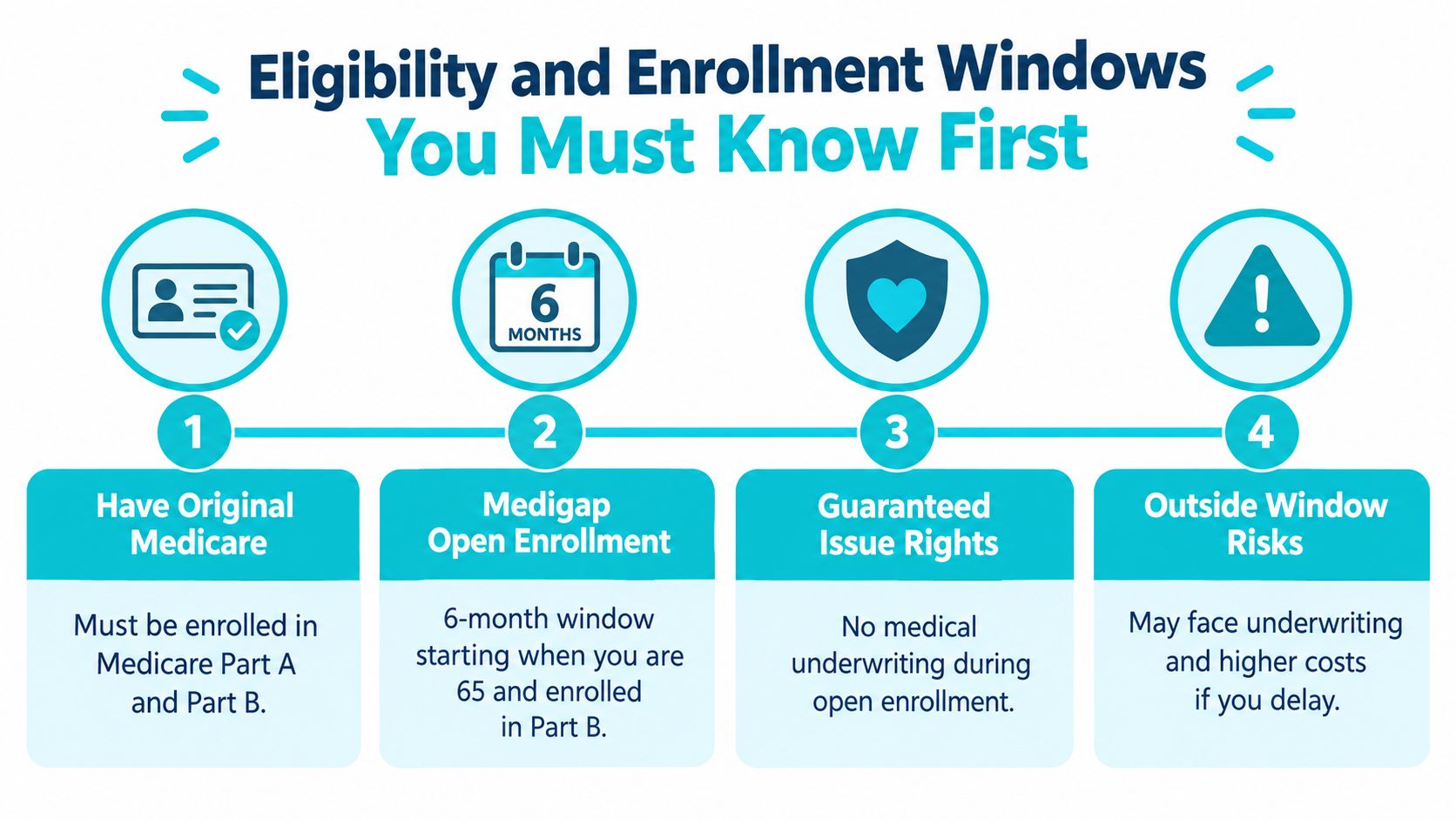
You must have Medicare Part A and Part B to buy a Medigap policy. Your Part B enrollment date is especially important because it determines when your one-time Medigap Open Enrollment Period begins.
Medicare says this window lasts 6 months. It starts during the first month that you're both 65 or older and enrolled in Part B (Medicare Medigap basics). During that period, an insurer can't deny you coverage because of pre-existing health problems.
That protection is valuable because it removes medical underwriting from the initial purchase decision. You can compare plans based on benefits, premiums, and service instead of worrying that a health condition will block the application.
Don't confuse the two enrollment periods
The annual Medicare Open Enrollment Period is associated with changing Medicare Advantage or prescription drug coverage. It doesn't recreate your Medigap Open Enrollment Period each year. Your Medigap window is a one-time opportunity, not an annual reset.
If you wait until the window closes, you may face medical underwriting, higher premiums, or limited availability depending on your circumstances and state rules. You may still have guaranteed-issue rights after losing certain types of coverage, but those rights are situation-specific. Don't assume that waiting is harmless.
Your Part B effective date belongs on your Medicare shopping checklist before you compare a single premium.
If you're also trying to understand public health coverage options for a family member, a separate local resource can help you find NJ Family Care near you. That search is distinct from Medigap, but separating Medicaid-related options from Medicare supplement decisions can prevent duplicate or unsuitable coverage.
How to Use a Medicare Supplement Plan Finder Without Mistakes
The finder works best when you treat it as a controlled research process rather than a shopping cart. Entering your ZIP code and age is easy. The difficult part is deciding what to compare and knowing which displayed details still need verification.
Start with the plan letter
First, identify the benefit structure that fits your expected use of care. Don't begin by sorting carriers or selecting the brand you recognize. Medigap is standardized into 10 plan letters, A, B, C, D, F, G, K, L, M, and N, according to Medicare's plan comparison guidance (Medicare plan benefit comparison).
Review the differences that affect your decisions:
- Cost sharing: Decide whether you prefer more predictable coverage or are comfortable paying a greater share of certain expenses.
- Part B excess charges: Consider whether protection from potential excess charges matters in your area and provider choices.
- Foreign travel: Check whether travel-related emergency coverage is important to your lifestyle.
- Out-of-pocket exposure: Pay particular attention to plans with cost-sharing structures and applicable limits.
The exact choice depends on your situation. A person who values predictable medical costs may look at the tradeoff differently from someone who prioritizes a lower starting premium.
Use the finder for a same-letter search
After choosing the letter, enter your ZIP code, age, and other requested eligibility information. Filter the results to show only that plan letter. If the finder offers sorting, review premiums, insurer information, and available plan details, but don't treat the first result as the answer.
Now compare Plan G with Plan G, or Plan N with Plan N. Don't compare a low-priced Plan N against a higher-priced Plan G and conclude that one carrier is cheaper. Those are different standardized benefit packages.
Request the official quote
Many shoppers stop too early. The public finder is a screening layer. You still need an official quote from the insurer before enrollment because the final premium can be affected by application timing, health status, and discount eligibility.
Ask the carrier to confirm:
- The exact plan letter and policy type.
- The monthly premium and rating method.
- Whether medical underwriting applies.
- Whether household, autopay, or other discounts are available.
- Whether dental, vision, hearing, fitness, or other extras apply.
- The effective date and any application deadlines.
A directory price is a lead, not a promise. The carrier's written or recorded quote is the figure you should evaluate.
A common error is shopping carriers first. Another is trusting a listed price without asking about discounts or underwriting. The two-stage process corrects both problems by forcing you to settle the benefit question before you negotiate the price question.
Comparing Benefits and Prices the Right Way
A useful comparison separates coverage from price. Medicare standardizes each Medigap letter's core benefits, while insurers set premiums, apply pricing methods, and manage applications differently. Evaluate those two layers separately so a low quote does not distract you from the coverage structure.
| Feature | Standardized Benefit | What Varies by Insurer |
|---|---|---|
| Plan letter | Defines the core Medigap benefit package | Availability, application process, and customer service |
| Medical cost sharing | Follows the structure assigned to that letter | Premium, underwriting rules, and pricing method |
| Part A and Part B support | Follows the federal design for the selected letter | Carrier quote and eligibility review |
| Foreign travel benefits | Included only when provided by the selected letter | Premium and policy administration |
| Household discounts | Not part of the standardized letter benefit | Whether the carrier offers and applies a discount |
| Dental, vision, hearing, or fitness extras | Outside the core standardized Medigap package | Availability, eligibility, and terms |
The table shows why a directory's price alone is incomplete. A lower premium may come with more cost sharing, which can suit someone comfortable with variable expenses but create unpleasant surprises for someone who wants steadier medical bills. A higher premium can make sense when its benefit structure better matches the coverage level you want.
You are deciding how much financial uncertainty to accept, not choosing the most recognizable insurer.
Read cost-sharing details before judging value
Plans K, L, M, and N use different cost-sharing structures. Review how each option handles the expenses you are most likely to face, then consider whether those rules would still fit if your healthcare needs increase. The monthly premium is only one part of the price you may pay.
Plans C and F have eligibility limits for people who first qualify for Medicare on or after January 1, 2020. Confirm your eligibility with Medicare or the carrier before treating a directory result or preliminary quote as usable.
Confirm the carrier's quote
Directory listings help identify options, but the insurer must confirm the number you will evaluate. Request a written or recorded quote and ask the carrier to verify:
- The exact plan letter and policy type.
- The monthly premium and rating method.
- Whether medical underwriting applies.
- Whether household, autopay, or other discounts are available.
- Whether dental, vision, hearing, fitness, or other extras apply.
- The effective date and any application deadlines.
A directory price is a lead, not a promise. The carrier's confirmed quote is the figure that belongs in your comparison.
Use the table to judge benefits and cost-sharing first. Then compare the carrier's confirmed premium, underwriting terms, discounts, and policy details. That process exposes the difference between an attractive listing and a price you can rely on.
Smart Tips to Get the Best Value and Avoid Overpaying
A finder can show ten attractive prices and still leave you with the wrong policy. The reliable method has two stages: choose the standardized plan letter first, then compare prices for that same letter. State switching protections and the carrier's confirmed quote determine whether the apparent bargain is usable.
Ask about discounts the finder may miss
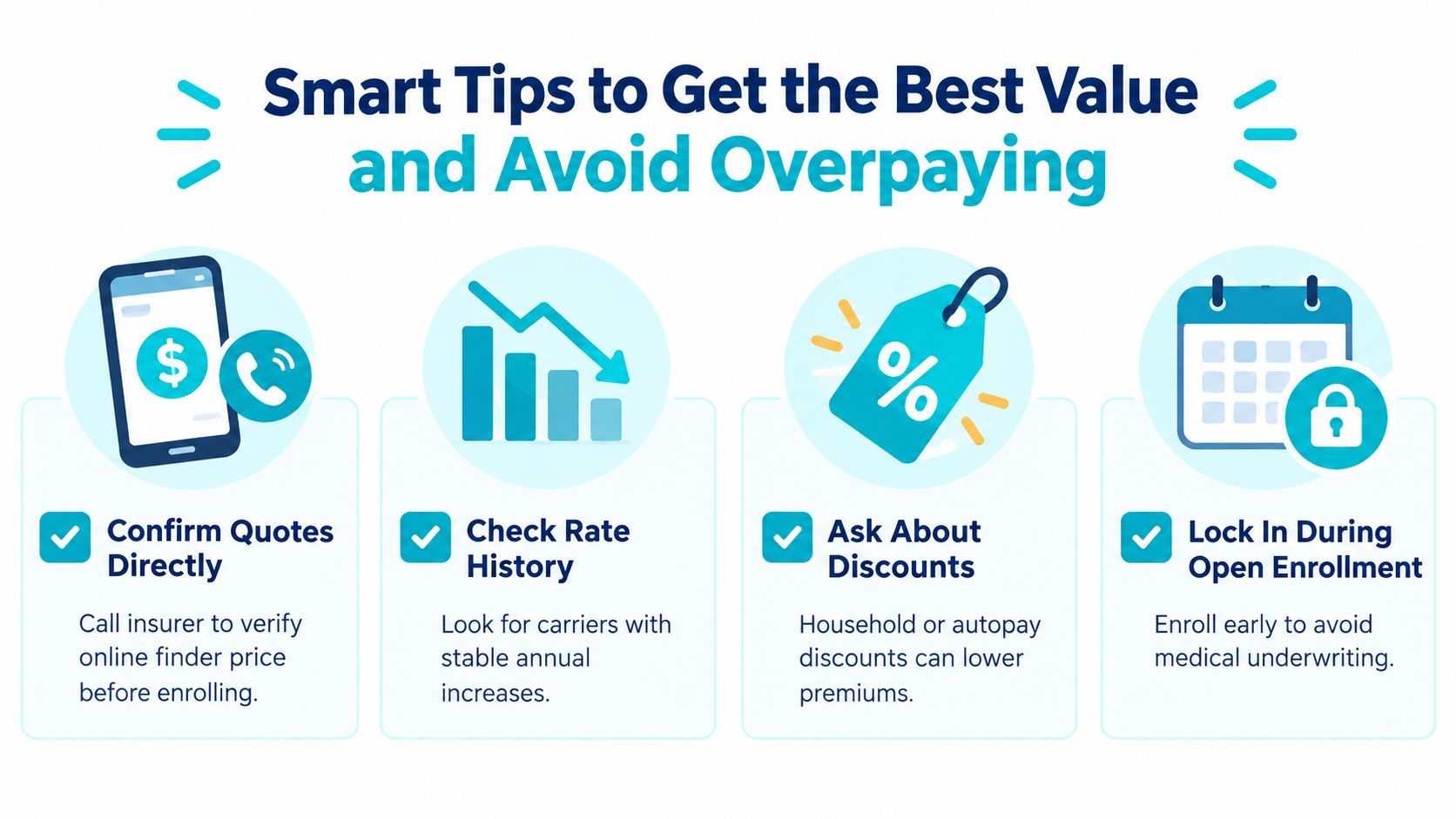
After narrowing your choices, call the insurer. Ask about household discounts, autopay savings, and services connected to the policy. Dental, vision, hearing, or fitness-related extras may not appear fully in the directory, and the carrier must confirm both availability and conditions.
Keep those extras in perspective. They do not change the standardized benefits of the plan letter. Choose the benefit package and premium that fit your needs first, then treat added services as a secondary consideration.
Look beyond the first-year price
A low starting premium does not guarantee the lowest long-term cost. Ask how the carrier prices its policies and how premiums are reviewed. You cannot predict every future adjustment, but you can avoid choosing from the first number shown.
The Medigap market includes many carriers and policy options, so comparison only helps when you compare equivalent plan letters. Industry reporting identifies 13.54 million Medigap enrollees in December 2024, underscoring the size of the market (recent Medigap market reporting). Use that choice to price-shop the same standardized benefits, not to compare unrelated packages.
Check state switching protections
State rules can change the timing and cost of a switch. Published 2026 summaries identify states with some form of birthday-rule or similar protection, including California, Idaho, Illinois, Kentucky, Louisiana, Maryland, Nevada, Oklahoma, Oregon, Utah, Virginia, West Virginia, and Wyoming (state Medigap underwriting rules).
These protections may let eligible residents change plans during a defined period without medical underwriting. Rules vary by state, plan type, and timing. Verify the details before cancelling an existing policy or assuming a later switch will be easy.
Use online tools for speed, not certainty
A Medicare supplement plan finder is excellent for building a shortlist. It is not the final authority on eligibility, underwriting, effective dates, or the premium you will pay. Independent insurance comparison tools can organize initial research before you contact a licensed agent or carrier directly.
Advisor's warning: Never cancel an existing Medigap policy because a directory displays a cheaper alternative. Confirm the carrier's quote and replacement terms first. The carrier should verify the exact plan letter, rating method, discounts, application requirements, and effective date.
Directory prices are leads, not promises. Compare the same letter across carriers, then rely on the written or recorded quote from the insurer that will issue the policy. That two-stage process prevents a low listing from becoming an expensive timing mistake.
Your Next Move to Lock In the Right Medigap Plan
A directory can show a promising price, then the carrier can quote something different. Before enrolling, verify the policy details with the insurer that will issue your coverage.
Check your Medicare status and enrollment rights first. Confirm whether you are within the six-month Medigap Open Enrollment Period or qualify for another guaranteed-issue right. Outside a protected window, ask whether medical underwriting applies before submitting an application.
Use this three-part checklist:
- Verify the quote: Ask the carrier to confirm the plan letter, premium, rating method, discounts, underwriting requirements, eligibility, and effective date. Get the details in writing or retain the recorded quote.
- Review the coverage tradeoff: Check cost sharing, travel benefits, excess-charge exposure, and the out-of-pocket costs that could matter for your care.
- Protect the switch: Review applicable state protections before replacing an existing policy, and save the quote, application details, and coverage confirmation.
Keep the comparison disciplined. Compare the same standardized letter across carriers, then confirm that the listed premium is available for your situation. A low directory price is a lead, not a promise, and cancelling current coverage before the replacement is approved can create a costly gap.
Once the carrier confirms the quote and effective date, check that the premium fits your budget and the benefits match your needs. Then submit the application through the insurer or a licensed Medicare advisor, following the stated replacement instructions.
Build your shortlist with the Medicare supplement plan finder, confirm the final terms directly with the carrier, and enroll only after the coverage details are clear.
Related guides
- details: Best Medicare Supplement Plans Comparison
- more on Understanding Medicare Parts A B C and D
- more on How to Qualify for Medicare Benefits
- a closer look at Health Insurance and Medicare Coordination Guide
- more on Medicare Drug Cost Estimator: Save on Prescriptions
- Understanding the Different Types of Health Insurance Plans: Which
- more on Prescription Drug Coverage: Understanding Your Benefits
- more on What is The One Big Beautiful Bill? – Changes You Need
- Navigate Your Coverage: When Is Open Enrollment for Health Insurance
- a closer look at Comprehensive Review of NEXT Insurance for Small
- more on How to Choose Between Medical Plans
- Best Student Health Insurance Options
- insurance policy scanner
- insurance tools and calculators