Personal Trainer Programming That Delivers Results in 2026
A new client sits on the bench, ready to work. The trainer opens a spreadsheet, chooses a familiar split, and starts assigning exercises. The session feels productive, but the next 20 minutes may have already decided whether that client is still training six months from now.
Strong personal trainer programming isn’t just a collection of exercises, sets, and reps. It’s a decision system built around the person’s goals, schedule, recovery, confidence, and ability to repeat the plan when life becomes inconvenient. The evidence supports precise loading, volume, and frequency, but adherence determines whether the client performs enough quality work for those variables to matter.
Table of Contents
- Why Most Personal Trainer Programming Fails Before the First Set
- The Intake and Assessment That Anchors Every Good Program
- Turning Assessment Data Into Goals That Actually Stick
- Structuring Microcycles, Mesocycles, and Macrocycles With the 2026 Evidence
- Session Templates and Progression Rules You Can Default To
- Modifications for Common Populations Trainers Meet First
- Wearable Data, the Thrive X Fitness App, and Readiness-Based Adjustments
- Quick Summary
- FAQ
- What is personal trainer programming?
- How many days per week should most clients train?
- How many sets per muscle group per week are best for hypertrophy?
- What does ACSM recommend for strength training?
- How do personal trainers progress a program safely?
- Should trainers use wearable readiness scores?
- How should trainers program for clients using GLP-1 medications?
- What makes a program easier for clients to stick with?
Why Most Personal Trainer Programming Fails Before the First Set
A new client arrives on Tuesday morning with limited time, uncertain confidence, and a vague goal to “get stronger.” The trainer opens a familiar template and starts assigning exercises. The session may run smoothly, yet the program is already at risk because the prescription came before the diagnosis.
Four failures show up repeatedly during week one:
- The diagnostic conversation gets skipped: “Lose weight” and “get stronger” describe outcomes, not a usable plan. Ask why the goal matters, what previous attempts looked like, how confident the client feels, which sessions fit the week, and how they will define success.
- The template becomes the client: An upper-lower split or full-body routine can work, but exercise choices must match preferences, movement confidence, equipment access, and available time. A technically sound plan can create resistance before it creates progress.
- Life constraints stay outside the program: Travel, childcare, shift work, poor sleep, and unpredictable stress are programming inputs. Build a minimum version of the week, identify sessions that can move, and decide in advance what gets reduced when recovery drops.
- Behavior gets assigned to the client: Coaching continues between sessions through clear goals, useful feedback, communication, and skill development. These factors influence whether a client keeps training, as discussed in the industry perspective on long-term personal training adherence.
A plan fails when the client cannot access it, understand it, or recover from it. Among people who begin exercise programs, about 50% discontinue within the first 6 months. That figure makes adherence a programming requirement, not a separate motivational conversation.
Coaching rule: Don’t write the average client in your notes app. Program the human sitting in front of you.
Use the opening session to establish both a working relationship and a decision framework. Observe how the client moves, then notice how they respond to difficulty, make commitments, and handle a missed session. Record those observations beside the exercises and loads. They will shape later choices, including progression, exercise substitutions, recovery adjustments, and the amount of structure the client can sustain.
Retention starts before the first set. A program earns repeat attendance by making the next action clear, achievable, and relevant to the client’s real week.
The Intake and Assessment That Anchors Every Good Program
A useful intake doesn’t need to become a medical interview or a lengthy movement certification. It needs to collect information that changes what you prescribe. Run it in four blocks, then write the first week only after the answers are clear.
Start with safety and movement history
Use the PAR-Q+ screening and clarify current medical considerations, medications, previous surgeries, and whether the client has professional restrictions. Ask for an injury list, when each issue occurred, how severe it was, what movements aggravate it, and what has helped.
Follow that with a quick movement screen:
- Hinge
- Squat
- Push
- Pull
- Single-leg balance
You’re looking for usable training options, not a dramatic pass-or-fail score. Note pain, instability, limited control, and fear. Refer out when the issue exceeds your scope.
Establish the starting point
Record prior training experience in months, recent consistency, current exercises, and the client’s familiarity with equipment. Capture body mass, optional waist circumference, and a baseline marker such as a goblet squat or push-up max. Then use a reference set anchored to RPE, so you know how the client describes effort rather than relying only on an external load.
Ask about the week they actually live
Find the sleep window, work pattern, stress load, travel demands, and the days available for hard sessions. Ask which sessions can happen even during a difficult week and which are likely to disappear first.
A client who can reliably train twice needs a different structure from one who has several flexible training windows. The best plan isn’t the one with the most available exercises. It’s the one that survives the client’s calendar.
Define the outcome priorities
Ask what matters most right now, what would make training feel worthwhile, and what the client doesn’t want to sacrifice. Clarify whether the priority is body composition, strength, energy, independence, confidence, or a combination.
Practical rule: If a data point won’t change a programming decision this month, stop collecting it.
The intake should finish with a short summary in plain language. For example: “We’ll build strength without aggravating the knee, train on two dependable days, and use a third session only when recovery and schedule allow.” That summary gives the client a program they can understand before they ever see the spreadsheet.
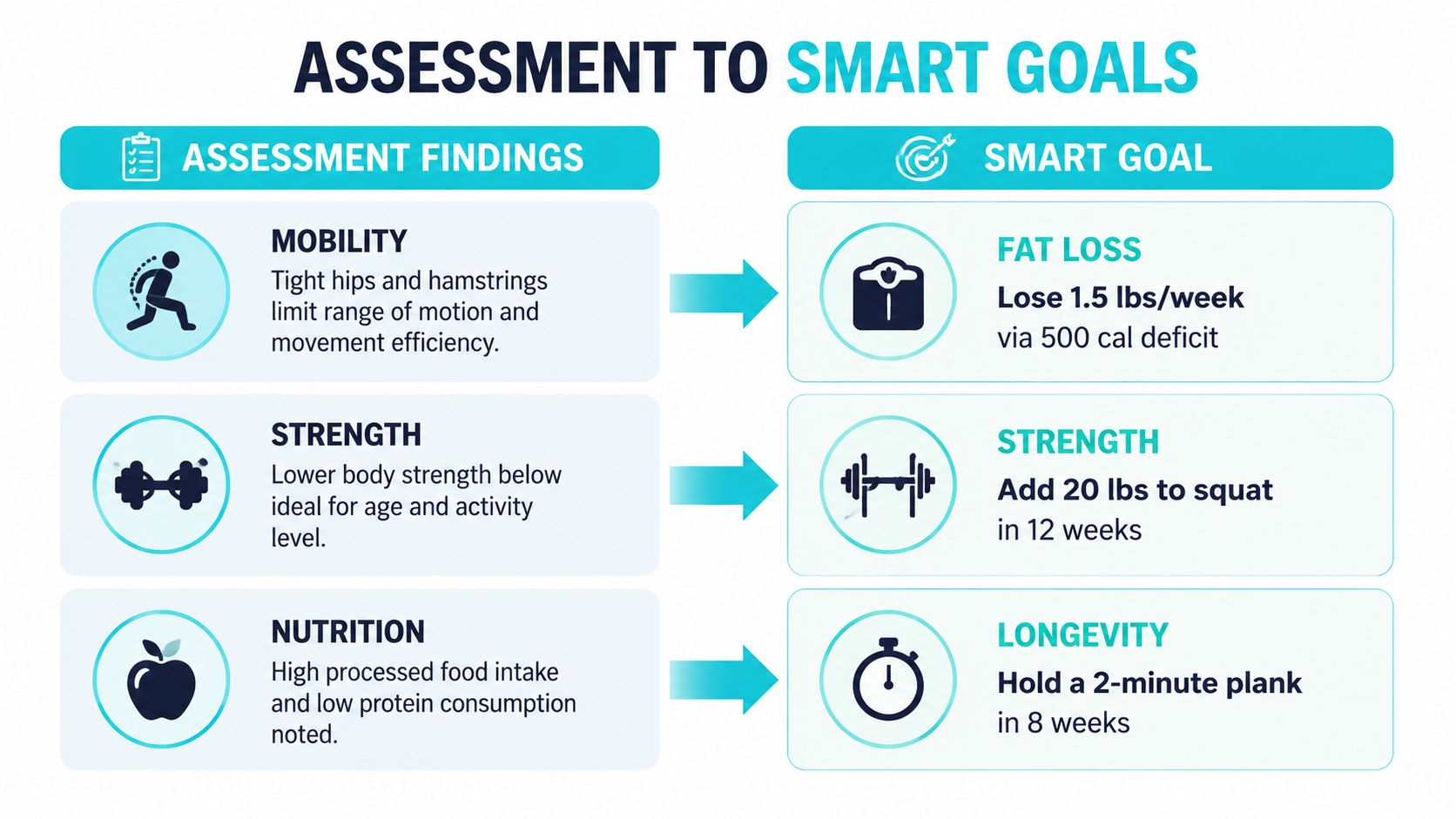
Turning Assessment Data Into Goals That Actually Stick
A goal becomes useful when the client can defend it on a bad week. “Get fit” doesn’t guide exercise selection, and “lose weight quickly” doesn’t tell you how to adjust when appetite, sleep, or schedule changes.
Use a simple formula:
- Specific: Name the outcome or test.
- Measurable: Choose one primary metric.
- Adjustable: Add one contingency for difficult weeks.
- Relevant: Tie the target to the client’s stated reason.
- Time-boxed: Set a review window, such as 8 to 16 weeks.
Consider three common conversations.
A 38-year-old parent wants fat loss without losing deadlift performance. The outcome could be a defined reduction in body mass or waist circumference over the review window, while maintaining a chosen deadlift reference set. The behavior target might be completing the planned sessions, preparing meals ahead of the busiest workdays, or meeting a personally agreed protein routine.
A 52-year-old recreational trainee wants a first strict pull-up. The measurable target is one controlled repetition, supported by a weekly practice habit and a contingency session using assisted variations when the client can’t reach the gym.
A 67-year-old retiree prioritizes longevity, balance, and confidence on stairs. The goal might combine a balance test with a strength or sit-to-stand marker, tied to regular training and brief balance practice at home.
The trap is creating a SMART outcome with no adherence design. That’s just a New Year’s resolution wearing professional language. Assign one behavior target, decide how you’ll review it, and make the fallback explicit before motivation fades.
Structuring Microcycles, Mesocycles, and Macrocycles With the 2026 Evidence
The 2026 American College of Sports Medicine update synthesized evidence from 137 systematic reviews covering more than 30,000 participants, giving trainers a broad basis for variable-driven resistance programming (ACSM’s 2026 resistance-training position stand update). The practical value isn’t a magic routine. It’s a clearer way to organize load, sets, range of motion, frequency, and training purpose.
For strength, the strongest-supported pattern uses heavy loading at about 80% or more of 1RM, 2 to 3 sets per exercise, full range of motion, and at least 2 sessions per week. For hypertrophy, the clearest signal is about 10 or more sets per muscle group per week. Power uses moderate loads of roughly 30% to 70% of 1RM, with low-to-moderate total volume, according to the same ACSM update.
The three planning horizons
A microcycle is the unit the client experiences. Use it to distribute weekly work across the available sessions, keep fatigue manageable, and make each workout feel purposeful.
A mesocycle is the unit that produces adaptation. Build several weeks around a clear emphasis, then reassess performance, recovery, and adherence before adding complexity. A macrocycle is the longer result window. It should connect weekly execution to a visible outcome instead of allowing sessions to drift.
The plan notes proposed specific working-set and intensity defaults, but those ranges shouldn’t be presented as universal 2026 ACSM findings. The update supports measurable prescription, while the exact distribution must still reflect the client’s goal, training age, tolerance, and schedule.
| Cycle | Duration | Sets per muscle per week | Intensity | Rep range | Check at end |
|---|---|---|---|---|---|
| Microcycle | 7 to 14 days | Set according to goal and recovery | Match strength, hypertrophy, or power emphasis | Match the exercise and objective | Session completion, RPE, technique |
| Mesocycle | 4 to 6 weeks | Adjust from response | Progress gradually or hold | Progress within the chosen range | Performance, soreness, readiness |
| Macrocycle | 12 to 24 weeks | Rebuild around the outcome | Periodize emphasis | Use phases rather than random changes | Outcome measurement and goal review |
For novice clients, ACSM recommends an 8 to 12 RM range, training 2 to 3 days per week, and increasing load by 2% to 10% only after the client can complete the current workload for 1 to 2 repetitions beyond the target (ACSM progression models for resistance training). Intermediate and advanced clients can use a wider 1 to 12 RM range, periodized over time, with eventual emphasis on heavy loading, longer rest, and more frequent training when appropriate.
For a deeper explanation of how planned variation can support periodization for consistent gains, use a resource that focuses on sequencing rather than random exercise novelty. The coach’s job is to make each horizon answer a different question: what happens this week, what adapts over the block, and what result should be visible at the end?
Session Templates and Progression Rules You Can Default To
A general-population client usually needs a repeatable session before they need a highly specialized split. Start with a 60-minute structure that gives every minute a job, then modify the movements for the client’s equipment, ability, pain response, and goal.
A practical 60-minute template
- Dynamic warm-up, 8 minutes: Raise temperature, rehearse the session’s patterns, and include one primer set.
- Compound pattern one: Use a squat, hinge, push, or pull at RPE 7 to 8, for 3 to 4 sets of 5 to 8.
- Compound pattern two: Pair a complementary pattern and keep the same effort ceiling.
- Accessory superset: Combine an upper-body and lower-body movement to use time efficiently without turning the session into conditioning chaos.
- Loaded carry or hinge finisher: Choose a simple movement that reinforces bracing, grip, posture, or work capacity.
- Cooldown, 5 minutes: Use one mobility drill that addresses the session and a short downshift.
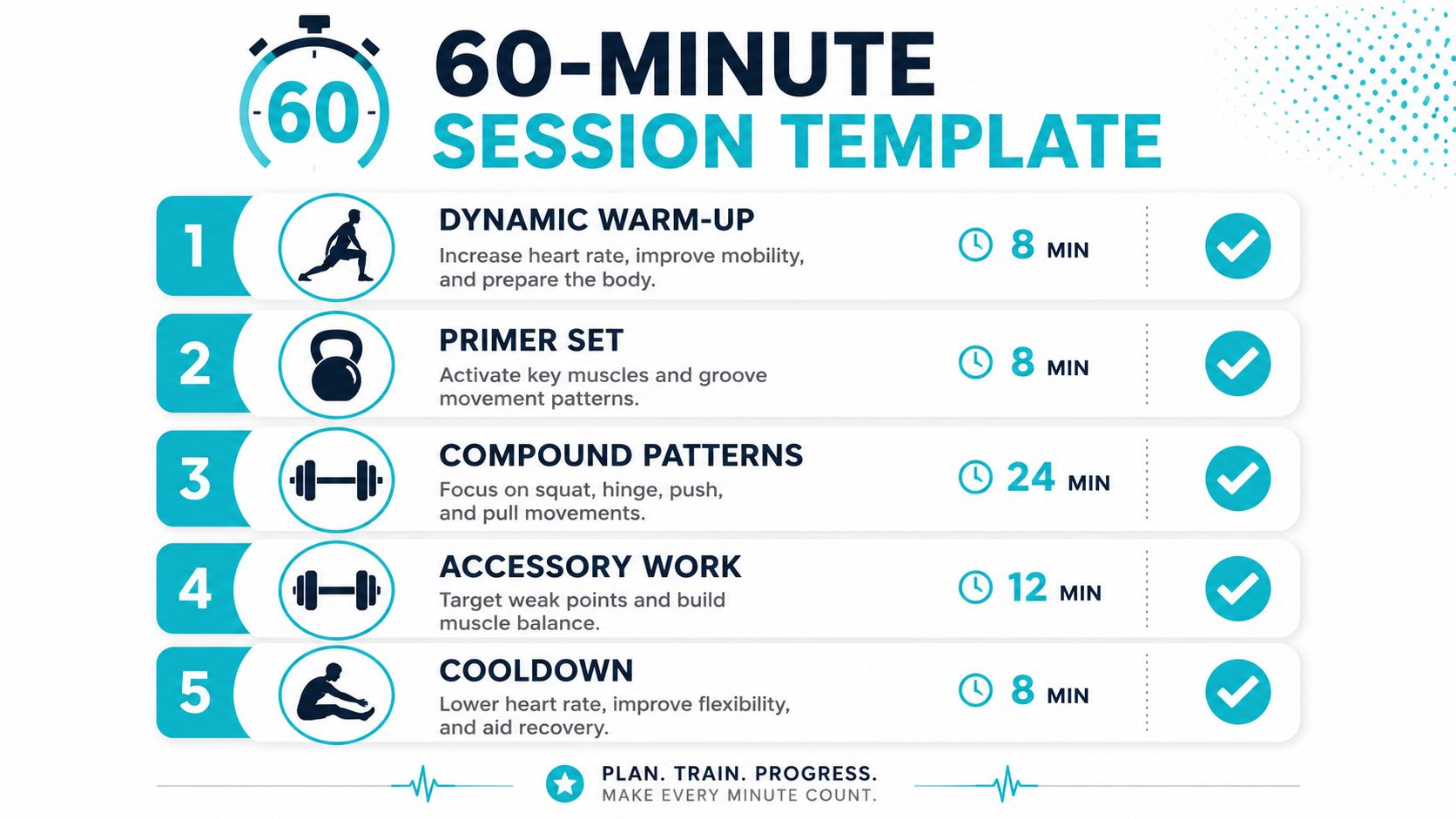
The template works because it gives the trainer a stable chassis. It doesn’t dictate whether the client uses a goblet squat, leg press, trap-bar deadlift, or box squat. Movement categories remain stable while the exercise choice changes.
Progress in this order
- Use double progression for accessories: Keep the load until the client reaches the top of the chosen rep range across three sessions, then add 2.5% to 5% and return to the lower end.
- Autoregulate compound top sets: Add a repetition when technique and effort allow, stopping at the planned rep ceiling before increasing load.
- Cap intermediate load increases: Avoid weekly increases above 5% for intermediate clients unless the response clearly supports it.
When pain, equipment, or schedule forces a substitution, preserve the movement intent. Swap a barbell squat for a leg press when the client needs more stability, a barbell bench for a machine press when setup is limiting, or a deadlift for a cable pull-through when fatigue changes technique. The replacement should match the pattern, target, and tolerance, not merely look similar.
Trainers who want a broader reference for choosing and adjusting exercises can review Cartwright Fitness’ prescription principles. Good prescription protects consistency. A brilliant exercise that the client can’t perform confidently is often inferior to a simpler option they can repeat well.
Modifications for Common Populations Trainers Meet First
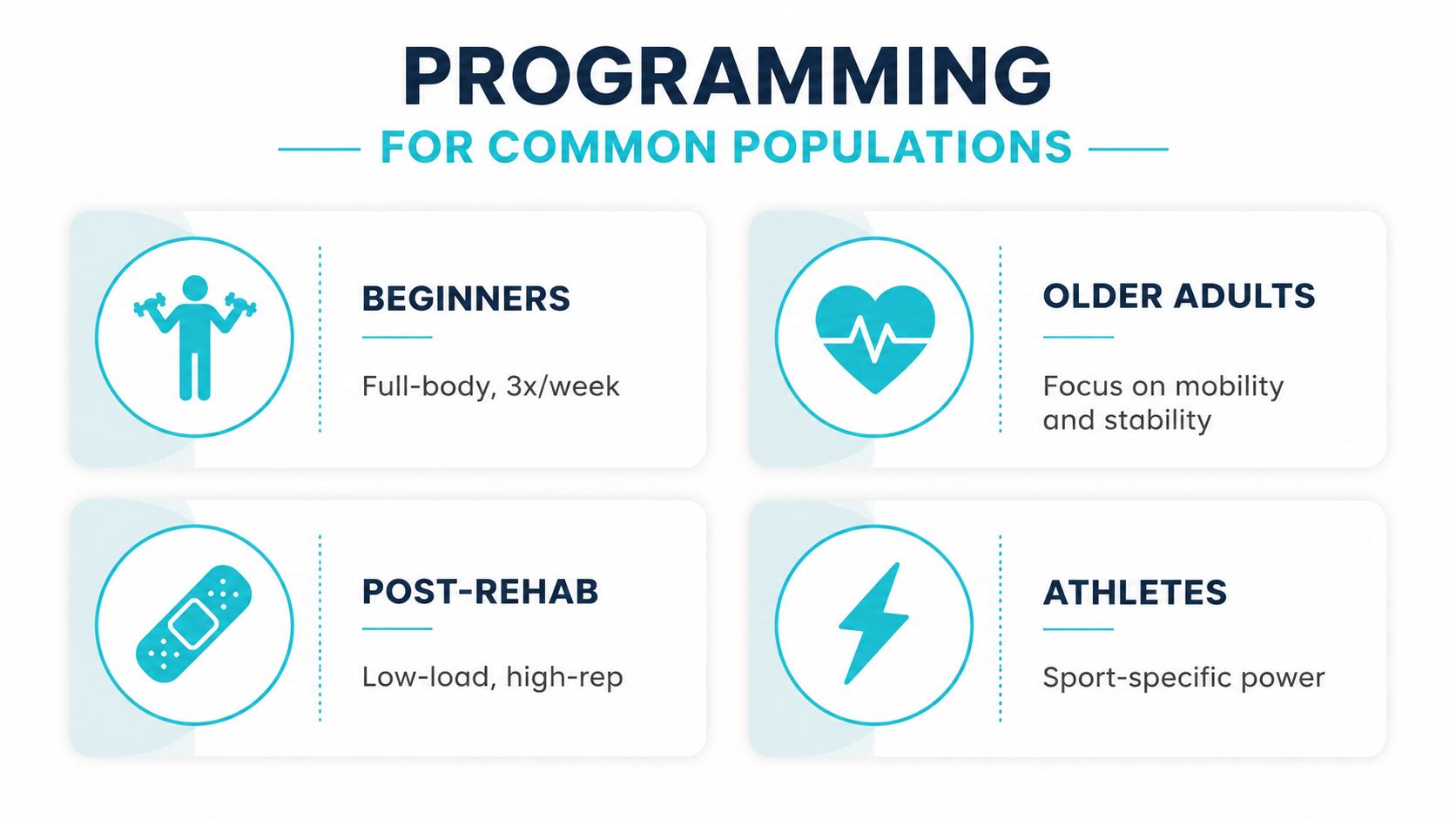
The standard template is a starting point, not a rulebook. Intake findings should change the default before the first training block is written.
Beginners
Clients with less than 6 months of training need full-body practice, clear demonstrations, and technique as a real training outcome. Use manageable loads, repeat key patterns, and let reps improve before chasing heavier weight. Early progression should reward control, confidence, and consistency rather than making every session a test.
Older adults
Older clients may need more time for setup, balance practice, and confidence under load. Use controlled repetitions, emphasize hip-hinge mechanics and grip, and include balance work that relates to daily function. Avoid turning “longevity” into random mobility drills. The program should build useful capacity.
Prenatal and postpartum clients
Prenatal programming requires communication with the client’s healthcare team and careful attention to symptoms, comfort, breathing, positioning, and pelvic-floor cues. Don’t impose a universal template on a changing pregnancy.
Postpartum return should begin with appropriate clearance, symptom monitoring, and capacity rebuilding. Avoid treating abdominal appearance as a diagnosis. Coordinate with qualified clinicians when pain, pressure, leaking, or suspected diastasis requires assessment.
Clients using GLP-1 medication
GLP-1 medication changes the coaching conversation because appetite and training tolerance may shift. The NASM overview of major fitness trends describes weight-loss medication as a disruptive force in the industry and highlights the need to think beyond generic fat-loss templates.
The trainer’s role is to preserve lean mass, support adequate intake within scope, watch for fatigue and poor recovery, and refer medication questions to the prescribing clinician. Don’t respond to low appetite by adding punishment cardio or forcing intensity. A moderate session that the client can repeat is often more valuable than a hard session that worsens adherence.
Wearable Data, the Thrive X Fitness App, and Readiness-Based Adjustments
Wearables are useful only when they change a decision. A readiness score that produces a colorful dashboard but no programming response is decoration.
ACSM has ranked wearable technology, mobile apps, and data-driven training among prominent fitness trends, while recent industry commentary has emphasized the value of trainers who can interpret HRV, sleep, and recovery information (ACSM fitness trends and personalized exercise programming). The same source reports favorable metabolic changes in 71% of inactive participants using personalized exercise programming versus 10% with standardized programming, and reports demand for personalized workout plans at 73%. Those figures support personalization, but they don’t justify pretending a wearable can diagnose readiness by itself.
Build a decision loop, not a data museum
Use the Thrive X Fitness App to gather HRV, resting heart rate, sleep duration, and the client’s recent session RPE. Don’t create a universal score with invented clinical thresholds. Establish a personal baseline, observe trends, and combine the number with a short human check-in.
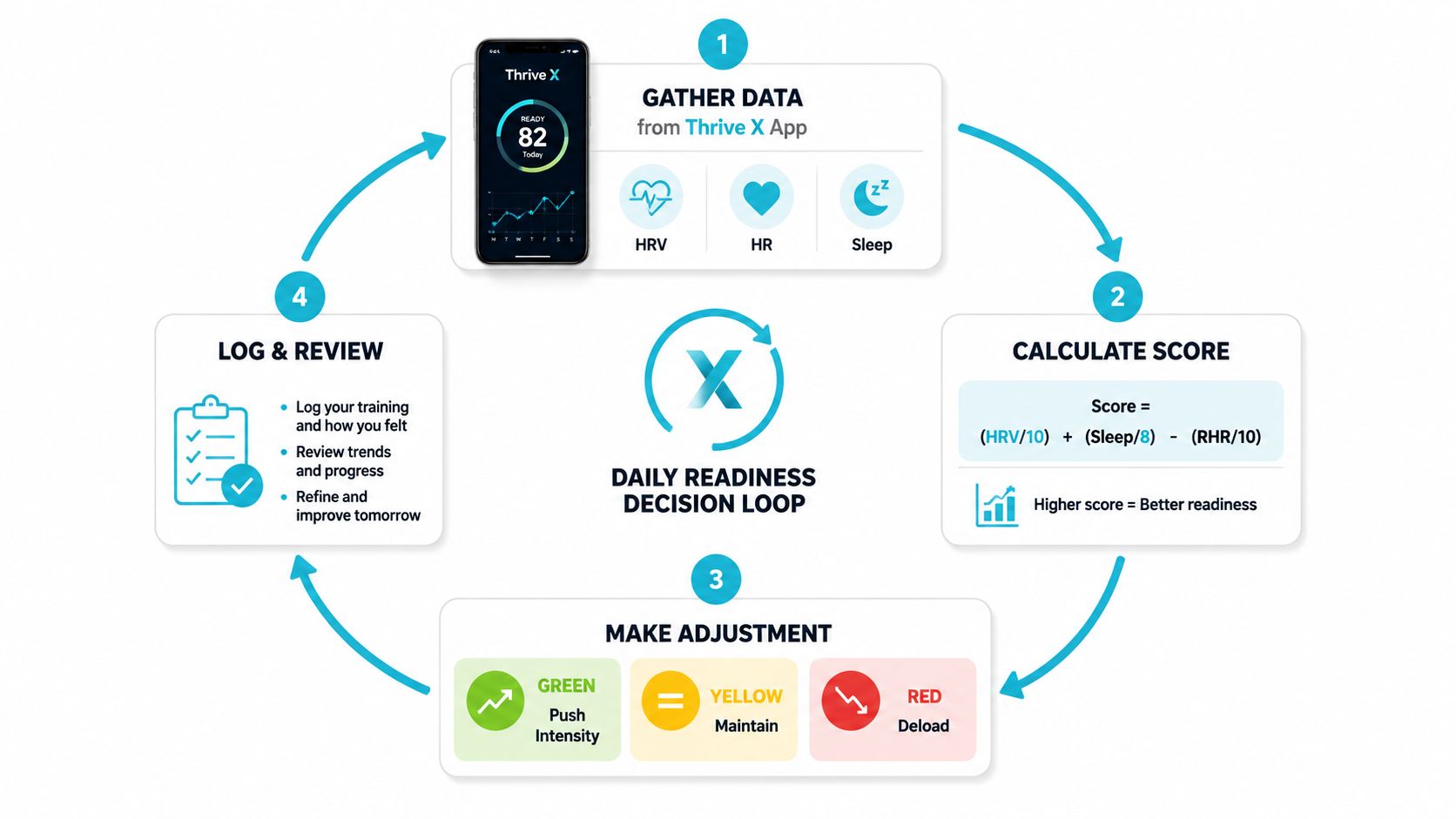
Use three practical bands:
- Green: The client feels normal, sleep and recovery look typical, and technique is stable. Keep planned intensity.
- Yellow: The score or subjective report is below the client’s normal pattern. Substitute a barbell compound with a tempo, machine, or supported variation, or reduce the number of hard sets.
- Red: The client reports illness, unusual fatigue, dizziness, significant pain, or a major recovery disruption. Convert the session to mobility, an easy walk, or rest, and refer when appropriate.
A single low score shouldn’t trigger a dramatic deload. Travel, alcohol, illness, menstrual-cycle changes, unusual stress, and poor device wear can explain the reading. Ask one question before changing the plan: “What happened outside the gym?”
Use the app to intervene early
Thrive X can help organize workout plans, feedback, adherence records, missed sessions, and load changes in one coaching workflow. The value comes from the trainer’s response. A missed session should prompt a practical reschedule conversation, not a guilt message. A sudden load jump should trigger a technique review. A repeated drop in RPE tolerance should lead to a recovery discussion before the client disappears.
A useful 12-week journey might look like this:
- Weeks one to two: Confirm the assessment, establish movement quality, and make the schedule dependable.
- Weeks three to six: Build base strength and conditioning with gradual progression.
- Weeks seven to nine: Move from accumulation toward intensification only if performance and recovery support it.
- Weeks ten to twelve: Test the relevant outcome, document the result, and decide what the next block should accomplish.
Retention rituals run alongside the training. Use a Sunday planning check-in to confirm session windows, a Friday win log to capture evidence of progress, and a monthly progress photo when appropriate and welcomed by the client. Coaches who want a broader view of coaches using wearable technology can compare how data collection supports decisions across training environments.
The retention discipline that separates a good coach from a great one is structured re-onboarding every quarter. Reset the goal, rebuild the program around current constraints, review what the client has learned, and reconnect the next phase to the reason they started. Personal trainer programming succeeds when the client keeps showing up long enough for the plan to work.
Quick Summary
Strong personal trainer programming works because it connects exercise selection to real-life constraints, not just ideal training theory. The best programs start with a clear intake, define a small number of measurable goals, organize training across weekly and monthly blocks, and use progression rules the client can actually sustain.
In practice, that usually means:
- Training major movement patterns consistently
- Matching session frequency to the client’s real schedule
- Progressing load, reps, or volume gradually
- Watching recovery, adherence, and pain response together
- Adjusting the plan early when life or readiness changes
Current ACSM coverage summarized in 2026 points trainers toward at least two weekly sessions per major muscle group, heavier loading for strength work, and about 10 sets per muscle group per week as a useful hypertrophy benchmark (ACSM resistance training guidelines update, ACSM guideline summary). The takeaway is simple: good programming is specific, trackable, and repeatable.
FAQ
What is personal trainer programming?
Personal trainer programming is the process of building a structured training plan around a client’s goals, schedule, recovery, movement ability, and progress data. It goes beyond choosing exercises. It sets rules for progression, session frequency, and modifications when the week does not go as planned.
How many days per week should most clients train?
Most general-population clients do well with 2 to 4 training days per week, depending on recovery, schedule, and goals. For many beginners, 2 to 3 sessions weekly is enough to build strength and consistency. ACSM guidance commonly emphasizes training major muscle groups at least twice per week (ACSM guideline summary).
How many sets per muscle group per week are best for hypertrophy?
A practical evidence-based target is about 10 hard sets per muscle group per week for hypertrophy, adjusted for training age, exercise quality, and recovery. That number is widely highlighted in 2026 ACSM coverage, but coaches should still scale volume to the individual rather than forcing a fixed total on every client (ACSM resistance training guidelines update, 2026 guideline overview).
What does ACSM recommend for strength training?
For strength, the headline guidance remains straightforward: use relatively heavy loading, often around 80% or more of 1RM, perform 2 to 3 sets per exercise, and train consistently across the week. Exercise selection, rest periods, and progression still need to match the client’s experience level and tolerance (ACSM resistance training guidelines update).
How do personal trainers progress a program safely?
A safe progression usually follows this order:
- Improve exercise technique
- Add reps within the target range
- Increase load slightly
- Add sets only when recovery supports it
This approach helps clients earn progression instead of chasing load too early.
Should trainers use wearable readiness scores?
Yes, but only as a decision aid. Wearables can help track sleep, heart rate, HRV, and recovery trends, but they should not replace coaching judgment. A low score becomes useful only when it changes the day’s session in a practical way.
How should trainers program for clients using GLP-1 medications?
Programming for clients using GLP-1 medications should focus on preserving lean mass, maintaining resistance training, monitoring fatigue, and supporting adequate nutrition within scope. Coaches should avoid assuming rapid weight loss means training capacity is improving automatically.
What makes a program easier for clients to stick with?
Adherence improves when the program is easy to understand, fits the client’s actual week, includes fallback options, and shows visible progress. A technically perfect plan fails if the client cannot repeat it.
ThriveXDNA offers access to the Thrive X Fitness App, including workout-plan generation based on goals, schedule constraints, and fitness level, plus tools for tracking feedback and adherence. Visit ThriveXDNA to explore a practical way to connect personalized programming with the coaching decisions that keep clients moving.