Health Insurance Plans with Dental: Compare 2026 Options
You're comparing two quotes, both dressed up as “good coverage,” and the difference isn't obvious until you need a dentist. One plan says dental included, the other says add dental for a monthly rider, and on paper they look close enough to blur together. In practice, they can send you to very different dentists, different bills, and very different surprises when a crown, filling, or orthodontic claim finally hits.
The right way to shop health insurance plans with dental is not to chase the lowest premium or the prettiest “included” label. It's to check the structure, the network, the annual maximum, and the waiting period before you assume the plan will pay when you use it. That's the part most shoppers miss, and that's where money gets wasted.
| Feature | Embedded or Bundled Dental | Add-On Rider | Standalone Dental |
|---|---|---|---|
| How it's sold | Folded into the medical plan or attached at checkout | Separate dental policy paired with medical coverage | Purchased on its own |
| Billing | Often one bill, sometimes one ID experience | Separate premium, often billed with the medical plan | Separate premium and separate policy |
| Deductible | May share the medical deductible in embedded designs | Usually has its own dental deductible | Usually has its own dental deductible |
| Annual max | Can be limited, especially for adults | Often clearer and easier to compare | Depends on the dental policy |
| Best fit | People who want simplicity | People who want more dental control | People whose medical plan offers no dental option |
Table of Contents
- Two Plans, One Real Decision
- The Three Ways Dental Joins a Health Plan
- Bundled vs Add-On Dental Coverage Compared
- How Dental Networks Shape Your Actual Cost
- Cost-Benefit Analysis for Common Dental Needs
- Matching the Right Structure to Your Situation
- A Simple Decision Framework You Can Use Today
- What Dental Coverage With Health Insurance Usually Excludes
Two Plans, One Real Decision
You sit down with a benefits advisor, and the screen shows two quotes side by side. The first is a Marketplace silver plan with pediatric dental embedded at no added premium. The second is a cheaper bronze plan with a standalone dental rider added for a separate monthly cost. Same doctor network. Same drug list. Same broad medical benefits. The decision still feels messy because the dental line item changes the entire deal.
That's because “included” doesn't mean free, and “add-on” doesn't mean better. A plan can advertise dental as bundled and still leave you with weak adult coverage, a short annual maximum, or a dentist network you don't want to use. A rider can look like an extra expense, then save you money if it gives you access to a dentist you trust and stronger coverage for the work you expect this year.
What the quote language is really telling you
The key question isn't whether dental appears on the quote. It's whether the plan is embedded, bundled, or separate, because that changes how the benefits behave when you use them. That's also why a Marketplace shopper should read the coverage summary carefully, not just glance at the monthly premium.
For a plain-English overview of employer-side comparisons, compare dental coverage for employees can help you see how medical and dental benefits are often packaged in real-world group plans. The terminology varies by carrier, but the shopping logic doesn't.
Practical rule: If the quote only tells you the premium and says “dental included,” assume nothing until you check the annual maximum, waiting period, and provider network.
The biggest mistake is treating dental like a tiny add-on to a medical plan. It's not tiny once you need a cleaning, a filling, or something major. The structure determines whether you're buying convenience, flexibility, or just a lower-looking monthly number.
The Three Ways Dental Joins a Health Plan
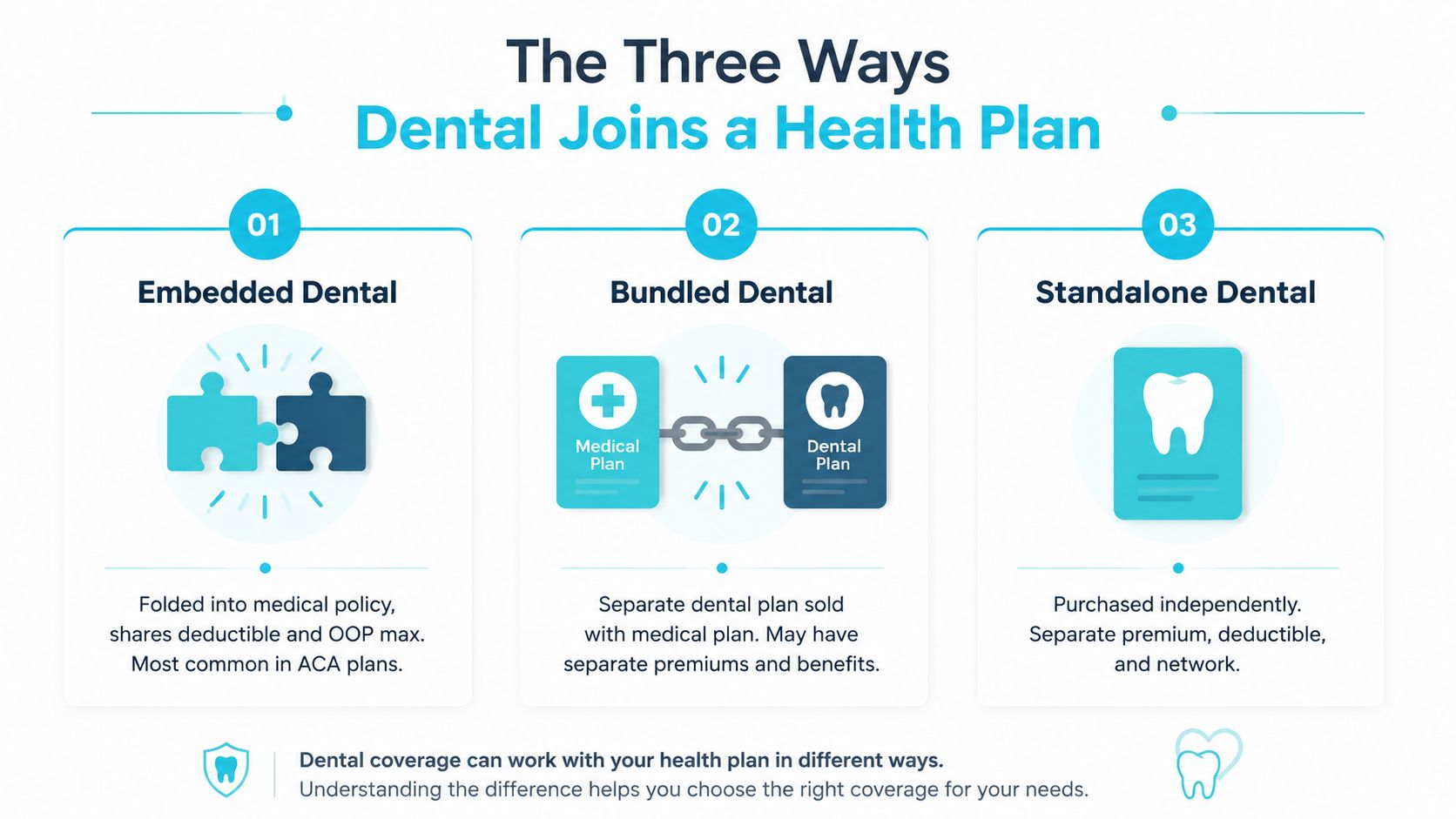
Embedded dental
Embedded dental is folded into the medical policy. In the cleanest version, it shares the medical deductible and often feels like one benefit package instead of two separate products. That's common in some ACA-style designs for children, and it can show up in employer plans too.
Embedded coverage is the easiest to use if you want simplicity. You deal with one plan, one ID card experience, and fewer moving parts. But simplicity doesn't guarantee strong adult dental benefits, and it definitely doesn't guarantee your preferred dentist participates.
Add-on rider
A dental rider is separate dental coverage sold alongside the medical plan. It's billed with the medical premium in some cases, but the benefits still act like their own policy with their own deductible, annual maximum, and network rules. This is the structure shoppers usually want when they care about actual dental value instead of just the existence of dental coverage.
If you want to compare plan designs without wading through carrier jargon, Benely small business dental is a useful example of how dental-specific coverage is often evaluated on its own terms, not just folded into the medical quote. That separation matters because dental usage and medical usage don't line up neatly.
Standalone dental
A standalone dental plan sits on its own. You can pair it with almost any medical plan, which makes it the most flexible option when your medical coverage doesn't include dental or when the dental network is the deciding factor. It's also the cleanest choice when you already know your dentist and want to keep that relationship intact.
If you want one bill and one coverage concept, look at embedded dental. If you want stronger adult dental control, look at a rider. If your medical plan gives you nothing dental, buy a standalone plan and stop forcing the medical policy to do a job it wasn't built for.
Bundled vs Add-On Dental Coverage Compared
Bundled dental and add-on dental can look similar from a distance, but they behave differently once you file a claim. The monthly premium gets most of the attention, yet the true cost shows up in deductible rules, annual maximums, and what happens when you need more than cleanings.
| Feature | Bundled / Embedded Dental | Add-On Rider |
|---|---|---|
| Premium impact | Often appears lower or even $0 on the quote | Usually adds a separate monthly charge |
| Deductible interaction | May share the medical deductible or sit inside the medical structure | Usually has its own dental deductible |
| Annual maximum | Can be modest, especially for adult dental benefits | Often clearer and easier to compare directly |
| Orthodontics | Usually narrow, often dependent-focused | More likely to spell out adult orthodontic terms |
Where the bill changes
The trap is simple. A plan with a low monthly price can still be expensive if the annual maximum is too small to matter. That's how shoppers end up paying a lot out of pocket even though they thought they “had dental.”
A rider can be the better value when you expect real dental use. That's especially true if the embedded option looks cheap because it keeps the premium low but caps adult benefits at a level that won't cover much beyond basic care.
The benefit design that matters most
Don't shop dental by the premium alone. Shop it by the combination of premium, deductible, annual maximum, and orthodontics rules. Those four pieces tell you whether the plan is a cost-control tool or just a coverage label.
A low premium with a thin dental maximum is often the most expensive option once you need a crown.
That's the practical test. If you're comparing two plans and one has a richer dental structure, run the numbers on the procedure you expect. If the plan can't absorb that cost, the monthly savings don't matter much.
How Dental Networks Shape Your Actual Cost
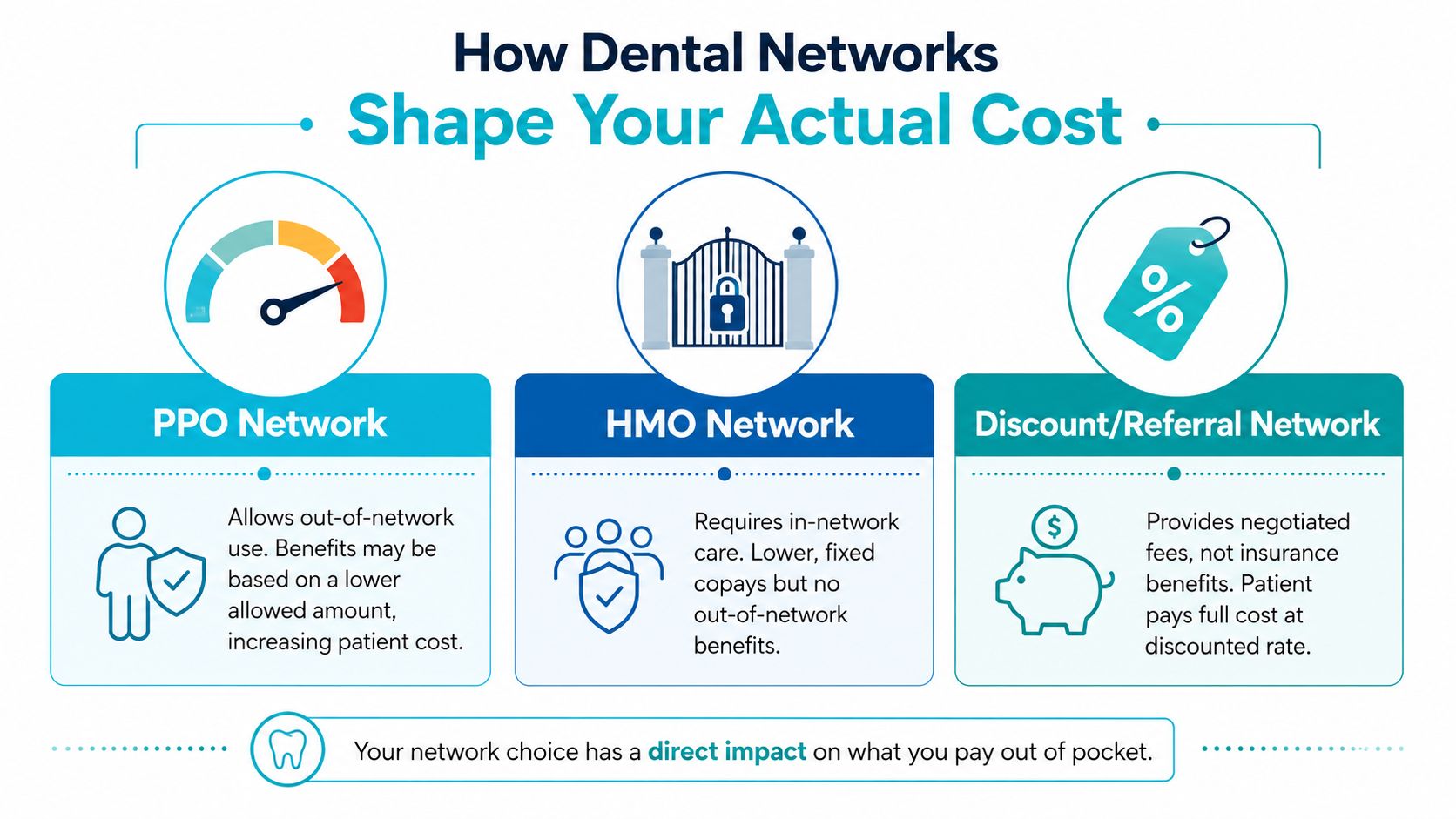
Use an out-of-network dentist under a PPO, and the bill can jump well above the copay on the brochure. The network does the pricing work before you ever sit in the chair.
PPO, DHMO, and fee-for-service
A PPO usually gives you the most flexibility. You can often see an out-of-network dentist, but the plan may pay only up to a lower allowed amount, so you cover anything above that. That is where balance billing shows up.
A DHMO is tighter. You usually choose a primary dentist, stay in the network, and pay fixed copayments. The upside is predictability. The tradeoff is limited choice.
A fee-for-service plan gives you the broadest choice on paper, but that freedom can still come with higher costs and more limits than shoppers expect. It sounds open-ended. It rarely is.
What to verify before you enroll
Check more than the dentist's name. Confirm whether specialists are in network, whether orthodontists need separate authorization, and whether the dental network is separate from the medical network. Those are different networks, and people mix them up all the time.
Also compare the negotiated fee, not just the listed copay. A lower copay can still cost more if the plan's allowed amount is low and the dentist charges above it. Final cost comes from the billing rules, not the marketing summary.
Ask one direct question before you sign, “If I use my current dentist, what will I pay after the plan's allowed amount is applied?”
That question gets you closer to the number than any brochure headline. It also tells you whether the network fits your dentist, or whether you are buying coverage that looks better than it performs.
Cost-Benefit Analysis for Common Dental Needs
Dental coverage pays off differently depending on what you use. A cleaning and exam are one calculation, a filling is another, and a crown or denture changes the math fast. Premiums alone do a bad job of showing that.
Preventive and basic care
Routine cleanings, exams, and X-rays are easiest to justify when the plan cuts your out-of-pocket cost to nearly nothing. If you already know you will use preventive care on schedule, even a modest plan can make sense because those visits are predictable.
Basic care is where value starts to split. Fillings, extractions, and emergency exams can justify coverage if the plan covers them after a short waiting period and you expect treatment soon. If the waiting period is long and the dentist wants work done now, the plan may help less than the brochure suggests.
Major care and specialty treatment
Crowns, bridges, dentures, and oral surgery expose the weak spot in a lot of dental coverage: the annual maximum. A plan can look inexpensive every month and still leave you carrying most of a major procedure once the benefit cap is used up. A $1,500 crown on a plan with a $1,000 annual maximum and 50% major coverage can still leave you paying $750 after the maximum is exhausted. That is why the cheapest premium is often a poor deal.
Orthodontics needs its own check. Lifetime limits, age rules, waiting periods, and dependent-only benefits vary enough that you should never assume adult braces or aligners are covered just because the policy mentions orthodontics.
| Procedure Type | Typical Cost Exposure | Coverage Feature to Check |
|---|---|---|
| Preventive care | Usually low if the plan covers cleanings and exams well | Preventive benefit level and network participation |
| Basic care | Moderate if the waiting period is short | Waiting period and coinsurance on fillings or extractions |
| Major care | High if the annual maximum is thin | Annual maximum and coverage percentage for crowns or dentures |
| Orthodontics | Often separate and tightly limited | Lifetime maximum, age rules, and dependent eligibility |
For a broader small-business view of whether dental coverage is worth paying for, the Benely small business dental page is useful because it centers the decision on actual use, not just monthly cost. That is the same lens to use here.
Matching the Right Structure to Your Situation
Your household's dental pattern should drive the choice. “Included” and “add-on” describe the structure, not the value. Compare expected use, dentist access, annual maximums, waiting periods, and total yearly cost before choosing.
Young adult with stable teeth
If your teeth are in good shape and you already trust your dentist, avoid paying for benefits you will not use. A standalone PPO or low-cost add-on rider usually gives you more provider choice without forcing you into a richer medical plan. Embedded dental works when its premium is competitive and your dentist is in network.
Family with children
Families should prioritize predictable access over a small premium difference. Cleanings, sealants, fillings, and orthodontic rules can make a modestly priced plan expensive if dependent coverage is narrow or the pediatric network is weak. A bundled plan is a strong choice when it keeps the total premium reasonable, covers children clearly, and includes the providers you need.
Freelancer or self-employed shopper
Compare the full annual cost of a Marketplace plan with embedded dental against a medical plan plus separate dental coverage. For example, a self-employed shopper comparing a $280 Marketplace plan with embedded dental against a $240 plan plus a $60 standalone rider should add expected cleanings, one filling, deductibles, and other out-of-pocket costs before deciding. The lower medical premium does not automatically produce the lower total cost.
Check how subsidy rules affect the complete quote, and confirm how the dental coverage renews. A rider may offer better dental benefits while creating a separate bill and separate network rules.
Near-retiree
If retirement is approaching, prioritize annual maximums, major-service coverage, waiting periods, and specialist access. Missing teeth, implants, and dentures may be limited or excluded. Read those provisions before enrolling, especially if you expect restorative work. This shopper is most likely to regret choosing by premium alone.
My rule of thumb: choose bundled coverage when the total premium is competitive and your dentist is in network. Choose an add-on when you want more control over dental benefits. Choose standalone when the medical plan offers no dental path that fits your providers and expected care.
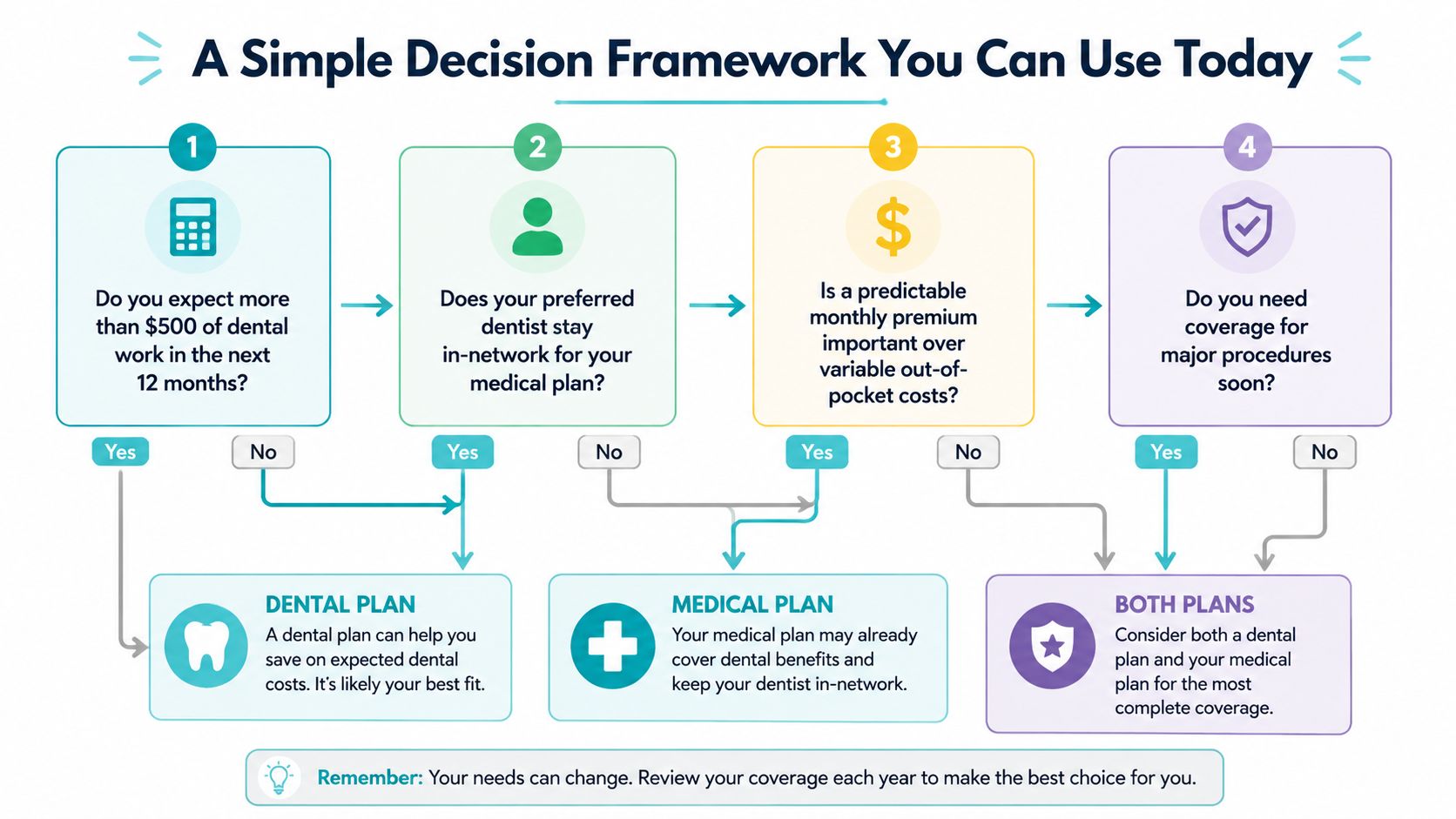
A Simple Decision Framework You Can Use Today
Start with four questions, and don't soften them.
- Do you expect more than $500 of dental work in the next 12 months?
- Is your preferred dentist in the dental network under the plan you're considering?
- Are you willing to accept a waiting period to save on premium?
- Do you need orthodontics or implants within the next few years?
If you answered yes to the first and fourth questions, lean hard toward the structure with the clearest major-service coverage and the strongest dental cap. If you answered no to the second question, don't force the plan. If your dentist isn't in network, the “cheap” option can get expensive fast.
One-page quote checklist
- Confirm the annual maximum. If it's too low to help with major care, move on.
- Verify the dentist under both IDs. Medical network and dental network are not interchangeable.
- Calculate total annual cost. Add premium, deductible, and likely out-of-pocket spend before you compare.
That's the whole game. If the quote tool doesn't make those three things obvious, the quote tool is incomplete.
What Dental Coverage With Health Insurance Usually Excludes
A lot of shoppers think dental coverage means everything below the gum line is included. It doesn't. Cosmetic work like whitening and veneers is usually out, and adult orthodontics can run into lifetime maximums, age limits, or outright exclusions.
Implants, TMJ treatment, occlusal adjustments, and services started before the policy effective date are also common trouble spots. If you switch carriers midyear, waiting periods can reset and erase the advantage you thought you had. Missing tooth rules can also block coverage for teeth lost before enrollment, no matter how strong the rest of the policy looks.
One coordination rule matters more than you might realize. If a medical plan covers oral surgery because of accident or disease, the dental rider usually doesn't pay again. The claim is paid once under the medical benefit, and the dental annual maximum stays untouched.
That's why the smartest shoppers read exclusions before they read the premium. The premium tells you what you'll pay to hold the policy. The exclusions tell you what you'll get.
If you want a faster way to compare health insurance plans with dental without getting lost in carrier language, use the tools and explainers at ThriveXDNA and run the numbers before you enroll. You'll make a cleaner choice when you can see the premium, the network, and the out-of-pocket exposure in one place.