Health Insurance Plans with Dental and Vision: A Complete
You're comparing health plans during open enrollment, and the options look deceptively simple. One medical plan appears to include dental and vision, while another offers cheaper medical coverage with separate policies. The lower monthly premium may not produce the lower annual cost once you add cleanings, fillings, eye exams, glasses, deductibles, copays, benefit caps, and the providers your family uses.
The practical question isn't whether bundled coverage sounds convenient. It's whether the combined premium and cost sharing fit your expected care. Health insurance plans with dental and vision can simplify enrollment and claims, but standalone add-ons may give you better flexibility or stronger dental benefits. The right choice depends on how the pieces interact.
Table of Contents
- Understanding Health Insurance Plans with Dental and Vision
- Integrated Coverage Versus Add-On Dental and Vision Plans
- Comparing Premiums, Annual Maximums, and Out-of-Pocket Costs
- When Integrated Plans Make Sense and When Add-Ons Are Smarter
- Key Factors to Evaluate Before Choosing Coverage
- Practical Buyer Checklist for Dental and Vision Coverage
Understanding Health Insurance Plans with Dental and Vision
A shopper often assumes that one integrated policy must be cheaper than medical coverage plus separate dental and vision plans. That assumption can fail because insurers may price dental and vision benefits differently, apply separate limits, or restrict access to particular provider networks. Compare the total annual cost, not just the medical premium.
Employer benefits show why these options deserve serious attention. A 2014 Kaiser Family Foundation survey of 2,052 firms found that 53% of companies offering health benefits also offered or contributed to a separate dental plan, while 35% offered or contributed to a separate vision plan. More recent research found that 83% of employers offered dental insurance and 80% offered vision insurance, compared with 93% offering medical insurance. These figures come from the EBRI employer benefits report.

What integrated coverage actually means
An integrated arrangement places medical, dental, and vision benefits within one enrollment experience or one broader plan structure. You may receive one member portal, one billing process, and coordinated customer service. That convenience matters when several family members need care, particularly during an employer enrollment period.
An add-on arrangement keeps dental and vision as separate benefit layers. You can often select a dental carrier independently from your vision carrier, compare each network on its own, and change one benefit without changing the medical plan. The trade-off is more administration, including separate cards, claims procedures, renewal dates, and provider directories.
Practical rule: Treat “included” as a starting point, not a verdict. Confirm what the plan pays, where it pays, and what it limits.
Why total compensation matters
Workers increasingly evaluate employer benefits as part of total compensation. A medical plan with modest dental and vision support may be less valuable than a package with separate, well-designed benefits, even if the headline medical premium looks similar. Conversely, an employer contribution can make add-on coverage attractive when the employee pays only a small share.
Before enrollment, write down the premium for each household tier, the annual dental maximum, vision allowances, deductibles, coinsurance, and network restrictions. A clear comparison is easier if you follow a step-by-step enrollment guide that organizes these decisions before you select coverage.
Integrated Coverage Versus Add-On Dental and Vision Plans
The structural difference is simple, but the financial consequences aren't. Integrated coverage combines benefits under one plan framework. Add-on coverage attaches separate dental and vision policies to your medical insurance without merging their benefit rules.
Integration usually reduces administrative friction. You may have fewer enrollment decisions and a more unified member experience. That doesn't guarantee broader coverage. A medical carrier can still use separate dental schedules, annual maximums, eyewear allowances, waiting periods, and provider networks inside the overall package.
Standalone policies preserve more control. If your preferred dentist leaves a network, you may be able to replace the dental plan without disturbing medical coverage. If your family has routine eye-care needs but little dental use, a low-cost vision policy can be paired with a different dental strategy. This flexibility can matter more than having a single insurer.
Premiums and benefit limits
Dental plans commonly use an annual maximum, which is the most the plan pays toward covered dental care during the plan year. A low premium may come with a modest maximum, waiting periods for major services, or significant coinsurance. Some dental designs instead emphasize predictable copays or network pricing.
Vision coverage often works differently. It may cover routine eye exams and provide an allowance toward frames, lenses, or contacts. A wellness-only vision benefit may cover an exam without paying meaningfully toward eyewear. Buyers should distinguish routine vision coverage from medical eye-care coverage for diagnosed conditions, which may run through the medical plan.
Add-on structures usually keep dental and vision limits independent. That can be useful because a dental claim won't consume a vision allowance, and changing one carrier won't necessarily affect the other. Integrated designs may be easier to manage, but buyers must read whether benefits are coordinated separately or subject to a shared limit.
Network and claims administration
A single insurer doesn't always mean a single provider network. The medical, dental, and vision networks may use different directories and participation rules. Verify each provider separately, especially if your family uses a particular dentist, orthodontist, optometrist, or optical retailer.
Federal employee coverage provides a useful comparison benchmark. The official marketplace lets shoppers compare up to three dental or vision plans side by side, with attention to premiums, location-based eligibility, and benefit differences. It also directs shoppers to official brochures for final selection, reinforcing that details such as copays, annual maximums, and network rules can vary within the same category. Review the official FEDVIP plan comparison guidance before treating a summary page as final.
Comparing Premiums, Annual Maximums, and Out-of-Pocket Costs
A household that expects regular cleanings, possible restorative dental work, and routine eyewear needs should compare the full yearly exposure, not just the monthly premium. Review the dental deductible, preventive coverage, coinsurance, waiting periods, and annual maximum. For vision, confirm whether the benefit covers an exam, frames, lenses, or contacts, and whether it uses a fixed allowance or a discount arrangement.
The interaction between plan types matters. A bundled Health Insurance Plan with Dental and Vision may reduce administrative work, but its combined price can exceed separate coverage when one benefit will rarely be used. Standalone dental and vision plans keep their premiums and limits separate, which makes unused coverage easier to identify. Employer contributions can change that result, so calculate the employee's actual share rather than comparing listed premiums alone.
Medicare Advantage shows how integrated access can expand routine benefits. In 2016, 21% of traditional Medicare beneficiaries had purchased a stand-alone dental plan, while 62% of Medicare Advantage enrollees were in plans with a dental benefit. Vision coverage reached 67% of Medicare Advantage enrollees, compared with 4% of traditional Medicare beneficiaries with stand-alone vision coverage. These historical comparisons appear in KFF's analysis of dental, hearing, and vision coverage.
By 2021, 99% of Medicare Advantage enrollees had access to some vision coverage, and 93% were in plans covering both eye exams and eyewear, according to the same KFF analysis. Access still leaves members responsible for some expenses. The analysis reported average annual vision dollar limits of about $160, so frames or lenses can cost more than the plan allowance.
| Feature | Integrated Plans | Add-On Plans |
|---|---|---|
| Enrollment | One broader enrollment process | Separate dental and vision selections |
| Administration | Usually simpler account and claims management | More cards, portals, and claim procedures |
| Dental maximum | Set by the integrated plan's dental rules | Set independently by the dental carrier |
| Vision benefit | May be embedded as an allowance or routine-care benefit | Can be selected based on exam and eyewear needs |
| Provider access | Medical, dental, and vision networks may still differ | Each carrier can be checked independently |
| Switching flexibility | Changing benefits may require changing the broader package | Dental or vision can often be changed separately |
| Cost control | Convenience may justify the premium when usage is regular | Separate selection can reduce payment for unused benefits |
Public rate sheets also show why dental and vision deserve separate calculations. Oregon's 2025–26 employer-style rate sheets list monthly self-only dental premiums from about $48.55 to $67.47, while self-only vision premiums range from about $8.10 to $15.29 across several plans. The figures appear in the Oregon benefit comparison rate sheet. Vision may be a relatively inexpensive add-on, while dental requires closer review of expected treatment, coinsurance, and the annual maximum.
When Integrated Plans Make Sense and When Add-Ons Are Smarter
Consider a household with predictable preventive needs. Two adults schedule routine dental cleanings and eye exams, and one person replaces eyewear regularly. An integrated plan may work well if the dental network includes their dentist, the vision allowance fits the eyewear pattern, and the combined premium is competitive with separate selections. The administrative simplicity has practical value because the family can manage enrollment and claims through a more unified system.
That same household should reject the bundle if the preferred dentist is out of network or the eyewear allowance applies only to a narrow group of providers. A low premium doesn't compensate for paying full retail prices or changing clinicians. The family may do better with a separate dental plan and an independent vision option that match their providers.
The low-use individual
A healthy individual who rarely sees a dentist and doesn't need corrective eyewear may prioritize low fixed costs. A separate vision plan could be unnecessary if the expected exam and eyewear spending is limited, while dental coverage may still provide useful negotiated network rates or preventive support. The buyer should compare the annual premium with the actual services likely to be used, rather than purchasing every available benefit.
Bundling makes more sense when an employer contributes substantially or when declining one component doesn't reduce the package price. If the employee pays for dental and vision regardless, keeping both may be rational even with low expected usage. The enrollment materials should confirm whether benefits can be waived independently.
The family managing recurring dental care
Families anticipating fillings, periodontal treatment, crowns, or orthodontic evaluation need to inspect the dental schedule in detail. An integrated plan may simplify coordination, but a separate dental policy could offer a more suitable annual maximum, broader specialist network, or fewer restrictions. Neither structure is automatically superior.
Waiting periods deserve special attention. A policy that appears affordable can provide little help for immediate major treatment if the relevant service has an eligibility delay. If treatment is already planned, compare the available benefit on the date care begins, not only the premium at enrollment.
The best structure follows usage, not branding. A familiar medical carrier can still provide a poor dental network or an unhelpful vision allowance.
Employer group dynamics also affect the decision. Employers may negotiate a strong integrated package, subsidize separate benefits, or offer limited choices. Review the full menu before assuming that the plan with one member ID creates the lowest household cost. Convenience is a legitimate priority, but it should be priced as a convenience, not mistaken for savings.
Key Factors to Evaluate Before Choosing Coverage
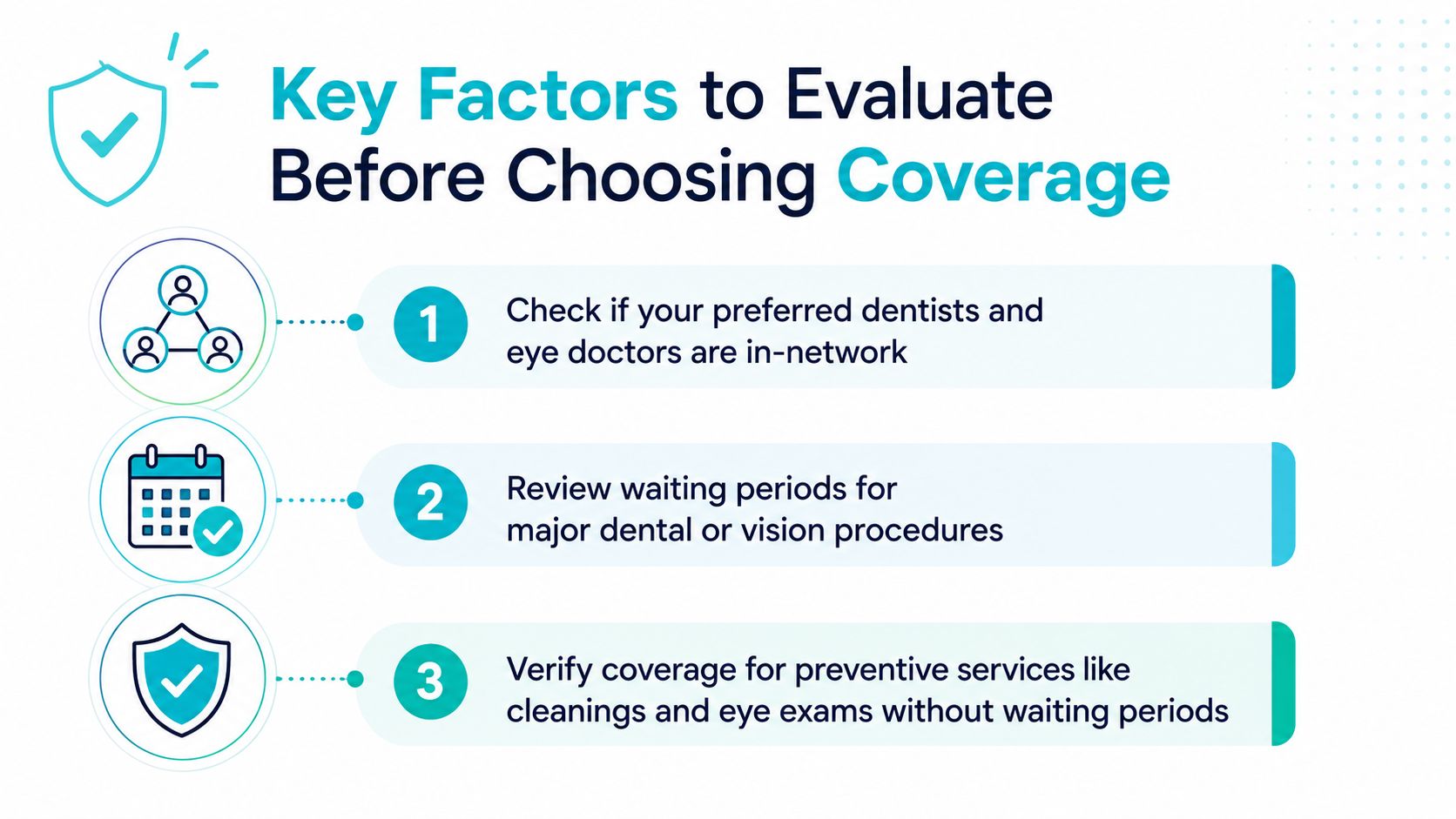
A useful comparison starts with the details that determine your actual cost and access. Review each plan's dental and vision benefits separately, even when one insurer administers the full package. Record the premium, deductible, copay, coinsurance, annual dental maximum, eyewear allowance, frequency limits, and waiting periods.
Three checks that prevent expensive surprises
- Benefit timing: Check whether preventive care begins immediately and whether major dental work, specialty services, eyewear, or contacts have waiting periods.
- Service limits: Separate exams from treatment, and confirm allowances for frames, lenses, and contacts. A routine vision benefit may not cover care for a diagnosed eye condition.
- Household fit: Apply the rules to each covered person. A family plan can cost more while offering little value if only one member expects regular dental or vision care.
Use a simple annual-cost calculation before choosing integration:
Total expected cost = annual premiums plus expected out-of-pocket costs minus employer contributions.
Calculate the bundled medical, dental, and vision option first. Then calculate medical coverage plus standalone dental and vision policies. Add expected dental spending only up to the plan's covered limits, and price eyewear after its allowance. This exposes whether a package saves money or merely reduces administrative work. Employer contributions can change the result, so use the enrollment figures rather than the headline premium.
Read the exclusions and coordination rules
Check exclusions for orthodontics, implants, specialty lenses, low-vision services, and procedures classified as medical rather than routine. Confirm how claims are handled when both medical and vision coverage could apply. The brochure and certificate of coverage should determine the decision.
Enrollment timing also affects value. If a cleaning, exam, crown, new glasses, or contact-lens purchase is already planned, compare the benefit available when care begins. A lower premium may be the worse choice if a waiting period delays the service or an annual allowance resets after the planned appointment.
For a plain-language reference on a carrier's routine benefits, review what Aetna vision covers, then compare its descriptions with the official documents offered during enrollment. Use the outside explanation to prepare questions, not to replace the contract.
Practical Buyer Checklist for Dental and Vision Coverage
Use the same worksheet for every option. Put the medical premium, dental premium, vision premium, employer contribution, deductible, copays, coinsurance, annual maximum, eyewear allowance, and waiting periods in separate fields. A bundled plan should still be unpacked into its medical, dental, and vision components so you can compare it fairly with add-ons.
Before you enroll
List expected care. Include preventive visits, planned dental work, prescriptions for glasses or contacts, and any specialist care. Don't assume a routine vision benefit covers medical eye treatment.
Confirm every provider. Check the dentist, hygienist, optometrist, ophthalmologist, orthodontist, and preferred optical shop. Verify the network under the correct dental or vision directory, not only the medical directory.
Calculate annual premiums. Multiply the applicable monthly premium by the number of covered months, then subtract any employer contribution shown in the enrollment materials. Compare the result with the separate add-on total.
Inspect dental limits. Find the annual maximum, deductible, service categories, coinsurance, exclusions, replacement rules, and waiting periods. Ask how the plan treats major procedures already under consideration.
Inspect vision allowances. Confirm exam frequency, frame or contact allowances, lens options, retailer restrictions, and whether discounts are being presented as insurance benefits.
Read the official documents. Summary pages are useful for screening. The certificate, schedule of benefits, provider directory, and official brochure determine what the plan pays.
Test two scenarios. Calculate a low-use year with preventive care only and a higher-use year involving dental treatment and eyewear. Choose the structure that remains acceptable under both scenarios.
Enrollment is a contract decision, not a shopping-cart decision. Save the benefit documents and confirmation page before the enrollment window closes.
For additional comparison support, ThriveXDNA offers insurance quote resources and an Insurance Policy Scanner that can help organize health coverage information alongside dental and vision details. Use those tools to prepare questions, then confirm the final terms directly in the insurer's official documents.
ThriveXDNA can help you organize quotes, review policy details, and compare the cost components that matter in health insurance plans with dental and vision. Visit ThriveXDNA to explore its insurance resources before your next enrollment decision.


