Best AI Claims Automation Software for 2026
Last reviewed: June 2026
The FBI estimates that insurance fraud costs U.S. property-casualty carriers more than $40 billion a year, but the headline number understates the operational drain at the file level. A single fraudulent auto claim that clears your queue undetected can cost your operation $20,000 to $80,000 in excess payments, and that is before accounting for the time your adjusters spend chasing documentation that should never have moved past intake. If you are evaluating the best AI claims automation software for 2026, the question is not whether to automate. It is which stage of your claims lifecycle is generating the most friction and which tool was actually built for that problem.
The market has consolidated around a few serious platforms, and they do not solve the same problem. Shift Technology handles fraud detection and FNOL triage. Tractable and CCC Intelligent Solutions both apply computer vision to physical damage estimating, but from completely different positions in the market. EvolutionIQ targets long-duration claims where speed matters less than reserve accuracy and adjuster guidance. You can compare a wider set of options in the AI insurance tools directory, but this guide focuses on those four because each represents a genuinely different bet on where AI adds value in the claims process.
Key takeaways
- Shift Technology uses network analytics rather than static rules to score claims at intake and flag fraud throughout the lifecycle, which means it catches organized fraud patterns a rules engine would miss entirely.
- Tractable is a standalone photo estimating layer you add on top of an existing workflow; CCC Intelligent Solutions is a full auto claims ecosystem that bundles estimating, parts sourcing, and shop networking in one platform.
- EvolutionIQ is purpose-built for workers compensation and disability claims and does not apply to short-tail personal lines. If your book does not include long-duration claims, this platform is not relevant to your evaluation.
- All four platforms carry enterprise pricing with no published rate cards. Every engagement starts with a scoping call, so build that into your evaluation timeline from the beginning.
- Most carriers running mature claims AI programs end up using two or more of these platforms because no single tool covers every stage of the lifecycle with equal depth.
Why 2026 Is a Different Buying Decision Than 2022 Was
[Add image: Best AI Claims Automation Software for 2026 – overview graphic – replace before publishing]
Three things shifted the claims AI landscape between 2022 and now. First, large language models made unstructured data, specifically medical records, adjuster notes, and first-party loss statements, processable at scale for the first time. Carriers that previously had to manually key information from a PDF intake form can now extract and classify that data automatically. Second, computer vision for physical damage assessment moved from early pilots into production deployment at multiple large carriers, so the technology is no longer experimental. Third, pressure on combined ratios pushed claims efficiency from an IT line item to a capital allocation decision at the executive level.
That third shift matters for how you frame your evaluation. If your combined ratio is under sustained pressure, a platform that takes 18 months to show measurable savings is a fundamentally different risk than one that automates a discrete step within 60 to 90 days. The right question is not ‘what does this platform do?’ It is ‘which specific failure point in my claims operation is this solving, and how fast will I see results?’ Every section below is structured around that framing.
One practical reality before you enter vendor conversations: none of the four platforms offer a self-serve trial or publish a rate card. You will be talking to a sales team before you see any numbers. Every engagement requires IT involvement from the first scoping call, not after you have signed. Plan for that.
How to Map the Claims Lifecycle Before You Contact a Vendor
A standard property-casualty claim moves through four stages: intake and triage at first notice of loss, physical damage or loss assessment, adjuster guidance and reserve setting, and fraud and leakage detection. Each stage has different data inputs and different failure modes. A platform built to score fraud signals at FNOL is not the same product as one built to estimate vehicle damage from photos, even if both vendors describe themselves as AI claims automation. See the National Association of Insurance Commissioners for official guidance.
Before you request a demo from anyone, pull your claims data and answer three specific questions. Where is your average cycle time longest? Where is your reserve deviation highest? Where is your paid leakage concentrated? The answers will point you to a stage, and the stage will tell you which vendor is worth your time. A carrier whose primary problem is slow cycle time on physical damage claims should talk to Tractable or CCC first. A carrier whose problem is organized fraud clearing intake should start with Shift. Mixing those up costs you months.
Also think about your claims volume. Every platform here uses machine learning, and machine learning performs better with more of your historical data. A national carrier writing 2 million auto claims a year will see different first-year performance than a regional carrier writing 80,000. That is not a reason to delay, but it is a reason to push vendors for specifics on how their models perform at your actual volume tier, not at the case-study carrier they lead with in every demo.

Shift Technology: Decision Intelligence at Intake and Beyond
Shift Technology was founded in 2014 in Paris and has grown into one of the more widely deployed fraud detection platforms in global insurance. The company raised a $220 million Series D round in 2021 at a valuation above $1 billion, which funded significant expansion into North American carrier relationships. The core product is the FORCE platform, which applies AI to score and route incoming claims at FNOL, flag fraud signals throughout the claim lifecycle, and surface subrogation recovery opportunities that would otherwise close unrecovered.
What separates Shift from a traditional rules-based system is how it combines signals. A rules engine flags claims that match predefined criteria, like a claim filed within 30 days of policy inception or a repair estimate that exceeds a threshold. Shift ingests structured claim data, third-party enrichment feeds, and network relationships between claimants, providers, and repair facilities, then scores the claim as a whole rather than running through a checklist. The practical result is that it catches fraud patterns that no prewritten rule anticipates. Organized fraud rings are built specifically to avoid triggering obvious rules, which is exactly why the network analytics approach matters.
For your FNOL triage workflow, Shift scores incoming claims by complexity and fraud risk before an adjuster touches the file. Straightforward, low-risk claims route to fast-track handling. Complex or suspicious claims route to specialist review. That routing decision at intake is where carriers report the clearest early impact on average handle time, because adjusters stop spending time on files that do not need them. The important caveat is that the model improves as it learns from your specific claim population. Smaller carriers with fewer claims per year should ask Shift directly about expected performance in the first 12 months, not just at steady state.
- Fraud detection via network analytics rather than static rules, which catches organized fraud that rules-based systems cannot anticipate
- FNOL triage scoring routes clean claims to fast-track handling and flags complex files before human review
- API integration with major policy and claims management systems; integration depth depends on your existing infrastructure
- Model performance improves over time as it trains on your specific claims history and claim population
- Smaller carriers should push for honest ramp-up timelines before engaging; performance at 80,000 annual claims differs from 2 million
Tractable: Photo Estimating as a Standalone Layer
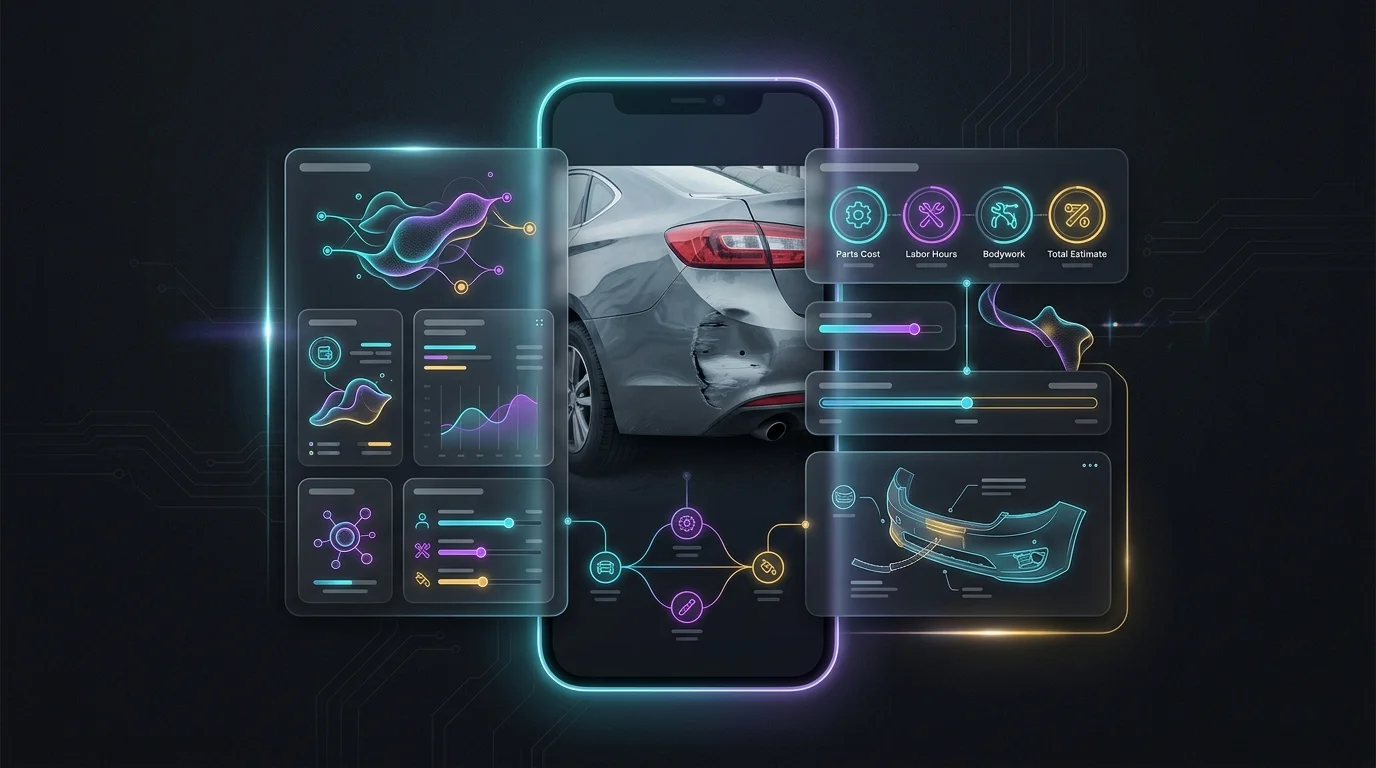
Tractable was also founded in 2014, in London, and raised approximately $65 million in a 2021 Series D round. The product uses deep learning models trained on large labeled datasets of vehicle and property damage images to produce line-item repair estimates directly from photos submitted by claimants or body shops. The workflow looks like this: a claimant photographs their damaged vehicle from multiple angles using a mobile link or app, Tractable processes those images and returns a structured estimate within minutes, and your team routes that estimate to a repair shop or uses it to set an initial reserve without waiting for an in-person inspection.
The architectural positioning is the key thing to understand. Tractable is a layer, not a platform. It does not replace your claims management system. It connects via API at the damage assessment step, returns structured estimate data to your existing system, and your standard adjuster workflow handles everything the model does not cover. That design makes it faster to deploy than a full platform migration and means you do not need to retrain adjusters on a new environment for claims that fall outside the photo model, including total losses, severe structural damage, and cases where photo quality is poor.
Tractable works best on moderate-damage auto claims with late-model vehicles and clear photos submitted from a reasonably consistent angle. The models handle common damage patterns reliably in those conditions. Where accuracy drops is on older vehicles with non-standard parts pricing, commercial vehicles with unusual configurations, and any claim where the submitted photos are incomplete or taken in low light. If your personal auto book skews toward late-model vehicles with straightforward physical damage, your coverage rate will be meaningfully higher than a carrier writing commercial fleet or high-mileage personal auto with variable photo submission quality.
- Photo-based AI estimating for auto and property physical damage from claimant or shop photos
- Returns line-item repair estimates in minutes, reducing physical damage cycle time on qualifying claims
- Designed as an API layer over existing claims portals, not a replacement for your claims management system
- Works best on moderate-damage, late-model auto claims with clear photo submissions
- Deployed with multiple European carriers; expanding in North American markets
CCC Intelligent Solutions: The Ecosystem Approach to Auto Claims
CCC Intelligent Solutions trades on Nasdaq under the ticker CCCS and operates a fundamentally different business than Tractable, even though both tools include AI damage estimating. CCC is not a point solution you bolt onto an existing workflow. It is a platform that connects carriers, body shops, OEM parts suppliers, and rental car networks in a single ecosystem. The company connects more than 30,000 repair facilities across the United States, which means that when a claim routes through CCC, the estimate, parts order, and shop assignment can all move through the same system without leaving the platform for a third-party handoff.
That integration depth is both the strongest reason to choose CCC and the main constraint to understand clearly. If your carrier is already embedded in the CCC network, adding the AI estimating layer is relatively low friction. Your adjusters are already in the system, your preferred shop relationships are already mapped, and the parts pricing data is already live. Adding AI-assisted estimating is an incremental extension rather than a new integration project. If you are not on CCC, the platform is a larger commitment than it appears in a demo, and you should evaluate whether the closed-loop network benefits justify the switching cost from your current setup.
CCC also has depth in areas Tractable does not cover, including total loss valuation, telematics data integration, and medical bill review. The platform has expanded into liability analytics in recent years. That breadth makes it a stronger fit if you want a single vendor relationship across multiple auto claim functions. It is a less efficient fit if you only need photo estimating and prefer to keep your core claims system separate, because you would be buying more platform than you need.
- Full auto claims ecosystem: estimating, parts sourcing, shop network, and rental coordination in one platform
- Connects more than 30,000 U.S. repair facilities, enabling closed-loop repair workflows without third-party handoffs
- Publicly traded on Nasdaq as CCCS, with quarterly financials and product roadmap disclosures accessible to buyers
- AI estimating is a built-in feature within the platform, not a standalone product you can license separately
- Higher switching cost for carriers starting fresh; lower friction for carriers already embedded in the CCC network
[Add image: Best AI Claims Automation Software for 2026 – comparison or process graphic – replace before publishing]

EvolutionIQ: Guidance for Workers Compensation and Long-Duration Claims
EvolutionIQ occupies a category the other three platforms do not touch. It focuses on workers compensation and disability claims, which are long-duration files where the difference between a 12-month close and a 36-month close often comes down to whether the adjuster took a specific action at 90 days rather than waiting until the file had already compounded in cost. The platform uses machine learning to predict which claims are trending toward higher cost early in their life, flag reserves that may be inadequate given current trajectory, and deliver prioritized, action-level guidance to adjusters rather than a raw risk score.
The action-level guidance is what makes the system useful in practice. A risk score tells your adjuster that a file is high risk. An action recommendation tells your adjuster to schedule an independent medical examination within 30 days or refer the file to a nurse case manager this week. When an adjuster is managing 120 to 150 active files simultaneously, the difference between a score and a specific recommended action is the difference between the system getting used and it getting ignored. Risk scores alone have a poor track record of driving behavior change in high-volume adjuster environments.
EvolutionIQ is the right platform if you write a meaningful workers compensation or long-term disability book, or if you are a TPA managing occupational injury claims for self-insured employers. It is not the right platform if your claims problem is in auto physical damage, homeowners, or short-tail general liability. The platform’s training data and model architecture reflect long-duration claim dynamics. Evaluating it for a personal auto book is a mismatch from the start.
The financial metrics EvolutionIQ targets are reserve accuracy and reduced litigation rates, both of which are lagging indicators. You need a 12-to-18-month measurement window before you can draw clean conclusions about ROI. Set your benchmarks and measurement methodology with the vendor before deployment, not after you are six months in and arguing about baselines.
- Predicts claim trajectory early in workers comp and disability files, before cost escalation becomes visible in standard reporting
- Delivers specific adjuster action recommendations per file rather than risk scores, which drives higher adoption rates
- Built for carriers and TPAs handling occupational injury and long-term disability claims
- Not applicable to short-tail personal lines such as auto physical damage or homeowners
- Reserve accuracy and litigation rate reduction are the primary ROI metrics, typically measured over 12 to 18 months
What Integration Actually Involves
All four platforms connect to your existing environment via API, but API integration describes a wide range of actual effort. A read-only feed that pulls structured claim fields into a fraud scoring model is a materially different project than a bidirectional integration that writes recommended actions back into your adjuster workqueue in real time. Ask every vendor to walk you through exactly what data flows in both directions, what your IT team needs to configure, and what your claims management system vendor has already tested with this particular integration. That last question matters more than buyers typically expect. A well-documented integration with Guidewire is different from one being built for the first time on a legacy system.
The variable that gets the least attention in demos is data quality. These platforms train on your historical claims data, and if that data has inconsistent field coding, missing values, or a large backlog of unstructured notes that were never keyed correctly, the model’s early performance will reflect those gaps. A data readiness assessment before you sign a contract is worth the investment. Carriers that run it upfront consistently see faster time to value than those who discover quality problems after deployment begins.
Timeline expectations vary by platform and integration scope. Tractable photo estimating on top of a modern claims portal can often go live in 8 to 12 weeks for a focused deployment. A full EvolutionIQ integration with a legacy claims management system requiring custom field mapping and adjuster training may take 4 to 6 months. Shift implementations at large carriers with complex policy administration environments can run longer. None of these timelines should disqualify a platform, but they affect your planning if you are targeting a specific operational milestone or regulatory reporting cycle.
A Decision Framework for Picking the Right Platform
If your primary problem is physical damage cycle time on personal auto claims, start with Tractable if you are not on CCC, and extend into CCC’s AI estimating layer if you already are. Adding a second estimating tool on top of a CCC workflow creates reconciliation friction you do not need. Use the network you have before you add a new vendor relationship with overlapping scope.
If fraud and leakage are your primary cost drivers and you have enough volume to train a model, Shift Technology is the strongest option in this group for that problem. It is particularly well suited to carriers seeing organized fraud patterns that your current rules engine is not catching. Smaller carriers should ask Shift for performance expectations at their specific annual claim volume before engaging further. The performance gap between a well-trained and an undertrained model is not small, and you deserve an honest answer on your ramp-up timeline.
If your book includes a meaningful share of workers compensation or long-term disability, put EvolutionIQ on your shortlist regardless of what else you run. It does not compete with Shift, Tractable, or CCC because it targets a different claim population entirely. Many carriers run EvolutionIQ alongside one of the auto-focused platforms without any functional overlap. The two categories of tooling address different problems.
The honest answer for most carriers is that you will end up using two of these platforms, not one. That reflects the actual structure of the claims lifecycle, not a gap in the market. Plan your roadmap in stages. Solve your most expensive problem first, prove the value over 12 months, and expand from there. Buying two platforms simultaneously before either one is fully integrated and measured is the fastest way to get a poor outcome from both.
How these tools compare
| Tool | Primary Claims Stage | Core Data Input | Best Fit | Pricing Model |
|---|---|---|---|---|
| Shift Technology | FNOL triage and fraud detection | Structured claim data, third-party signals, network relationships | Mid-to-large carriers with fraud or leakage problems | Enterprise, custom quote |
| Tractable | Physical damage estimating | Claimant or shop photos | Carriers adding AI photo estimating as a standalone layer | Enterprise, custom quote |
| CCC Intelligent Solutions | Full auto claims workflow including estimating | Shop network, parts, telematics, and image data | Carriers already on the CCC network or buying full auto workflow | Enterprise, custom quote |
| EvolutionIQ | Long-duration claim guidance and reserves | Medical records, claim notes, occupational and diagnostic data | Workers comp and long-term disability carriers and TPAs | Enterprise, custom quote |
Frequently asked questions
Can AI claims automation software replace human adjusters?
None of the platforms covered here are positioned to replace adjusters, and none of the carriers deploying them are moving in that direction. What the tools do is remove specific, repeatable decision points from the adjuster queue so your team can direct attention to judgment calls that genuinely require human review. Tractable handles the estimate on a routine dent claim. Shift handles the triage routing decision at intake. EvolutionIQ handles workqueue prioritization across a long-duration book. Adjusters still manage negotiations, coverage disputes, litigation, and complex losses. Even in the most automated carrier operations, adjuster judgment remains central to anything above routine physical damage.
How long does it typically take to see ROI from claims AI?
It depends on which tool you deploy and how clean your historical data is going in. Tractable on a well-defined physical damage workflow often shows measurable cycle time reductions within the first quarter after go-live. Shift’s fraud detection ROI takes longer because the model improves as it trains on your specific claim population, so the first 6 months typically run below peak performance. EvolutionIQ ROI shows up in reserve accuracy and litigation rates, both lagging indicators that require a 12-to-18-month window to measure cleanly. Set your benchmarks and agree on measurement methodology with the vendor before deployment, not after you are six months in.
What minimum claims volume do these platforms need to perform?
None of the vendors publish hard minimums, but volume is one of the most important questions to ask in your first call. The fraud detection and trajectory prediction models in Shift and EvolutionIQ need enough of your historical claims to identify patterns specific to your book. A carrier at 2 million annual claims will see faster model maturity than one at 75,000. Tractable is less sensitive to your volume because its damage models are trained on large cross-carrier image datasets rather than your proprietary history. That makes the minimum volume concern lower for photo estimating than for fraud detection or long-duration claim trajectory prediction.
Do these tools work with my existing claims management system?
All four integrate via API, but the integration effort varies significantly by platform and by the claims system you are running. Tractable is designed as a layer that connects to existing portals and returns estimate data through a standard API response, which makes it one of the faster integrations in this group. CCC is closer to a platform migration if you are not already on it. Shift and EvolutionIQ both require bidirectional data flows, meaning your claims system needs to send them data and receive scoring or recommended actions back. Your first technical call with any of these vendors should include your IT team and your claims system vendor, not just claims leadership.
Is there a single AI claims platform that covers the full lifecycle?
Not at this level of depth. Some vendors market end-to-end claims automation, but when you examine what those platforms actually do well, they tend to be strong in one or two stages and thin in others. The four platforms covered here are focused by design, and that focus is where the performance comes from. Most carriers running mature claims AI programs combine at least two vendors, using one for physical damage and one for fraud or long-duration guidance. The additional vendor management complexity is real, but it consistently outperforms a single platform trying to do everything at moderate depth.
How do these platforms handle data privacy and insurance regulatory compliance?
All four operate in regulated insurance markets and maintain compliance frameworks for HIPAA, state insurance department data requirements, and GDPR where applicable. That said, treat compliance verification as your responsibility rather than assuming the vendor has covered it on your behalf. Ask each vendor for their data processing agreements, audit log practices, and any state-specific certifications before signing. If your operation has data residency requirements, meaning claim data that cannot leave a specific jurisdiction, raise that requirement in the first call rather than after contract negotiation. Deployment options differ by residency constraint, and discovering a conflict late in the process is expensive.