

Last reviewed: June 2026
During the April 2025 tariff shock, the S&P 500 moved more than 4% in a single session. Traders with real-time scanners spotted the volume surge and reversal setup within minutes. Those relying on manual screening caught it later, or missed it entirely. That gap is where AI trading tools earn their subscription fee, and where the wrong tool costs you just as much as having none.
Four platforms cover most of what retail traders actually need: Trade Ideas for intraday scanning, Tickeron for pattern recognition, Composer for systematic automation, and TrendSpider for AI-assisted charting. Each one solves a specific problem well and handles others poorly. You can browse a wider set of options in AI finance tools directory, but these four represent the clearest differentiation across trader types, and that is what this guide maps out.
Key takeaways
- Trade Ideas is built for active intraday traders who want pre-market setups and real-time scanning. It is not designed for passive investors.
- Tickeron offers a freemium tier and AI-rated probability scores on chart patterns, making it one of the more accessible entry points for technical traders.
- Composer targets investors who want to run a rules-based portfolio strategy automatically, without coding and without monitoring positions daily.
- TrendSpider automates trendline and pattern detection across multiple timeframes, which saves significant time for traders whose analysis is chart-driven.
- No AI trading tool removes market risk. They reduce the time required to surface opportunities or execute a defined system, but the quality of outcomes depends on your underlying strategy.
The Question Behind the Question
When someone searches for the best AI stock trading tool, they usually have one of three actual problems. The first: they spend too much time scanning for intraday opportunities and want software to surface them faster. The second: they have a strategy in mind but cannot execute it consistently because doing so manually takes too much time or discipline. The third: they do technical analysis by hand and want AI to handle the pattern detection so they can focus on the actual decision. These are different problems, and they point to different tools.
A real-time scanner like Trade Ideas does not help you if your hold time is three months. An automation platform like Composer is not designed for intraday use. Confusing the tool with the need is how traders end up paying over $100 a month for software they barely open. Before evaluating any of these platforms, answer two questions: How often do you actually trade, and do you want the software to surface ideas or execute trades? The first question determines whether you need real-time data at all. The second determines whether a brokerage integration for automatic order routing is necessary.
One more layer worth flagging: the label ‘AI’ now gets applied to everything from simple moving average crossover alerts to overnight simulation systems to natural-language strategy builders. These are not equivalent capabilities. Reading a platform’s marketing copy will not tell you which type of AI it uses or whether that type suits how you trade. The sections below focus on what each platform’s AI actually does in practice, not what the marketing describes.
Trade Ideas: Built for the Pre-Market Ritual
Trade Ideas is a real-time scanning platform built for active and intraday traders. Its scanner monitors thousands of equities simultaneously and filters them based on price action, volume, relative strength, gap size, and dozens of additional parameters as the market moves. You configure a scan with the criteria that match your strategy and the platform surfaces candidates the moment they qualify. For a day trader who opens the terminal at 9:00 AM looking for the morning’s best setups, that real-time filtering is the core value. See the Consumer Financial Protection Bureau for official guidance.
The platform’s AI component, called Holly, runs simulations overnight rather than during live trading. Holly analyzes historical patterns to identify setups that preceded profitable outcomes in similar conditions, then produces a pre-market list of trade ideas with suggested entry and exit parameters for the following session. Holly is best understood as a pre-market research assistant, not a live execution engine. You still decide whether to act on any idea it surfaces, and you still manage the trade once it is open.
Trade Ideas includes a brokerage integration that lets you route orders directly from the platform, which adds a semi-automated execution layer without removing you from the decision entirely. The pricing is subscription-based with no meaningful free tier, and the monthly cost at higher plan levels is substantial. That cost is hard to justify unless you are trading several times a week and can point to improved filtering as a genuine contributor to your outcomes. The platform rewards traders who already understand basic technical concepts. It is not designed to teach you what relative strength means.
- Real-time scanning across equities with highly configurable filters
- Holly AI generates a daily pre-market idea list based on overnight pattern simulations
- Brokerage integration enables semi-automated order routing
- Subscription-based with no meaningful free tier; higher plans carry a significant monthly cost
- Best suited to active traders who monitor positions during market hours
Tickeron: Pattern Alerts Without the Chart-by-Chart Grind
Tickeron takes a pattern-recognition approach. The platform scans charts automatically for classic technical formations, including head and shoulders, double tops, ascending triangles, and bullish flags, then applies AI to estimate the probability that each pattern resolves in the historically expected direction. You receive a probability score alongside each flagged setup rather than a binary buy or sell signal.
That probability framing is one of Tickeron’s more useful features because it forces you to think in terms of expectancy rather than certainty. A 70% historical resolution rate on an ascending triangle does not mean the trade wins; it means that across many historical occurrences of similar setups, the pattern resolved upward more often than not. Whether that edge is large enough to trade depends on your own position sizing and risk management. Tickeron surfaces the probability. The judgment call remains yours.
The platform also offers a library of pre-built AI trading robots, automated strategies you can connect to a brokerage and run with limited ongoing input. The robot library ranges from strategies built around specific pattern types to broader momentum and mean-reversion approaches. A free tier is available with reduced functionality, which makes Tickeron one of the lower-barrier entry points among the four tools covered here. Paid tiers unlock more simultaneous scans, more robots, and additional asset classes including forex and crypto depending on the plan. If you are evaluating AI trading tools for the first time, the freemium model is a genuine advantage. It lets you assess whether pattern-recognition software fits your actual workflow before you commit to a monthly subscription.
- AI-rated probability scores attached to detected chart patterns
- Scans for classic formations automatically across equities, ETFs, and on paid plans forex and crypto
- Pre-built trading robot library with brokerage connectivity for automated execution
- Freemium pricing model with a usable free tier
- More accessible to traders without a deep technical background than Trade Ideas or TrendSpider

Composer: Rules-Based Automation Without Writing Code
Composer is aimed at a different kind of investor entirely: someone who has a systematic approach in mind and wants to run it automatically without monitoring positions every day. The platform uses a visual interface to build investment strategies. You define the logic, which assets to hold, when to rebalance, what triggers an allocation shift, and Composer translates that into an automated workflow connected to a brokerage account. Once the strategy is running, the platform executes it according to your rules without requiring daily attention.
The AI layer in Composer is a natural-language drafting tool. You describe a strategy in plain English, and Composer converts the description into a structured workflow that you can review and modify. The conversion is imperfect and you will need to check the output, but it accelerates the build process compared to constructing the logic entirely from scratch. This is particularly useful for investors who have a clear thesis but are not familiar with the mechanics of building a rules-based system from the ground up.
Backtesting is included, and it matters here more than in most platforms because Composer is designed for longer-horizon strategies where historical analysis provides at least some signal. That said, overfitting a strategy to historical data is a real risk. A backtest that looks strong can reflect data mining rather than a genuine edge. Use it as a sanity check on the strategy’s internal logic, not as a forward projection. Composer is not designed for intraday use. Strategies typically rebalance on daily or longer intervals, which means it is not the right tool if you need the system to react to price moves within the trading session.
- No-code visual strategy builder with AI-assisted natural-language drafting
- Automated execution connected to a brokerage account once the strategy is configured
- Backtesting included for evaluating strategy logic against historical data
- Designed for systematic investing on daily or longer rebalancing intervals
- Not suited for intraday trading or strategies that require real-time reaction
TrendSpider: AI That Does the Chart Markup for You
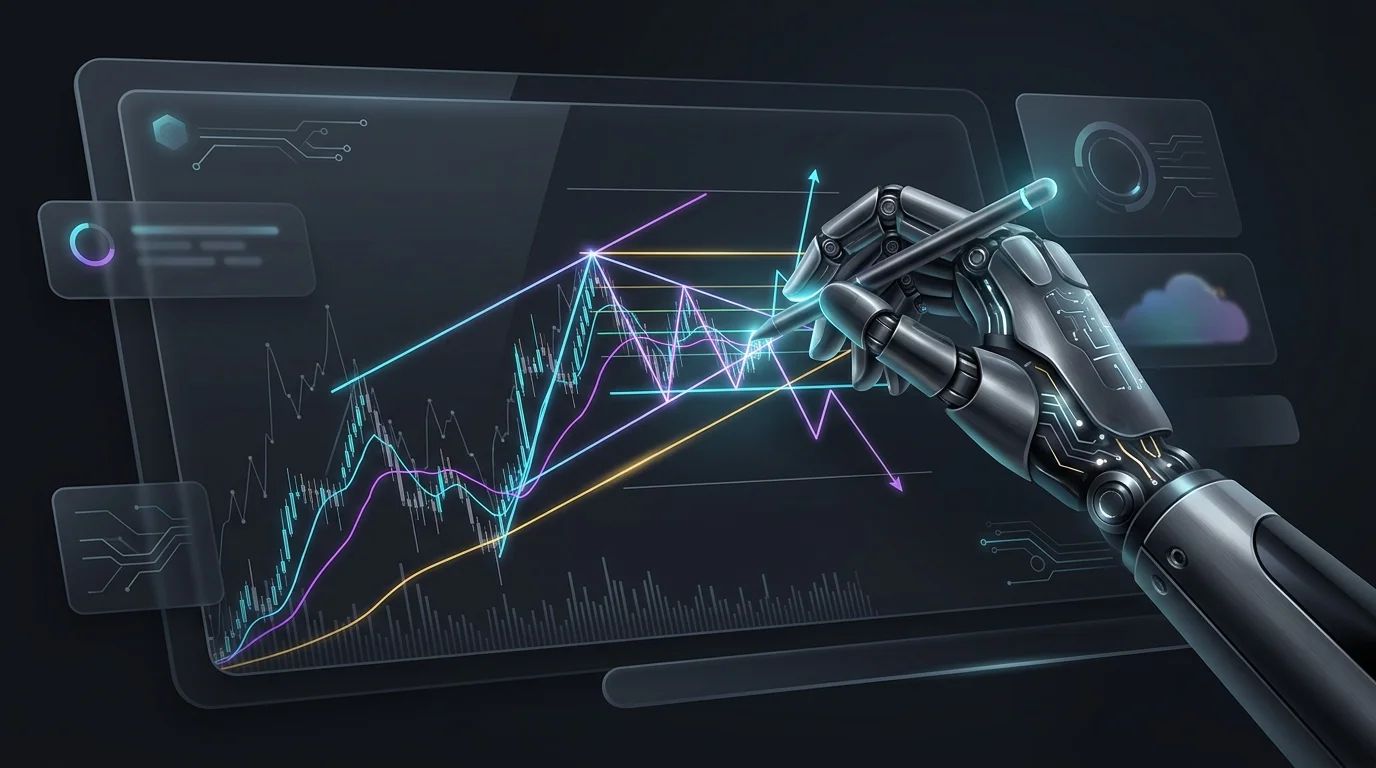
TrendSpider is a technical analysis platform. Its AI automatically detects trendlines, support and resistance levels, Fibonacci retracements, and other chart elements that technical traders typically draw by hand. The practical result is that a chart that would take you 20 minutes to annotate manually arrives pre-drawn in seconds, and the AI applies consistent rules across the chart rather than the subjective judgments that vary between analysts doing it manually. For traders who spend significant time maintaining chart annotations as price moves, that time saving is concrete.
The multi-timeframe analysis feature is one of TrendSpider’s more distinctive capabilities. It lets you visualize how patterns and levels align across different time horizons on a single chart view, which is useful if your methodology involves confirming signals across timeframes before entering a position. Most standard charting platforms require you to switch between views manually and hold the alignment in your head. TrendSpider renders it in one place, which removes a step that is easy to skip under time pressure.
TrendSpider includes some backtesting and strategy automation tools, but the platform is fundamentally a charting and analysis tool rather than an execution engine. You form a view based on what the AI surfaces, then act on it through your brokerage. It does not automate order execution the way Composer does. Traders who use a fundamentals-first approach and rarely reference chart patterns will find limited application for it. Traders whose process is heavily technical, and who currently spend hours each week annotating charts, will find it removes a meaningful portion of that overhead.
- Automatic trendline and support/resistance detection using machine learning
- Multi-timeframe analysis displayed on a single chart view
- Strategy backtesting included within the platform
- Does not automate trade execution; analysis and charting focused
- Best suited to technical traders who spend significant time on chart annotation
Four Dimensions That Actually Separate These Platforms
Most comparisons of AI trading tools focus on feature counts. A more useful frame is to compare them on the four dimensions that determine whether a platform fits your actual workflow. The first is speed of feedback. Trade Ideas operates in real time during market hours. Tickeron’s pattern scans are near-real-time. Composer and TrendSpider are not time-sensitive in the same way; you are building strategy or reviewing charts, not reacting to a live feed. If your trading requires you to act within minutes of a signal forming, real-time scanning is non-negotiable and narrows the list immediately.
The second dimension is automation depth. Composer automates full strategy execution once you configure the rules. Trade Ideas and Tickeron allow semi-automated order routing with brokerage integrations, but you remain in the loop on individual trade decisions. TrendSpider does not execute trades at all. How much of the execution process you want automated versus supervised determines which category you need. Conflating analysis tools with execution tools is one of the most common mistakes when evaluating this space.
The third dimension is the assumed knowledge level. Trade Ideas and TrendSpider both assume you understand basic technical concepts before the AI output is useful to you. Tickeron and Composer are designed to be more accessible to investors without a technical trading background, though Tickeron’s probability scores are more meaningful if you understand what the underlying patterns represent. The fourth is cost relative to use frequency. These platforms range from free tiers to several hundred dollars per month at the high end. A platform at $150 per month is justifiable if you trade actively several times a week and can point to decisions it improved. It is not justifiable if you open the platform twice a month. Be honest about your expected usage before committing to an annual plan.
What AI Trading Tools Cannot Do
This belongs in any honest evaluation. None of these platforms generate consistently profitable trades. They reduce the time required to surface opportunities or execute a defined system. The quality of outcomes still depends on the quality of your underlying strategy and your discipline in following it. Buying one of these platforms and expecting it to make good decisions for you is a reliable way to lose both the subscription fee and trading capital.
AI in financial software is currently best understood as a pattern-matching and screening acceleration layer. Holly in Trade Ideas runs simulations based on historical patterns, but historical patterns do not have binding authority over future price action. Tickeron’s probability scores reflect historical resolution rates for chart formations, which vary significantly depending on the broader market regime. A pattern that resolved upward 70% of the time in a low-volatility trending market may behave very differently in a range-bound or high-volatility environment. Composer’s backtests are accurate representations of past performance, not forward projections, and the usual warnings about overfitting apply.
The realistic value proposition for all four tools is this: if you have a strategy you believe in, these platforms can help you execute it more consistently, find setups faster, or automate the mechanical parts. If you do not yet have a strategy, these tools will not provide one. They are implementation aids, not strategy generators. That distinction sounds obvious but it is the thing most disappointed users get wrong before subscribing.
How to Choose: Match the Tool to How You Actually Trade
The decision is cleaner than most comparison guides make it look. If you trade intraday and want to be alerted to setups as they form in real time, Trade Ideas is the most purpose-built option in this group. If you do chart-pattern analysis and want AI to screen the entire market for you rather than reviewing charts one by one, start with Tickeron on its free tier before committing to a paid plan. If you have a rules-based investing approach and want it automated without writing code or monitoring positions daily, Composer is the only no-code execution platform in this group. If your edge is in technical analysis and you spend meaningful time each week annotating charts by hand, TrendSpider removes a significant portion of that overhead.
If none of those four descriptions fit your actual situation, the issue may be that you do not yet need a specialized AI trading platform. A standard brokerage with built-in screening tools, a free charting platform, and a clear trading plan covers most of what retail investors actually need before the incremental value of an AI platform becomes meaningful. The worst outcome is paying for a sophisticated tool while the real gap in your process is strategy clarity, not screening speed.
For traders who are genuinely ready to add one of these platforms, the practical next step is to match your primary trading activity to the category above, test on a free or trial plan first, and evaluate the platform against a specific question: did this tool help me make a better decision or execute a consistent strategy more reliably in the past 30 days? If the answer is yes, the subscription is earning its cost. If the answer is no, the tool is probably the wrong fit for how you actually trade.
How these tools compare
| Tool | Primary Use Case | AI Feature | Executes Trades | Free Tier |
|---|---|---|---|---|
| Trade Ideas | Intraday scanning and pre-market setup generation | Holly AI: overnight simulation producing a pre-market idea list | Semi-automated via brokerage order routing | No |
| Tickeron | Chart pattern recognition and automated trading robots | AI probability scores on detected chart formations | Yes, via pre-built robots connected to a brokerage | Yes, limited functionality |
| Composer | No-code rules-based portfolio automation | Natural-language strategy drafting and conversion to structured workflow | Yes, full automation via brokerage connection | No (trial available) |
| TrendSpider | AI-assisted technical charting and multi-timeframe analysis | Automatic trendline, support/resistance, and pattern detection | No, analysis only | No (trial available) |
Related guides
- What Is TrumpRx.gov? Good or Bad? Your Complete Guide to Lower Prescription Drug Prices in 2026
- Your Guide to the Best Cyber Liability Coverage Options That Won’t Break the Bank
- Best Identity Theft Protection Plans in 2025: Secure Your Personal Data Now
- Trade Ideas vs TrendSpider: AI Trading Tools Compared
- Best Trade Ideas Alternatives: AI Stock Tools
- Is Trade Ideas Worth It in 2026 for Day Traders?
- Technology & Modern Finance Intersections
- 3Commas vs Pionex: AI Crypto Trading Bots Compared
- Best AI Tools for Day Traders in
- Best AI Stock Trading Algorithms
Summary
You’re comparing AI trading tools to find the one that fits your workflow, and the right pick depends on how you trade. If you’re an active intraday trader, Trade Ideas gives you pre-market setups and real-time scanning; if you want accessible pattern alerts, Tickeron’s freemium tier fits; if you want a hands-off, rules-based approach, Composer runs your strategy automatically without coding; and if your analysis is chart-driven, TrendSpider automates trendline and pattern detection. Whichever you choose, remember these tools save time surfacing opportunities or executing a system, but none remove market risk, and your results still depend on the strategy behind them.
Frequently asked questions
Do AI stock trading tools work for beginners?
It depends on the tool and what you mean by work. Tickeron and Composer are designed to be accessible without a technical trading background. Trade Ideas and TrendSpider assume you already understand the concepts underlying the AI output; if you do not know what relative strength or a head-and-shoulders pattern means, the platform’s output is not useful to you. For beginners, Tickeron’s free tier is the most reasonable starting point. It lets you see AI-rated pattern alerts in practice before committing money to a subscription or to a trade based on an alert you do not fully understand.
Is it legal to use AI trading tools for personal investing?
Yes. Using an AI scanning or automation platform for your own account is legal in the United States and most other jurisdictions. These platforms are designed for retail investors and are widely available. The legal considerations that apply are the same ones that apply to any trading activity: you are responsible for your own tax reporting, you cannot trade on material non-public information regardless of what tool you use, and if you manage money for others you may need to meet additional regulatory requirements. The SEC and FINRA have published guidance on algorithmic and automated trading that is worth reviewing if you plan to use fully automated execution.
Can an AI trading tool replace a financial advisor?
No. These tools are designed for implementing a trading or investment strategy, not for building one around your full financial picture. A financial advisor helps you think through goals, tax situation, retirement timeline, risk tolerance, and the interaction between your investments and the rest of your finances. An AI trading platform assumes you already have a strategy and helps you execute it more efficiently. They serve different functions. Some people use both: a financial advisor for overall planning and an AI tool for managing a portion of their portfolio systematically.
What is the difference between an AI scanner and an AI trading robot?
An AI scanner surfaces opportunities and alerts you to them. You decide whether to act. An AI trading robot executes trades automatically based on predefined rules without requiring your approval on each individual order. Trade Ideas’ Holly is closer to a scanner: it produces a list of ideas that you act on manually or semi-manually. Tickeron’s trading robots and Composer’s automated strategies are execution engines: once configured and connected to a brokerage, they place orders without your direct involvement on each trade. The distinction matters because fully automated execution requires a higher level of confidence in your strategy rules and more rigorous risk controls.
Do these tools cover crypto or only stocks?
Trade Ideas focuses primarily on equities. Tickeron’s higher-tier paid plans extend coverage to forex and crypto in addition to stocks and ETFs. Composer’s automated strategy building supports ETFs and equities; crypto coverage depends on which brokerage you connect. TrendSpider supports charting across equities, futures, forex, and crypto. If crypto is your primary focus, Tickeron and TrendSpider offer the most direct support among these four platforms.
How much should I expect to spend on an AI trading tool?
Pricing varies considerably. Tickeron has a free tier with real functionality and paid plans that start at a modest monthly rate. Trade Ideas is subscription-based and carries a higher monthly cost, particularly for the plans that include Holly AI and the full feature set; that investment is harder to justify unless you are actively trading several days a week. Composer and TrendSpider sit in a mid-range price bracket and both offer trial periods. Across all four, the honest calculation is not just the subscription cost but whether the platform produces enough improvement in your decision-making to offset it. If you are not trading frequently enough for the AI features to make a meaningful difference, a free brokerage screener may be all you need.