How to Track Macros for Weight Loss: A Practical Guide
You've downloaded the macro app, chosen a diet split, and logged breakfast with impressive accuracy. Then dinner arrives, a restaurant meal appears, and the whole day seems ruined. By the end of the second week, the app is abandoned and you're back to guessing.
That pattern is common because most people are taught to chase perfect numbers before they've built a repeatable process. Learning how to track macros for weight loss works better when you treat logging as feedback, not judgment. The useful question isn't whether every entry is flawless. It's whether your records are accurate enough and consistent enough to help you make better decisions.
Table of Contents
- Why Macro Tracking Works for Weight Loss
- Calculating Your Macro Targets for a Calorie Deficit
- Choosing Between Tracking Apps and Manual Logs
- Building a Sample Day of Macro-Friendly Meals
- Troubleshooting Plateaus and Logging Errors
- Monitoring Progress and Adjusting Your Targets
- FAQ
Why Macro Tracking Works for Weight Loss
A client once arrived after trying three different diets. Each plan promised the ideal balance of protein, carbohydrates, and fat. One required very low carbohydrates, another emphasized low fat, and a third prescribed a precise percentage split. All three worked briefly. None survived a busy week, a restaurant dinner, or the loss of motivation that followed a missed target.
The problem wasn't a lack of nutrition knowledge. It was the assumption that the exact macro ratio would do the work. A 2020 BMJ network meta-analysis covering 121 randomized trials and 21,942 participants found that popular macronutrient-pattern diets produced similar short-term weight loss. Low-carbohydrate diets produced 4.63 kg of loss at six months compared with 4.37 kg for low-fat diets, relative to a usual diet. By twelve months, the average advantage had narrowed to about 1–2 kg, which points to adherence as the more durable driver.
Macro tracking gives you a feedback loop:
- You record reality: Meals, drinks, cooking fats, snacks, and portions become visible.
- You gain an advantage: You can reduce a portion or change one ingredient without banning an entire food group.
- You protect priorities: Protein gets deliberate attention while carbohydrates and fats remain flexible.
- You learn your routine: Repeated meals become easier to estimate and adjust.
A rigid meal plan can look tidy on paper but fail at the first social meal. Tracking lets you order the meal, estimate it sensibly, and continue without turning one imperfect entry into a failed diet.
Practical rule: Good-enough logging that lasts is more useful than perfect logging abandoned after ten days.
That doesn't mean accuracy is irrelevant. It means accuracy should serve adherence. Use detailed weighing during the learning phase, then simplify familiar meals with measured recipes, saved entries, and hand-size portions. The aim is sustainable awareness, not obsessive precision. Macro tracking is a skill, and skills improve through repeated use.
Calculating Your Macro Targets for a Calorie Deficit
Macro targets should start with an estimated calorie budget, not a fashionable ratio. The calculation below is a framework, not medical advice, and people with medical conditions, pregnancy, a history of eating-disorder recovery, or medication-related appetite changes should set targets with a qualified professional.
Start with maintenance calories
Suppose a 165-pound moderately active woman wants to lose roughly one pound per week. To use the Mifflin-St Jeor equation, you'll need age and height. Because those details aren't provided here, the example can show the method without pretending to produce a personalized calorie result.
- Estimate resting energy needs with the Mifflin-St Jeor equation.
- Multiply that estimate by an activity factor that matches ordinary movement and training.
- Treat the result as estimated maintenance, not a guaranteed measurement.
- Subtract a planned deficit, then monitor the trend.
The familiar one-pound-per-week example uses a 500-calorie daily deficit, but that figure is a planning assumption rather than a promise of results. Actual progress depends on adherence, water fluctuations, body size, activity, and changing energy needs.
Set protein before the remaining macros
Use a protein starting range of 0.8–1 gram per pound of target body weight when preserving lean mass is a priority. For someone with obesity, using target weight rather than total current body weight can create a more practical starting point, but a clinician or dietitian should individualize the plan when health conditions are involved.
Protein deserves early attention because a related analysis of 1,518 adults who had already lost at least five percent found an average intake pattern of 20.6% protein, 33.8% fat, and 43.1% carbohydrate. Higher protein energy was associated with lower total energy intake and better twelve-month maintenance outcomes in that analysis. The POUNDS LOST analysis supports making protein a foundational priority, not necessarily forcing everyone into one fixed ratio.
Allocate fats and carbohydrates
Set fat at roughly 25–30% of total calories as a starting range. Convert those calories to grams by dividing fat calories by 9. Allocate the remaining calories to carbohydrates, converting carbohydrate calories by dividing by 4. Protein and carbohydrates provide about 4 calories per gram, while fat provides about 9, so app totals can vary slightly because labels and databases round values.
| Step | Calculation | Result |
|---|---|---|
| Maintenance estimate | Mifflin-St Jeor × activity factor | Personal estimate |
| Deficit | Estimated maintenance minus planned deficit | Daily calorie target |
| Protein | Target body weight × 0.8–1 g | Protein grams |
| Fat | Daily calories × 25–30%, divided by 9 | Fat grams |
| Carbohydrates | Remaining calories, divided by 4 | Carbohydrate grams |
Recalculate when body weight, activity, or routine changes materially. Don't assume the first estimate remains appropriate forever. A macro calculator for weight loss and meal planning can help organize the arithmetic, but the calculator doesn't replace trend monitoring.
Quick formula: Calories first, protein second, fat range third, carbohydrates with the remaining calories.
Avoid overestimating activity, especially if your job is sedentary and exercise is occasional. Also avoid treating a calorie target as a contract. It's a starting hypothesis that needs real-world feedback.
Choosing Between Tracking Apps and Manual Logs
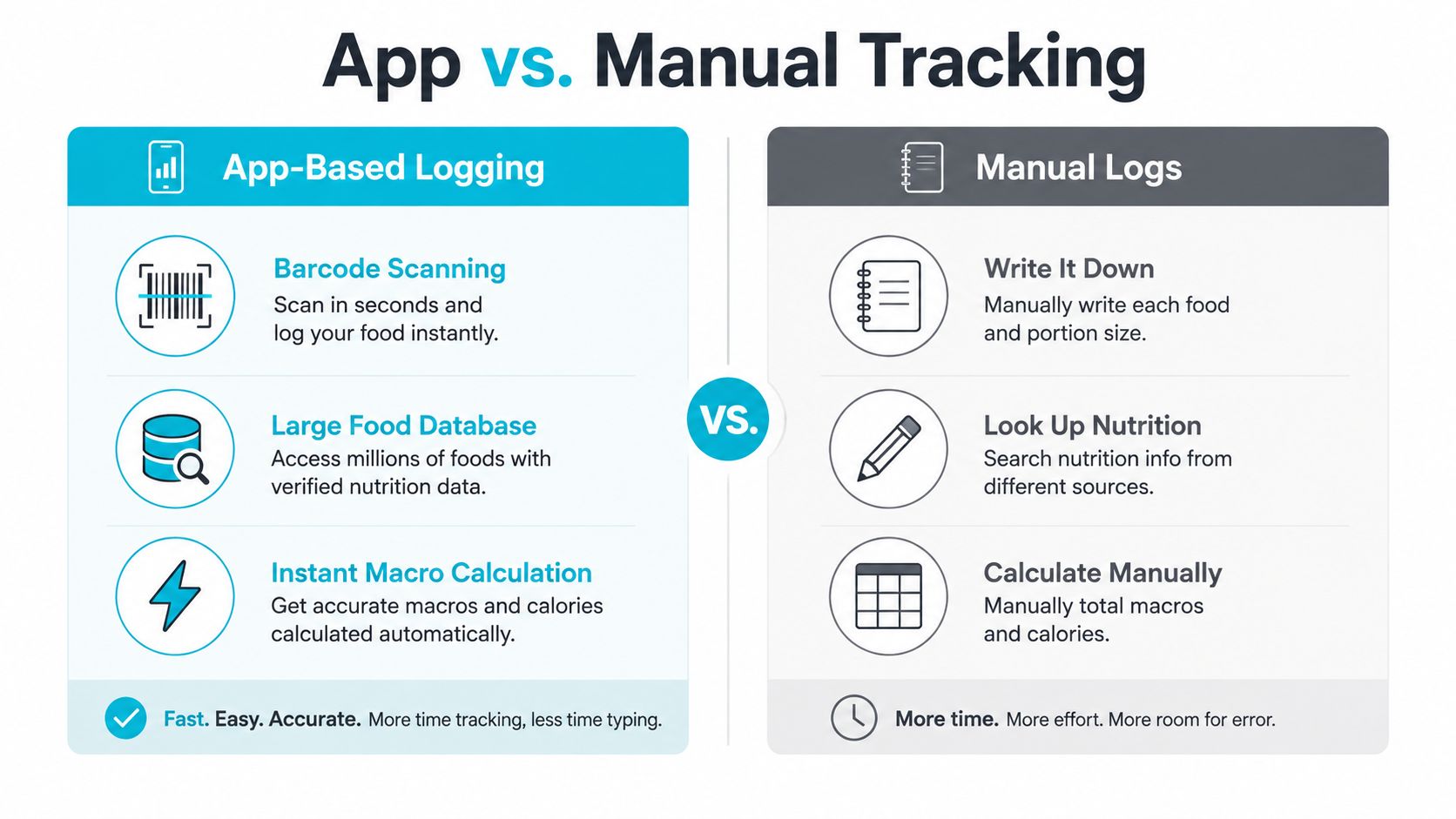
An app and a notebook can both answer the same question, but they create different habits. Apps such as MyFitnessPal, Cronometer, and MacroFactor reduce arithmetic and make repeated foods easy to save. Manual logs give you control over every entry and remove the pressure of notifications, streaks, and progress bars.
Where apps help
Barcode scanning is fast for packaged foods. Large databases save repeated label searches, and some platforms summarize micronutrients or show rolling averages. Those features matter when the app makes logging easier than skipping it.
The weakness is that a large database isn't automatically a reliable database. Restaurant meals, generic entries, user-submitted foods, and raw-versus-cooked mismatches can produce misleading totals. Subscription paywalls can also limit useful features, while daily streaks can encourage you to protect the record instead of learning from it.
For a broader overview of tracking macros for fat loss, compare the workflow with your actual routine rather than selecting an app because it has the most features.
Where manual logs help
A spreadsheet or paper journal shows exactly what you entered. You can record a home-cooked recipe, note hunger and energy, and avoid screen time during meals. The trade-off is labor. You'll need to look up nutrition information, calculate recipe totals, and add columns manually.
A hybrid system usually works well. Use an app for packaged foods and restaurant estimates, then weigh home-cooked staples and build reliable saved recipes. Once you've measured rice, oil, pasta, or a common protein several times, you can use a familiar portion more confidently.
| Your priority | Better starting choice |
|---|---|
| Speed and comfort with technology | App |
| Full control and minimal screen use | Manual log |
| Frequent packaged foods | App with label verification |
| Mostly home-cooked meals | Spreadsheet or saved app recipes |
| Tendency to chase streaks | Manual log or weekly app review |
| Uncertain adherence | The method you'll use consistently |
Choose the tool that lowers friction. An app won't help if you avoid opening it, and a notebook won't help if the arithmetic becomes so tedious that you stop recording.
Building a Sample Day of Macro-Friendly Meals
A sample day can demonstrate flexibility without pretending that one menu fits everyone. The outline below uses a roughly 1,800-calorie target with a 40/30/30 split, but the meal figures are planning estimates, not verified nutrition facts for every brand. Labels, preparation methods, and serving sizes will change the totals, so adjust entries in your own tracker.
Breakfast
Start with Greek yogurt, berries, and a measured scoop of protein powder. A repeatable bowl might use 250 grams of Greek yogurt, 100 grams of berries, and one labeled serving of protein powder. The yogurt supplies a substantial protein base, the berries add carbohydrate and volume, and the powder makes the meal easier to adjust without cooking.
You don't need to weigh berries forever. Weigh the ingredients while learning, save the combination as a meal, and later use a familiar bowl or container. If you're evaluating protein powder, a practical protein powder weight loss guide can help you compare serving information and use cases.
Lunch
Build lunch around a palm-sized portion of cooked chicken, tofu, fish, or another protein, then add a measured serving of rice or potatoes and vegetables. Include the dressing or cooking oil in the log. Oil, mayonnaise, creamy sauces, cheese, and dressings are easy to overlook because they don't take up much space on the plate.
Snack
Use a snack that solves the next hunger window without consuming all your remaining fat. Low-fat cottage cheese with fruit, a protein shake with a banana, or Greek yogurt with cereal can work. The best choice depends on what the earlier meals left available, not on a universal list of “clean” foods.
Dinner and flexibility
Dinner might include lean ground turkey tacos, tortillas, salsa, vegetables, cheese, and a small dessert. If you want a beverage or treat, log it before eating and adjust the portion of another ingredient. That approach preserves choice without pretending the treat has no calories.
| Meal | Calories | Protein (g) | Carbs (g) | Fat (g) |
|---|---|---|---|---|
| Yogurt, berries, protein powder | Estimate in your tracker | Verify label | Verify label | Verify label |
| Chicken, rice, vegetables, dressing | Estimate in your tracker | Weigh protein | Weigh starch | Log oil or dressing |
| Cottage cheese and fruit | Estimate in your tracker | Check package | Check fruit portion | Check product |
| Tacos, vegetables, cheese, dessert | Estimate in your tracker | Verify ingredients | Count tortillas and sides | Log cheese and sauces |
| Daily total | About 1,800 target | Add entries | Add entries | Add entries |
The sample works because it doesn't require chicken and broccoli at every sitting. Round routine entries to the nearest 5 grams when that keeps you consistent, pre-log meals you repeat, and batch-cook proteins so fatigue doesn't decide dinner. Precision has value during calibration, but the sustainable version is the one you can repeat through ordinary weeks.
Troubleshooting Plateaus and Logging Errors
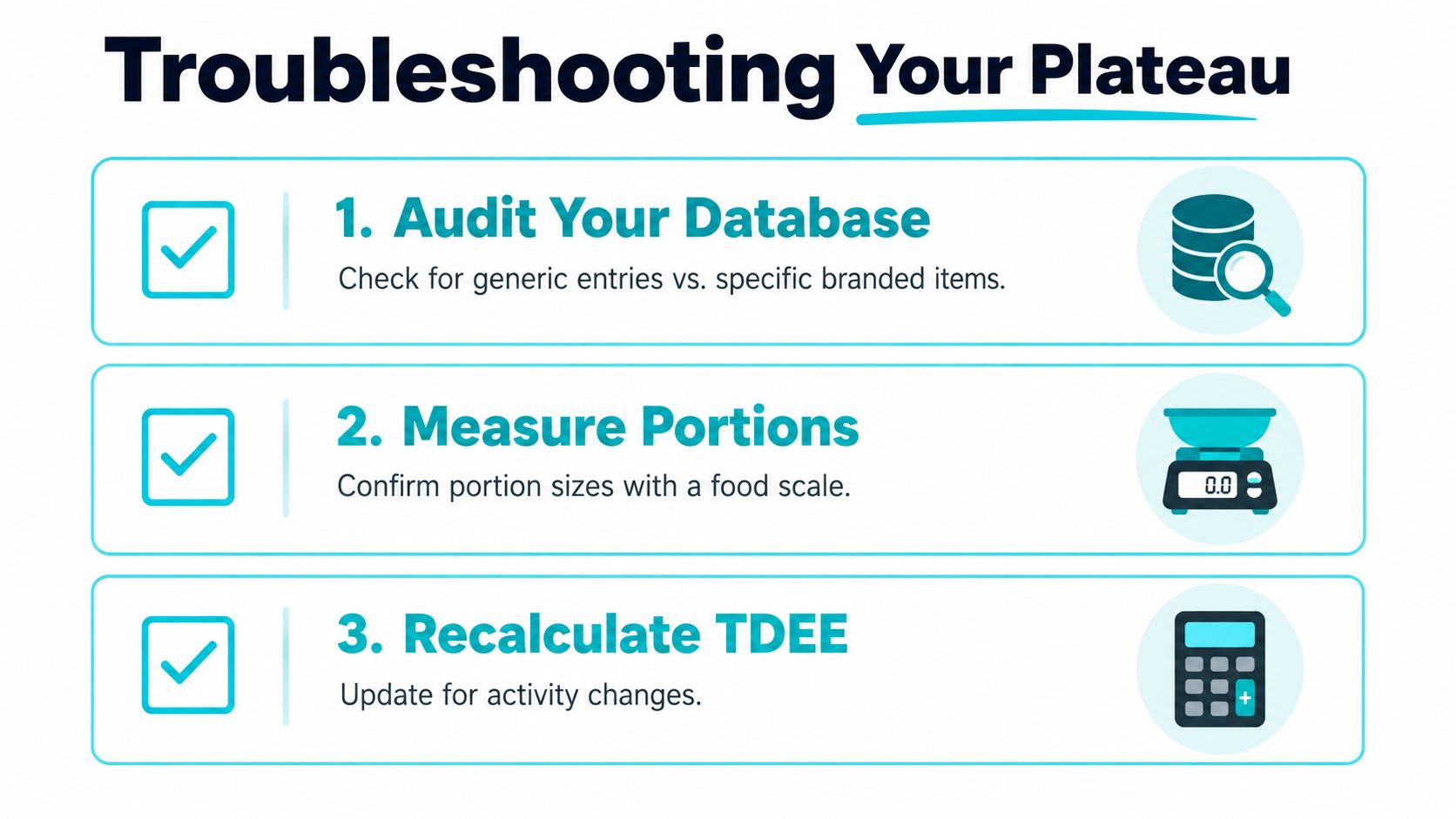
A flat scale reading doesn't automatically mean your macros have stopped working. Weight reflects water, digestion, sodium, stress, hormonal changes, and food volume as well as fat tissue. Review a rolling seven-day average and look for a genuine lack of trend over three to four weeks, rather than reacting to one unchanged morning, as outlined in this plateau and macro-tracking analysis.
Audit the record before changing the target
Start with the previous two weeks of logs. Look for generic database entries, suspiciously round numbers, missing ingredients, and meals recorded from memory hours later. Cross-check the foods most likely to be wrong against brand labels or a trusted food database.
Then measure the highest-error foods for three days. Cooking oil, bites while preparing food, coffee creamer, condiments, restaurant sauces, and “just a taste” portions commonly create drift. Don't assume the problem is motivation when the record itself is incomplete.
Separate noise from a true plateau
Compare your actual logged intake with the target and compare both with the rolling weight average. If the entries show repeated omissions or uncertain portions, tighten the logging first. If the records are reasonably complete and the average has stopped moving, reassess activity, maintenance needs, and whether the planned deficit is still appropriate.
The evidence supports a pragmatic adherence approach. In a digital weight-management program, tracking 28.5% of intervention days was enough to reach at least 3% weight loss, 39.4% of days for at least 5% weight loss, and 67.1% of days for 10% weight loss, based on ROC analysis in the published study. These thresholds don't promise a result, but they show why an imperfect record can still be useful.
Audit before adjustment. Fix missing entries and unreliable portions before cutting food from an already restrictive plan.
Don't automatically reduce calories by a fixed amount. The appropriate adjustment depends on the quality of the data, the length of the plateau, health context, and how sustainable the current intake feels. If you're using a GLP-1 medication or experiencing nausea and meal skipping, discuss protein and calorie adequacy with your healthcare professional rather than just tightening targets.
Monitoring Progress and Adjusting Your Targets
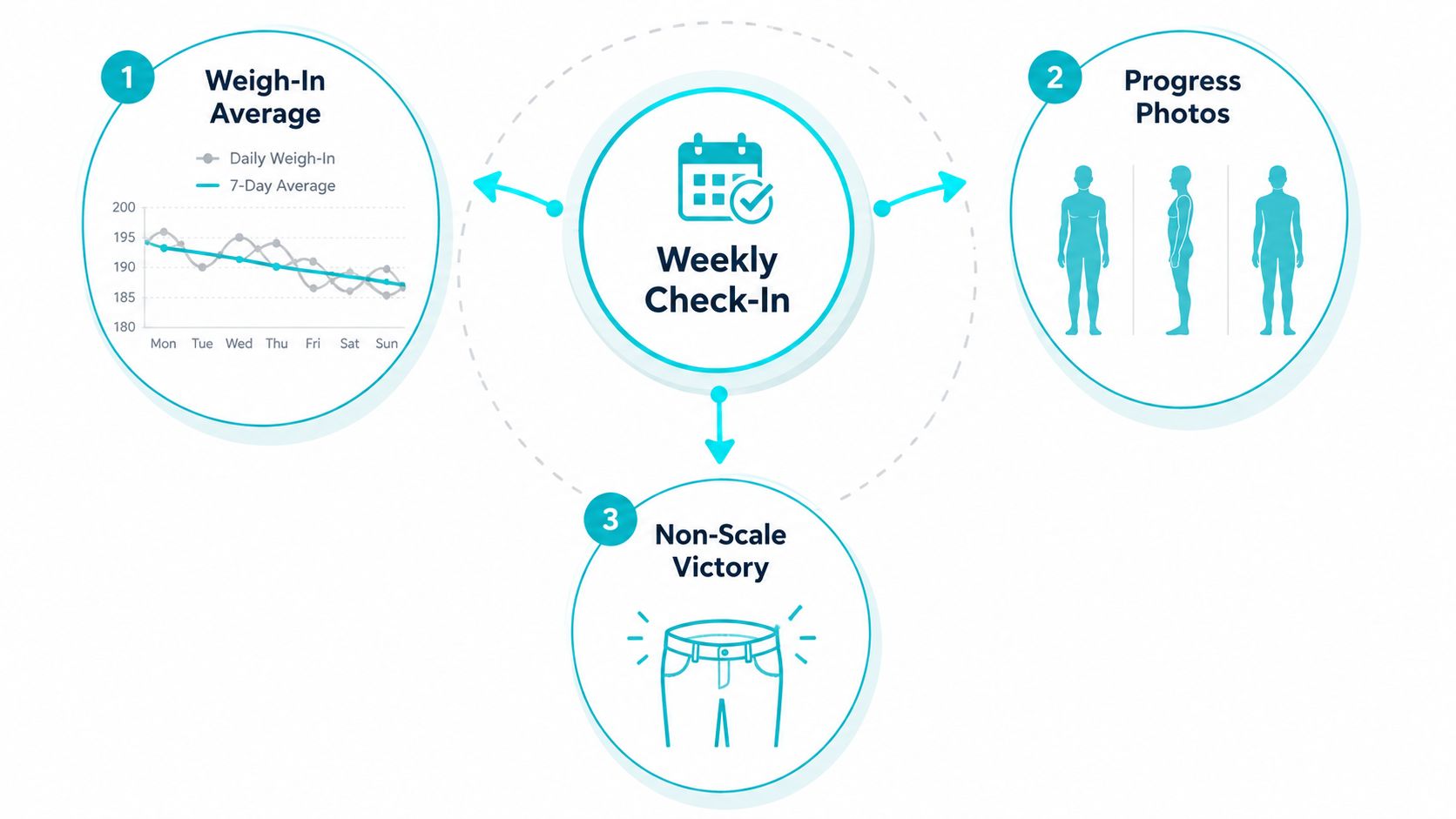
A sustainable tracking rhythm uses several signals instead of asking the scale to explain everything. Weigh under similar conditions when possible, calculate a weekly average, and compare averages rather than isolated readings. Progress photos, waist or clothing changes, training performance, hunger, and energy can add context when scale weight is temporarily noisy.
Use clear decision rules
Review your average intake and weight trend together. If weight remains flat for two consecutive weeks despite verified accurate logging, you can consider a modest calorie adjustment or a measured increase in daily activity, provided the current plan is safe and sustainable for you. The plan notes commonly use 100–150 calories or 1,500–2,000 steps, but those are not universal prescriptions and shouldn't override clinical guidance.
Targets will change as body weight, activity, appetite, and routines change. That isn't evidence that you failed. It's the normal consequence of using an estimate and then collecting better information.
For people who've spent 12 or more weeks in a deficit, a diet break at estimated maintenance can be useful for adherence. A one-to-two-week maintenance period may make meals and social routines easier, but it isn't a guaranteed metabolic reset and should still include adequate nutrition. If you have a history of disordered eating, frequent tracking may be counterproductive, so get individualized support.
The final skill is knowing when to reduce tracking. After you've learned portions, built reliable meals, and maintained a stable trend, you might track selected meals, use hand portions, and review one weekly check-in instead of logging every bite. The app is a tool, not a permanent requirement.
Summary
If you want macro tracking to help with weight loss, keep the process simple enough to repeat:
- Start with a calorie target, then set protein first.
- Use fats and carbohydrates as flexible levers within your calorie budget.
- Track consistently enough to spot patterns, not perfectly enough to impress an app.
- Weigh foods during the learning phase, especially calorie-dense items like oils, dressings, rice, and pasta.
- Review weekly weight averages before changing your targets.
- Audit logging gaps before assuming your macros stopped working.
- Adjust calories or activity only after you have reasonably accurate data.
The best macro plan is the one you can follow through busy workdays, restaurant meals, and ordinary weeks.
FAQ
How do I track macros for weight loss?
Start by setting a calorie target, then assign protein first, fat second, and carbohydrates with the remaining calories. Log meals as consistently as possible, weigh foods during the learning phase, and review your weekly weight trend before making adjustments.
What macro ratio is best for weight loss?
There is no single best ratio for everyone. A calorie deficit and consistent adherence matter more than choosing low-carb or low-fat, which is why many people do well with a protein-focused setup and flexible carbs and fats.
Do I need to weigh every food?
No. Weighing foods is most useful at the start, especially for calorie-dense items like oil, dressings, nut butter, rice, and pasta. Once you know your usual portions, you can rely more on saved meals, labels, and familiar serving sizes.
Which macro should I hit first?
Protein is usually the top priority during weight loss because it helps support lean mass and can make meals more filling. After protein, keep total calories in range and use carbs and fats more flexibly.
Can I track macros without an app?
Yes. A notebook or spreadsheet can work well if you prefer full control or less screen time. Apps are faster for barcode scanning and saved foods, but the best system is the one you will actually use consistently.
Why am I not losing weight even though I hit my macros?
Check your logging accuracy before changing your targets. Common issues include missed oils, sauces, drinks, restaurant estimates, and portion creep. Use a rolling seven-day weight average and look for trends over several weeks, not single weigh-ins.
ThriveXDNA brings together wellness resources and fitness guidance, including tools and content that can support macro tracking alongside broader health routines. Visit ThriveXDNA to explore its fitness and wellness resources, then choose a tracking method you can use consistently and review without judgment.