How to Choose a Financial Advisor You Can Trust
People ask how to choose a financial advisor by comparing credentials, fee labels, and maybe a referral from a friend. That's the wrong starting point. The question is whether this person will tell you hard truths, explain tradeoffs clearly, and stay consistent after the first meeting ends.
Good advice looks impressive on paper and still fails in real life when the advisor won't explain conflicts, won't answer direct questions, or won't follow through. The U.S. Securities and Exchange Commission and FINRA both push investors to verify registration, review disciplinary history, and ask about compensation, service scope, and conflicts before hiring anyone, because those checks turn a vague search into a real screening process (SEC investor guidance). If you want a fast fee comparison to start narrowing the field, compare financial advisor fees before you sit down with candidates.
Practical rule: Don't shop for the smartest-sounding advisor first. Shop for the one who can explain their process, admit what they don't do, and stay steady when you push on cost, conflicts, and communication.
Table of Contents
- The Question Most People Get Wrong
- Map Your Money Before You Shop for an Advisor
- Fee-Only vs Fee-Based vs Commission Models
- Verify the Record Before You Trust the Pitch
- Interview Questions That Reveal the Real Advisor
- Calculate the Real Cost of an Advisor
- Your Final Decision Checklist and Red Flags
- Quick Summary
- FAQ
The Question Most People Get Wrong
The default mistake is simple. People look for the advisor with the strongest brand, the slickest website, or the lowest posted fee, then act surprised when the relationship feels off. That is the wrong filter. Credentials and marketing can be polished, but trust shows up in how someone answers uncomfortable questions.
The U.S. Securities and Exchange Commission tells investors to confirm that both the individual and the firm are registered, then compare that information with BrokerCheck and other third-party sources. It also recommends asking directly about experience with similar clients, compensation methods, investment philosophy, product limitations, minimum account balances, and any disciplinary actions, arbitration awards, or customer complaints. That kind of screening catches problems early, before you hand over documents or assets, and if you want a quick starting point on price, compare financial advisor fees before you sit down with candidates.
A serious advisor can explain their process without jargon and without dodging questions. If they cannot make themselves clear in the first meeting, they will not suddenly become a better communicator once your money is on the line.
Transparency matters just as much. The advisor should say how they are paid, where conflicts can arise, and what you are buying. Your job is to press on those points, not accept a polished pitch.
Follow-through is the part that separates a real planning relationship from a sales meeting. Plenty of advisors can sell confidence. Fewer can keep a steady cadence, return calls, and stick to the agreed process when the market gets noisy or your life changes.
Ask this instead, which advisor will tell me things I do not want to hear and still keep me on track? That question is harder to fake, and it exposes who is built for real advice, not just a good first impression.
The legal standard attached to advice matters too, because it shapes conflicts of interest and product recommendations. The U.S. Department of Labor's 2016 fiduciary rule marked a shift toward best-interest obligations in retirement advice, and the Securities and Exchange Commission's Regulation Best Interest later established a general best-interest obligation for broker-dealers when recommending securities to retail customers (DOL fiduciary rule history).
Map Your Money Before You Shop for an Advisor
Before the first meeting, write down three numbers, three goals, and one constraint. The numbers are your investable assets, your annual savings rate, and your current debt or cash buffer. The goals should be concrete, such as retirement income, a home purchase, or a business exit. The constraint is the one thing that makes your finances harder, maybe taxes, time, or the need to coordinate with a CPA.
That inventory tells you what kind of help you need. Someone with a simple portfolio and steady paycheck needs a different setup than a business owner with irregular income and tax issues.
Match the model to the mess
Simple finances call for simpler help. If you mainly want automated investing, a robo-advisor fits. If you want a one-time plan and nothing more, hourly advice or a flat-fee planner can be a good fit. If you need ongoing portfolio oversight plus planning, an AUM relationship can work, but only if the service covers the problems on your list.
Simple rule: The more moving parts you have, the less useful it is to shop on headline price alone.
The point is to avoid paying for services you will never use. A plain-language guide can help you avoid common financial mistakes while you sort out whether your problem is basic discipline or real planning complexity.
Here is the blunt version. If your finances are mostly accumulation with one or two clear goals, keep the search narrow and price-sensitive. If taxes, estate questions, business ownership, or retirement income decisions are in play, you need an advisor who can handle those issues without making you coordinate everything yourself.
Write down what you want help with before you book calls. If you cannot describe the problem in one paragraph, you are not ready to hire anyone yet. Once you can, the first conversation gets sharper because you are testing whether the advisor understands your situation or just sells the same package to everyone.
Fee-Only vs Fee-Based vs Commission Models
People get sloppy. Fee-only and fee-based are not the same thing, even though the words look similar. One can be clean and aligned, the other can hide conflicts behind a professional-sounding label.
How the models actually work
| Advisor Compensation Models Compared | How They Get Paid | Conflict of Interest Risk | Typical Cost Range | Best Fit For |
|---|---|---|---|---|
| Fee-only | Paid directly by the client through a flat fee, hourly rate, retainer, or AUM fee | Lower, because compensation is tied to advice rather than product sales | Varies by service model | Ongoing planning, holistic advice, clients who want clearer alignment |
| Fee-based | Paid by the client and may also receive commissions or other third-party compensation | Higher, because revenue can come from multiple places | Varies by service model | People who understand the tradeoffs and are willing to inspect disclosures closely |
| Commission-based | Earns money when a product is sold | Highest, because the sale itself creates the payout | Depends on product and transaction | Limited-scope insurance or one-off product transactions |
| Robo-advisor | Charges a platform fee for automated portfolio management | Lower on human conflict, but limited customization | Usually lower than full-service planning | Simple portfolios and investors who want automation |
The issue is incentive. A fee-only fiduciary usually wins on alignment for ongoing planning because the advisor gets paid for advice, not for steering you into a specific product. A commission model can be defensible in a narrow situation, especially for a one-time insurance need or a single transaction, but it is a poor default for most ongoing financial relationships.
Where hidden costs hide
People fixate on the advisory fee and miss the rest. That's a mistake. The cheaper-looking option can still cost more once fund expenses, product loads, and transaction charges are layered in. The practical move is to compare the full service model, not just the line item on the brochure.
A fee-based advisor may still be a solid professional, but you need to work harder. Ask what they earn from third parties, what products they're allowed to recommend, and whether they can show you the conflict points in writing. If they get defensive about that question, you already have your answer.
Bottom line: If you want long-term planning and you care about conflict control, start with fee-only fiduciary options first, then make any exception on purpose.
Verify the Record Before You Trust the Pitch
Do not hand over a single financial document until you have checked the record. An advisor can sound polished in a meeting and still have a history that should change your view. You are hiring a steward for your money, so start with proof.
The verification workflow
Start with FINRA BrokerCheck and the SEC's Investment Adviser Public Disclosure system to confirm registration, employment history, and disclosures. Then ask for Form ADV Part 2A to see services, fees, conflicts, and business practices in plain English, and Form CRS for the required relationship summary. Verify any credential they claim directly with the issuing body.
| Verification Sources at a Glance | What It Confirms | Standard to Verify |
|---|---|---|
| BrokerCheck | Registration and disciplinary history | Look for complaints, arbitration, and employment gaps |
| SEC IAPD | Registered investment adviser records | Confirm the firm and the individual are properly registered |
| Form ADV Part 2A | Services, fees, conflicts, and business practices | Read the details, not just the summary |
| Form CRS | Plain-language relationship summary | Check whether the relationship type matches what you were told |
| Credential issuers | Professional designation status | Verify CFP, CFA, CPA-PFS, or other claimed credentials directly |
What to ask about the record
Ask whether the disclosures match the pitch. If the advisor describes a clean track record but the filings show customer disputes, that mismatch matters more than a slick presentation.
Do a quick public search for complaints, arbitration, and prior firms. Silence is not proof of quality, but missing or vague disclosure is a warning sign. A single arbitration award over unsuitable recommendations can happen. Three within five years should end the conversation.
Also check whether the advisor's registration lines up with the work they want to do for you. If they hedge, deflect, or say the paperwork is “just a formality,” stop there. Good advisors expect scrutiny and answer straight.
The point is simple. Records do not prove skill, but they do expose patterns. If the filings, history, and pitch do not line up, walk away.
Interview Questions That Reveal the Real Advisor
The first meeting is not small talk. It's a stress test. Credentials can be copied onto a website, but behavior under pressure shows up in the room when you ask for specifics.
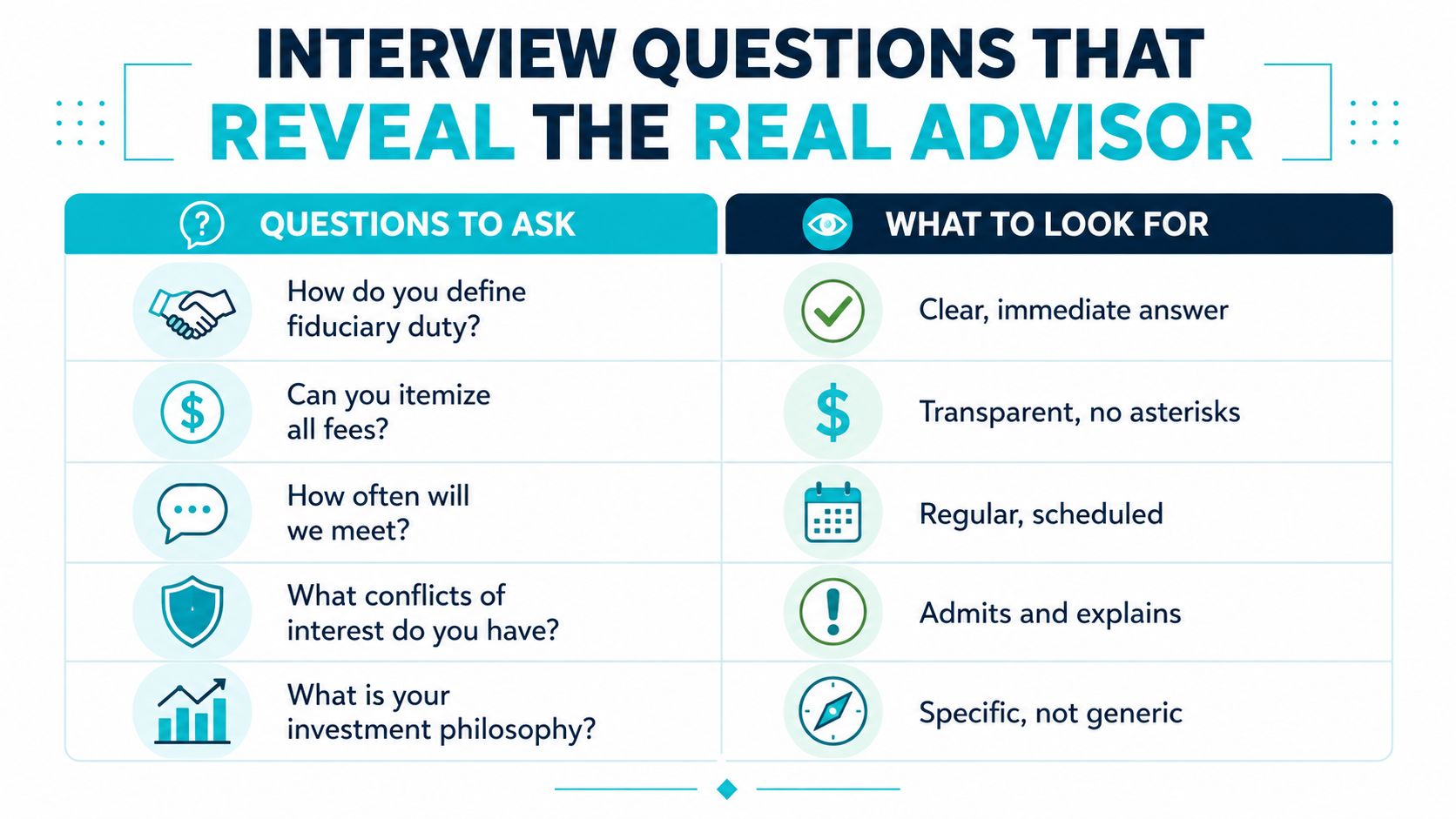
Questions that separate real advisors from salespeople
Ask, “Are you a fiduciary 100% of the time, and where is that written in the agreement?” If the answer is fuzzy, that's a bad sign. Ask how they're compensated, what their top revenue sources are, and whether any third parties pay them anything you wouldn't see on a statement.
Then ask how they'd handle a recommendation that conflicts with a product their firm prefers. A good advisor can explain the tension without squirming. A weak one hides behind policy language and hopes you won't notice the mismatch.
Direct test: If they can't give a straight answer on compensation, conflicts, and service cadence, they're not ready for your business.
Service and communication questions
Ask how fast they respond, who does the work, and what triggers a phone call instead of a quarterly email. Ask for two current client references and one former client reference, then call them. Former clients are especially useful because they'll tell you how the relationship ended, not just how the pitch sounded at the start.
The most common mistake is treating communication as a soft issue. It isn't. Clear communication is a working requirement, because people who can't explain the plan now will not magically become better once markets get choppy or your life changes.
You should also ask about their investment philosophy and how it fits your situation. Not every advisor needs to run the same portfolio, but every advisor should be able to say what they believe and why. Generic answers usually mean the answer is either inconsistent or not thought through.
Calculate the Real Cost of an Advisor
Sticker price is the first lie in advisor shopping. Cost sits in layers, and you need to pull them apart before you sign anything. If you don't, a simple-looking relationship can get expensive fast.
Build the cost stack
Start with the advisory fee, which might be an AUM percentage, flat fee, hourly rate, or retainer. Then add fund expense ratios, which are built into the investments themselves. After that, factor in transaction costs, including commissions, markups, and bid-ask spread, plus product loads or surrender charges if insurance or mutual fund products are involved.
The practical move is to ask for a written fee disclosure that shows custodians, product partners, and any revenue-sharing agreements. If the advisor won't give you a clear breakdown, you're not getting transparency, you're getting sales with better packaging.
| Cost Components of an Advisory Relationship | How It Is Charged | Question to Ask |
|---|---|---|
| Advisory fee | Percentage of assets, flat fee, hourly rate, or retainer | What exactly does this fee include? |
| Fund expense ratios | Built into the funds or ETFs you hold | What's the weighted average expense ratio in the proposed portfolio? |
| Transaction costs | Commissions, spreads, markups, or trading costs | How much trading do you expect to do, and why? |
| Product loads or surrender charges | Embedded in certain insurance or investment products | Are there any penalties, loads, or hidden product costs? |
Compare cost against the same benchmark
A high-fee plan is one problem. A high-fee plan with extra product costs is worse. The only fair comparison is to look at the total cost of ownership against a passive benchmark with the same allocation, then decide whether the advice is worth the difference.
Run the math once before you hire them, then check it again after a year. If the costs don't line up with what was projected, ask why. Good advisors don't need opacity to justify their value.
Rule of thumb: If the only number you can easily see is the advisory fee, you're probably not seeing the real bill.
Your Final Decision Checklist and Red Flags
By the time you've interviewed candidates, the decision should feel simple. Not easy, simple. The advisor either cleared the screening or didn't. Don't rescue a weak candidate because they were charming or because their office is close to yours.
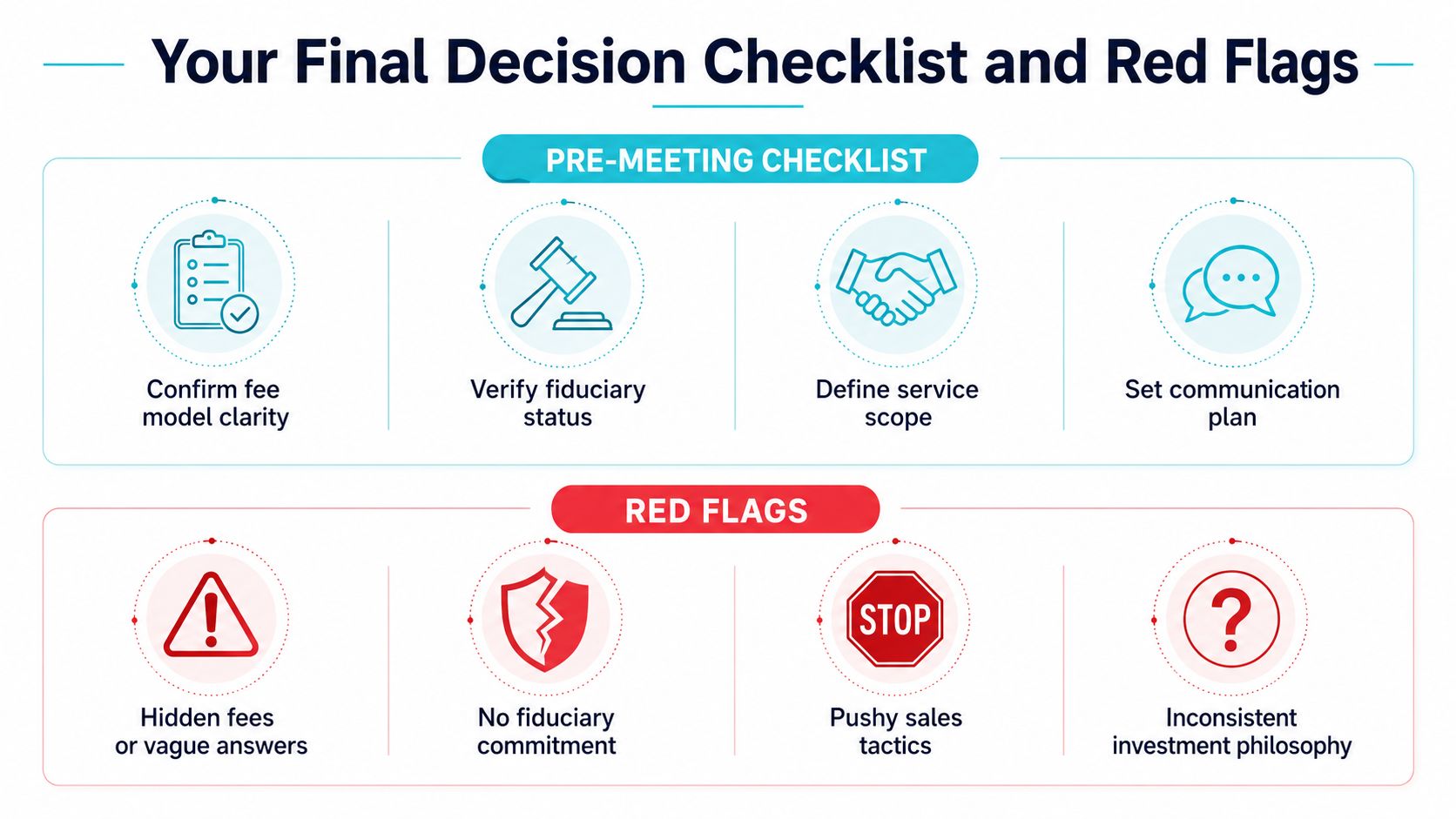
Final pre-meeting checklist
- Confirm fee model clarity. You should know whether you're paying fee-only, fee-based, commission-based, or automated platform pricing.
- Verify fiduciary status. Ask for it in writing, then match the answer to the registration record and relationship summary.
- Define service scope. Make sure the advisor is handling the planning areas you care about.
- Set the communication plan. Decide how often you'll hear from them, who responds, and how fast.
Red flags that should end the conversation
Pressure tactics are a hard no. So are vague performance promises, proprietary product requirements, undisclosed third-party compensation, and any advisor who acts annoyed when you ask questions. If the conversation feels rushed, one-sided, or evasive, stop there.
If they discourage scrutiny before the engagement starts, they'll hate scrutiny after the engagement starts.
Give yourself a 48-hour cooling-off period before signing anything. Review the disclosures again, run one more BrokerCheck search, compare at least two proposals, and sleep on the decision. The right advisor will still look right after the adrenaline fades.
Quick Summary
Choosing a financial advisor starts with clarity about your own needs, not the advisor's branding or pitch. Define your goals, assets, savings rate, and biggest constraint before you start comparing options. Then match the advisor model to your situation, verify their registration and disclosures, and ask direct questions about fees, conflicts, service scope, and communication.
For most people who want ongoing planning, fee-only fiduciary advisors are the cleanest place to start because compensation is more directly tied to advice than product sales. Still, no label is enough on its own. You need to review Form ADV, check BrokerCheck and SEC records, confirm credentials, and compare the full cost stack, not just the headline advisory fee.
The right advisor should be able to explain tradeoffs in plain English, answer uncomfortable questions without getting defensive, and follow through consistently after the first meeting. If the filings, pricing, and pitch do not line up, walk away.
FAQ
How do I know if a financial advisor is trustworthy?
Start by verifying registration through FINRA BrokerCheck and the SEC's Investment Adviser Public Disclosure system. Then review Form ADV Part 2A, Form CRS, and any claimed credentials. Trust also shows up in behavior. A reliable advisor gives straight answers on compensation, conflicts, and service scope.
Is fee-only always better than fee-based?
Not automatically, but fee-only is usually the cleaner default for ongoing planning because the advisor is paid directly by the client. Fee-based advisors can still be good, but they may also receive commissions or third-party compensation, so disclosures matter more.
What questions should I ask before hiring an advisor?
Ask whether they are a fiduciary at all times, how they are compensated, what services are included, who will manage your account, how often they communicate, and whether they have experience with clients like you. Also ask where conflicts are disclosed in writing.
What credentials matter most for a financial advisor?
Common credentials worth checking include CFP, CFA, and CPA-PFS, depending on the type of help you need. The key is not just the designation itself, but whether it is active, relevant to your situation, and backed by a clean record.
How much does a financial advisor really cost?
The real cost includes more than the advisor's stated fee. You also need to account for fund expense ratios, transaction costs, product loads, surrender charges, and any third-party compensation built into recommendations.
When should I walk away from an advisor?
Walk away if the advisor is vague about fees, defensive about conflicts, pushes proprietary products, makes performance promises, discourages scrutiny, or if their disclosures do not match their pitch.
If you want a cleaner, more practical way to sort through advisor options, fees, and planning tools in one place, ThriveXDNA offers calculators, comparison content, and a directory-style entry point for finding financial advisor help. Visit ThriveXDNA and use it to pressure-test your shortlist before you commit.