How to Find Your Insurance Company Policy Number Fast
You're standing beside a damaged car, trying to stay calm while someone asks for your insurance details. Your wallet has an old card, your phone won't load the insurer's app, and you're no longer sure whether the number in your email is current. That's exactly when an insurance company policy number matters.
The number is a unique contract identifier. It connects your coverage, billing, renewals, claims, and insurer records. It isn't a market-wide statistic or a universal customer number. It identifies your specific policy inside an insurer's much larger policy system.
Table of Contents
- Why Your Insurance Company Policy Number Matters More Than You Think
- Where to Find Your Policy Number on Physical and Digital Documents
- Why Policy Numbers Differ Across Products and Channels
- When to Share Your Policy Number and When to Keep It Private
- How to Contact Your Insurer When You Cannot Find the Number
- Quick Reference Checklist for Locating and Protecting Your Policy Number
Why Your Insurance Company Policy Number Matters More Than You Think

At a collision scene, your auto policy number helps the insurer connect the incident to the correct vehicle, coverage period, deductible, and named drivers. A hospital or pharmacy may need health-plan identification details to verify benefits. A mortgage lender may request homeowners coverage information, while a life insurer uses the policy identifier to locate the contract, beneficiaries, premium history, and status.
The same basic number serves different operational purposes across products:
- Auto insurance: identifies the policy used for accident reporting, repairs, roadside assistance, and proof of coverage.
- Home insurance: connects property coverage to the insured address, limits, endorsements, and claim records.
- Health insurance: helps providers route eligibility and billing information through the appropriate plan.
- Life insurance: links the policyholder to the contract, premium records, beneficiaries, and service requests.
A wrong, expired, or incomplete number can send a representative to the wrong record. That may delay verification, create billing confusion, or complicate a claim. The problem is especially serious when a renewal has changed the identifier or when you've replaced one insurer with another.
Practical rule: Keep the current number with the current policy documents. Don't rely on memory or an old card.
Insurance systems handle enormous policy inventories. The United States had approximately 259.74 million life insurance policies in force in 2023, according to reported U.S. life insurance policy data. India's general insurance market issued 3,208.77 lakh policies in 2023-24, according to official market reporting summarized in the OECD insurance statistics resource. Your policy number is the practical key that helps staff find one contract within that large administrative environment.
For insurance teams handling repeated customer requests, a structured knowledge resource such as DocsBot for insurance teams can also help standardize answers about policy documents and servicing processes. For consumers, the immediate priority is simpler. Find the current number before you need it.
Where to Find Your Policy Number on Physical and Digital Documents
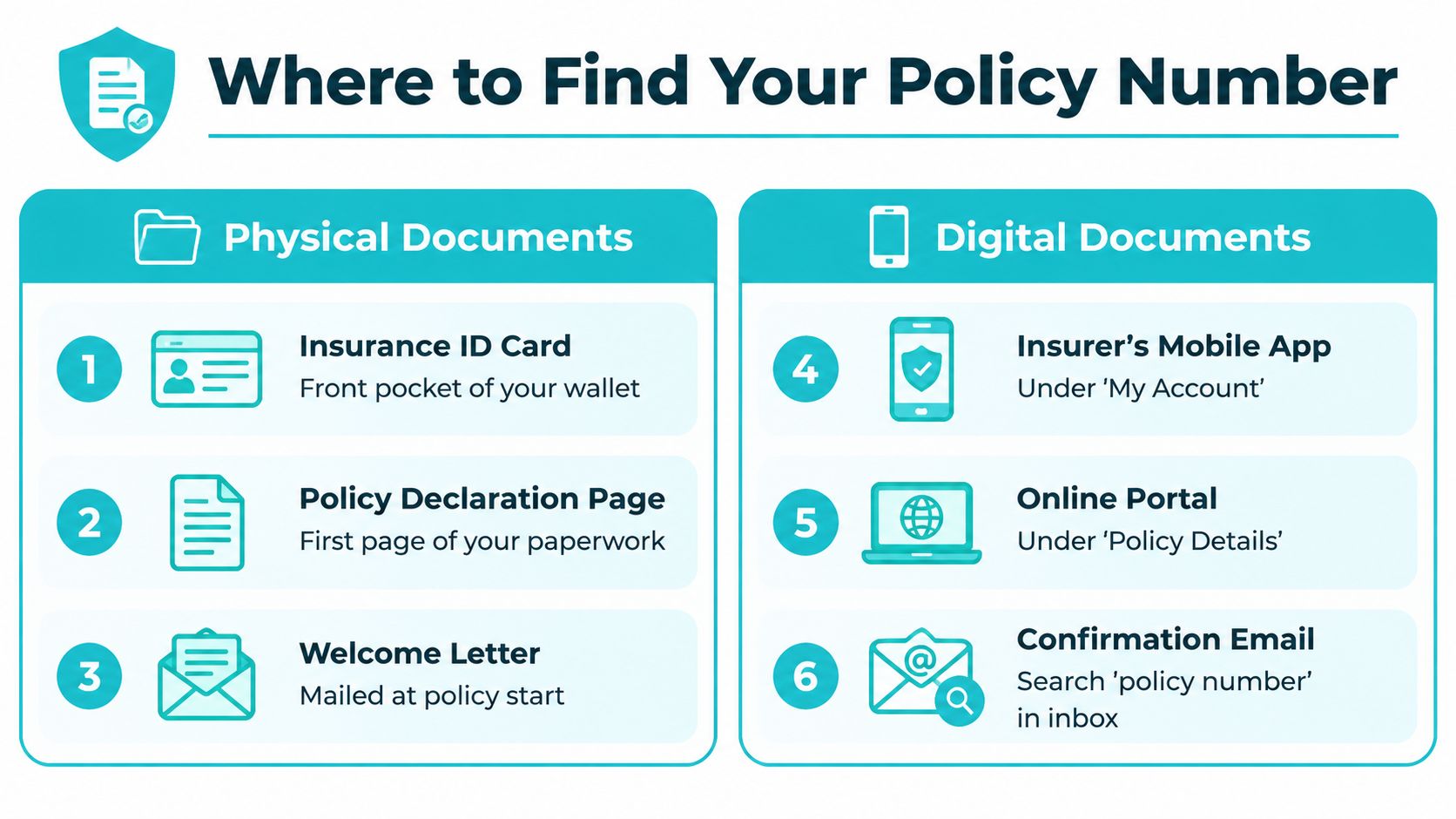
Start with the document issued closest to the policy itself. If you need the authoritative identifier, don't stop at the first number you see. Check the label beside it and compare the policy term or effective dates.
Insurance ID cards
Auto and health ID cards usually place the policy or member identifier near the insured person's name, insurer information, group number, or vehicle details. The label may say policy number, member ID, subscriber ID, or something similar. Those terms aren't interchangeable in every system, so use the number exactly as the insurer displays it.
Check both sides of a physical card. If you use a digital card, open the insurer's app and save a secure offline copy or screenshot where you can reach it quickly. Don't post that image publicly, and avoid leaving it in an unprotected shared photo folder.
Declarations pages
For auto and home insurance, the declarations page is usually the strongest reference document. It summarizes the named insured, covered property or vehicles, policy period, limits, deductibles, and policy identifier. Insurers commonly issue it when coverage begins and again when the policy renews.
Search the first page for policy number, then confirm that the effective dates match your current coverage. If the ID card and declarations page appear inconsistent, use the declarations page as the starting point and ask the insurer to reconcile the records.
Billing statements and confirmation emails
Monthly statements, payment receipts, renewal notices, welcome letters, and claim correspondence often include the number in an account summary or document header. Search your email for phrases such as policy number, the insurer's name, renewal, or declarations.
Online portals and mobile apps
Log in through the insurer's official website or app, then look under My Policies, Policy Details, Documents, or My Account. Download the declarations page and current ID card rather than copying a number from a general account screen. That preserves the surrounding details needed to identify the correct policy.
Create one secure folder for current insurance documents. Keep old policies separately, label renewal dates clearly, and replace saved cards when the insurer issues updated documents.
Why Policy Numbers Differ Across Products and Channels
A policy number does not always identify every product you hold with one insurer. Auto, home, life, health, and umbrella coverage may run on separate administrative systems. Bundling can place them on one bill without creating one universal identifier. Your auto and home policies may therefore have different numbers, even when the same company services both.
Group coverage adds another layer. An employer plan may use a master contract number for the organization, then assign each employee a certificate or member number. The certificate identifies your coverage under that contract, while the master number identifies the employer's plan. Providing the wrong one can delay billing or claims handling.
Renewals can also change the identifier. An insurer may preserve the main number, add a suffix, or issue a new number when its system creates a new policy term. Prefixes and letter patterns are carrier-specific, so do not infer the product, coverage status, or insurer from the characters alone. Policy numbers commonly use 8 to 16 alphanumeric characters, although some carriers use fixed numeric IDs or other letter-number combinations, as described in this overview of car insurance policy numbers.
| Document Source | Number Format | Why It Differs |
|---|---|---|
| Insurance ID card | Member ID, policy number, or abbreviated reference | May identify the insured person, vehicle, or coverage record |
| Declarations page | Full policy identifier | Connects to the underwriting record and coverage terms |
| Billing statement | Account or policy reference | Supports payment processing and account servicing |
| Employer or group document | Master contract plus member identifier | Separates group coverage from the individual enrollee |
| Online portal | Full number, account number, or document-specific reference | May connect policy administration with login records |
Treat a difference as serious when it points to another insurer, an expired term, a different vehicle, or another insured person. Spacing, punctuation, capitalization, and labels such as policy number or member ID often reflect formatting rather than a coverage problem.
Check every character, including prefixes and suffixes. Then match the named insured, covered asset, and policy dates. If those details conflict, stop before filing a claim and contact the insurer through its official channel. State which document shows each identifier and ask the representative to confirm which number applies to your claim or service request.
When to Share Your Policy Number and When to Keep It Private
Your policy number isn't a password, but it's still sensitive. Claims databases may store policy information alongside a person's name, date of birth, policy number, and claim history. The Utah Insurance Department's explanation of C.L.U.E. reports describes how insurers use this kind of information in underwriting and rating decisions.
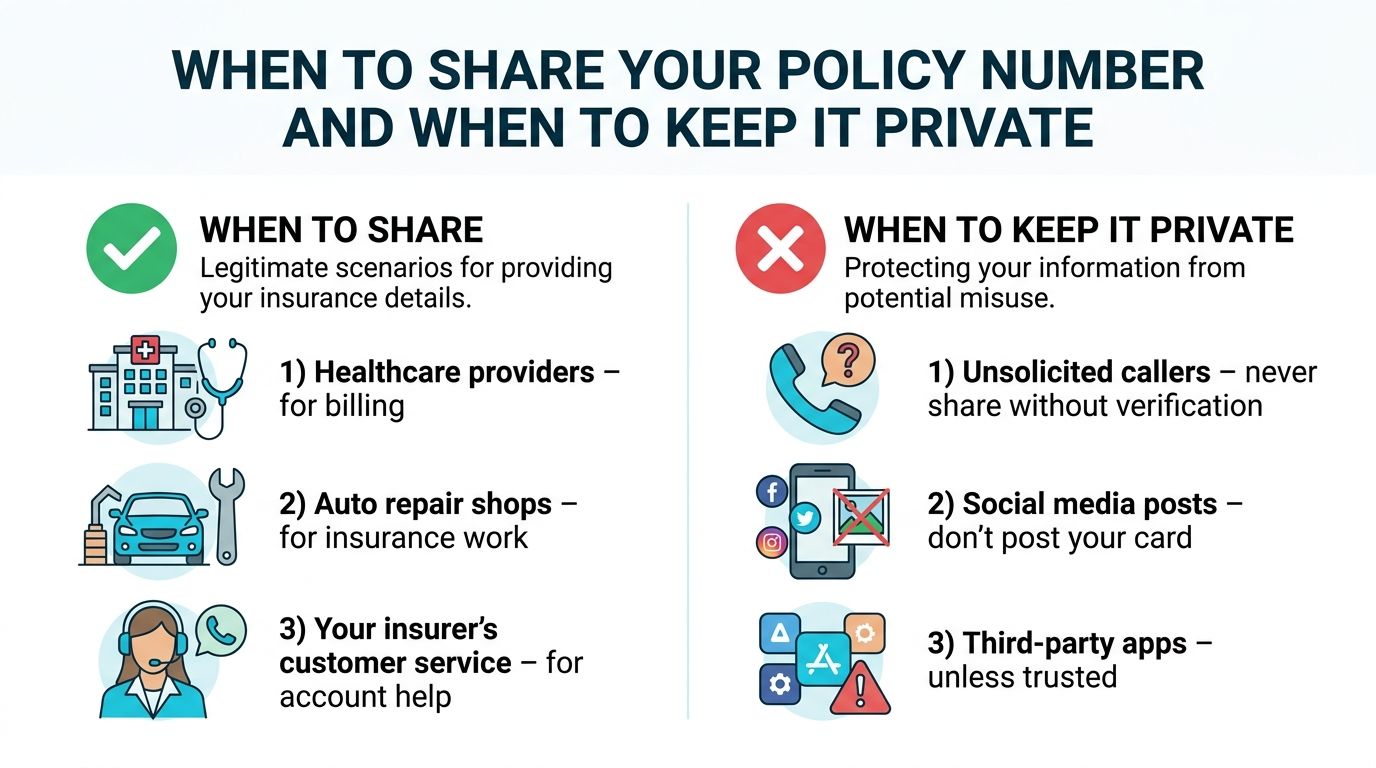
Share the number when there's a clear insurance purpose and you initiated or independently verified the contact. A healthcare provider may need it for billing. An auto repair shop may require it to coordinate insurer-approved work. Your own insurer's customer service team may ask for it to locate your account.
Use this decision test before disclosing it:
- Who is requesting it? Confirm the organization through its official website, app, card, or known telephone number.
- Why do they need it? The reason should match a real claim, billing, eligibility, renewal, or coverage task.
- How will you provide it? Prefer a secure portal, authenticated app, verified provider system, or a phone number you found independently.
Security check: An urgent request is not proof of legitimacy. Slow the conversation down and verify the requester yourself.
Be cautious with unsolicited calls, texts, and emails. A caller claiming to be an insurer, government official, repair coordinator, or investigator may be trying to collect enough information to impersonate you or submit a false claim. Don't send a photograph of your full card through social media, and don't add the number to an unfamiliar third-party app because the app promises a faster quote.
Protecting policy information works best as part of broader practical PII protection strategies. If you've already shared the number with a suspicious party, contact your insurer through its official website, explain what happened, ask whether recent account changes or claims exist, and request guidance on monitoring the policy.
How to Contact Your Insurer When You Cannot Find the Number
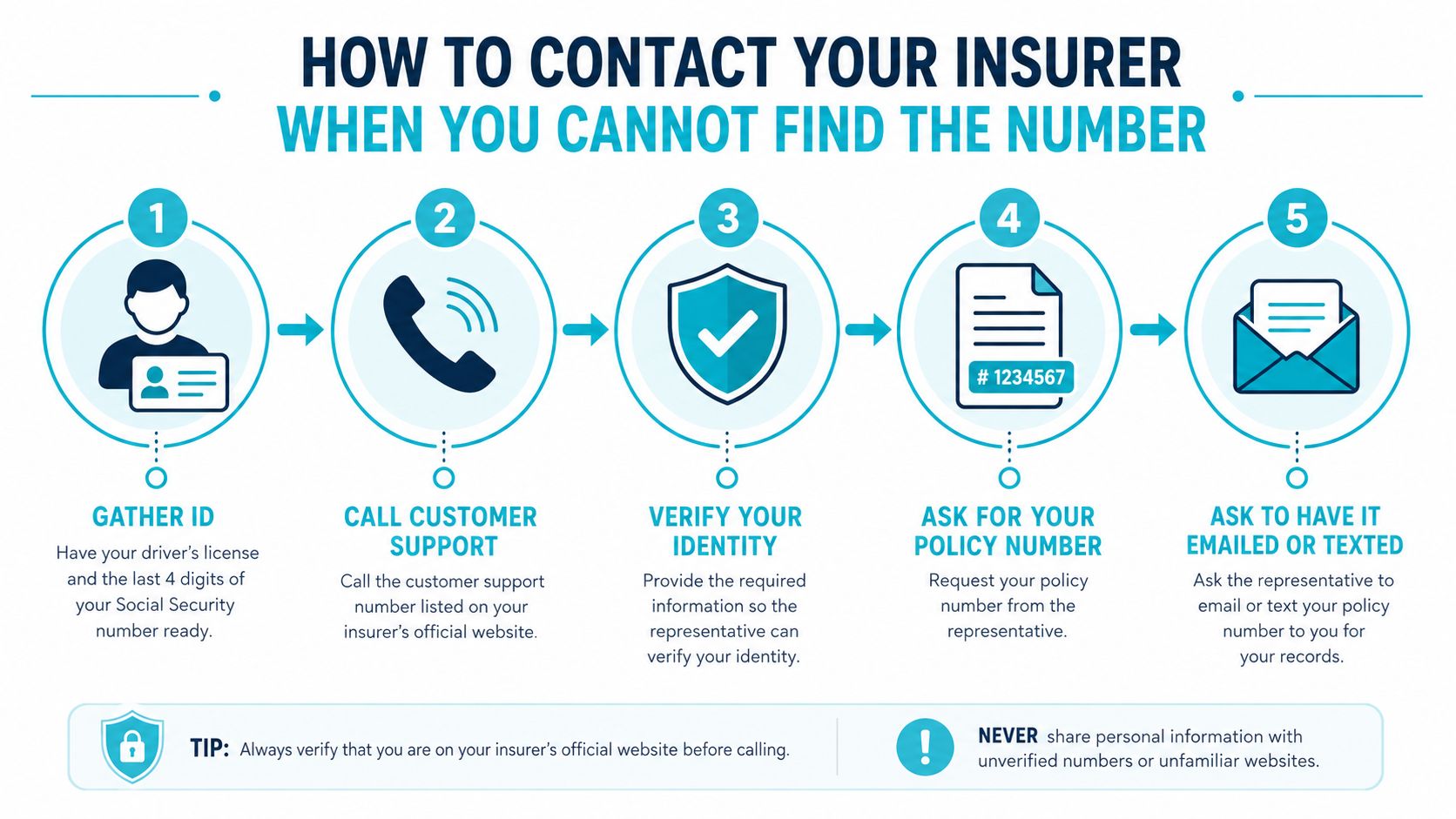
Lost papers and a locked portal don't leave you stuck. The insurer can usually locate your record using other identifying details, but you'll need to pass its verification process.
- Gather your full name, address on file, date of birth, and any partial policy information you remember.
- Find the customer service number on the insurer's official website, a current bill, or a document you trust. Don't use a number from an unsolicited text or email.
- Choose the option for existing customers, policy information, billing, or claims.
- Verify the representative. Ask for their name, department, and an approved callback method if anything feels unusual.
- Request the current policy number and a new declarations page or ID card.
Have the representative confirm the policy type and effective dates before you end the call. That catches mix-ups between products or old and current terms.
Many insurers also offer secure chat or messaging inside the authenticated app. Those channels can provide written confirmation, which is useful when you need to document what the insurer told you.
Quick Reference Checklist for Locating and Protecting Your Policy Number
Use this checklist when a claim, billing question, or proof-of-insurance request requires the number quickly:
- Record the number securely: Save it in a password manager with the insurer's verified support number.
- Set a renewal reminder: Before the policy expires, verify the identifier and replace outdated records.
- Compare product records: Label auto, home, life, or health files separately so similar identifiers do not get mixed up.
- Check the source channel: A card, portal, bill, and declarations page may show different references for the same coverage.
- Contact the insurer: Use an official number if your records and authenticated account do not resolve the discrepancy.
- Limit disclosure: Share the number only with the insurer, a provider, an agent, or another verified party that has a clear reason to request it.
- Secure the record: Store current documents in a protected folder and shred unnecessary paper copies.
- Document changes: Keep the old identifier only when a claim, payment, or audit requires it, then mark it as inactive.
Policy numbers are not always universal across an insurer's products and systems. A group, billing, account, or endorsement reference can appear beside the policy number, so copy the label and surrounding policy details with it. Never send a full document when the recipient needs only the identifier. Redact addresses, dates of birth, payment details, and other information that creates unnecessary privacy exposure.
ThriveXDNA offers insurance document tools, policy scanning, quote resources, and practical coverage guidance for consumers managing auto, home, life, health, and other policies. Visit ThriveXDNA to organize your insurance information and make the next policy-number search faster.