
Gradescope
AI grading platform used by 500+ institutions grouping student responses for efficient consistent grading
About this Tool
Gradescope is an AI-assisted grading platform developed by Turnitin, designed for higher education instructors who need to grade large volumes of student work accurately and consistently. It serves university and college faculty across STEM, humanities, and professional programs, and is used by more than 500 institutions worldwide. The platform handles both paper-based and digital submissions, making it practical for courses that mix traditional exams with online assignments.
How Gradescope works
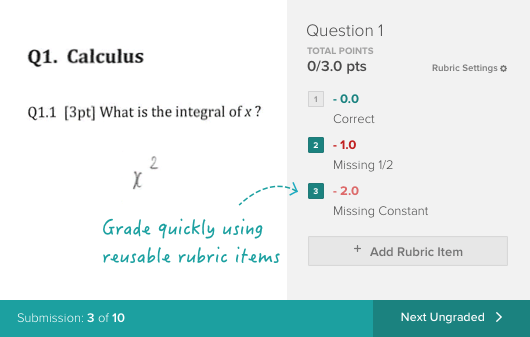
Instructors upload student submissions – scanned paper exams or digital files – and build a rubric directly inside the platform. Gradescope’s AI then groups similar student responses together, so a grader can apply a rubric decision to an entire cluster of answers at once rather than evaluating each response one by one. The handwriting recognition layer converts handwritten text into a readable format, reducing the manual effort of deciphering poor penmanship. Once grading is complete, the platform generates grade analytics that let instructors see score distributions, identify which rubric items students struggled with most, and flag anomalies for review.
Students receive annotated feedback directly through the platform and can submit regrade requests, which instructors can accept or reject with a single response that applies to all students who made the same argument.
Strengths
- AI response grouping: Clustering similar answers dramatically cuts grading time for large courses, since a single rubric decision can be applied to dozens of grouped responses at once.
- Hybrid submission support: Accepting both paper and online submissions means instructors are not forced to change their existing exam format to use the platform.
- Grading consistency: Rubric-based grading tied to grouped responses reduces the grade variance that often occurs when multiple teaching assistants grade independently.
- Grade analytics: The built-in reporting surfaces item-level data that is useful for course improvement and accreditation reporting.
- Regrade workflow: The structured regrade request system keeps disputes organized and auditable, which is important in academic contexts.
Limitations
- Pricing opacity: Institutional licensing costs are not published, which makes it difficult for departments or individual instructors to evaluate affordability without contacting sales.
- Setup overhead: Building rubrics and configuring assignments takes meaningful upfront time, and the platform has a learning curve that can slow adoption in departments without instructional technology support.
- Limited free tier: The free basic plan restricts the number of courses and students, which means instructors at institutions without a site license may hit ceilings quickly.
- AI grouping is suggestive, not final: The AI clusters are a starting point, not a finished product. Instructors still need to review groupings for accuracy, particularly in courses where nuanced reasoning matters more than pattern matching.
- Paper scan quality dependency: Handwriting recognition accuracy drops with low-quality scans, so departments with older scanning equipment may see less benefit from that feature.
Who it is for
Gradescope is best suited for college and university instructors who manage large enrollment courses and rely on teaching assistants to share grading workload. It is particularly useful in STEM disciplines where problem sets and exams produce high volumes of similar-structured responses that benefit from AI grouping. Departments running professional certification programs or programs subject to accreditation review will also find the grade analytics and audit trail useful. Instructors at institutions with an existing site license will get the most value, since the free tier alone is not sufficient for most real course loads.
It is less likely to fit K-12 settings, individual tutors, or self-paced learners, since those use cases do not map to the platform’s institutional workflow.
How it compares
Gradescope occupies a narrow vertical in the education AI space. It does not try to teach students directly – it is a grading infrastructure tool rather than a learning platform. That separates it from general-purpose learning platforms like Udemy, which focuses on delivering on-demand video courses to individual learners rather than supporting instructor-led assessment at scale.
It also differs from language-focused learning tools like Duolingo, which uses AI to personalize skill practice for individual users. Gradescope’s AI is pointed at the instructor’s workflow, not the student’s learning path. If an institution needs both grading infrastructure and student-facing learning tools, those two categories of platform would need to be used alongside each other rather than as substitutes.
Pros & Cons
✓ Pros
- ✓AI Response Grouping
- ✓Online & Paper Submissions
- ✓500+ Institution Clients
- ✓AI-powered features
- ✓Free plan or freemium pricing
✗ Cons
- ✗Some advanced features may require higher-tier plans
- ✗Limited public documentation on advanced use cases
Key Features
AI Response Grouping
Handwriting Recognition
Online & Paper Submissions
Rubric-Based Grading
Grade Analytics
Plagiarism Detection
500+ Institution Clients
LMS Integration
📋 Scripts & Prompts for Gradescope
Copy these AI-powered scripts to get maximum value from this tool. Sign up free to copy.
🔌 MCP Servers for Gradescope
Connect these MCP servers to give Claude, Cursor & Cline superpowers with this tool. Sign up free to copy install commands.
🤖 AI Agents for Gradescope
Pre-built automation agents that work with this tool — import in one click. Sign up free to access.
Similar Education Tools


Who Is This For?
Students
Tags
Frequently Asked Questions
Gradescope is available as free basic; institutional licensing. Visit the tool's website for the latest pricing details and plan options.
Gradescope offers a free plan. Check the website for feature limitations and upgrade options.
Gradescope is available on Api, Web. Check the official website for the latest platform support.
Many tools offer free trials to let you test before subscribing. Check the Gradescope website for current trial availability and duration.
Community Rating
Is this your tool? Claim this listing →