
Tability
AI OKR platform that generates goals from strategy descriptions and automates progress tracking
About this Tool
Tability is an AI-powered OKR (Objectives and Key Results) platform built for teams that want to connect strategy to measurable goals without spending hours writing them manually. It is made by Tability, a company focused on goal-tracking software, and is aimed at startup teams, growth-stage companies, and operations leads who run quarterly planning cycles but struggle to maintain visibility between review meetings.
How Tability works
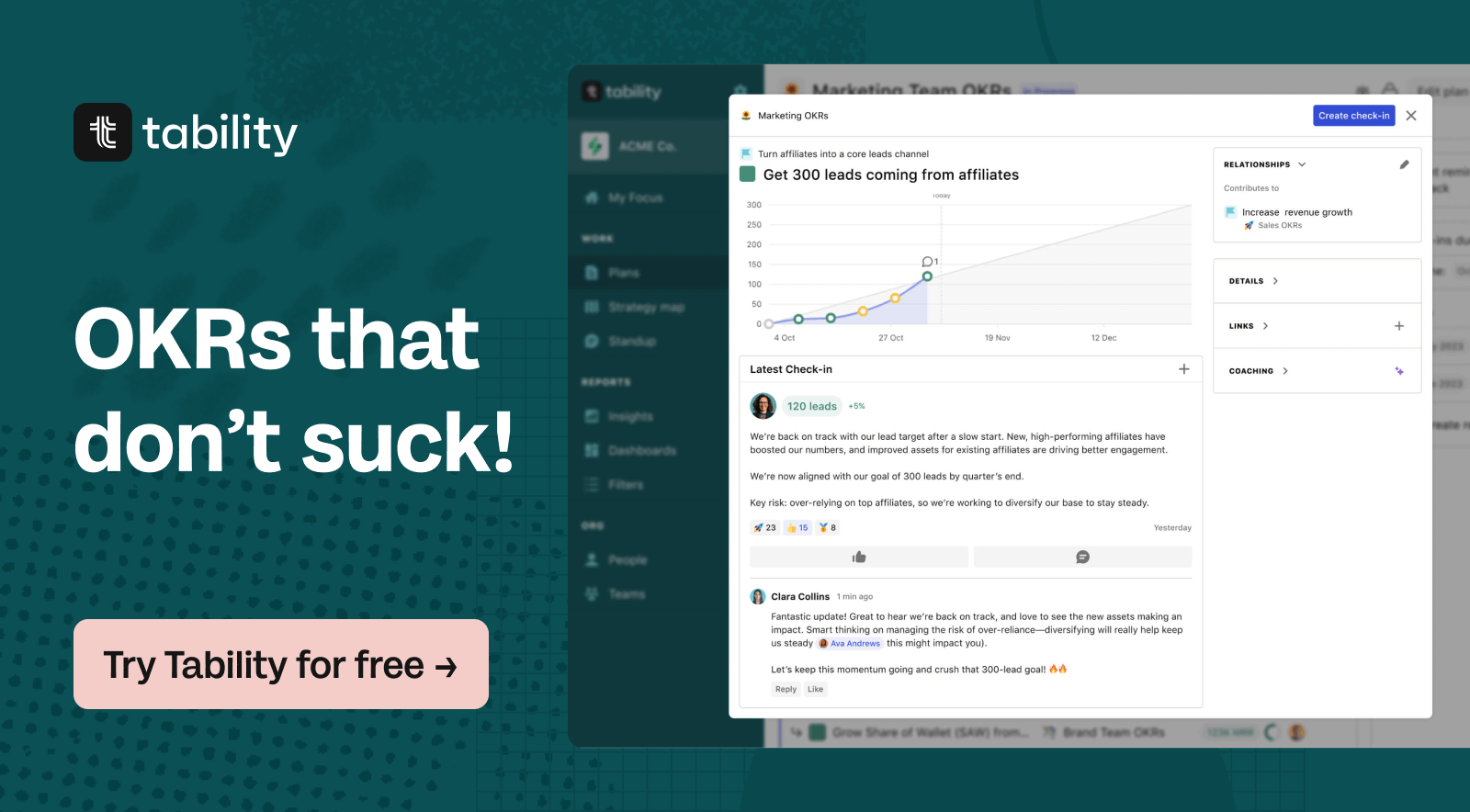
The core workflow starts with a strategy description. You write a plain-language summary of what your team is trying to achieve, and Tability’s AI generates a draft set of OKRs from that input. From there, the platform automates progress tracking by pulling in updates and prompting team members with weekly nudges to report on their key results. Tability monitors goal health continuously and flags objectives that are falling behind before the end of a cycle, giving managers a chance to course-correct early. The interface is built around a team dashboard that shows goal status across the organization in one view.
Strengths
- AI OKR generation from strategy text. The ability to go from a written strategy description to a structured set of OKRs in seconds removes a significant amount of friction from quarterly planning. Teams that previously spent hours in workshops drafting goals can use the AI output as a solid starting draft.
- Automated progress nudges. Weekly AI nudges prompt contributors to update their key results without requiring a manager to chase them. This keeps data fresh between formal review meetings.
- At-risk detection. Tability surfaces goals that are trending off-track before the deadline, which is more useful than a simple status dashboard that only shows where things stand at the end of a period.
- Accessible pricing tier. A free plan means small teams or individuals can evaluate the product without a credit card commitment, and the Growth tier at $9 per user per month is competitive for this category.
Limitations
- AI output requires editing. The strategy-to-goals feature produces a starting point, not a finished set of OKRs. Teams with complex or highly technical strategies will likely need several rounds of editing to get goals that are specific enough to be measurable.
- Dependency on team adoption. The automated progress tracking only works if team members actually respond to nudges and update their results. If your team ignores notifications, the platform’s data quickly becomes stale.
- OKR-centric scope. Tability is purpose-built for the OKR methodology. Teams that use a different goal framework (such as SMART goals or MBOs) or that want general project management features will find the platform too narrow.
- Integration depth at lower tiers. Deeper integrations with tools like Jira or Salesforce may require the Scale plan, which means smaller teams on the free or Growth tier get a more limited data connection story.
Who it is for
Tability is best suited for operations managers, heads of product, and team leads at companies between 10 and 200 people who have already bought into the OKR framework but find manual tracking unsustainable. It also works well for newly-formed leadership teams that want AI guidance on how to structure goals from a strategy document. Solo founders or very small teams experimenting with OKRs for the first time can use the free plan to get familiar with the methodology before committing to a paid seat.
How it compares
Tability occupies a specific lane that most general productivity tools do not cover. Todoist, for example, is a strong task and project management tool but has no OKR framework, no strategy-to-goals AI, and no concept of quarterly objective health. If your team needs to manage individual tasks alongside broader goals, you would likely run both tools rather than replace one with the other.
Writing and communication tools like Grammarly serve a completely different function, though teams that use Tability for goal documentation may benefit from a writing assistant when drafting strategy descriptions or stakeholder updates. The two tools do not overlap and are not alternatives to each other.
Within the OKR software category itself, Tability’s main differentiator is the AI generation layer. Competing platforms like Lattice or Gtmhub offer richer HR and performance management integrations but come at a significantly higher price point. Tability is the more accessible option for teams that want AI-assisted OKR setup without enterprise-level costs.
Pros & Cons
✓ Pros
- ✓AI OKR Generation
- ✓Automated Progress Updates
- ✓At-Risk Goal Detection
- ✓AI-powered features
- ✓Built-in analytics and reporting
✗ Cons
- ✗Some advanced features may require higher-tier plans
- ✗Limited public documentation on advanced use cases
Key Features
AI OKR Generation
Strategy-to-Goals AI
Automated Progress Updates
At-Risk Goal Detection
AI Weekly Nudges
Team Accountability
Slack Integration
Goal Analytics
📋 Scripts & Prompts for Tability
Copy these AI-powered scripts to get maximum value from this tool. Sign up free to copy.
No scripts added for this tool yet.
Browse all Productivity scripts in the Vault →🔌 MCP Servers for Tability
Connect these MCP servers to give Claude, Cursor & Cline superpowers with this tool. Sign up free to copy install commands.
🤖 AI Agents for Tability
Pre-built automation agents that work with this tool — import in one click. Sign up free to access.
Similar Productivity Tools




Who Is This For?
Startups
Enterprise
Tags
Frequently Asked Questions
Tability is available as free; growth $9/user/mo; scale $19/user/mo. Visit the tool's website for the latest pricing details and plan options.
Tability offers a free plan. Check the website for feature limitations and upgrade options.
Tability is available on Web. Check the official website for the latest platform support.
Many tools offer free trials to let you test before subscribing. Check the Tability website for current trial availability and duration.
Community Rating
Is this your tool? Claim this listing →