

If a calorie calculator gives you an exact number, why can't it tell you whether your weight will stay steady at that intake?
Because the calculator estimates your needs; it doesn't measure them. The useful answer starts with a formula, then becomes more personal when you compare your food intake with real weight trends. Your job isn't to obey the first number forever. It's to find an intake that fits your body, activity, and goal without turning every meal into a math test.
Table of Contents
- How the Calorie Estimate Is Worked Out
- One Worked Example With Round Numbers
- What Moves the Estimate Up or Down
- Check the Number Against Two Weeks of Weigh-Ins
- When a Calorie Target Is the Wrong Tool
- Summary
- Frequently Asked Questions
How the Calorie Estimate Is Worked Out
A calorie calculator answers two different questions: how much energy your body uses at rest, and how much you probably use across an ordinary day. Mixing those questions up is a common reason people choose an intake that doesn't match their needs.
Resting metabolic rate, or RMR, is the energy your body uses at rest to support functions such as breathing, circulation, and maintaining tissues. Total daily energy expenditure, or TDEE, is the broader daily total after activity is considered. Neither is automatically a fat-loss target.
Start with resting energy
The Academy of Nutrition and Dietetics recommends Mifflin-St Jeor when indirect calorimetry is unavailable, including for adults with overweight or obesity; the equation was developed from measurements of 498 healthy adults and is generally favored over older formulas in systematic comparisons.
Indirect calorimetry measures energy expenditure through respiratory gases. The original Mifflin-St Jeor study used those measurements to develop its prediction equation. A calculator instead predicts resting energy from information you enter, so it should label the result as an estimate.
Use these Mifflin-St Jeor equations with weight in kilograms, height in centimeters, and age in years:
Men: RMR = 10 × weight + 6.25 × height − 5 × age + 5
Women: RMR = 10 × weight + 6.25 × height − 5 × age − 161
The difference is the final constant. Don't subtract the female constant from a result that already includes the male constant. Use the appropriate complete equation from the start.
Check your input units before calculating. If you know your weight in pounds or height in feet and inches, use a calculator with explicit unit conversion, or convert those measurements before entering them. Putting pounds into a kilograms field changes the calculation substantially.
The equation's male and female categories are biological inputs, not a complete description of someone's identity or physiology. If the appropriate selection is unclear for your circumstances, a qualified clinician or dietitian can help interpret the estimate.
Then account for daily activity
Once you have resting energy, multiply it by an activity factor to estimate maintenance calories. NASM's calorie-calculator guide gives the common factors below: 1.2 for sedentary activity, 1.375 for light exercise one to three days weekly, and 1.55 for moderate exercise three to five days weekly.
Activity multipliers for total daily energy
| Activity label | Multiplier | What it stands for |
|---|---|---|
| Sedentary | 1.2 | Little planned exercise |
| Light | 1.375 | Exercise 1 to 3 days a week |
| Moderate | 1.55 | Exercise 3 to 5 days a week |
The calculation is straightforward:
Estimated maintenance calories = estimated RMR × activity multiplier
The interpretation takes more care. An activity label compresses your working day, walking, household movement, and training into a single choice. Someone who trains regularly but sits for most of the day may have different needs from someone with a physically active job and similar workouts.
Choose the label that describes your usual routine, not your hardest recent session or the schedule you hope to follow. A repeatable ordinary week is a better starting point than an unusually active weekend.
Keep maintenance separate from your goal
Maintenance means an intake that should keep average body weight roughly steady if the estimate is close. A calorie deficit means eating below maintenance; a surplus means eating above it.
Those are decisions made after estimating maintenance. The formula doesn't directly measure the intake that will produce your preferred rate of fat loss or muscle gain.
- For maintenance: Start near the estimated daily total and check whether your average weight stays steady.
- For fat loss: Establish a useful maintenance baseline before deciding how much to reduce intake.
- For weight gain: Use that baseline to make a deliberate increase rather than assuming more food is always better.
Don't mistake resting energy for a complete daily allowance. Resting energy leaves out the activity adjustment, so it answers a different question from total daily needs.
A good calculator should also reject implausible inputs rather than producing an impressive-looking answer. Check your age, measurement units, and equation selection before trusting the output.
The final label matters: estimated maintenance, not measured calorie requirement. Extra decimal places don't make an approximate activity multiplier more accurate.
One Worked Example With Round Numbers
Say a hypothetical man is 30 years old, weighs 80 kilograms, and is 180 centimeters tall. These round inputs make the arithmetic easy to follow; your own measurements replace them.
Calculate the resting figure
Work through the Mifflin-St Jeor terms separately:
10 × 80 = 800
6.25 × 180 = 1,125
5 × 30 = 150
Then combine them and include the male constant:
800 + 1,125 − 150 + 5 = 1,780 calories per day at rest
The visual breaks down the main arithmetic terms.
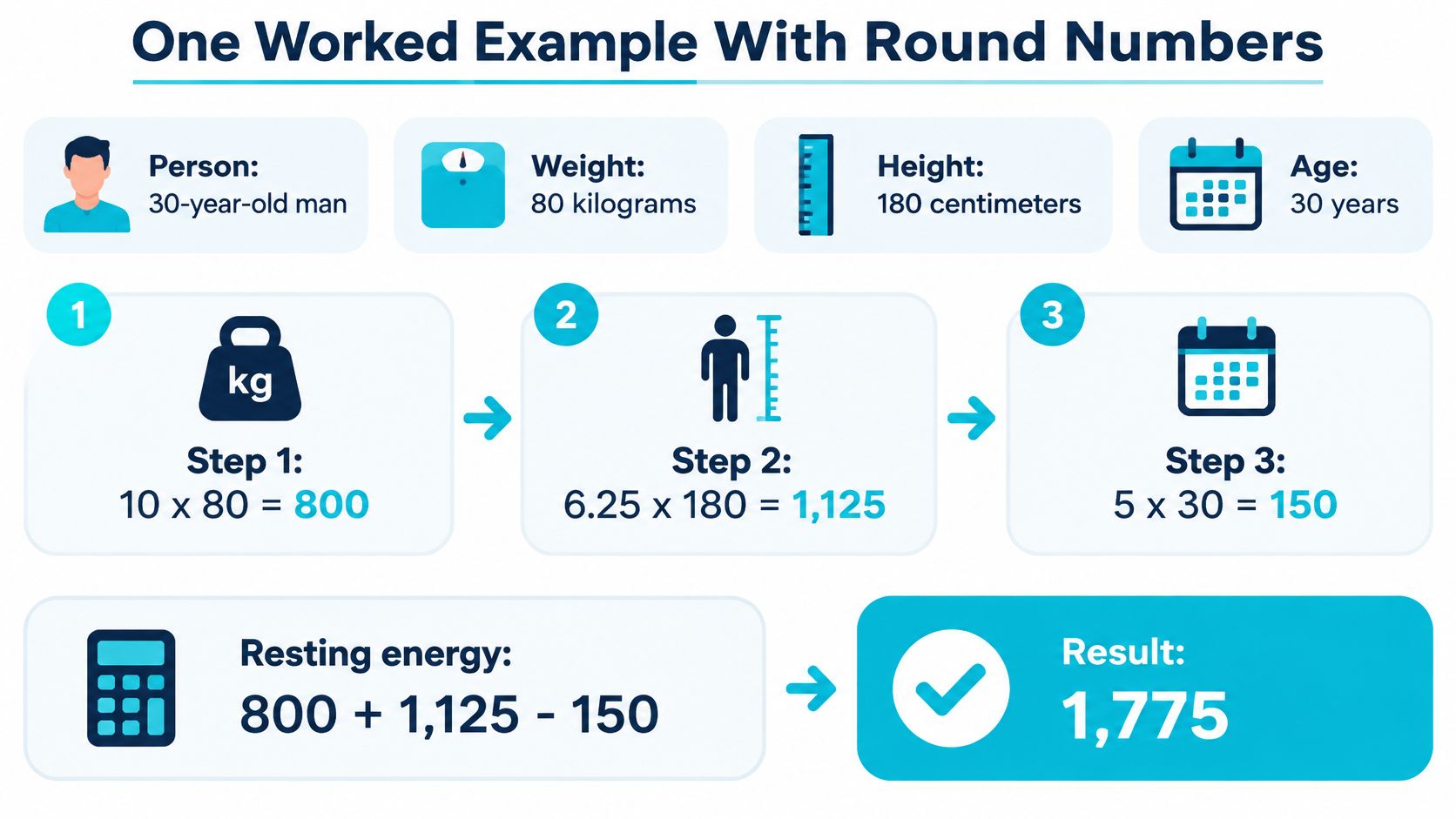
The 1,775 subtotal shown in the visual is before the final male constant. The complete resting-energy calculation is 1,780, which is the figure to use for the activity adjustment.
Apply the activity multiplier
For sedentary activity:
1,780 × 1.2 = 2,136 calories per day
For light activity:
1,780 × 1.375 = 2,447.5, or about 2,448 calories per day
For moderate activity:
1,780 × 1.55 = 2,759, or about 2,760 calories per day
These are alternative estimates for the same hypothetical person under different activity assumptions. They aren't interchangeable targets to select according to which one sounds most appealing.
Worked example totals for a 30-year-old man
| Activity label | Multiplier |
|---|---|
| Sedentary | 1.2 |
| Light | 1.375 |
| Moderate | 1.55 |
The table's multipliers apply to the calculated resting figure of 1,780 calories. The resulting daily totals include the activity estimate; they aren't additional calories to add on top of resting energy.
A calculated maintenance number is a testable starting point, not an order to eat exactly that amount.
For a woman of the same hypothetical age, height, and weight, the only change in the resting equation is −161 instead of +5. That makes the resting estimate 166 calories lower before applying an activity multiplier.
There's no need for a huge day-one cut in this example. First, choose the maintenance estimate that best matches ordinary activity and collect enough consistent observations to judge it.
If the activity category is uncertain, keep the plausible neighboring estimates in mind as a starting range. That range reflects uncertainty about activity, not a medically validated confidence interval.
You'll ultimately want a narrower working range supported by your own intake and weight records. It should allow normal variation between days rather than making every meal fit an exact daily total.
What Moves the Estimate Up or Down
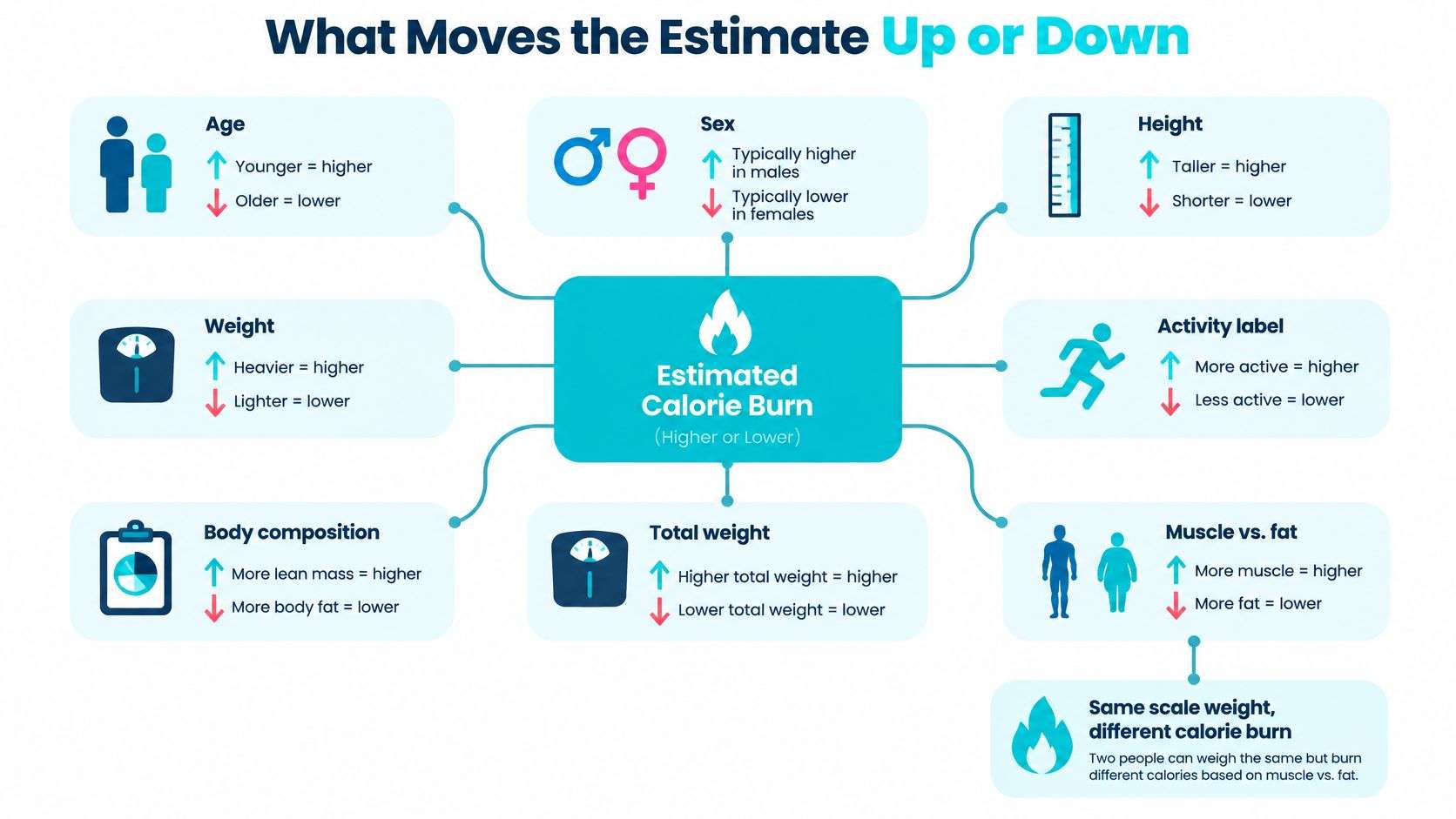
Two people can enter the same age, sex, height, and weight and still burn different amounts. The inputs describe a body on paper. They don't describe the tissue it's made of or how the day gets spent.
The factors below explain where a reasonable calculation can still miss.
Body composition and age
The 2020–2025 U.S. Dietary Guidelines give broad adult ranges of approximately 1,600–2,400 calories for females and 2,000–3,000 for males, and note that calorie needs generally decline with age as basal metabolic rate decreases.
Those ranges are useful for checking whether a result looks reasonable. Your own maintenance sits somewhere, and only your records show where.
Muscle and fat draw different amounts of energy at rest, but the resting equation only sees total scale weight. Two people at the same weight can carry very different proportions of each, so an identical equation output doesn't guarantee identical resting expenditure.
Training and the rest of your day
A workout label doesn't capture everything that happens outside the gym. Walking between work tasks, carrying groceries, cleaning, and spending more time standing all change daily energy use.
- Training type: A short lifting session and a long endurance session aren't equivalent just because both count as exercise.
- Occupational movement: A desk-based day and a shift spent moving create different activity patterns.
- Rest days: Less planned exercise doesn't mean no energy needs, but your movement pattern may differ from a training day.
Your needs can also shift as your body weight changes. A validation study comparing prediction equations with indirect calorimetry discusses why static 3,500-calorie-rule logic is inadequate for longer weight-loss projections. The NIH Body Weight Planner uses a dynamic model that accounts for changes in energy expenditure as weight changes. In plain terms, a smaller body generally burns fewer calories, so a deficit that worked early on can gradually lose its effect.
Treat watch calories as uncertain
Wearables estimate exercise calories from heart rate, movement, and the details in your profile. A systematic review of wearable energy-expenditure estimates found that accuracy varies by device and activity. Those calorie estimates can be meaningfully off, so there is no dependable correction factor you can apply to every workout.
Don't automatically add every wearable-reported exercise calorie to your allowance. If your activity multiplier already represents your usual training, doing so may count that activity twice.
Use the watch to describe activity patterns, not to settle the food budget exactly. Keep notes about unusually long sessions or unusually sedentary days so you can interpret your weight trend fairly.
If your weight holds steady at the calculator number, that intake is close to your current maintenance. The practical question is whether the trend matches your goal, not whether the formula or the watch got the day exactly right.
Check the Number Against Two Weeks of Weigh-Ins
A calculator-based target becomes more useful when you pair it with consistent food records and comparable weigh-ins. You're testing a hypothesis about maintenance, not grading your discipline.
Benchmark Body's practical guide recommends testing the estimate for two to three weeks, comparing weekly weight averages, and making gradual adjustments of about 100 to 150 calories before repeating a two-week check.
Run a repeatable maintenance check
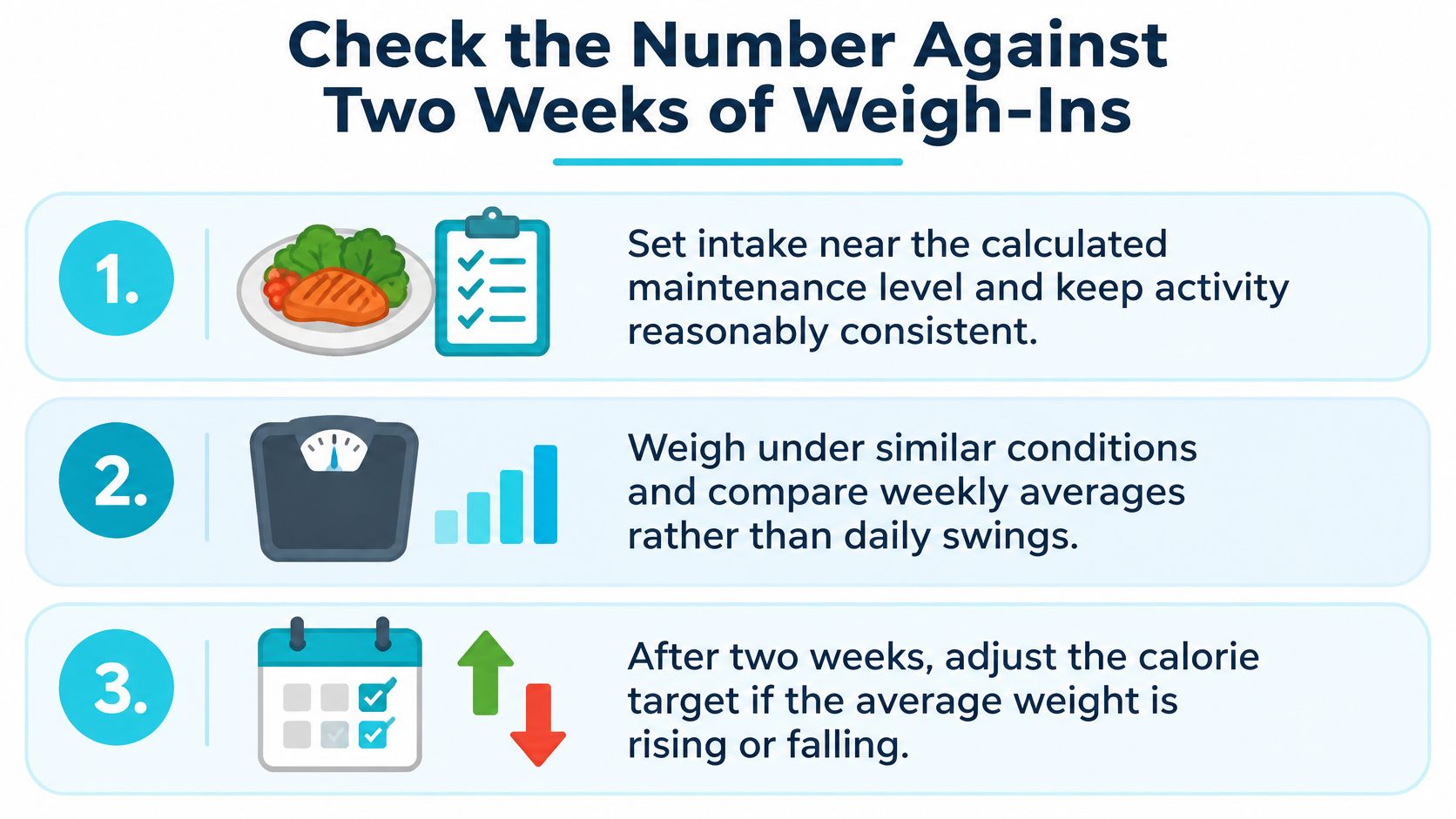
Set intake near calculated maintenance and keep activity reasonably consistent. Don't combine the test with a sudden increase in training and a major food reduction. If several things change together, it becomes harder to interpret the result.
Weigh under similar conditions, such as after using the bathroom and before breakfast, using the same scale on a firm surface. Record the readings and compare weekly averages rather than choosing the highest or lowest number.
Continue for two to three weeks. Log what you eat, including drinks, snacks, cooking oils, and weekend meals. Honest, reasonably consistent records are more useful than a target entered into an app but not followed.
Read the trend alongside actual average intake. If average weight stays stable, that intake is a useful maintenance estimate. If weight trends down, actual needs may be higher than calculated; if it trends up, the target may be too high for maintenance.
Adjust gradually, then repeat the check. For a clear downward trend when maintenance is the goal, increase intake by about 100 to 150 calories; for a clear upward trend, reduce it by that amount. Keep the revised approach steady through another two-week check rather than adjusting again the next morning.
This visual captures the basic routine.
Make your records easy to interpret
To calculate a weekly average, add the recorded weights and divide by the number of readings. Use the same approach each week so you're comparing like with like.
A spreadsheet or notebook can hold intake, weigh-ins, and activity notes. The ThriveX Fitness app offers photo or barcode nutrition tracking, meal plans, AI workouts, form-clip review, challenges, and gamification to help put food and training habits into practice; keep your comparable weigh-in record alongside that routine.
Don't rewrite the target after a salty meal, a depleted training day, or a post-workout scale reading. Short-term changes in water and food in your digestive tract can obscure the underlying trend.
Adjustment rule: Change the plan because of a consistent pattern, not because of an uncomfortable morning on the scale.
Also compare actual intake with the intended target before blaming the equation. If they differ, your observations describe the intake you followed.
Once weight is broadly stable, treat the corresponding intake as a personal maintenance range, not a requirement to repeat identical meals. The original calculator result is a flexible starting point for a nutrition goal, not a permanent prescription.
When a Calorie Target Is the Wrong Tool
If tracking calories makes you more anxious, restrictive, prone to bingeing, or driven to exercise compulsively, stop using the calculator as a daily rule. More detailed logging isn't automatically the right response.
A 2025 systematic review of health-tracking technologies found that many tools weren't designed or thoroughly evaluated for people with eating-disorder histories; the reviewed literature also linked weight-related self-monitoring with fasting, meal skipping, and excessive exercise in some student populations.
Choose a non-numeric approach
A target that appears manageable on a screen may still be harmful for a particular person. You don't need to prove that you can tolerate tracking before choosing another way to support your health.
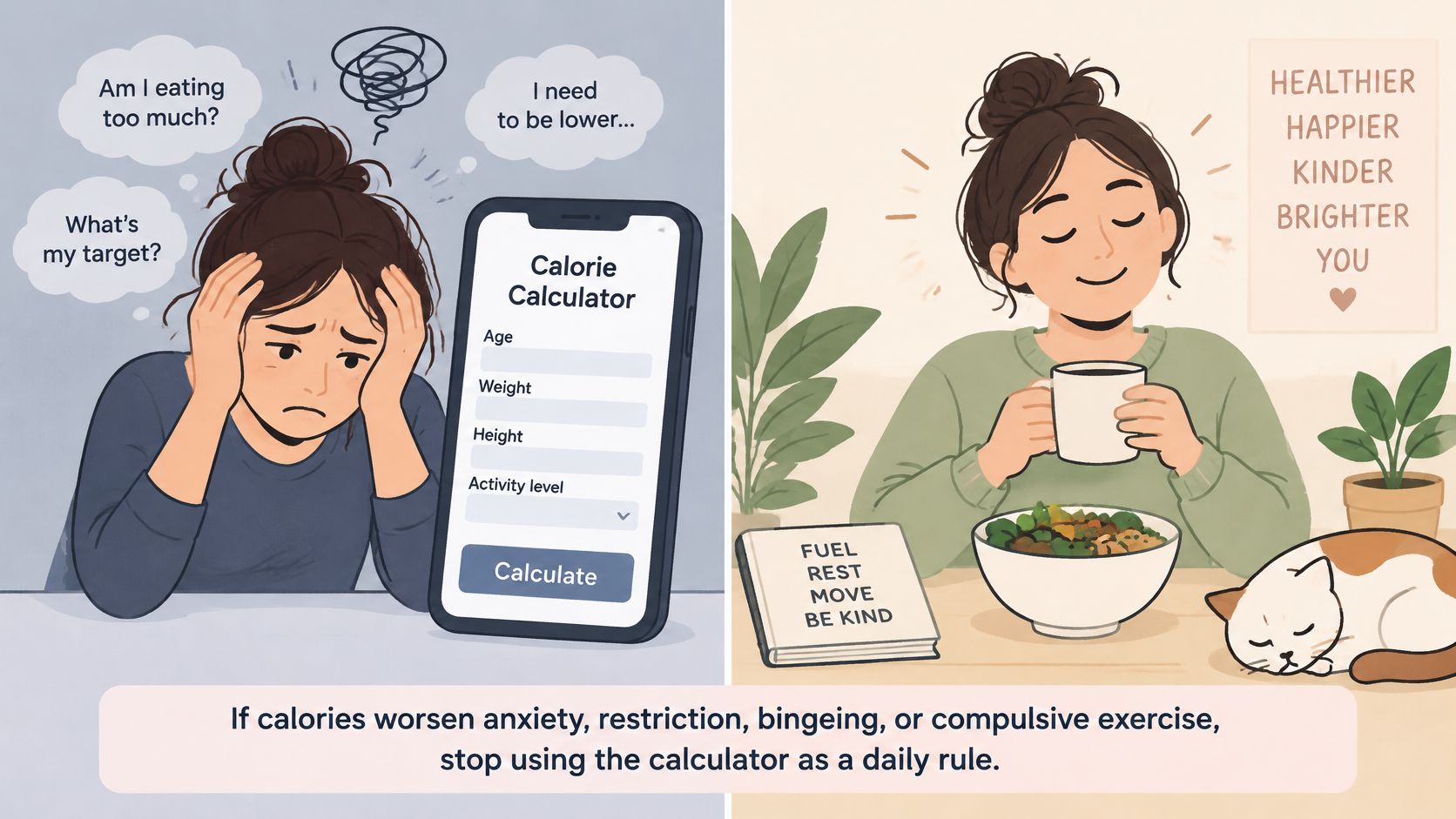
Instead of calorie totals, focus on practical behaviors:
- Plate and portion guidance: Build regular, balanced meals without assigning a daily calorie score.
- Protein and fiber habits: Include protein foods and fiber-containing foods such as beans, vegetables, fruit, and whole grains.
- Hunger and fullness: Notice physical cues without treating them as another strict test.
- Performance goals: Pay attention to training quality, energy, and recovery rather than calories burned.
Seek qualified clinical support when tracking causes harm, especially with an eating-disorder history. Hunger and fullness guidance may also need individual support rather than being used as a substitute set of rules.
This is general education, not individualized medical advice. Our app users should consult a physician before starting any new diet or exercise program, especially if they have a history of heart disease, high blood pressure, or other medical conditions.
Related guides
- logging macros for weight loss
- choosing a macronutrient ratio for fat loss
- how much protein you actually need
- hidden calories behind a weight loss plateau
- an 1800 calorie high protein meal plan
- Best MacroFactor Alternatives (Free and Adaptive)
- free apps that replace MyFitnessPal
- nutrition apps that help with weight loss
- Best AI Macro Tracking Apps
- finding your maintenance calories
- setting a realistic calorie deficit
- BMI Calculator: Formula, Ranges and Limits
Summary
A calorie calculator estimates resting energy, then applies an activity multiplier to estimate maintenance. In the worked example, the resting result was 1,780 calories, with estimated daily maintenance changing according to activity. Body composition, job movement, training, and uncertain wearable estimates can all affect the fit. Test your starting intake for two to three weeks using weekly weight averages, then adjust gradually by about 100 to 150 calories when the trend warrants it. Aim for a personal working range, not a fixed prescription. If tracking worsens anxiety or eating behaviors, use non-numeric habits and seek qualified support.
Frequently Asked Questions
How do I calculate resting calories with Mifflin-St Jeor?
Use kilograms for weight, centimeters for height, and years for age. For men, calculate 10 × weight + 6.25 × height − 5 × age + 5. For women, use the same terms and finish with −161 instead of +5. The result estimates resting energy, which is the baseline cost of running the body before daily movement and training are added. Check the units and equation selection before applying an activity multiplier, because a centimeters-versus-inches mistake can move the estimate more than a small multiplier change.
Which activity multiplier should I pick?
Choose 1.2 for sedentary activity with little planned exercise, 1.375 for light exercise one to three days weekly, or 1.55 for moderate exercise three to five days weekly. Base the choice on your usual week, not an unusually busy one. These categories are approximate because workout duration, training type, occupational movement, and walking differ. If two categories both sound plausible, treat the lower and higher results as a starting range and let consistent records narrow it.
Why did my weight not change at the calculator number?
A steady weekly average can mean the intake is close to maintenance for now. A maintenance estimate is not automatically a fat-loss target, so match the intake to the goal before judging the result. Compare weekly weight averages over two to three weeks and review actual portions, weekends, drinks, and untracked snacks before changing anything. When the trend and goal disagree, adjust gradually by about 100 to 150 calories and repeat the check. A single scale reading is noise, not a verdict.
Should I add exercise calories from my watch?
Treat wearable exercise calories as a clue, not a food allowance. Wearable energy estimates can be meaningfully off, and the displayed total should not be eaten back calorie for calorie. Your activity multiplier may already account for your usual workouts, so adding a full exercise estimate can double count part of the same activity. Use the watch to spot patterns and flag unusual sessions, then judge intake against weekly weight averages and performance rather than the daily burn number.
Should I use a calorie calculator if numbers make me anxious?
Use a different tool if tracking worsens anxiety, restriction, bingeing, or compulsive exercise. Plate or portion guidance, protein and fiber habits, hunger and fullness awareness, sleep, and performance goals can build consistency without giving every meal a score. Seek qualified clinical support when tracking causes harm, especially with an eating-disorder history. Progress does not require assigning a calorie total to every bite.
ThriveXDNA offers AI workout and nutrition plans, photo or barcode nutrition tracking, and meal plans to support a consistent food-and-training routine. Visit ThriveXDNA to explore those tools and use your maintenance estimate as a starting point for habits you can review and adjust.