
You're two minutes into a skipping round. The rope taps the canvas, your breathing stays controlled, and your feet barely leave the floor. Then fatigue arrives. Your stance widens, the rope starts catching your toes, and the smooth rhythm you expected disappears.
That moment is where useful boxing jump rope training begins. The rope isn't a magic cardio trick. It's a load-managed conditioning tool that can build rhythm, foot-ankle endurance, fight-relevant work capacity, and coordination under fatigue, provided you teach technique before adding volume. This guide moves from stance and rope mechanics to skill drills, circuits, weekly programming, recovery, and app-based tracking.
Table of Contents
- Why Boxing Jump Rope Training Still Matters in 2026
- Skill Drills From Basic Bounce to Boxer Step
- What Jump Rope Actually Improves in a Boxer
- Conditioning Circuits and Sample Workouts
- Weekly Programming Templates for Every Level
- Recovery, Injury Prevention, and Dose Management
- Tracking and Coaching the Plan With Thrive X Fitness
Why Boxing Jump Rope Training Still Matters in 2026
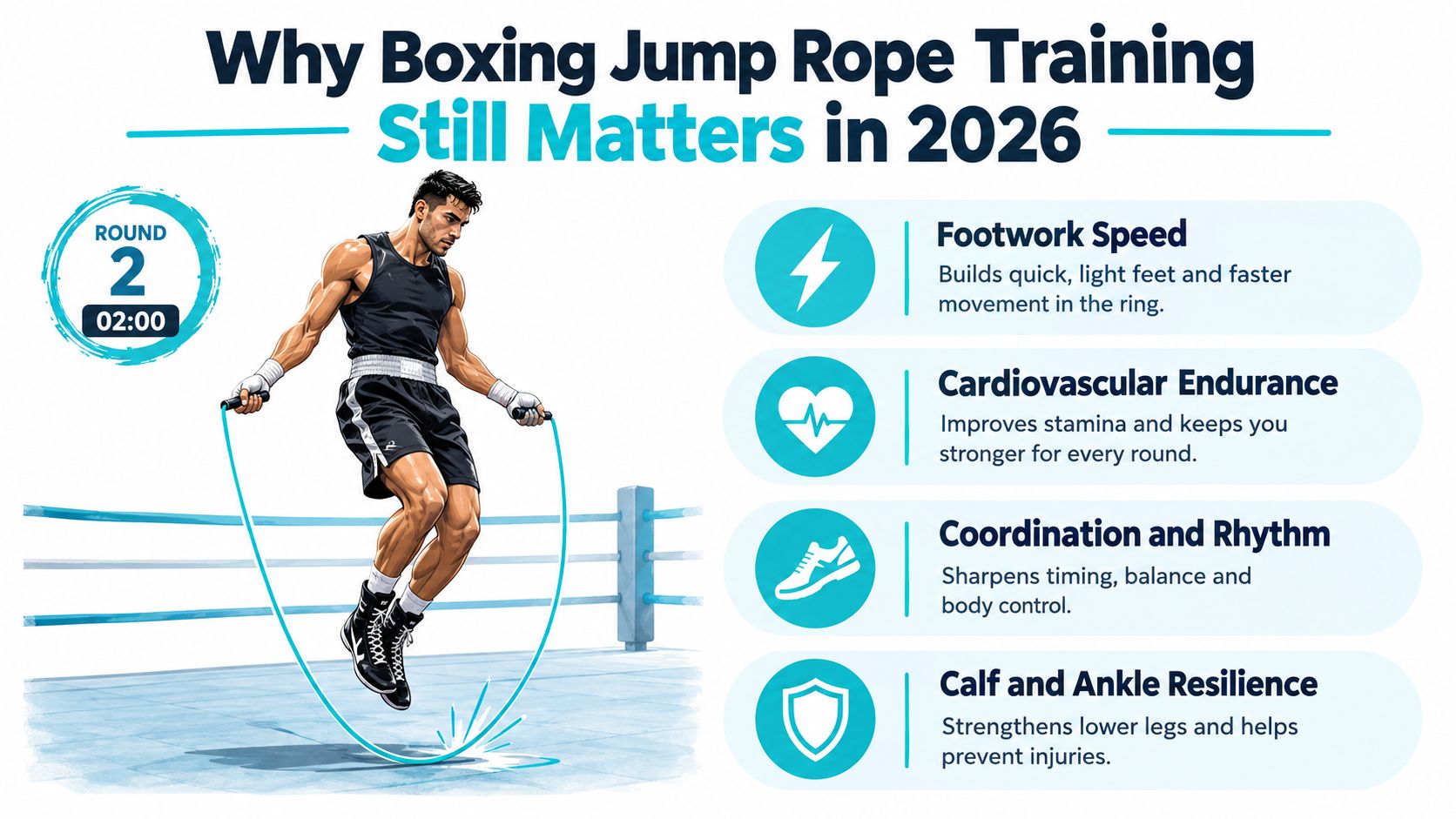
A boxer gets more from the rope than a faster warm-up. Done consistently, it trains rhythm and timing, which can influence punch cadence; calf and foot-ankle stiffness, which helps maintain stance stability; an aerobic base at fight-relevant intensities; and proprioceptive coordination under fatigue. Those qualities matter because a punch is rarely thrown from a perfectly fresh, motionless stance.
A 2022 peer-reviewed study in the Journal of Human Kinetics compared jump-rope training with plyometric training in junior amateur boxers. The researchers found no significant difference between the two methods for lower-extremity sports performance or punching performance (Journal of Human Kinetics study). That supports jump rope as a legitimate boxing-conditioning tool, not a novelty drill.
The practical value is accessibility. A rope needs little space and little equipment, yet it can challenge the feet, calves, breathing, and timing together. It also lets coaches manage joint mileage more precisely than telling a fighter to run harder or longer. For readers comparing conditioning tools, general boxing conditioning guidance from USA Boxing and exercise references from the American Council on Exercise can add useful context.
Build the movement before the volume
Start in an athletic boxing stance:
- Knees soft: Keep enough flexion to absorb each landing.
- Weight centered: Stay near the mid-foot, with contact biased toward the balls of the feet.
- Elbows tucked: Hold them around 45 degrees from the torso.
- Hands at hip height: This gives the rope a compact pivot point.
Stand on the center of the rope and pull the handles upward. They should reach the armpits. For speed-focused work, shorten the rope by one inch once your mechanics are reliable.
The rope should turn from the wrists, not from broad arm circles. Keep the forearms quiet, then flick the wrists at the bottom of each handle path. The rope travels roughly 180 degrees per beat, so large shoulder movements waste energy and disturb timing.
Your foundational bounce has one rope turn per jump. Keep the knees relaxed, land near the balls of the feet, and clear the rope by only half an inch to two inches. A higher jump creates unnecessary impact and makes it harder to repeat the movement late in a round. Technical boxing rope guidance also emphasizes close elbows, wrist-led rotation, and low jumps (boxing skipping technique guidance).
Use a simple readiness gate
Before adding another drill or extending a round, complete ten clean consecutive bounces. The rope should turn without noise, your landings should stay soft, and you should be able to breathe through your nose.
Common errors deserve correction early:
- Jumping high instead of clearing the rope efficiently.
- Reaching outward with the arms.
- Landing flat-footed or on the heels.
- Looking down at the feet.
- Skipping barefoot, especially when the calves and ankles aren't conditioned.
The progression is straightforward. Lock the stance and mechanics first. Layer alternate-foot, boxer-step, lateral, double-under, and crossover patterns second. Build fight-length circuits third. Then distribute the work across the week so hard rope sessions don't compete with sparring, lower-body strength, or power training.
Coach's rule: If the rope is loud, your jump is probably too high, your landing is probably too heavy, or your wrists aren't controlling the rotation.
Skill Drills From Basic Bounce to Boxer Step
Skill progression works best when each drill has a boxing purpose. The basic bounce teaches rhythm. The alternate-foot run develops cadence. The boxer step brings weight transfer closer to the demands of the ring. Double-unders and crossovers then add a sharper power and coordination challenge.
A fighter I coached once rushed the alternate-foot drill because the movement looked easy. Within fifteen seconds, the feet were sprinting, the rope was late, and the shoulders had taken over. The fix was a steady 180 BPM beat, with the instruction to match the rope sound rather than chase speed. Cadence comes before intensity.
The boxer step creates a small tripod-like relationship between the feet and the shifting center of mass. One foot receives the body while the other lightens, then the roles switch. Another fighter stayed too tall and bounced on both feet like a basic skip. The correction was to lower the stance, shift weight clearly, and let the feet switch roles instead of rising and falling together.
Double-unders require relaxed wrists and a slightly higher jump. The common failure is arm-circling, which burns the shoulders before the round has meaningfully challenged the legs. Keep the elbows close, lift only enough to create extra airtime, and make the second rope pass a quick wrist action.
Use stance-specific work after the general ladder. Complete orthodox boxer-step rounds, then southpaw rounds. Finish with a 30-second sequence that changes stance every ten seconds, keeping the rope rhythm stable while the lead foot changes.
| Drill | Primary Cue | Most Common Mistake |
|---|---|---|
| Basic bounce | One turn per jump, low and quiet | Jumping too high |
| Alternate-foot run | Match a steady 180 BPM beat | Rushing into a sprint cadence |
| Boxer step | Shift weight between feet with a compact stance | Staying tall and bouncing on both feet |
| Double-under | Relaxed wrists and slightly higher jump | Arm-circling until the shoulders fail |
| Crossover | Keep the jump low while crossing the arms | Turning the drill into a large upper-body movement |
| Stance-specific patterns | Preserve timing through orthodox and southpaw changes | Letting stance changes widen the base |
The rope should complement ring movement, not replace it. For a broader beginner foundation, pair this ladder with defensive footwork drills for beginners, especially work that teaches balance while moving away from attacks.
What Jump Rope Actually Improves in a Boxer
Jump rope develops calf-ankle endurance, rhythm under fatigue, stance-transition economy, and breathing control. It teaches a boxer to rebound repeatedly without letting the guard, posture, or foot placement unravel.
The boxing-specific 2022 comparison found that both jump-rope and plyometric groups improved rate of force development, punch reaction time, rear-leg ground reaction force, and jab velocity, while the plyometric group produced larger gains in the cited summary. That summary reported roughly 9.5% versus 4.6% for jab speed and 9% versus 1.4% for punch force in the plyometric and jump-rope groups respectively (Frontiers study summary).
The distinction matters. Rope work builds repeatable rebound and conditioning density, but it doesn't fully reproduce the reactive stiffness, landing demand, and stretch-shortening-cycle stress of box jumps, depth jumps, or other explosive work.
| Quality | Jump Rope | Plyometrics |
|---|---|---|
| Rhythm and cadence | Strong fit, especially under fatigue | Useful but secondary |
| Calf and ankle endurance | Strong fit through repeated low contacts | More focused on forceful reactions |
| Punch timing support | Helps cadence and coordination | Can support rapid force expression |
| Maximum lower-body power | Limited as a standalone method | Better suited to high-force output |
| Stance transitions | Directly trainable with boxer-step patterns | Requires more sport-specific integration |
If a fighter is still missing basic bounces, fix the rope first. If the fighter is rope-proficient and needs more lower-body explosiveness, add plyometric or sport-specific power work rather than asking the rope to do a job it wasn't designed to do.
Conditioning Circuits and Sample Workouts
Use round-based intervals so the rope resembles the rhythm of boxing rather than becoming an unstructured cardio test. The circuits below use three-minute rounds with one-minute rest, a format described in boxing jump-rope programming guidance (boxing jump-rope interval guide).
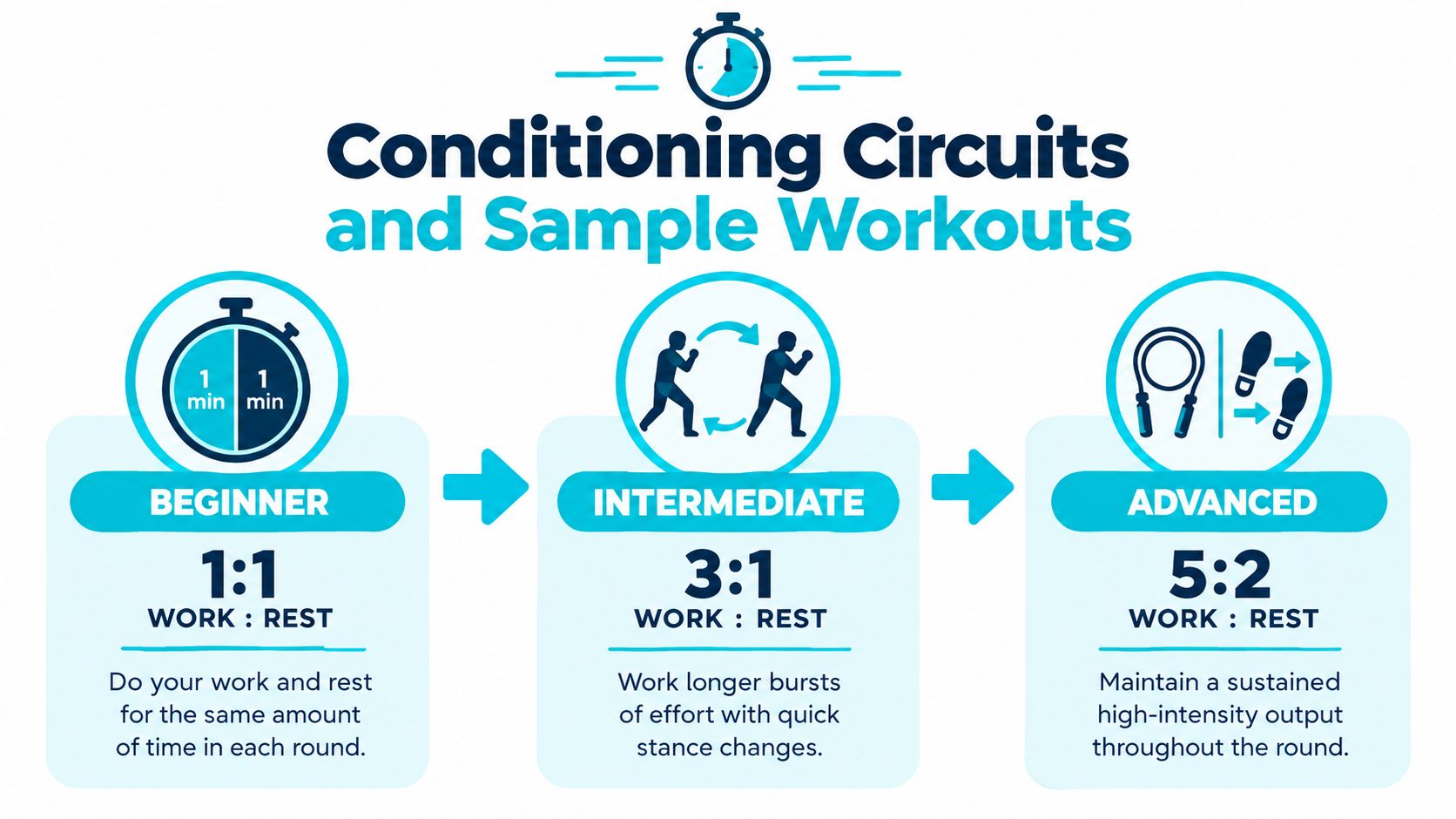
Beginner circuit
Work at 120 RPM with a 1:1 work-to-rest ratio inside the round.
- Basic bounce for 20 seconds.
- Walk and breathe for 20 seconds.
- Repeat the sequence through the round.
- Rest one minute between rounds.
- Complete three rounds before adding complexity.
The equal recovery keeps beginners focused on quiet landings and wrist control. Don't progress because the session feels easy once. Progress after three clean rounds at the target RPM.
Intermediate circuit
Use a 3:1 work-to-rest ratio. Alternate basic bounce, alternate foot, boxer step, and stance switches. Keep the rope moving through longer work blocks, then use the shorter recovery to practice returning to a composed guard.
Advanced circuit
Use a 5:2 work-to-rest ratio. Blend boxer step, double-unders, lateral shuffles, and stance-specific changes. The objective isn't to sprint from the opening bell. Hold technical quality while fatigue makes poor habits tempting.
A complete beginner session
For a 20-minute beginner session, use this order:
- Mobility warm-up for wrists, ankles, knees, shoulders, and hips.
- Four rounds of basic bounce at 120 RPM.
- Three rounds of alternate foot.
- Two rounds of boxer step.
- A short cool-down with walking and calf and hip-flexor mobility.
The last 30 seconds of each work period should feel hard but controlled. If the athlete is jumping higher, landing noisily, or losing nose-breathing control early, reduce the drill complexity before increasing the pace.
Weekly Programming Templates for Every Level
A four-week plan should make the training load visible. Start with 60 weekly rope minutes for a beginner, build toward 180 weekly rope minutes for an advanced athlete, and introduce stance-specific patterns in weeks three and four. Those totals are programming targets, not permission to ignore pain or technique.
The progression rule is deliberately narrow: add one round or five seconds per drill per week, never both in the same week. Lower-body strength fits best on rope-off days. For intermediates, add plyometric power in week three. Advanced fighters can add it from week one, provided their rope mechanics and recovery are already dependable.
| Week | Beginner | Intermediate | Advanced |
|---|---|---|---|
| Week 1 | Basic bounce and alternate foot, two rope days | Basic bounce, boxer step, three rope days | Rope, stance patterns, and power work across planned sessions |
| Week 2 | Add one round or five seconds per drill | Extend work periods without adding both volume changes | Add lateral movement while preserving target pace |
| Week 3 | Introduce stance-specific patterns | Add stance work and plyometrics | Maintain stance work and use higher-skill combinations |
| Week 4 | Repeat the cleanest week as a peak block | Repeat the strongest technical week | Repeat the peak week as maintenance |
A copyable weekly grid looks like this:
- Monday: Rope conditioning.
- Tuesday: Lower-body strength, no rope.
- Wednesday: Rope skill and stance work.
- Thursday: Rest or light mobility.
- Friday: Rope conditioning, with power work where appropriate.
- Saturday: Boxing practice or technical movement.
- Sunday: Full rest.
Step back one level if completion falls below 80% of target RPM in two consecutive sessions. That isn't failure. It's a sign that the current combination of volume, drill difficulty, fatigue, or recovery needs adjustment.
Recovery, Injury Prevention, and Dose Management
Skipping can feel deceptively light because the movement is compact. In reality, moderate-speed rope work has been reported at 76% to 88% of VO2max in men and around 92% in women, while fast skipping has reached a MET value of 12.3 (boxing jump-rope intensity overview). That intensity explains why calves, shins, ankles, and the Achilles tendon can become the limiting tissues before the lungs do.
Treat shin splints and Achilles irritation as dose warnings first. Don't jump from no rope work into long daily sessions. Start on a cushioned gym floor or a suitable rope mat rather than concrete, and wear shoes with lateral support when stance-specific patterns put repeated demands through the ankle.
Keep the load observable
Track:
- Rope contacts: Use a counter or estimate by RPM and work time.
- Hard-session spacing: Separate demanding rope sessions with recovery or technical work.
- Pain response: Note whether discomfort changes your landing or stance.
- Surface and footwear: Record them because they affect impact and stability.
- Next-session readiness: A tired calf that changes mechanics isn't ready for more volume.
Hydrate before, during, and after training. Finish with easy walking and mobility for the calves and hip flexors. After a layoff, return to basic bounce and short intervals, then rebuild only when the readiness check and landing quality are consistent.
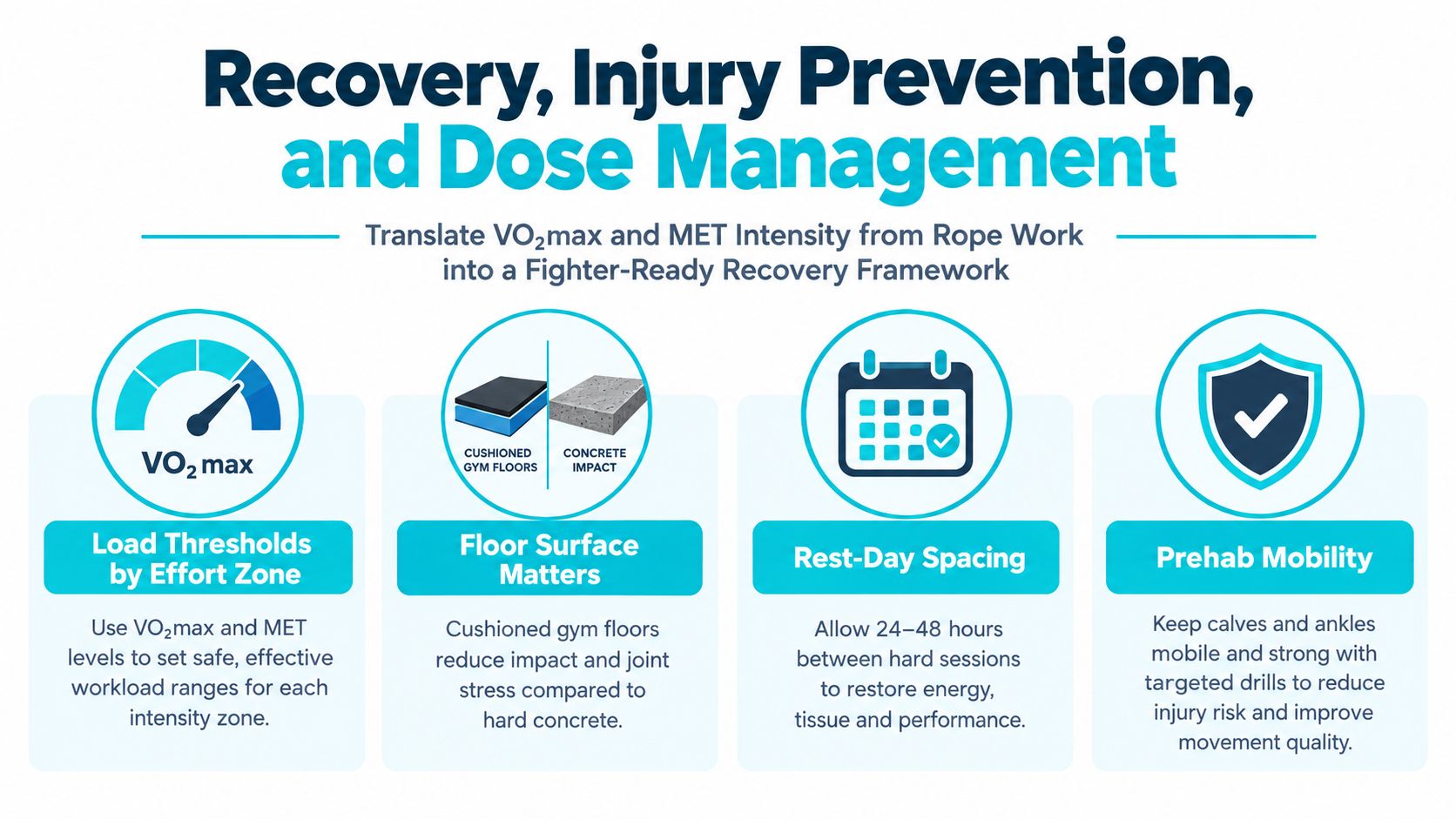
Rope work can substitute for some conditioning volume when the goal is rhythm, foot endurance, and repeatable aerobic work. It can't replace dedicated plyometric or sprint conditioning when the goal is maximum lower-body power. For broader guidance on managing training stress, use these recovery tips for athletes alongside the rope-specific checks above.
Tracking and Coaching the Plan With Thrive X Fitness
A rope program falls apart without documentation when the only record is, “I skipped for a while.” A useful coaching system records the drill, target pace, completed work, technical notes, surface, and recovery response. That turns a vague conditioning habit into a progression a fighter and coach can review.
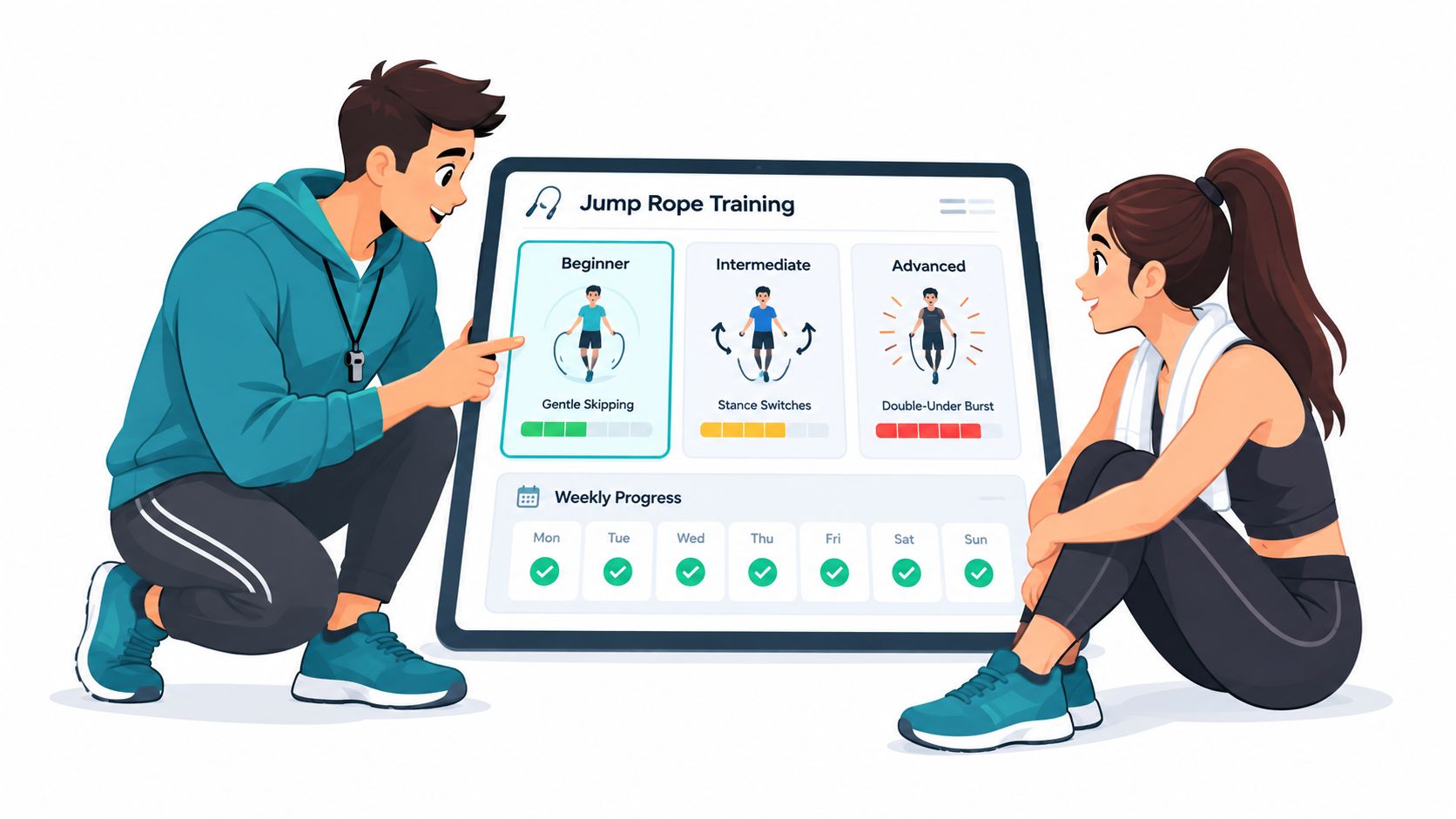
Thrive X Fitness can organize the plan around the three levels described earlier. A new user can receive a beginner session built around basic bounce and equal recovery. An intermediate athlete can request boxer-step and stance-switch blocks. An advanced fighter can be assigned double-unders, lateral shuffles, and more demanding work-to-rest structures, provided the coach controls the total load.
Turn form into a reviewable skill
Form-clip review is valuable because rope errors often appear before performance drops. A coach can use slow-motion footage to inspect:
- Wrist-driven rotation: The forearms and shoulders should stay quiet.
- Landing pattern: Heel strikes and flat-footed landings are easy to miss during a live class.
- Jump height: Excess height exposes wasted movement and impact.
- Boxer-step symmetry: The athlete should shift weight rather than bounce tall on both feet.
- Stance transitions: Orthodox and southpaw changes should preserve rhythm.
The clip doesn't replace coaching judgment. It gives the coach a repeatable view between sessions, especially when fatigue makes the athlete's self-assessment unreliable.
Build a coach workflow
Assign the weekly grid first, then attach the session target. The athlete records rounds, RPM, interruptions, stance patterns, and any calf or ankle symptoms. The coach reviews the dashboard and clips, then adjusts one variable at a time, either a round or five seconds per drill.
Messaging should stay concrete:
- “Keep the elbows tucked and lower the jump.”
- “Hold the target RPM before adding double-unders.”
- “Your southpaw transition is widening the base.”
- “Repeat this volume until the rope stays quiet.”
The app also supports AI workout generation and form-focused review, so the plan can remain specific without relying on memory or scattered messages. A coach can assign a template, review a clip between sessions, modify volume, and keep the athlete moving toward the same technical standard.
The core point is simple. Jump rope builds footwork rhythm, calf-anchored reactive endurance, and conditioning density, but only when technique comes before volume. The skill ladder moves from basic bounce through alternate foot, boxer step, and double-unders. Three conditioning levels fit into a four-week progression, while plyometrics and sprint work remain necessary for complete lower-body power. Surface, shoes, and recovery influence the load as much as drill selection. Tracking every session makes progress visible instead of guessed.
Frequently Asked Questions
How long should beginners jump rope per session?
Beginners should start with short, controlled intervals rather than chasing continuous time. A practical entry point is a 1:1 work-to-rest ratio, using basic bounce at 120 RPM and building through three clean rounds. A complete beginner session can include mobility, four rounds of basic bounce, three rounds of alternate foot, two rounds of boxer step, and a cool-down. Progress only when landings, breathing, and rope control remain consistent.
How often should boxers train with a jump rope?
Use planned rope days separated by rest, boxing practice, mobility, or lower-body strength. The weekly template places rope conditioning on selected days rather than every day, with lower-body strength on rope-off days. Add one round or five seconds per drill per week, never both. If target completion drops below 80% of target RPM in two consecutive sessions, step back a level.
What's the best rope type for beginners?
A basic rope that allows you to learn wrist-led rotation and low bouncing is enough. The important starting points are correct length, close elbows, soft forefoot contact, and a jump height of half an inch to two inches. Stand on the rope center and check that the handles reach your armpits. Once technique is reliable, shorten the rope by one inch for speed-focused work.
Does jump rope replace roadwork?
It can replace some conditioning volume when you need rhythm, foot endurance, and repeatable aerobic work with manageable equipment and space. It doesn't replace every conditioning method. Sprint work and plyometrics still have a role when the goal is maximum lower-body power, while roadwork may remain useful depending on the fighter's wider program and recovery budget.
How long does it take for footwork to improve?
Footwork improves through consistent exposure to the right patterns, not through a guaranteed calendar deadline. Start with basic bounce, then build alternate-foot cadence, boxer-step weight transfer, and stance-specific rounds. Record target RPM, interruptions, and form clips so improvement is visible. A cleaner rhythm, quieter rope, and more stable stance are better progress markers than skipping faster alone.
Do shin splints mean I have to stop completely?
Shin pain is a reason to reduce load and review technique, surface, footwear, and recovery. Don't continue adding volume if discomfort changes your landing or stance. Return to basic, low-volume work after symptoms settle, using a cushioned surface and supportive shoes, then rebuild gradually. Persistent or worsening pain needs assessment from an appropriately qualified clinician rather than a harder conditioning session.
ThriveXDNA offers Thrive X Fitness for AI-generated workouts, form-clip review, nutrition support, challenges, and coach-delivered programming. Use ThriveXDNA to turn your boxing jump rope sessions into a tracked plan with visible technique and conditioning progress.