

You stepped on the scale this morning, opened a calorie app, and got one tidy number. It might read 1,800. It might read 2,600. You still don't know whether that figure already includes the commute, the evening class, or only the hours you spend sitting.
That number is meant to be your maintenance calories, the intake that holds weight steady. A TDEE calculator builds it in two moves. First it estimates resting energy. Then it multiplies by an activity factor that stands for the rest of the day. Treat the result as a starting range, and confirm it with two to three weeks of average weigh-ins. Don't stack a watch's exercise calories on top of a multiplier that already tried to count your training.
Table of Contents
- How a TDEE Calculator Gets Your Maintenance Number
- Four Parts That Add Up to Daily Burn
- Why the First Number Is Only a Starting Range
- How to Shift Intake for Fat Loss or Muscle
- Set Your Next Intake from the Trend
- Summary
- Frequently Asked Questions
How a TDEE Calculator Gets Your Maintenance Number
Total daily energy expenditure is not the calorie total from one workout. A sound TDEE calculator keeps resting energy expenditure (REE) separate from activity, then joins them with a multiplier. Physical activity level is PAL = TDEE / REE, so the model is TDEE = REE × PAL. Doubly labeled water, the reference method for free-living expenditure over roughly one to three weeks, shows that PAL in vigorously active people generally reaches about 2.00–2.40, which is why these multipliers stay population estimates rather than a personal lab result, as set out in the Proceedings of the Nutrition Society.
The usual resting equation is Mifflin-St Jeor, published in 1990 from measurements of 498 adults.
Men: (10 × kg) + (6.25 × cm) − (5 × age) + 5
Women: (10 × kg) + (6.25 × cm) − (5 × age) − 161
One round example
Take a 30-year-old woman at 60 kg and 160 cm.
10 × 60 = 600. 6.25 × 160 = 1,000. 5 × 30 = 150. Then 600 + 1,000 − 150 − 161 = 1,289, rounded to 1,290 kcal of resting energy.
A moderately active multiplier of 1.55 gives 1,290 × 1.55 = 1,999.5, about 2,000 kcal. That 2,000 is the maintenance estimate for this person. It is not a target for everyone with a similar photo on social media.
Pick the row from the day you actually live
Match the label to your job plus your training days. A gym selfie doesn't choose the row.
| Activity label | Multiplier | Typical day | Structured training |
|---|---|---|---|
| Sedentary | 1.2 | Desk job, most of the day seated | Little or none |
| Lightly active | 1.375 | Some walking or a job on your feet | About 1–3 days a week |
| Moderately active | 1.55 | Regular movement most days | About 3–5 days a week |
| Very active | 1.725 | Hard training or a physical job | About 6–7 days a week |
| Extra active | 1.9 | Physical work plus hard training | Daily hard sessions |
Say the same woman sits at a desk and lifts three evenings a week, with the other days mostly seated. That life is closer to 1.375 than to 1.725. Three to five training days plus walking most days is the 1.55 row behind the 2,000 kcal example. For context, the CDC's physical activity guidance recommends at least 150 minutes of moderate activity and two days of muscle-strengthening activity per week for adults. Meeting that recommendation does not automatically put you in a particular calculator row: your job and movement outside workouts still matter. The 1.9 row is the familiar top of the table. Measured vigorous days can sit higher, near 2.00-2.40, so don't treat 1.9 as your own laboratory printout.
Practical rule: Eat near the calculator result, then judge it only after two to three weeks of morning weigh-ins. One heavy dinner doesn't rewrite the estimate.
Four Parts That Add Up to Daily Burn
Picture the 1,290 kcal resting figure as the base block of a daily budget. Everything else is a slice on top of that block, not a second bill you pay after the workout.
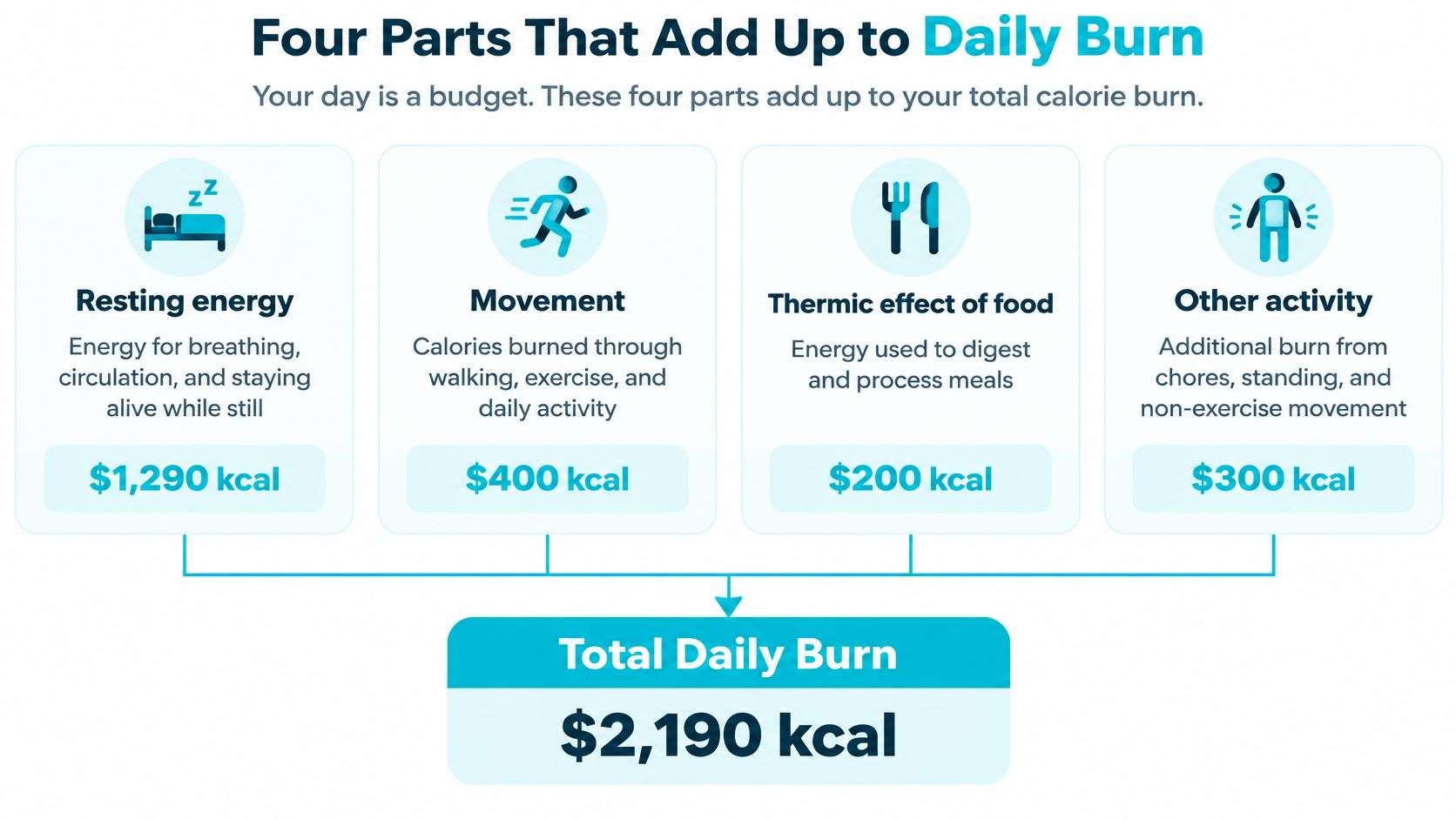
Resting energy is the cost of staying alive while you are still. Breathing, circulation, and organ work sit in this slice, and for individuals who do not have a physical job it is the largest part of the day. In the example it is already calculated at 1,290 kcal before any steps or sessions.
Daily movement is the unplanned slice. Standing at a counter, commuting, fidgeting, and carrying bags all count. Researchers call this nonexercise activity thermogenesis (NEAT). That spontaneous movement can shrink when you diet, even if the planned workouts stay on the calendar. Fatigue trims the walk to the far platform, and the budget drops without a change in the gym plan.
Exercise is the structured session. It belongs inside the activity multiplier, not as a second number you add after the TDEE calculator finishes. If the moderate row already assumes three to five training days, the Tuesday class is inside the 2,000 kcal, not on top of it.
Digestion, often called the thermic effect of food, is the energy spent processing the meal itself. Protein costs more to process than fat. The calculator doesn't itemize that, because the multiplier is applied to resting energy, not to each macro on the plate.
TDEE is the whole day, not the workout.
Two people with the same 1,290 kcal resting energy can land on different totals because one walks for work and the other sits. The multiplier row carries that difference. Guessing an exercise calorie and adding it afterward usually counts the session twice.
If the scale is noisy and you also have cycle changes, poor sleep, or other signs that feel bigger than a calorie row, that is a clinical question, not a multiplier question. Personalized care for hormone imbalance is the kind of appointment that looks at those signs directly, while the calculator only estimates the energy budget.
Why the First Number Is Only a Starting Range
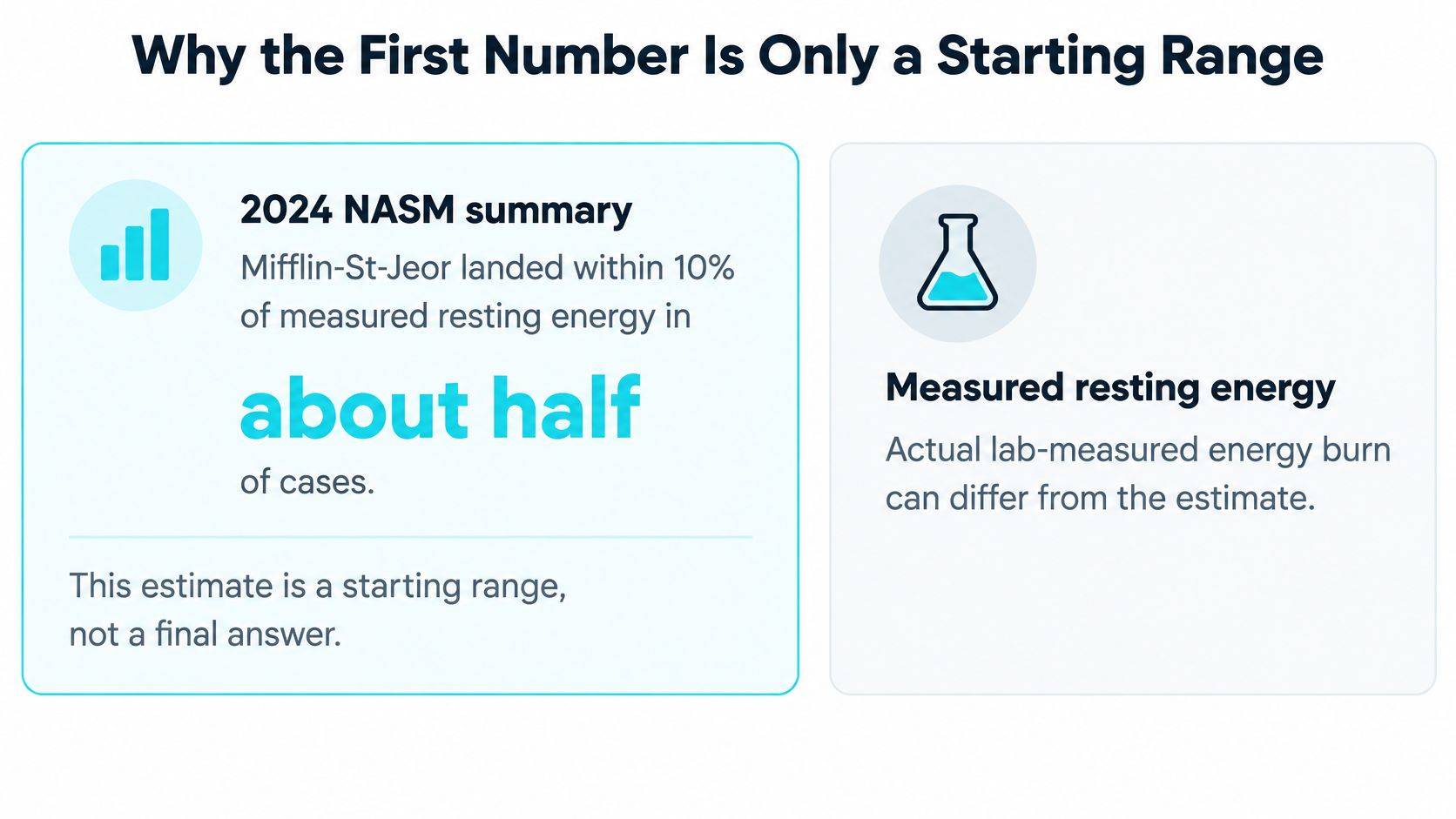
A printed 2,000 kcal looks exact. The equation underneath is not. A 2024 summary from the National Academy of Sports Medicine reports that the Mifflin-St Jeor equation produced estimates within 10% of measured resting energy expenditure in about 50% of cases. For the example, 10% of 1,290 kcal is about 130 kcal on the resting piece alone, before the activity row adds its own guess. The honest output is a band around 2,000, not a dot.
Where a watch makes the band worse
Consumer wearables don't close that gap. A 2025 study of smartwatches during aerobic dance found energy-expenditure errors ranging from 16.56% to 42.84%, reported in the Journal of Science in Sport and Exercise. The practical mistake is adding those watch calories to a TDEE that already used a moderate or high multiplier. The session gets counted twice, and the app invents a surplus you didn't earn.
Pick one system.
- Calculator total: Eat from the maintenance estimate, or from the goal row you choose next, and leave the watch's burn number off the food log.
- Intake matched to the scale: Keep a steady intake and let the weekly average weight tell you whether that intake is above or below what you use.
People whose commute, climate, or shift pattern doesn't match the five labels shouldn't hunt for a sixth multiplier. Start in the nearest row. A night-shift nurse who lifts twice a week is not "extra active" just because the week feels hard. Let the weigh-in trend move the intake. The first number was only a draft.
How to Shift Intake for Fat Loss or Muscle
Start from the example maintenance of about 2,000 kcal. The formula is done. What changes now is the purpose you give that number, and the scale pattern that would prove the purpose worked.
Holding weight means eating near 2,000 and expecting the weekly average to wobble inside a small band. A salty dinner or a late meal can push a single morning up without touching the trend, so one spike decides nothing.
Fat loss means a modest cut, about 300-500 kcal below maintenance, so 1,500-1,700 kcal on this example. Aim for roughly a quarter to a half kilogram a week rather than the fastest drop the app will offer. The CDC recommends gradual weight loss as a more sustainable approach. A 500 kcal daily deficit is the steep end of this example cut, not a requirement, and the slower row is easier to hold through a stressful month.
Muscle gain means a small surplus, about 200–300 kcal, so 2,200–2,300 kcal, paired with training that gets harder over the weeks. A bigger surplus mostly adds fat. If the bar isn't heavier or the reps aren't climbing, the extra food has nothing to build with.
Staying at maintenance while training hard, the recomp row, keeps the scale flat on purpose. The proof there is the tape or how clothes fit, since the average weight barely moves.
Goal rows from the same 2,000 kcal
| Goal | Change from maintenance | Example intake | Scale check |
|---|---|---|---|
| Hold weight | None | About 2,000 kcal | Average weight steady |
| Lose fat, slower | About 300 kcal below | About 1,700 kcal | About a quarter kilogram a week |
| Lose fat, steeper | About 500 kcal below | About 1,500 kcal | Faster loss; add a small step back if energy is poor |
| Recomp | None, with training and protein kept high | About 2,000 kcal | Average weight steady while body composition shifts |
| Gain muscle | About 200–300 kcal above | About 2,200–2,300 kcal | Slow gain paired with harder training |
Protein and training decide whether the change shows up as fat lost or muscle gained. The table sets the calorie row; it doesn't rebuild a meal plan. For a plate-level walkthrough of how those pieces fit a cut or a slow gain, nutrition for fat loss and muscle gain works as a companion to whichever row you pick.
The goal row is a hypothesis until the two-to-three-week average confirms the rate.
If the average isn't moving the way the row predicted, adjust intake in a small step. One loud week on the scale is not a reason to swap the whole goal.
Set Your Next Intake from the Trend
Run this sequence after the first estimate. Change one thing at a time so the next two weeks still mean something.
- Weigh under the same conditions most mornings for two to three weeks. MedlinePlus recommends using the same scale after the bathroom and before breakfast. Average each week, and ignore a single spike. The CDC's weight-maintenance guidance also recommends monitoring weight, diet, and physical activity to spot changes over time. For a broader look at how eating, activity, sleep, and stress fit together, see the CDC's healthy weight overview.
- Keep intake near the chosen row from the goal table.
- If the average is steady, treat that intake as your real maintenance even if it sits 100–200 kcal from the calculator.
- If loss is faster than about half a kilogram a week and energy is poor, add back a small step.
- If loss has stopped, rerun Mifflin-St Jeor at the new body weight first, because a lighter body has a lower resting cost. Then trim 100–200 kcal or add a little daily movement. Don't jump another 500 kcal.
- Compare the average of the latest week with the average of the first week. A flat or slowly moving average decides the next move, not one morning's reading.
The ThriveX Fitness app is a simple way to keep that number next to training and food. The page presents ThriveX Fitness as an AI fitness app with AI-powered workouts, nutrition tracking, and a fitness community.
Why a stall isn't a broken metabolism
Measured expenditure can fall beyond what the lighter body predicts. In one controlled weight-loss study, the gap reached approximately 963 kJ/day in men and 614 kJ/day in women by week 8, about 230 and 147 kcal/day, and a separate study of 44 adults on a very-low-energy diet found adaptive reductions in resting expenditure averaging 121 ± 188 kcal/day after a loss of 18.4 ± 3.9 kg, as reported in the British Journal of Nutrition. A plateau calls for a modest recalibration, not an automatic deep cut.
Lookalikes that are not a "broken" metabolism include a salty week of water retention, weekends that erase the weekday deficit, and less spontaneous walking as fatigue rises. The adaptive piece often eases once weight is stable, so maintenance after a diet is a new calculation, not the original 2,000 kcal forever. Eating less does not always restart the scale. If you want a plain-language conversation on what changes after a long diet, understand your metabolism with Heather Deba and then come back to your own weekly averages.
Keep the intake that matches the trend you want. Rerun the calculator when body weight has clearly changed, not every Monday. For another way to model changing calorie needs over time, try the NIH Body Weight Planner. For an explanation of why a fixed calorie cut can produce slower loss than expected, see NIDDK's guide to the planner.
Related guides
- Calorie Deficit Calculator for a Realistic Cut
- Balanced Diet for Weight Loss: How to Build Your Plate
- best macronutrient ratio for weight loss
- hidden calories behind a weight loss plateau
- how much protein you actually need
- Best AI Macro Tracking Apps
- a simple calorie needs calculator
- what your BMI number does not show
- logging macros for fat loss
- eating enough to build muscle
Summary
A TDEE calculator multiplies resting energy from Mifflin-St Jeor by an activity multiplier that stands for the whole day, including movement, exercise, and digestion. In the worked example, a woman at 60 kg, 160 cm, and age 30 rested near 1,290 kcal and landed near 2,000 kcal at the moderate multiplier. That figure is a starting estimate, because the equation is within 10% of measured resting energy in only about half of cases, and a watch can double-count exercise. Eat for the goal, then judge the average scale over two to three weeks. If loss stalls, update body weight and make a small change rather than assuming metabolism is broken.
Frequently Asked Questions
What is TDEE?
TDEE is total daily energy expenditure, the full-day energy cost. It includes resting energy, daily movement that isn't a workout, structured exercise, and the energy spent digesting food. A TDEE calculator doesn't measure each slice in a lab. It estimates resting energy, then multiplies by an activity factor that stands for the rest of the day. Eat near that total and, over time, weight should hold. Eat under it and the average should fall. Eat over it and the average should rise. The first printout is still a draft until your weigh-ins agree.
Which formula should I use for resting energy?
Use Mifflin-St Jeor, then the activity multiplier. For men the equation is (10 × kg) + (6.25 × cm) − (5 × age) + 5. For women it is the same three terms minus 161. In the worked example, 60 kg, 160 cm, and age 30 produced 1,289 kcal, rounded to 1,290. Multiplying by 1.55 produced about 2,000 kcal of maintenance for that person only. The equation is a population tool. It landed within 10% of measured resting energy in about half of cases, so expect a band, not a perfect dot.
How do I pick my activity multiplier?
Match your job and your training days to the five rows, from sedentary at 1.2 through extra active at 1.9. A desk plus rare workouts is 1.2. Some walking or one to three training days is 1.375. Regular movement plus three to five training days is 1.55. Hard training or a physical job most days is 1.725. Physical work plus daily hard sessions is 1.9. Measured physical activity level in vigorously active people often lands near 2.00–2.40, so the top row is still an estimate. If you sit between two labels, start with the lower one.
Should I add calories burned from my watch?
No. The multiplier already includes activity, including the structured session. Adding a watch's "calories burned" on top counts that session twice and invents a surplus. Wearables also miss by a wide margin. In one aerobic dance study, smartwatch energy-expenditure errors ran from 16.56% to 42.84%. Pick one system. Either eat from the calculator total, or match a steady intake to the weekly weight average. Don't mix the two on the same day. A shift pattern that doesn't fit the labels still starts in the nearest row.
How soon should I change the number?
Wait for two to three weeks of weigh-ins taken under the same conditions, then use the weekly averages. One heavy dinner, one salty day, or one missed workout doesn't justify a new target. If the average is steady, that intake is your real maintenance even when it sits 100–200 kcal off the calculator. If loss is very fast and energy is poor, add a small step back. If nothing is moving, rerun the resting equation at the new body weight before you cut again. Change one variable so the next fortnight still means something.
Why did my deficit stop producing weight loss?
Expenditure can fall by more than the lighter body weight alone would predict. In one weight-loss study the extra drop by week 8 was about 230 kcal a day in men and 147 kcal a day in women. Another study saw resting expenditure lower by about 121 kcal a day on average after a large loss, with a wide spread between people. Update body weight in the equation, then trim 100–200 kcal or add a little daily movement. Water retention, weekend intake, and less spontaneous walking can look the same as a stall. A smaller intake doesn't always restart the scale.
ThriveXDNA builds tools that keep training and eating decisions honest, including ways to estimate daily energy needs and turn them into workouts and nutrition you can follow. If you want the maintenance number from this TDEE calculator sitting next to a plan you can keep past the first fortnight, start at ThriveXDNA. Bring your two-to-three-week weigh-in average with you so the next intake is based on your trend, not on a single printed calorie.