

The most repeated advice after birth is still a calendar. Wait six weeks, get cleared, then pick up the workout you did before. That treats a clinic visit like a finish line. A clearance note means a clinician saw no reason to forbid activity. It doesn't mean your pelvic floor, abdominal wall, incision, or sleep will tolerate jumps, sit-ups, or a weight-loss plan.
A good postpartum fitness coach judges readiness by symptoms, tissue healing, and what you can do that day. Parents drop plans more often because of night feeds, childcare, and broken sleep than because they lack motivation. The useful coach matches the session to the day you really have.
Table of Contents
- What a Postpartum Fitness Coach Does
- Red Flags That Mean Stop or Change the Session
- Return-to-Exercise Timeline and Sample Sessions by Stage
- How to Vet and Hire a Postpartum Fitness Coach
- Remote Coaching Best Practices and Thrive X Fitness Tools
- Confirm Your Next Step Before You Train
- Summary
- Frequently Asked Questions
What a Postpartum Fitness Coach Does
A postpartum fitness coach programs exercise through the first year after birth, checks recovery before adding load, and coaches behavior when sleep is broken. The coach works like a building inspector after a renovation: examine what shifted before anyone stacks weight on the structure.
Three jobs sit together. Safe programming builds activity in stages, so easier work earns the right to harder work. Pelvic-floor and abdominal-wall awareness catches leakage, heaviness, and doming early, while a regression can still fix the session. Behavior coaching keeps a new parent consistent when the day collapses, which usually means shrinking the session instead of skipping it.
The World Health Organization physical activity fact sheet sets a benchmark of at least 150 minutes of moderate-intensity aerobic activity per week for women without medical contraindications, plus muscle strengthening and, where appropriate, gentle stretching, and reports that 27.5% of adults worldwide fall short of recommended activity levels, with inactivity higher among women than men at 31.7% versus 23.4%. A coach treats that weekly target as a direction to build toward over months. Before any of it, the coach screens for contraindications and current symptoms.
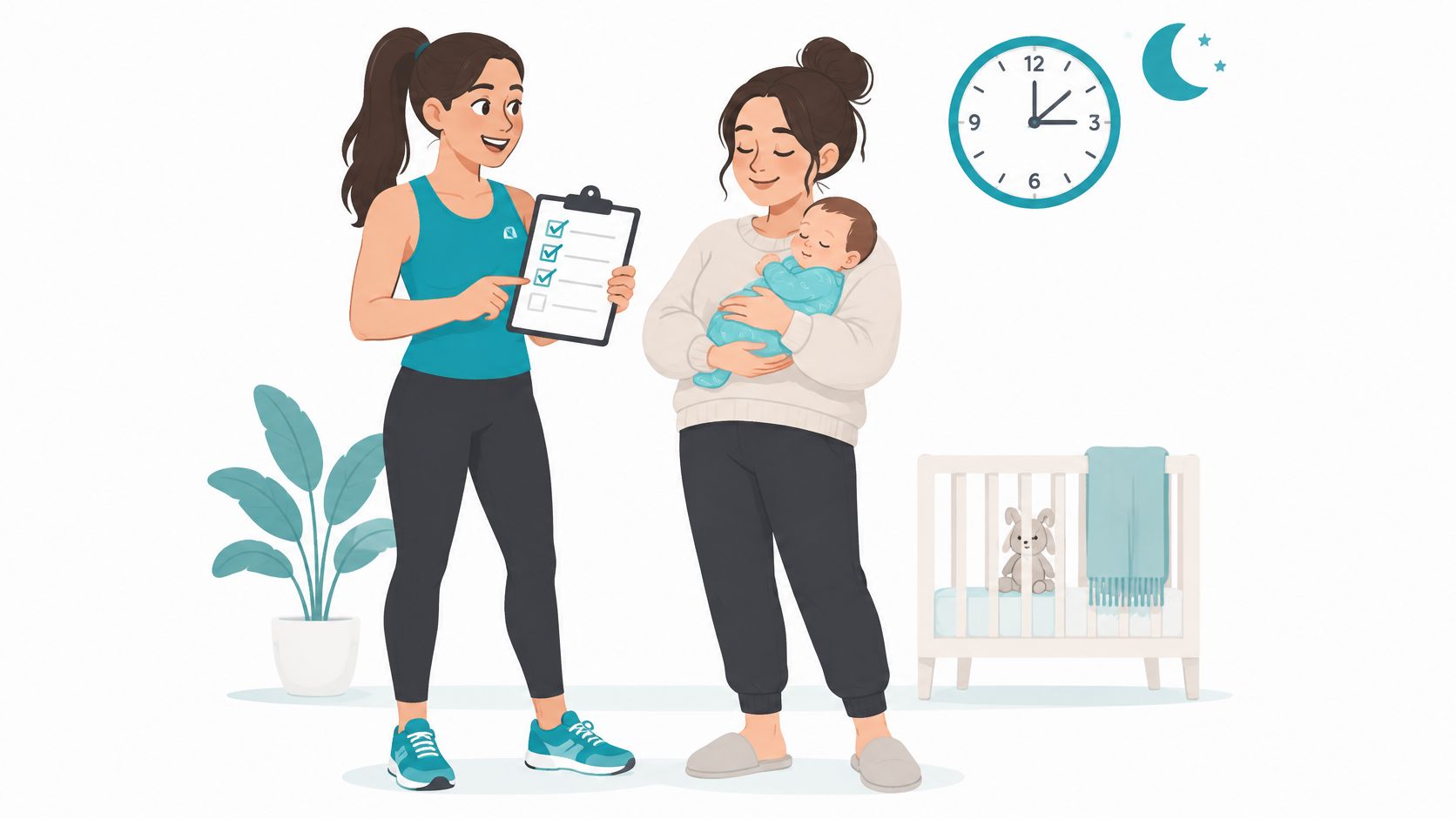
A working week runs in a set order. Intake and symptom screening come first, then a written clearance check, a staged plan, weekly check-ins, and a referral when something sits outside scope. Each step gates the next one, so a symptom raised on Monday changes the session on Wednesday instead of getting carried through it.
Say a parent is six weeks after a cesarean birth and leaks during jumps. Impact stays off the plan. The next step is a pelvic-health physiotherapy referral, and that day's session becomes work that keeps symptoms quiet. That's where this coach splits from a general weight-loss trainer.
What you should expect:
- Written clearance check: Loaded work doesn't start until that note is on file.
- Symptom screening before each session: Leakage, heaviness, pain, and bleeding get asked every time, and a "yes" changes the session that day.
- A staged plan: Volume and impact rise only after easier work stays quiet between sessions.
- A named referral route: A pelvic-health physiotherapist or obstetric clinician is already identified, so a symptom goes to a person instead of a search bar.
Red Flags That Mean Stop or Change the Session
Use this table the moment a symptom shows up. It pairs what you feel with what it may mean and what the coach should do in that session.
| Symptom | What it may signal | Coach action |
|---|---|---|
| Urine or fecal leakage | Pelvic-floor overload or weakness | Stop impact, reduce load, refer if persistent |
| Vaginal heaviness, dragging or bulging | Strain on pelvic-organ support | Stop the session and refer to a pelvic-health physiotherapist |
| Abdominal doming or ridging | Abdominal-wall strain under load | Drop crunches and heavy core work; regress the movement |
| Increased or changed bleeding | Healing may be affected | Stop the session and contact the clinician |
| Wound pain, redness or discharge at incision or tear | Possible healing problem | Stop and refer to the clinician |
| Pain anywhere during exercise | Unresolved tissue or joint load | Stop; never coach through pain |
| Pelvic pain or pain with sex | Possible pelvic-floor dysfunction | Refer for professional assessment |
| Unusual fatigue or persistent muscle pain | Load exceeds recovery | Reduce volume and reassess within the week |
| Low mood, anxiety or withdrawal | Possible postpartum mental-health concern | Pause the plan and refer to a clinician |
Before every session, the coach asks three questions. Any leakage? Any heaviness or bulging? Any pain or pressure during impact or lifting? The answers pick the workout. They aren't a formality.
Why screening changes the workout
A 2025 systematic review and meta-analysis covering 65 studies and 21,334 participants found that postpartum pelvic-floor muscle training reduced the odds of urinary incontinence by 37% across seven randomized controlled trials. One randomized trial also reported a 56% reduction in pelvic-organ-prolapse odds. Daily pelvic-floor work can fit, but technique and an individual check matter more than extra reps.
Practical rule: Symptoms are progression checks. They aren't signals to coach through.
Persistent leakage, heaviness, pelvic pain, or pressure means a referral to a pelvic-health physiotherapist, not another set. NHS Lanarkshire's postnatal pelvic-health guidance explains where to seek help for symptoms after birth. A fixed clearance date is a weaker guide than how the body responds. Early, progressive exercise can be appropriate when it's tolerated and pelvic-floor symptoms stay monitored. Programming starts with breathing coordination and low-impact strength, then tests impact tolerance before running, jumping, or hard circuits.
If a movement flags, stop that movement, drop back to the last pain-free level, and write down the change before the next session.
Return-to-Exercise Timeline and Sample Sessions by Stage
The six-week checkup gets treated like a green flag. It isn't one. Clearance means a clinician found no reason to stop you. Readiness means your body passes specific tests, and those two things can be weeks or months apart.
Many people can begin exercising a few days after giving birth, or when they feel ready, but anyone who had a cesarean birth or complications should ask an obstetric clinician when activity is safe, according to the American College of Obstetricians and Gynecologists. ACOG also splits the weekly aerobic target into practical pieces, such as 30 minutes on five days or 10-minute blocks across a day, which matters when sleep arrives in two-hour fragments.
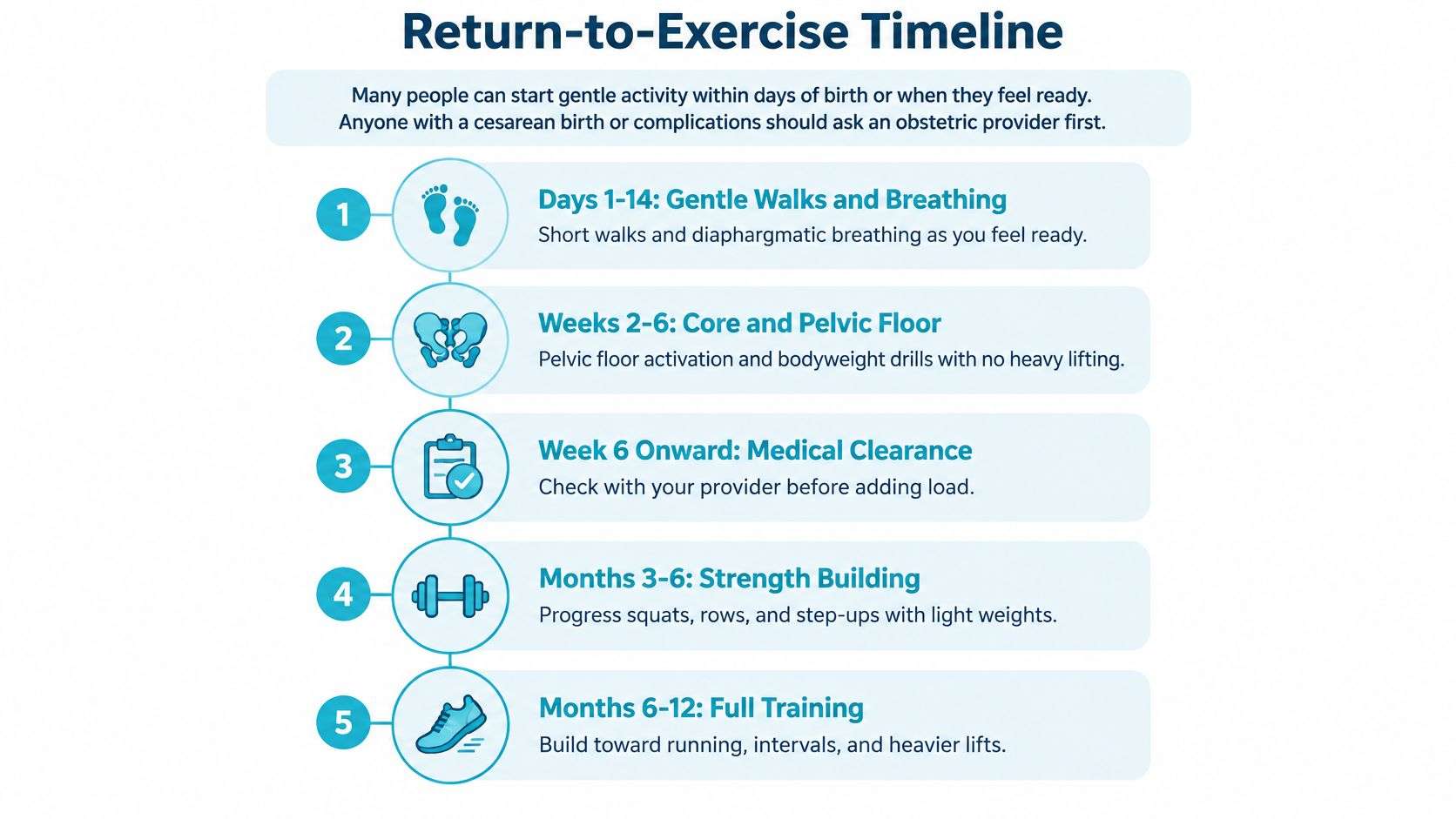
Find your stage, confirm every check, and move on only when all of them pass. The 2025 Canadian guideline builds toward at least 120 minutes of moderate-to-vigorous activity weekly across four or more days, while checking that incisions or perineal tears have healed and that vaginal bleeding stays stable during activity. For a closer look at how clinicians frame the early weeks, when to resume exercise after birth from Lake City Physical Therapy is a useful companion to this table.
| Stage | Timing | Typical activity | Check before advancing |
|---|---|---|---|
| Early recovery | First 0–6 weeks | Pelvic-floor work, pelvic tilts, deep abdominal activation, walking | Pelvic-floor work may start on day one unless a clinician advises otherwise |
| Low-impact rebuild | Weeks 6–12 | Low-impact exercise, faster walking, stationary bike | No leakage, heaviness, doming or bleeding increase during sessions |
| Impact return | After 12 weeks | Gradual increase in impact and cardio, subject to individual assessment | Pain-free impact tolerance before jumping or running |
| Running and impact sports | At least 12 weeks postpartum, then graded progression | Graded running or impact sports | No urinary or fecal leakage, dragging, doming or pain |
| Sit-ups and high-intensity work | Wait until a clinician confirms pelvic-floor recovery | Only after pelvic-floor recovery is confirmed | Clinician confirms pelvic-floor recovery |
| Cesarean birth or complications | Set by an obstetric clinician | Activity only as clinician allows | Written clinical clearance on file |
| Readiness ladder | Tested in order | Walking, lifting, impact, then running | Advance one rung only when the prior rung passes |
An NHS postnatal exercise guide places pelvic-floor work, pelvic tilts, deep abdominal activation, and walking in the first 0–6 weeks, low-impact work with faster walking or a stationary bike in weeks 6–12, and a gradual rise in impact and cardio after 12 weeks, subject to individual assessment. Increased fatigue, vaginal heaviness, persistent muscle pain, bleeding, abdominal doming, and urinary incontinence or urgency are reasons to reduce activity. Oxford University Hospitals advises waiting at least 12 weeks before running or other impact sports, then using a graded progression, and says leakage, dragging, doming, and pain shouldn't occur during that work.
For broader clinical context, see ACOG's guidance on physical activity during pregnancy and postpartum.
Notice what the table never does. It never advances you because a date passed. Every check is a symptom check or a healing check, which is why two people at the same week postpartum can sit in different stages.
A 15-minute foundation session
- Two minutes of diaphragmatic breathing, ribs widening on the inhale and softening on the exhale.
- Three minutes of pelvic-floor work: sustained holds and short quick contractions, with a full relax between reps.
- Five minutes of pelvic tilts and deep abdominal activation on your back or side.
- Five minutes of easy walking on flat ground.
Milton Keynes University Hospital states that gentle pelvic-floor exercises may start on the first day after birth, vaginal or cesarean, unless a clinician says otherwise, using sustained and quick contractions three times daily. A catheter should be removed before you begin. Leakage, urgency, dragging, bowel-control problems, and pain with sex need professional attention, not harder contractions.
Sessions that fit real weeks
Motivation rarely decides whether postpartum training happens. Sleep, feeding schedules, and childcare decide. The plan below is built so each of those barriers has a fallback instead of a skipped day.
Rebuild sessions use glute bridges, bird-dogs, wall push-ups, step-ups, and a stationary bike once low-impact checks are clean.
Return-to-impact sessions add goblet squats, rowing, and low-impact intervals only after a pain-free hop test. If the hop leaks or feels heavy, you stay on the bike.
A minimum viable day, after awful sleep or illness, is two breathing rounds, 10 chair squats, and one minute of walking. Count that as success.
Baby-nearby sessions are floor strength where you can see the baby, plus short stroller loops, paused for feeds.
Progress volume before load. Add pace only when there's no leakage. Skip weight-loss targets while breastfeeding.
How to Vet and Hire a Postpartum Fitness Coach
Start with proof, not a polished feed. A general personal trainer certification is a starting point. It isn't proof that someone can coach the year after birth.
| Credential or evidence | Why it matters | How to verify |
|---|---|---|
| Certified personal trainer or exercise specialist | Foundational programming and safety training | Check the certifying body's public directory |
| Prenatal and postnatal specialty certification | Covers pregnancy-to-postpartum changes | Ask for the course name, year and hours completed |
| Pelvic-health or women's health training | Recognizes leakage and prolapse signs and when to refer | Ask for the provider and recent continuing education |
| First aid and CPR | Emergency readiness during in-person sessions | Request a current card |
| Referral network with a physiotherapist or obstetric clinician | Provides an escalation path | Ask for named referral partners |
| Screening and liability coverage | Protects client safety and the coach | Ask whether intake includes red-flag screening and whether insurance is in place |
Seven questions for the consult
- What postpartum-specific training have you completed, and when?
- How do you adjust a plan after a cesarean birth or complications?
- What happens when a client reports leakage during a session?
- Do you require written clinical clearance before the first session?
- How do you adapt training during breastfeeding and fragmented sleep?
- Which clinicians do you refer to, and how quickly?
- How do you measure progress beyond body weight?
A strong answer names the course, the screening step, and a real referral partner. A vague answer about bouncing back is a generic trainer in nicer language.
Watch for these coach red flags:
- A flat stomach in six weeks: Healing tissue doesn't follow a marketing deadline.
- No pelvic-floor screening at intake: Leakage and heaviness never get a chance to change the plan.
- Advice to skip the doctor: Scope starts with clinical clearance, especially after surgery or complications.
- Weight-loss-only messaging during breastfeeding: Aggressive calorie cuts fight recovery and feeding.
- No named referral pathway: "See someone if it hurts" isn't a pathway.
Ask about the pricing structure, whether sessions run in person or remotely, the cancellation policy, and whether the coach will share the plan with your clinician. Those answers should line up with the clearance and referral steps you already expect. If they don't, keep looking.
Remote Coaching Best Practices and Thrive X Fitness Tools
A template cannot see the moment a squat changes because the baby woke at 3 a.m. Remote coaching works when the plan is built around what can be observed between visits: symptoms, sleep, feeding, childcare, and the clips a client can send.
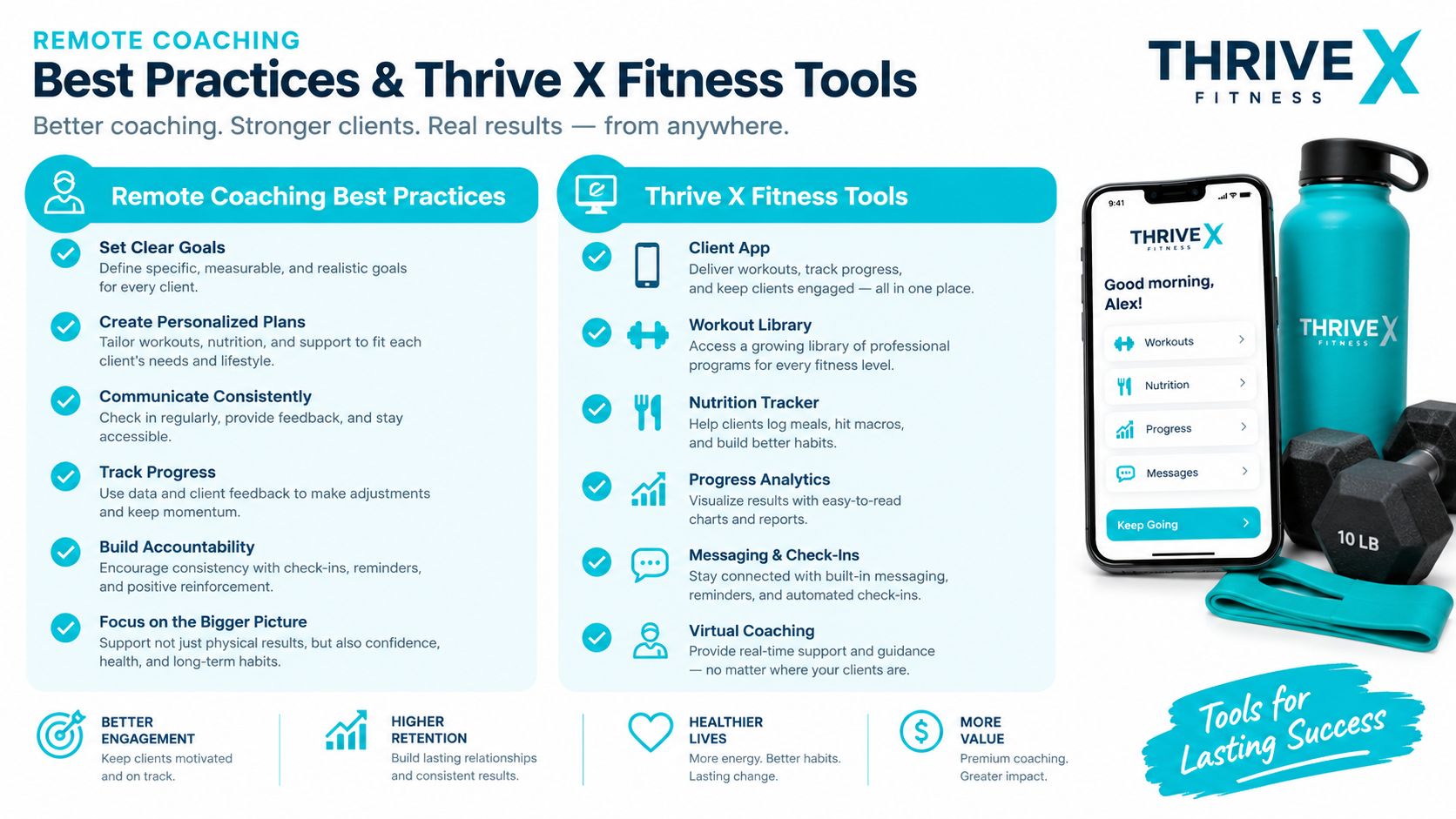
Use this checklist before you trust an app or a video plan:
- Symptom questionnaire before session one: Leakage, heaviness, pain, bleeding, and mood are on the form.
- Written clinical clearance on file: The file exists before load is added.
- A short form-clip review: Technique is judged from video, not guessed from a text reply.
- Weekly symptom check-ins: The plan changes when the week changes.
- Sessions sized to the day: Ten quiet minutes beat a skipped 45-minute block.
- A named escalation route: A pelvic-health physiotherapist or clinician is one message away.
- No weight-loss targets during breastfeeding: Fuel and recovery come before a scale goal.
Many parents are left to piece together pelvic-floor changes and return-to-sport choices with thin professional guidance. That gap shows up at inconvenient times: feeding runs long, sleep is broken, pain creates caution, wound healing limits positions, and childcare decides whether a session happens at all. A good remote plan treats those constraints as training variables, with a minimum version for rough days and a lower-intensity option already written.
Where the tools fit
For clients, the Thrive X Fitness app offers AI workouts, a form coach that reviews a clip of about 60 seconds, photo and barcode nutrition logging, meal plans, and challenges. For coaches, it lets solo trainers deliver programs, check form remotely, assign meal plans, and earn when clients buy plans in the marketplace. The Thrive X API lets partner apps generate workout and meal plans. If you're comparing older coaching platforms first, Trainerize versus Everfit for fitness coaches from Zee Palm lays out how those tools differ before you add a postpartum layer.
App output still sits under the same rules as the checklist. Clearance comes first, symptoms can shrink the day's session, and the coach owns the escalation call. Software can organize the week, but readiness is read from the body in front of you.
Confirm Your Next Step Before You Train
Choose the path that matches your history, not your impatience. A coach fits anyone with a cesarean birth, pelvic symptoms, or an old injury. A self-guided plan fits someone already cleared for walking and low-impact work, with none of the stop signs.
This week's single first action is written clinical clearance. It gates every later stage. Without it, stage charts and sample sessions are just reading.
Then work in this order. Find your stage. Run the red-flag screen before each session. Shortlist two or three coaches with the credential checks and the seven questions.
The Thrive X Fitness app is a practical place to start AI workouts and form-clip review, or a coach workflow if you deliver programs. Keep clinical clearance as step one either way.
Related guides
- Personal Training for Pregnancy: A Trainer’s Safe How-To
- what a postpartum fitness trainer does
- choosing an app for postpartum workouts
- fitness coach or personal trainer compared
- whether a personal trainer is worth the cost
- health apps built for women
- rebuilding core strength on a reformer
- what a qualified trainer should know
Summary
A postpartum fitness coach builds toward at least 150 minutes of moderate aerobic activity a week for women without contraindications, using strength work and gentle stretching along the way. Cesarean birth or complications need clinician clearance, and running waits at least 12 weeks with a graded build. Symptoms are progression checks, with stop-and-refer steps for leakage, heaviness, doming, bleeding, pain, and low mood. Pelvic-floor training was linked to a 37% reduction in the odds of urinary incontinence. Hiring means credential checks, screening questions, and a named referral. Remote plans still need clearance, symptom check-ins, and the same stop rules.
Frequently Asked Questions
What does a postpartum fitness coach do?
A postpartum fitness coach programs the first year after birth, screens symptoms, and keeps training realistic when sleep is broken. The week starts with intake and a written clearance check, then a staged plan and regular check-ins. If leakage, heaviness, or wound problems show up, the coach refers out instead of adding intervals. The aim is steady activity and safe load, not a weight-loss sprint.
When can I start exercising after a cesarean birth?
Ask your obstetric clinician before you begin. A cesarean birth or complications sets the start date, and written clearance should be on file before a coach adds load. Gentle pelvic-floor work may be allowed early if your clinician agrees and no catheter is still in place. Impact, running, and sit-ups stay off until later checks pass, including the 12-week mark for running.
Which symptoms mean I should stop a session?
Stop for urine or fecal leakage, vaginal heaviness, dragging, or bulging, abdominal doming, increased or changed bleeding, wound pain, redness, or discharge, and pain anywhere in the body. Pelvic pain or pain with sex needs a professional assessment. Unusual fatigue means less volume that week. Low mood, anxiety, or withdrawal means pausing the plan and speaking with a clinician. Don't coach through these signs.
Can pelvic-floor exercise start on the first day after birth?
Gentle pelvic-floor exercise may start on the first day after a vaginal or cesarean birth, unless a clinician gives different instructions. Use both sustained holds and short quick contractions, and fully relax between reps. A common pattern is three times a day. Wait until a catheter is removed. Leakage, urgency, dragging, bowel-control problems, or pain with sex means you need professional attention, not more repetitions.
What should I ask before hiring a postpartum coach?
Ask what postpartum training they completed and when, how they change a plan after a cesarean birth, and what they do if you leak in a session. Confirm they require written clearance, how they adapt for breastfeeding and broken sleep, which clinicians they refer to, and how they track progress besides body weight. Skip anyone promising a flat stomach in six weeks or telling you to skip your doctor.
What should remote postpartum coaching include?
Remote coaching needs a symptom questionnaire before the first session, written clearance on file, and a short video review of your form. Weekly symptom check-ins should resize the session to the day you had, including a very short option after bad sleep. There should be a named route to a pelvic-health physiotherapist or clinician, and no weight-loss target while you're breastfeeding. An app can build the workout. It doesn't replace that escalation.
ThriveXDNA builds practical fitness tools for the year after birth, including AI workouts, short form-clip review, and meal planning that can sit beside clinical clearance and symptom checks. If you're choosing a postpartum fitness coach or coaching clients yourself, start with a plan that respects healing, sleep, and feeding. Visit ThriveXDNA to see the app and partner tools.