

By 2 PM you’re dragging. You’ve had coffee, maybe a second cup, and you still feel like your brain is wading through mud. If that happens most weekdays, the fix probably isn’t more caffeine. It’s what you ate for breakfast, or skipped, and the simplest correction is a high protein breakfast instead of the bagel or granola bar you grabbed on the way out.
Most people treat the afternoon crash like a mystery. It isn’t. A carb-heavy breakfast, or no breakfast at all, spikes your blood sugar and then drops it hard a few hours later, right around 1 or 2 PM. Change the composition of that first meal and the crash mostly disappears. This isn’t about eating less or eating “clean.” It’s about eating enough protein early enough that your blood sugar has something steady to run on.
This isn’t a productivity hack or a supplement stack. It’s just breakfast, done differently.
Key Takeaways
- A high protein breakfast, roughly 25 to 40 grams of protein, blunts the post-meal glucose spike that drives the 2 to 3 PM crash, according to NIH research on insulin and glucose response.
- Searches for “healthy breakfast ideas” run around 180,962 a month, while “why am i always tired” and “why am i tired all the time” add up to close to 44,000 more, a sign that a lot of people are treating fatigue as a mystery instead of a breakfast problem.
- A real example, a bison and mushroom breakfast skillet, runs 55g protein, 30g fat, 10g carbs, and 520 kcal for 15 minutes of prep and 25 minutes of cook time, which is a useful reference point for what “high protein” actually means on a plate.
- Protein slows how fast your stomach empties and triggers satiety hormones, which is why a high protein breakfast keeps you full past 11 AM instead of hunting for a snack by 10.
- Coffee doesn’t fix a blood sugar crash. Caffeine masks it for 30 to 45 minutes and then the crash comes back, often worse.
- Swapping one carb-heavy breakfast for a protein-forward one is a bigger lever on afternoon energy than most people expect, and it doesn’t require fasting or cutting carbs everywhere else.
The Real Reason You’re Searching “Why Am I Always Tired”
You’re probably not sick, under-caffeinated, or sleep-deprived in the specific way you assume. In most cases where sleep is roughly normal, an afternoon crash traces back to a blood sugar swing that started at breakfast. Our own keyword research shows tens of thousands of people search for an explanation every month, and very few of them start by looking at their plate.
The numbers make the gap obvious. “Why am i always tired” pulls about 34,886 searches a month, and “why am i tired all the time” adds another 9,303. Meanwhile “healthy breakfast ideas” gets searched roughly 180,962 times a month, five times as often, and those two search patterns almost never connect for the person typing them. People troubleshoot fatigue as a sleep problem or a stress problem long before they check whether their first meal has any protein in it. Sleep matters too, plenty, but it isn’t the only lever, and for a lot of people it isn’t even the biggest one.

The Blood Sugar Crash, Explained
Here’s what’s happening physiologically: a breakfast that’s mostly carbohydrate, cereal, toast, a bagel, juice, gets digested fast and dumps glucose into your bloodstream quickly. Your pancreas responds with a large insulin release to clear that glucose. That insulin surge often overshoots, pulling your blood sugar down below where it started, and that dip is what you feel as the crash.
The symptoms line up closely with how the National Institute of Diabetes and Digestive and Kidney Diseases describes low blood sugar: shakiness, hunger, fatigue, dizziness, and irritability or difficulty concentrating. Protein and fat slow that whole process down. They digest more slowly, so glucose enters your blood gradually instead of in a spike, and there’s less of an insulin overshoot to crash from later. A high protein breakfast doesn’t eliminate blood sugar movement entirely, nobody’s biology works that flat, but it keeps the swing small enough that you don’t feel it as fatigue by early afternoon. This is well-established physiology, not a fringe theory, and it’s worth saying plainly: it explains a lot of afternoon crashes, but it isn’t a cure-all for every kind of tiredness. Thyroid issues, anemia, poor sleep, and other medical causes are real and worth ruling out with a doctor if breakfast changes don’t move the needle.
What a High Protein Breakfast Actually Looks Like
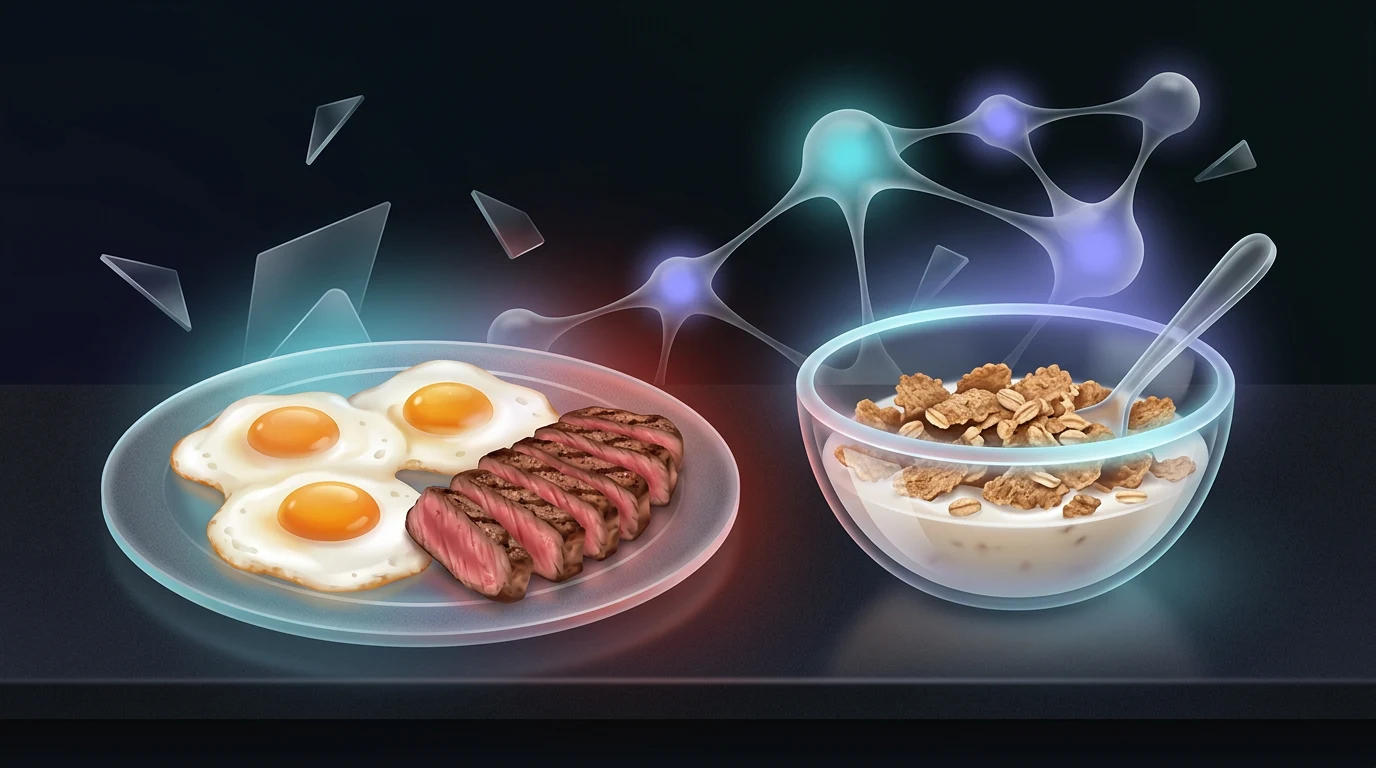
A high protein breakfast means getting 25 to 40 grams of protein into your first meal, not a token boiled egg balanced against a stack of pancakes. Eggs, meat, fish, and full-fat dairy all work. Cereal, toast, fruit smoothies, and pastries mostly don’t, no matter how “healthy” the packaging looks.
Most default breakfasts fail this test badly. A bowl of cereal with milk might carry 8 to 10 grams of protein against 40-plus grams of carbs. A bagel with cream cheese is worse, mostly refined carbohydrate with barely any protein at all. Even a lot of “protein” breakfast marketing is thin: a yogurt cup with 6 grams of protein and 20 grams of sugar isn’t doing the job either, because the sugar load undoes most of the benefit. The fix is simpler than the marketing makes it sound. Build the meal around a protein source first, eggs, meat, or fish, and let everything else, vegetables, a small amount of fruit, healthy fats, fill in around it instead of leading.
Building a High-Protein Morning Without Overthinking It
You don’t need a meal plan to eat this way, you need two or three go-to breakfasts you can make without thinking, plus a shopping list that matches. That’s the whole strategy: reduce the decision to almost nothing so it survives a rushed Tuesday morning.
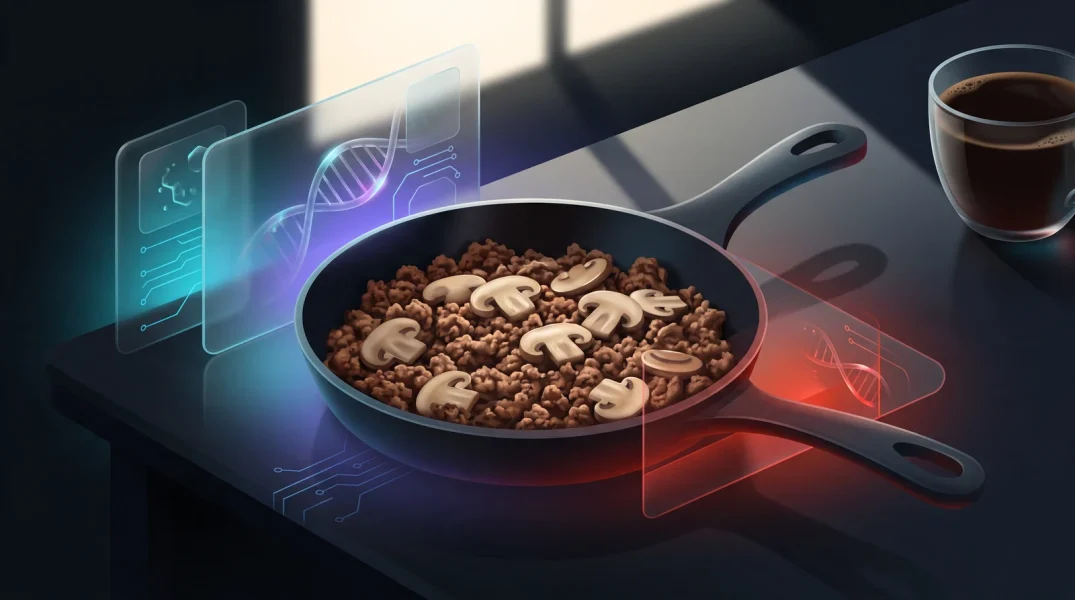
One example that hits the target hard is a bison and mushroom breakfast skillet: ground bison and mushrooms cooked together, 55 grams of protein, 30 grams of fat, and only 10 grams of carbs for 520 calories, with 15 minutes of prep and 25 minutes of cook time. That’s a full day’s protein floor in one meal, and it’s the kind of thing that’s easy to batch on a Sunday and reheat all week. If you want a stack of options like that instead of building your own from scratch, the ThriveXDNA recipe packs include a Breakfast pack with 35 recipes for $5.99, all animal-based, no seed oil, no wheat, no corn syrup, built around exactly this kind of protein-first composition. If you’d rather have something built around your own goals and schedule, the ThriveX App can put together a personalized plan instead of leaving you to guess portion sizes on your own.
It’s Not Just Breakfast
Breakfast composition is the biggest single lever for most people’s afternoon energy, but it isn’t the only one, and it’s worth being honest about that instead of overselling one fix. If you’re consistently under-slept, no amount of protein at 7 AM will fully cover for it. If you’re training hard without enough recovery, fatigue can look identical to a blood sugar crash even when your breakfast is fine.
Worth checking alongside your breakfast: whether your sleep timing actually matches your chronotype, not just the hours you’re getting, covered in our piece on sleep hygiene habits that work with your biology instead of against it. If you train regularly, tiredness that shows up after workouts more than after meals points toward training recovery rather than breakfast. And if you want to actually see the pattern instead of guessing, a decent wearable can separate a glucose dip from a sleep debt from overtraining, which we cover in our rundown of wearable tech built for tracking exactly this kind of thing. Fix breakfast first, it’s the cheapest and fastest change to test, and then layer in the rest if the crash doesn’t fully go away.
Related guides
- High Protein Snacks for When You’re Doing Everything Right and Still H
- more on How Much Protein Do You Actually Need?
- Anti Inflammatory Breakfast for Joint Pain: What Seed Oils Have to Do
- a closer look at High-Protein Meal Prep for Weight Loss That Keeps
- more on High Protein Meal Prep for Muscle Gain: The Under-Eating
- How to Track Macros for Weight Loss: A Practical Guide
- Auto Insurance Quote High Risk Explained and Lowered
Sources
- background reading: Habits form through repetition over time
- USDA MyPlate guidance on protein food sources
- meta-analysis on protein supplementation and muscle gain
- research on protein and aging muscle
Summary
The 2 PM crash usually isn’t a caffeine problem or even purely a sleep problem, it’s a blood sugar problem that starts at breakfast. A carb-heavy morning meal spikes glucose, triggers a big insulin response, and the resulting dip shows up as exhaustion right when you need to be sharp. A high protein breakfast, somewhere around 25 to 40 grams, slows that whole process down and keeps your energy flatter through the afternoon. You don’t need to overhaul your whole diet to test this, just change what’s on your plate before 9 AM for a week and pay attention to how 2 PM feels. If it still doesn’t improve, that’s useful information too, and worth mentioning to a doctor rather than assuming it’s just a willpower problem.
Frequently Asked Questions
How much protein do I actually need at breakfast to stop the crash?
Most research on this lands somewhere between 25 and 40 grams as the range that meaningfully blunts the glucose spike and keeps you full. A single egg or a splash of protein powder in coffee won’t get you there. Three eggs with meat, or a protein shake stacked on top of a real food source, usually will.
Will a high protein breakfast still work if I keep drinking coffee?
Yes, coffee and a high protein breakfast aren’t in competition. Coffee doesn’t cause the crash on its own, and it’s fine to keep drinking it. The problem is using caffeine to override a blood sugar dip instead of preventing the dip in the first place. Do both and you’ll likely need less coffee overall, not none.
What if I’m genuinely not hungry in the morning?
That’s common, and it’s often a side effect of the same pattern, a heavy or late dinner, or grazing on carbs the night before, that also sets up the next day’s crash. Start small: even 15 to 20 grams of protein, a couple of eggs or a small portion of meat, is enough to notice a difference. You can build up appetite for a full breakfast over a couple of weeks as your eating pattern shifts.
Does it matter if the protein comes from eggs versus a shake or bar?
Whole food sources, eggs, meat, fish, full-fat dairy, tend to work slightly better because they usually come with fat too, which slows digestion further. A shake or bar can absolutely work in a pinch, but check the label. A lot of “protein” bars carry 15 to 20 grams of sugar alongside the protein, which partially cancels out the benefit you’re going for.
How fast will I actually notice the difference?
Most people notice something within two or three days, and it’s usually obvious within a week. The clearest sign is that 2 PM stops feeling like a wall. You’ll likely also notice you’re less hungry mid-morning and don’t reach for a snack around 10 or 11 the way you used to.