
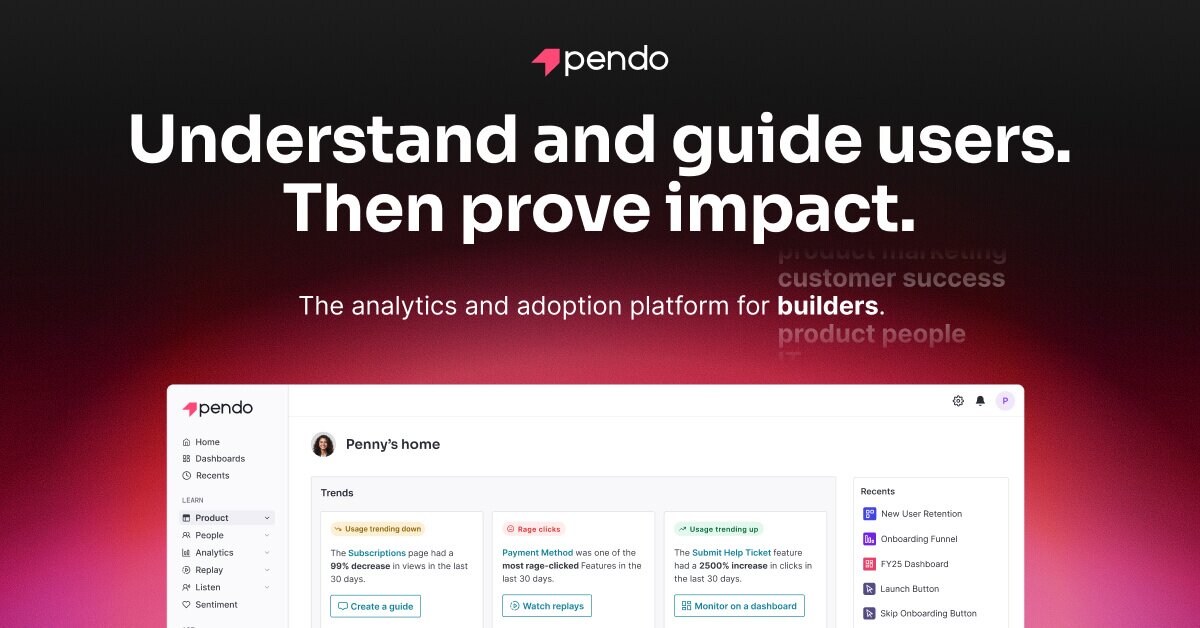
Pendo
AI product experience platform predicting feature adoption and churn risk from user behavior
About this Tool
Pendo is an AI-powered product experience platform built for software companies that want to understand how users interact with their product and act on that data without waiting for a data team. Developed by Pendo.io, the platform sits inside your web or mobile app and combines behavioral analytics with in-app communication tools. It is aimed primarily at product managers, customer success teams, and growth teams at SaaS companies who need to reduce churn, improve feature adoption, and collect user feedback from within the product itself.
How Pendo works
Pendo installs via a JavaScript snippet or mobile SDK and begins capturing user behavior automatically, without requiring manual event instrumentation for every action. Once data flows in, its AI layer analyzes usage patterns to surface which features are being adopted, which users are disengaging, and where friction points exist in the product journey. Alongside the analytics layer, Pendo lets teams build in-app guides, tooltips, and walkthroughs that can be triggered based on user behavior segments. Feedback collection happens through in-app polls and NPS surveys that feed back into the same dashboard, giving teams a combined view of behavioral signals and direct user sentiment.
Strengths
- AI Feature Adoption Analysis: Pendo identifies which features users engage with and which go unused, helping product teams prioritize roadmap decisions based on actual behavior rather than assumptions.
- Churn Prediction: The platform uses behavioral signals to flag accounts that show early signs of disengagement, giving customer success teams a window to intervene before a renewal conversation becomes a recovery conversation.
- In-App Guides: Onboarding flows, feature announcements, and contextual help can be created and deployed without engineering support, which reduces the cost of improving the user experience iteratively.
- Unified data view: Behavioral analytics, in-app messaging, and feedback collection live in one platform, which reduces the overhead of stitching together separate tools.
- Free tier available: The free plan supports up to 1,000 monthly active users, which makes it accessible for early-stage teams before committing to custom enterprise pricing.
Limitations
- Pricing transparency: Beyond the free tier, Pendo moves to custom pricing with no published rates, which makes it difficult for smaller teams to budget without going through a sales conversation first.
- Implementation complexity: While the snippet-based setup is straightforward, getting meaningful segmentation and guide logic configured correctly takes time and familiarity with the platform. Teams without a dedicated product ops function may find the ramp-up slower than expected.
- Overkill for simple use cases: If a team only needs basic analytics or a single onboarding walkthrough, Pendo’s breadth of features can feel excessive relative to simpler and cheaper alternatives.
- Mobile coverage varies: The mobile SDK has historically lagged behind the web product in feature parity, which matters for teams with a mobile-first product.
Who it is for
Pendo is a strong fit for B2B SaaS companies with an established product and a recurring revenue model where churn has a direct impact on growth. Product managers who want to make roadmap decisions based on real usage data will get the most out of the feature adoption layer. Customer success teams managing a book of accounts benefit from the churn prediction signals. It is less suited to content sites, e-commerce, or any context where the product is not a software application with logged-in users and recurring sessions.
How it compares
Pendo occupies a specific slice of the market focused on product-led analytics and in-app engagement. It is not a general-purpose creative or content tool. If you are looking for tools that use AI to support marketing content creation rather than product analytics, the comparison points are quite different. Canva and Canva AI both address the design and visual content side of marketing workflows, which is a separate problem set from what Pendo solves. Teams running product-led growth strategies will likely need both categories: a tool like Pendo to understand in-product behavior and separate creative tools for the marketing layer that drives acquisition. Pendo does not attempt to do both, and that focus is generally a feature rather than a limitation for the teams it is built for.
Pros & Cons
✓ Pros
- ✓AI Feature Adoption Analysis
- ✓User Feedback Collection
- ✓AI-powered features
- ✓Free plan or freemium pricing
- ✓Browser-based — no install required
✗ Cons
- ✗Some advanced features may require higher-tier plans
- ✗Limited public documentation on advanced use cases
Key Features
AI Feature Adoption Analysis
Churn Prediction
Product Analytics
In-App Guides
User Feedback Collection
Roadmap Planning
Segmentation
NPS Surveys
📋 Scripts & Prompts for Pendo
Copy these AI-powered scripts to get maximum value from this tool. Sign up free to copy.
🔌 MCP Servers for Pendo
Connect these MCP servers to give Claude, Cursor & Cline superpowers with this tool. Sign up free to copy install commands.
🤖 AI Agents for Pendo
Pre-built automation agents that work with this tool — import in one click. Sign up free to access.
Similar Marketing & Content Tools










Who Is This For?
Startups
Enterprise
Developers
Tags
Frequently Asked Questions
Pendo is available as free (1,000 mau) / custom pricing. Visit the tool's website for the latest pricing details and plan options.
Pendo offers a free plan. Check the website for feature limitations and upgrade options.
Pendo is available on Api, Web. Check the official website for the latest platform support.
Many tools offer free trials to let you test before subscribing. Check the Pendo website for current trial availability and duration.
Community Rating
Is this your tool? Claim this listing →